- How It All Began
- Theodora’s Biography
- Theodora In Arendal
- Theodora Sings 1866-1869
- Arendal II 1870-1887
- Cormontan Publishing Co.
- Sacred Heart 1887-1889
- District Court Case
- Circuit Court Transcript
- Fort Ridgely And Dale Book
- Franklin Minnesota 1891-1895
- Rognlie Collection 1895
- Franklin Minnesota 1896-1899
- Madelia Minnesota 1899-1902
- Hanska Minnesota 1902-1905
- Madelia Minnesota II 1905-1908
- St. James Minnesota 1908-1917
- Aase Haugen Home Iowa 1917-1922
How It All Began
Our story about Theodora Cormontan starts in a grocery store in St. Peter, Minnesota in May of 2011. Bonnie ran into our friends, Barb and Roger Nelson. Knowing that we are musicians, Barb asked if we would like to have a few boxes of old music that had been stored in their attic for decades, because they were moving and wanting to downsize. We enthusiastically accepted the gift. A few days later Roger brought several boxes of music to our home, and while we were looking through one of the boxes we found a stack of hand-written manuscript music composed by someone named Theodora Cormontan.
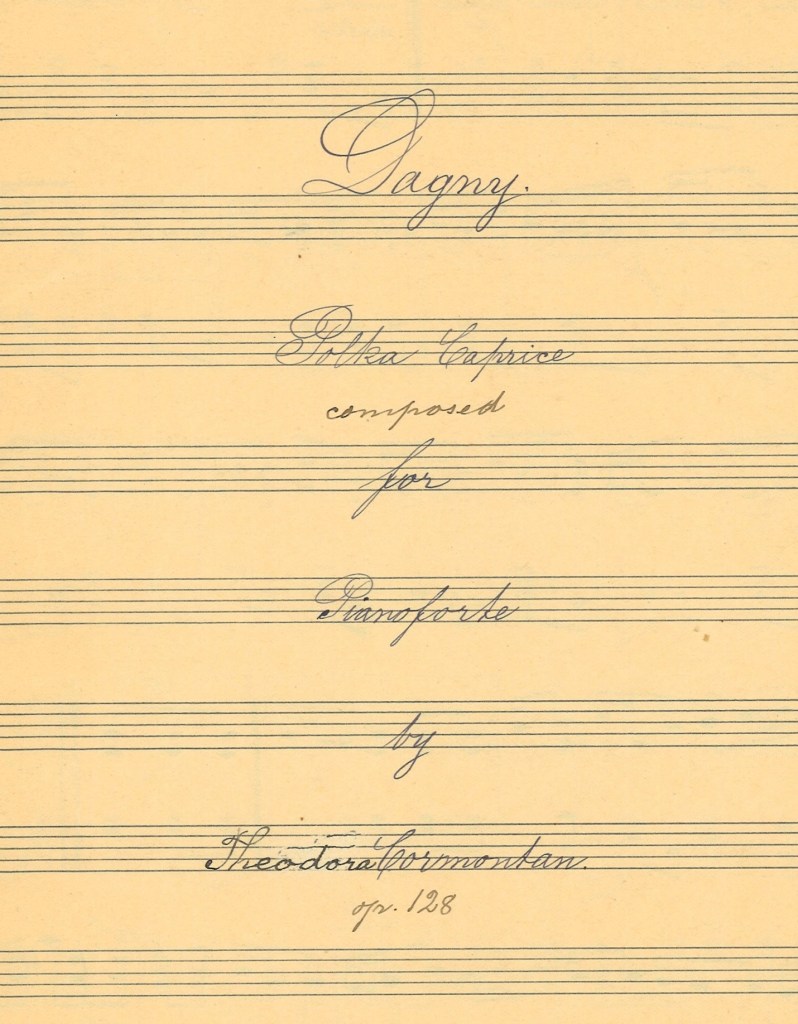
The first thing that impressed us was the beauty of her handwriting. Note the care she brings to her work: after writing the title page she subsequently returned to add “composed” and to write out her complete first name and the opus number. On several of her manuscripts she originally wrote “Th. Cormontan” (likely to avoid gender bias toward her work) but revisited the page later to write out her full first name.
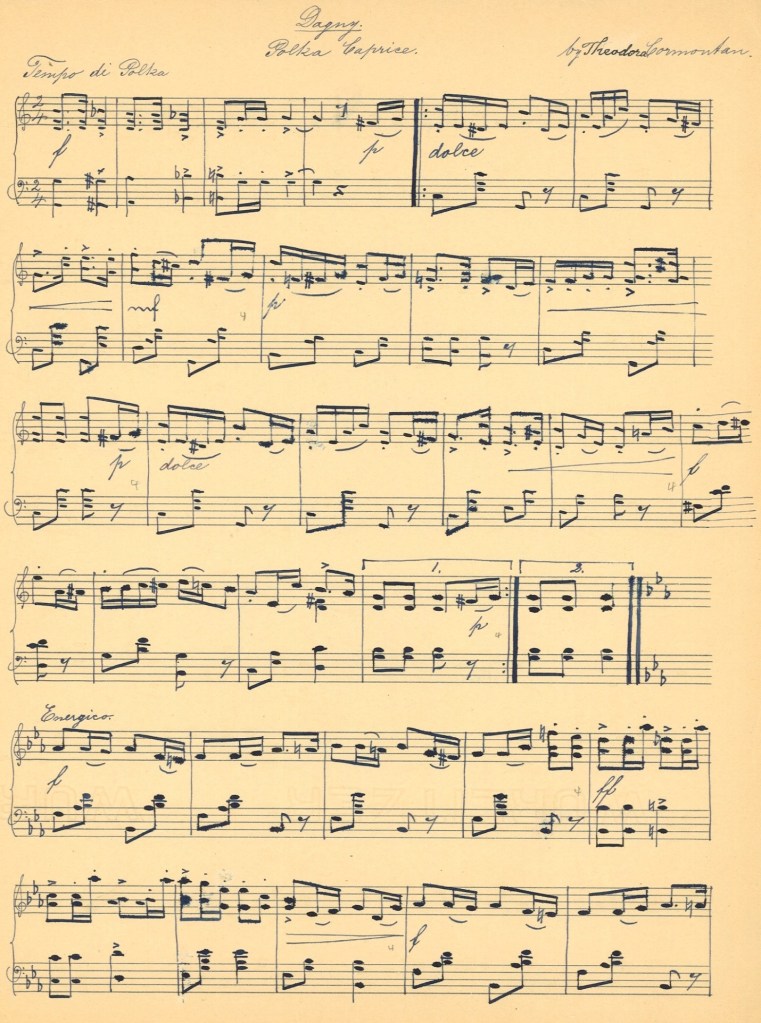
Then we opened up one of the scores and saw the work of a sophisticated professional composer. Also, again note her added full first name.
We counted the scores and discovered about 125 different works, and we were very impressed! So, we wanted to learn more about Theodora Cormontan. One of the things we wanted to find out is how all this music ended up in Barb Nelson’s attic. She told us the story began at the Aase Haugen “Old People’s Home” near Decorah, Iowa. Theodora lived at the Aase Haugen Home from 1917 until her death in 1922.
Barb’s grandfather, Otto Schmidt, became the first Administrator of this home when it opened in 1915. Otto’s wife, Mollie, held a degree in music and had been a music teacher. She used to go to the Home and play the piano for the residents and became friends with Theodora. Theodora gave Mollie all her original compositions as well as her own personal library of music.
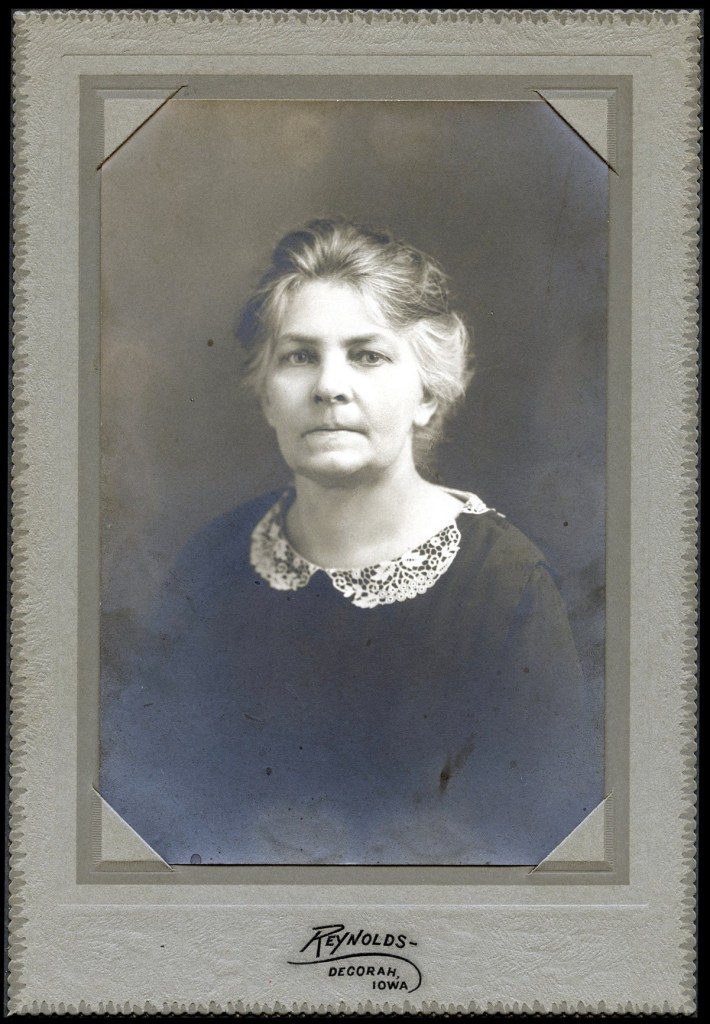
(above) Molly Schmidt, around 1925
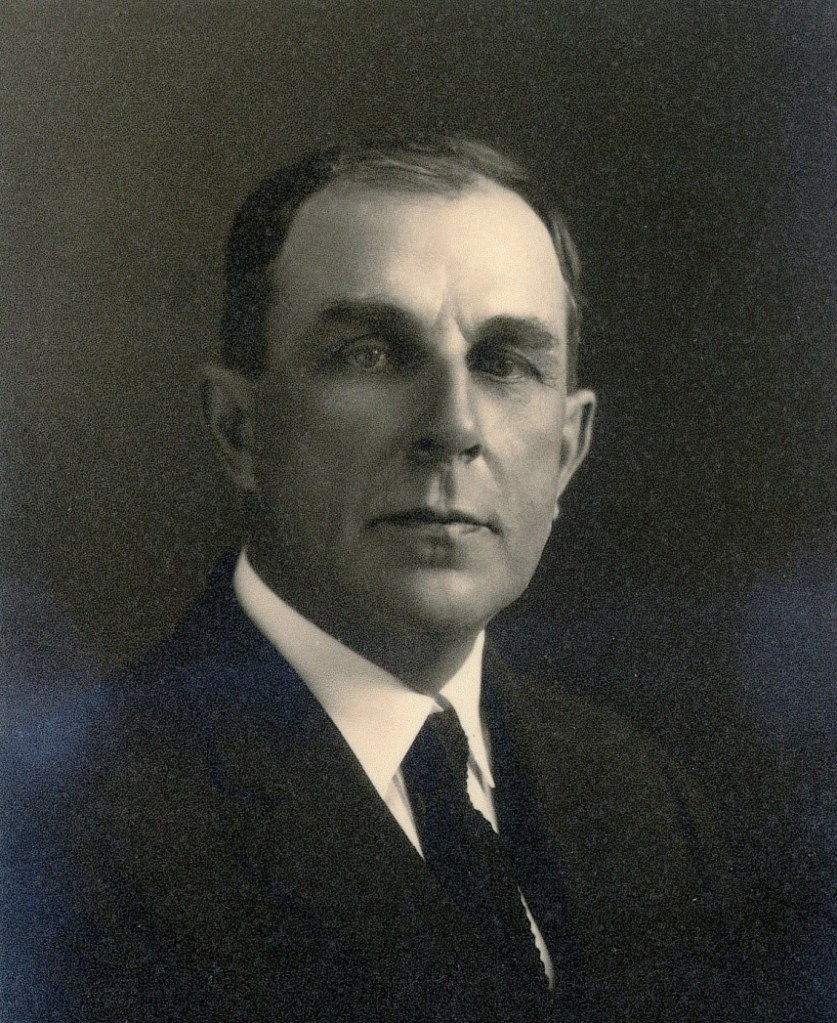
(above) Otto Schmidt, around 1925
Mollie passed the music on to her daughter Carola, who kept it until she died in 1975. Barb (Schmidt) Nelson subsequently received the boxes and put them away, never to really look at them again. Barb was somewhat aware that there was music in her possession from a composer who had lived at the Aase Haugen Home, but she was unaware just how much music there was and didn’t know Theodora Cormontan’s history.
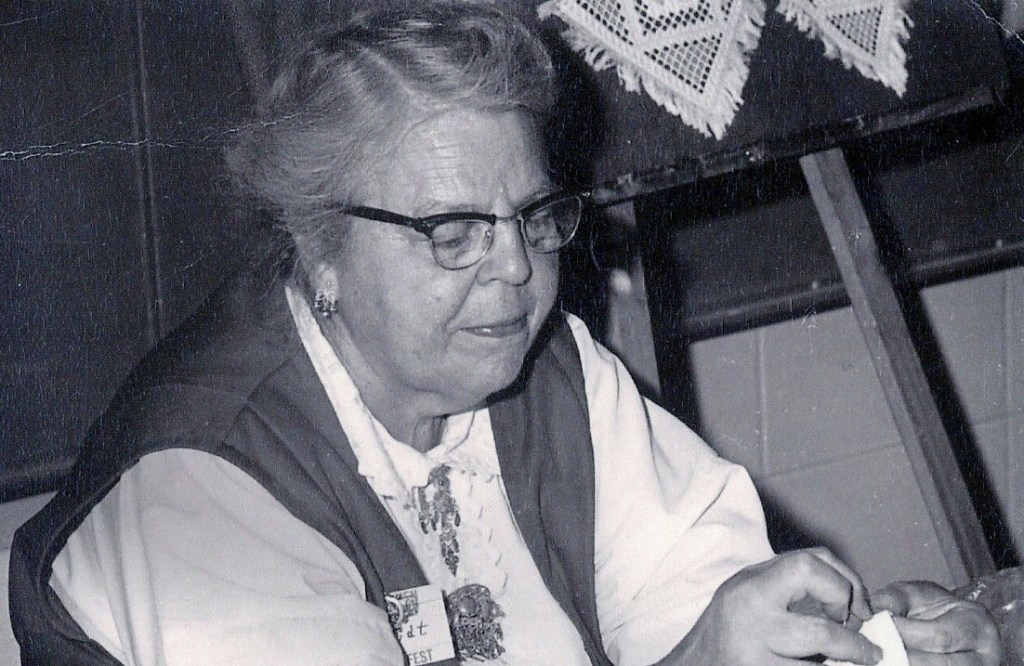
(above) Carola Schmidt in 1970. She is wearing her Norwegian Bunad and Solje silver
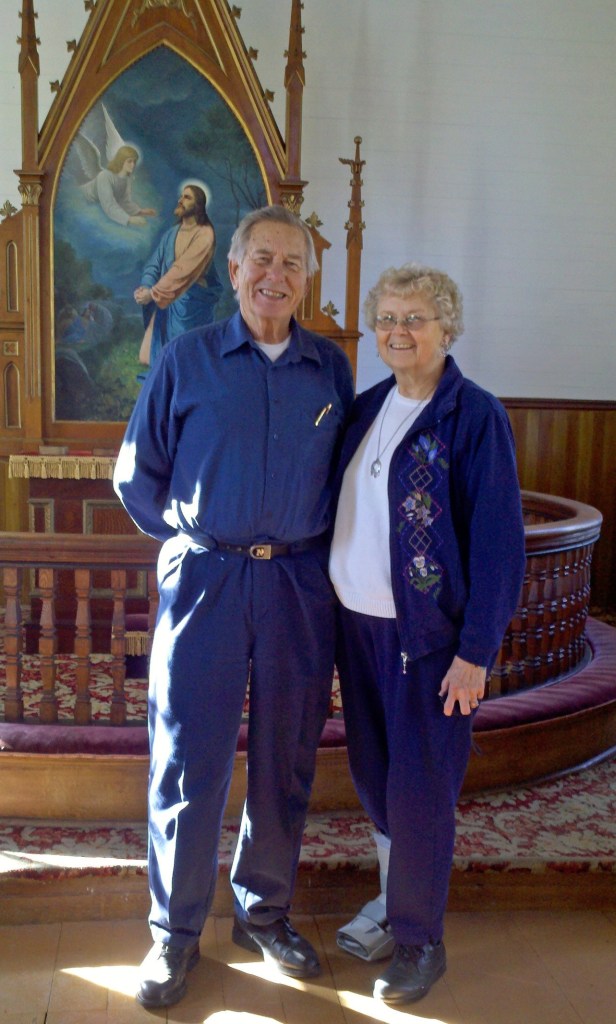
(above) Roger & Barb Nelson in 2011 at the Ft. Ridgely & Dale Church near Franklin MN, where Theodora worshiped and played the organ.
After our first presentation in September, 2011 at the Ft. Ridgely and Dale Lutheran Church, we presented many performances of Theodora Cormontan’s music, mostly in Minnesota but also in Iowa, Wisconsin, Florida, Washington, and Winnipeg, Canada. On May 28, 2015 we donated Theodora Cormontan’s scores to the National Library of Norway (Nasjonalbibiloteket) in Oslo and performed her music there with a group of musician friends, including Barb and Roger. On June 2, 2015 we gave a concert at the cultural history museum (KUBEN) in Cormontan’s hometown of Arendal, Norway.
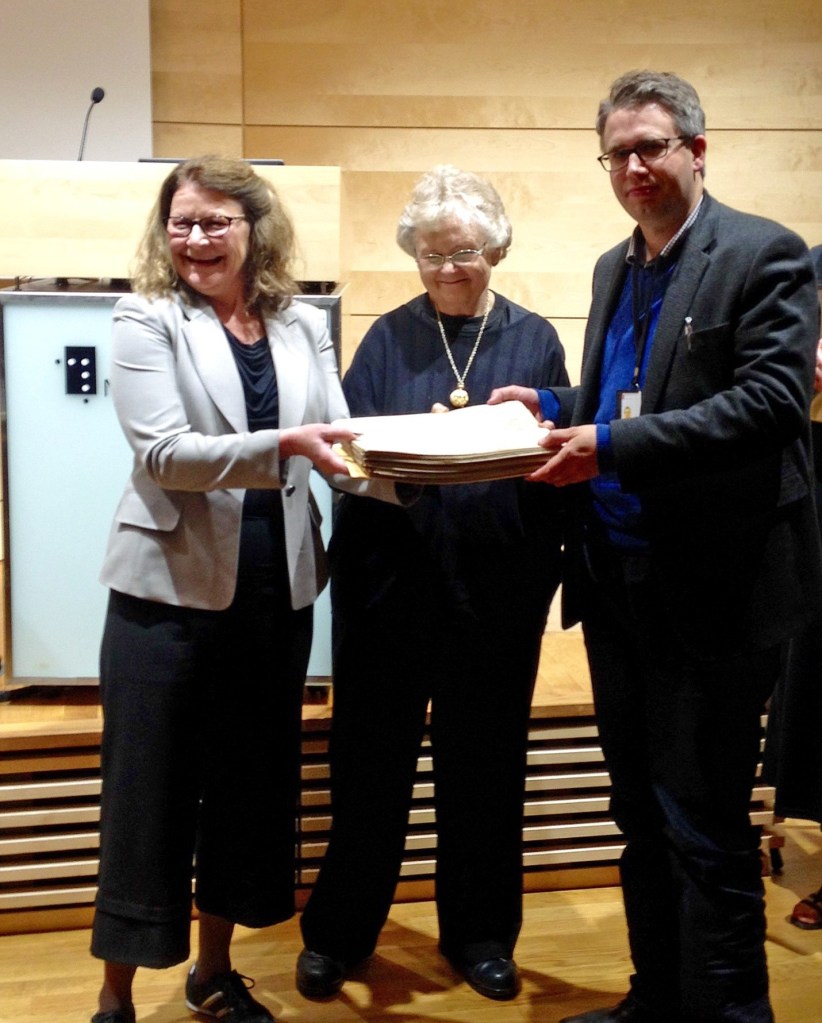
(above) Nancy Clasen (left), the great-great grand niece of Theodora Cormontan, and Barb Nelson present the music of Theodora Cormontan to Richard Gjems at the National Library of Norway (Nasjonalbiblioteket) on May 28, 2015.
Theodora’s Biography
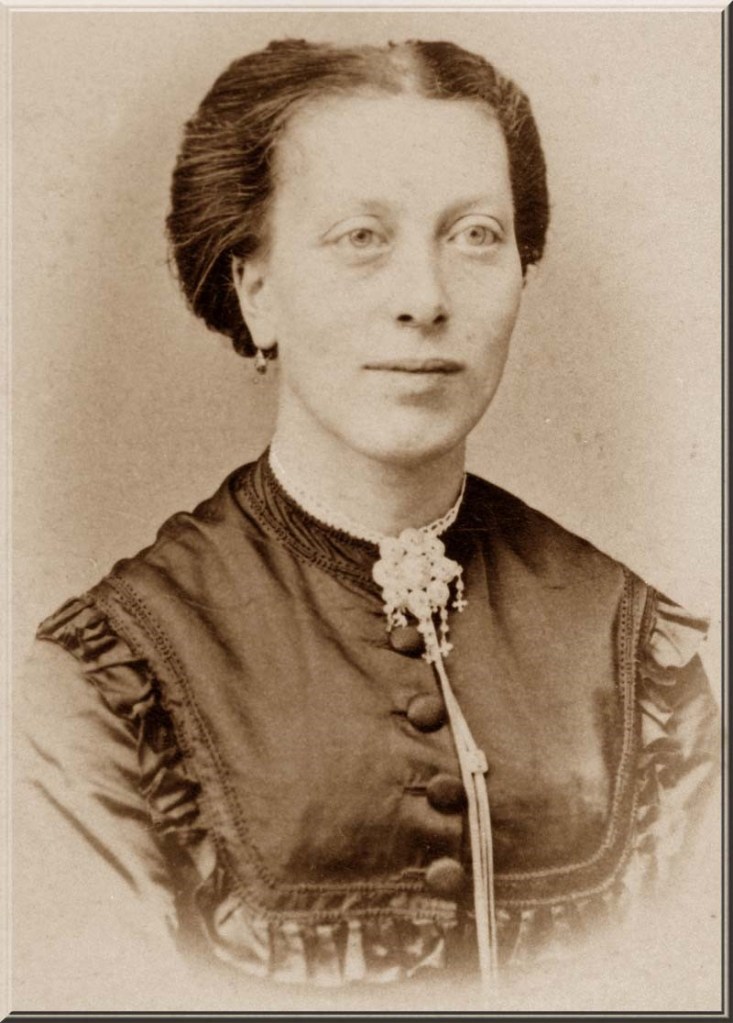
(above) Theodora Cormontan, 1840-1922. This picture was taken in 1870.
Theodora Cormontan’s Biography
The first two paragraphs are electronic translations of the original Norwegian from the following source: Kari Michelsen: Musikkhandel i Norge (Music Publishers in Norway), Chapter 10, pp 216-219. University of Oslo: 2010. Bracketed texts are editorial additions.
“Theodora Nicoline Meldal Cormontan was born June 9, 1840 in Beitstad in North Trøndelag, Norway, the daughter of pastor Even Meldal Schjelderup Cormontan (1798-1893). In 1847 the family moved to Arendal, and settled in the parsonage. [Her Confirmation Records from the Trinity Church in Arendal note that she was baptized on September 20, 1840 and confirmed on April 19, 1857.] In 1865 there were 15 people there, including the pastor, his son [Hans] Nicolai and three daughters, all unmarried, and all in their twenties. Theodora probably studied music with F.W. Thoschlag before she studied further in Copenhagen during the 1860s. As a singer she later appeared in several concerts. Presumably in 1879 Theodora became a music publisher, developing a significant music business and a fairly extensive music rental library in Arendal. Of the many ads from the music trade, we see that she was well up to date with inventory.
In February, 1886 the old rectory burned down, and the same year the bank collapsed in Arendal. The following year Theodora, her father, and one of the sisters immigrated to Illinois [Minnesota], USA. She supported herself as a music teacher and died in Decorah, Iowa in 1922.”
The following text is based on research done by Michael Jorgensen. Valuable information was provided by Nancy Clasen, great-great granddaughter of Marie Cormontan Lyders, Theodora’s younger sister:
Theodora came from Norway to the United States with her father Even and older sister Eivinda, almost certainly to live with her older brother Gottfred Christian Vogelsang Cormontan (known as Gottfred, Christian, C.G., or C.G.V. Cormontan). C.G.V. received his druggist/pharmacist degree from the Norwegian University on December 10, 1868, and moved to the U. S. in 1873. He became a naturalized citizen on June 8, 1880 in Clayton Co., Iowa, where he was a school teacher. By 1881 he had moved to Sacred Heart in Renville County, Minnesota where his youngest sister Marie had lived since 1880 with her husband, Edvard Lyders, also a druggist. Around this time C.G V. returned to Norway, perhaps to visit his father and sisters Eivinda and Theodora. He returned to Sacred Heart in 1884. In the summer of 1887 Theodora, her father Even, and her sister Eivinda temporarily moved to Sacred Heart to live with Marie and family, while C.G.V. now lived in Franklin, Minnesota. C.G.V.’s older brother Hans Nicolai Patroclus Cormontan, a carpenter, also came to Sacred Heart in 1887, probably from Illinois. None of the four siblings were married. Their mother, Louise Augusta Hirsch, died in 1865.
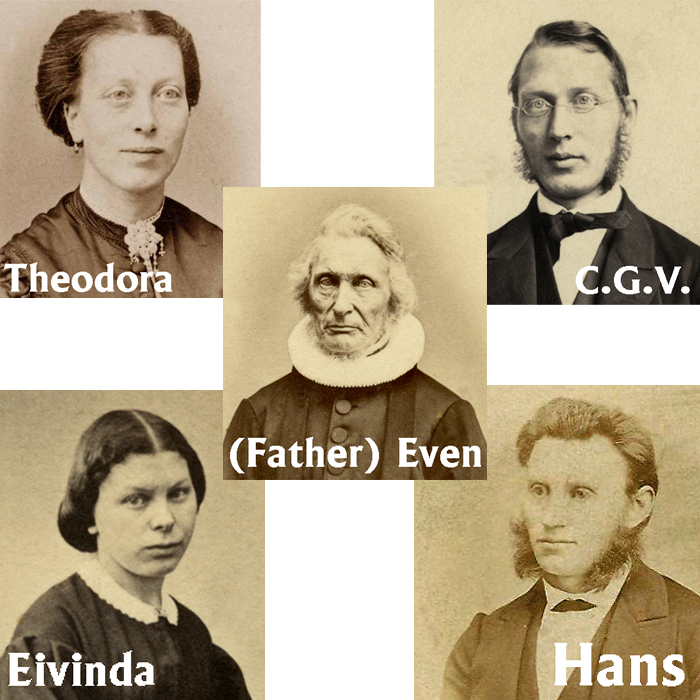
(above) The five members of the Cormontan family.
The front page of the Granite Falls Tribune reported on October 18, 1887 that “Miss Theodora Cormontan, of Sacred Heart, will give a concert at Winter’s Hall Friday evening, Oct. 21st, consisting of vocal and instrumental music. Miss Cormontan studied music for 7 years in Germany and other countries in Europe; has given concerts at Copenhagen, Denmark and Arendahl [sic] and other cities in Norway. She will sing English, Norwegian, Swedish, German and Italian, some of the pieces being of her own compositions. The concert promises to be a rich treat and let all remember the day and place.” In a review of the concert on October 25, 1887, the front page of the same paper read “The concert at the hall on Friday last was well patronized and we hear many flattering words of praise for the singer who entertained for nearly two hours. Her superior gift is plainly instrumental music and her admirers are numerous. We hope to hear her again.” Cormontan advertised as a teacher of vocal and instrumental music in the Granite Falls paper that November and December.
On November 4, 1887, the Renville Weekly News reported “The concert given by Miss Theodora Cormanton [sic] with the assistance of Mrs. Lyders and Miss Louisa [Marie’s daughter] was a great musical treat and a decided success. Miss Cormanton is a capital musician, a fine singer, and is highly spoken of in musical circles and those who did not attend missed a rare treat.”
Pastor Cormontan, Theodora, and Eivinda all moved to Franklin, MN in 1888, where C.G V. owned and operated the Franklin Drug Store. C.G.V. also served several years as a town councilman. Newspaper clippings from the St. Paul Daily Globe in October, 1889 report that Eivinda and Theodora Cormontan were in St. Paul attending court. Theodora brought suit against the Chicago, Milwaukee and St. Paul Railway Company for damages from injuries received in Granite Falls, MN in December of 1887. The train lurched forward as Theodora was boarding to return to Sacred Heart, causing her to fall and resulting in a spinal injury that left her physically disabled. The jury found in favor of the plaintiff and awarded her $5,000 damages.
Theodora was in St. Paul again in March of 1891, according to the composition date written on one of her manuscripts. Also by 1891 C.G.V. was advertising his business in newspapers published in the towns of Franklin and Morton in Renville County, Minnesota. By 1892 Theodora played organ for at least two Franklin area churches, conducted choirs, and taught music lessons. The Morton Enterprise reported in April of that year “The lady [Theodora] is certainly an excellent teacher in vocal as well as instrumental music.” Also by 1892 she was traveling to nearby Morton, where she taught approximately fifty students. Around this time she saw several of her Norwegian language hymns published in a Norwegian magazine entitled Ugdommens Ven (The Youth’s Friend) and subsequently in a Norwegian Evangelical Lutheran hymnal called the Frydetoner (Joyful Songs). Her father Even Cormontan died in Franklin in 1893. C.G.V. and Hans were among a group of founders of the Concordia Evangelical Lutheran Church in Franklin. Seven of Theodora’s manuscripts carry dates that indicate that they were composed or edited while she lived in Franklin. It is likely that a number of the undated works were also written there.
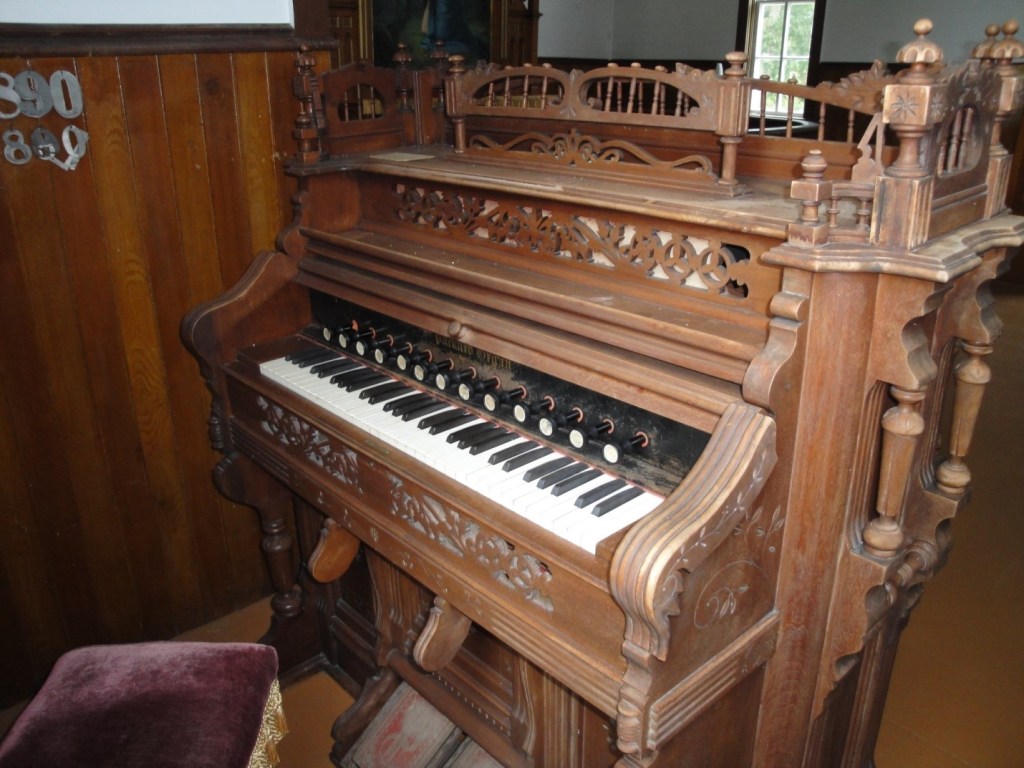
(above) The pump organ located in the Fort Ridgely and Dale Church between Franklin and Fairfax, Minnesota (photo taken in 2011). This is the organ procured by the Cormontan family in 1892.
In February of 1899 C.G.V. Cormontan purchased the Madelia Drug Company on Main Street in the town of Madelia in Watonwan County, Minnesota. By March Theodora described herself as a composer and music teacher in ads in the Madelia Messenger. In October of that year she advertised that she was selling several of her own compositions at the drug store. In her advertisements for her teaching, Theodora described herself as “Pupil of Europe’s Greatest Musicans” and said she “gave instruction on piano, organ, and vocal.” She said she practiced “The newest and best methods . . . Vocal Culture, Mathilde Marchesi’s Italian Singing Method.” It appears she offered piano and voice lessons from her home on 405 Shepard Street in Madelia. She offered organ lessons at another residence on Shepard. She traveled to Linden and Hanska, Minnesota to offer music lessons to students of those towns.
By 1901 C.G.V. no longer owned and operated the Madelia Drug Company and was running a drug store in nearby Hanska. Theodora, Eivinda, and Hans moved to Hanska in June of 1902. Theodora continued performing, offering a prelude and a “closing instrumental” at a Christmas program for the Lutheran Ladies’ Society at the Hanska school house in December of 1903. Early in 1904 C.G.V. traveled by himself to take a pharmacist position in the town of Kennedy in Kittson County, Minnesota, leaving Hans, Eivinda, and Theodora behind. In an ad from the Madelia Times Messenger in January of 1905 Theodora reported that she was offering lessons from her home at the L.A. Dodge residence in Madelia. She continued to perform, including playing Schubert’s “Serenade” at the 1906 Madelia High School Commencement. Many of Theodora’s manuscripts bear completion dates from 1899-1908, indicating that Theodora continued composing in Madelia and Hanska.
C.G.V. rejoined his siblings and they moved to St. James, Minnesota by 1908, where they became members of the Norwegian Evangelical Lutheran Church, C.G.V. continued to be employed as a pharmacist, and Theodora continued to teach music and perform. The St. James Journal Gazette reported in its January 22, 1910 edition that she played the piano in a program for an anti-tuberculosis educational meeting. Quoting the paper, “Miss Theodora Cormonton [sic] will render a piano solo at the State Board exhibit both Monday and Tuesday afternoons. This number will be given just previous to Dr. Pratt’s lecture. Miss Cormonton is a pianist of rare ability. Her study under the greatest masters of Europe has made of her a player of ability, as well as a composer of piano music. All lovers of music and especially the ladies are urged to attend all of the meetings.” She also performed at the 1910 Farmer’s Institute, as noted in the February 5 edition of the Journal Gazette. While the men attended meetings, programs were provided for the women, featuring addresses on “Sanitation in the Home” and “Poultry Raising” as well as performances by a vocal duet team and the High School Girls’ Chorus in addition to Cormontan. Though none of her manuscripts are dated later than 1908, the catalog numbers she assigned to many of her works indicate she continued to be an active composer until at least 1913.
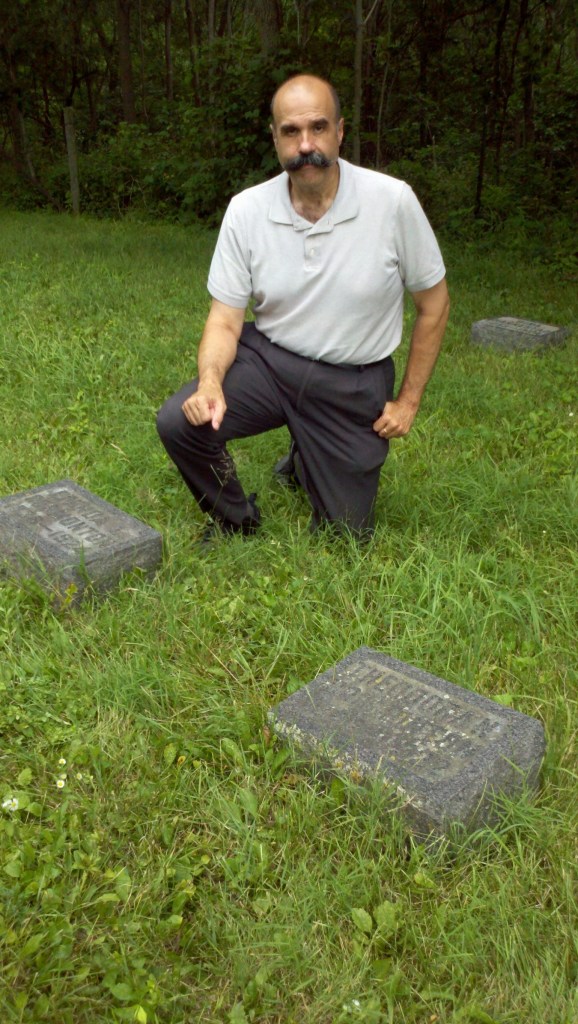
Hans died on April 17, 1913, and C.G.V. died on June 13, 1917. Theodora and Eivinda entered the Aase Haugen Home about four miles southwest of Decorah, Iowa on August 7, 1917. According to handwritten notes from the Home they were the 65th and 66th people registered there. Theodora died at Aase Haugen on October 26, 1922. Eivinda passed away on November 8, 1924. They are buried in the Aase Haugen Cemetery near the site of the former Home, now a private residence.
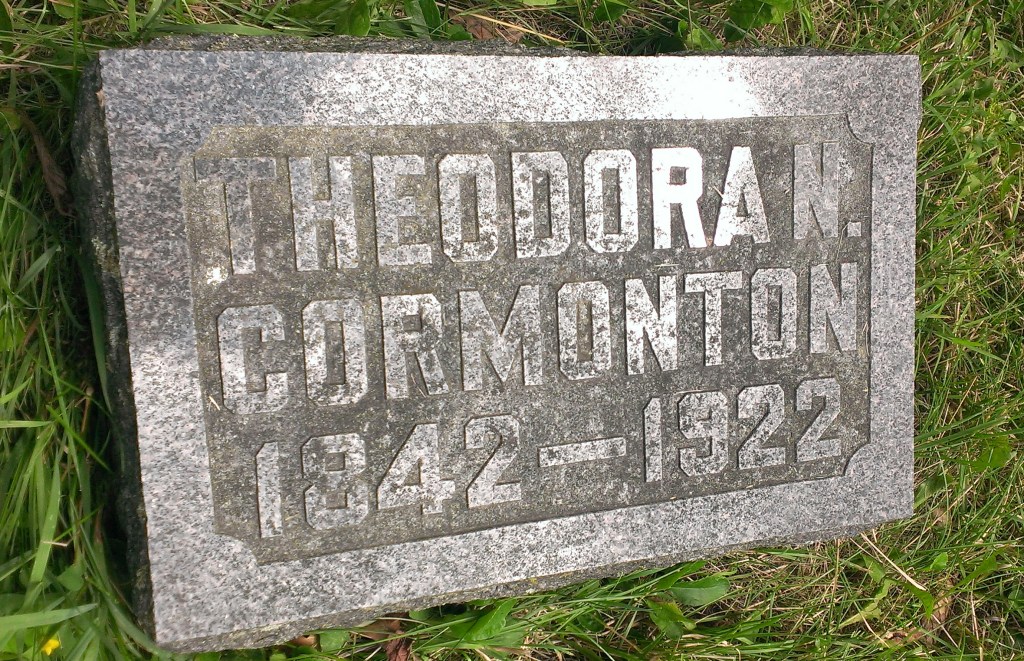
(above) The Aase Haugen records misspelled Theodora’s last name and recorded the wrong birth year. The errors carried over to her grave marker.
(below) Michael Jorgensen by the graves of Eivinda and Theodora Cormontan.
Otto Schmidt (1873-1946) was a Lutheran pastor in Decorah and “the guiding spirit” in the erection of the Aase Haugen Home. In 1915 he resigned as pastor of the Decorah Lutheran Church to manage the Home, continuing in that position until 1944. His wife Mollie played the piano for the people there, including Theodora, and that is how Theodora knew her and knew she was a pianist. According to oral tradition passed on by the Schmidt family, Mollie played some of Theodora’s music and, before she died, Theodora gave Mollie the manuscripts. Mollie’s daughter, Carola M. Schmidt (1903-1975), trained as a nurse and took care of Mollie until Mollie died in 1933, and later took care of Otto and also worked at the Home. Carola received Theodora’s music from her mother Mollie. When Carola died, Barb Schmidt Nelson received the music and stored it at her home in St. Peter, Minnesota until 2011, when she gave the manuscripts along with other music to Bonnie and Michael Jorgensen of St. Peter.
In 2011 Michael was a Professor of Music (voice) at Gustavus Adolphus College in St. Peter, while Bonnie was a professional pianist. Michael began to research Theodora and discovered that she is still remembered in Norway. The Jorgensens decided to promote the life and music of Theodora Cormontan through various outlets, including a website, newsletters, and lecture/recitals. The Jorgensens donated the Cormontan manuscripts to the National Library of Norway in 2015.
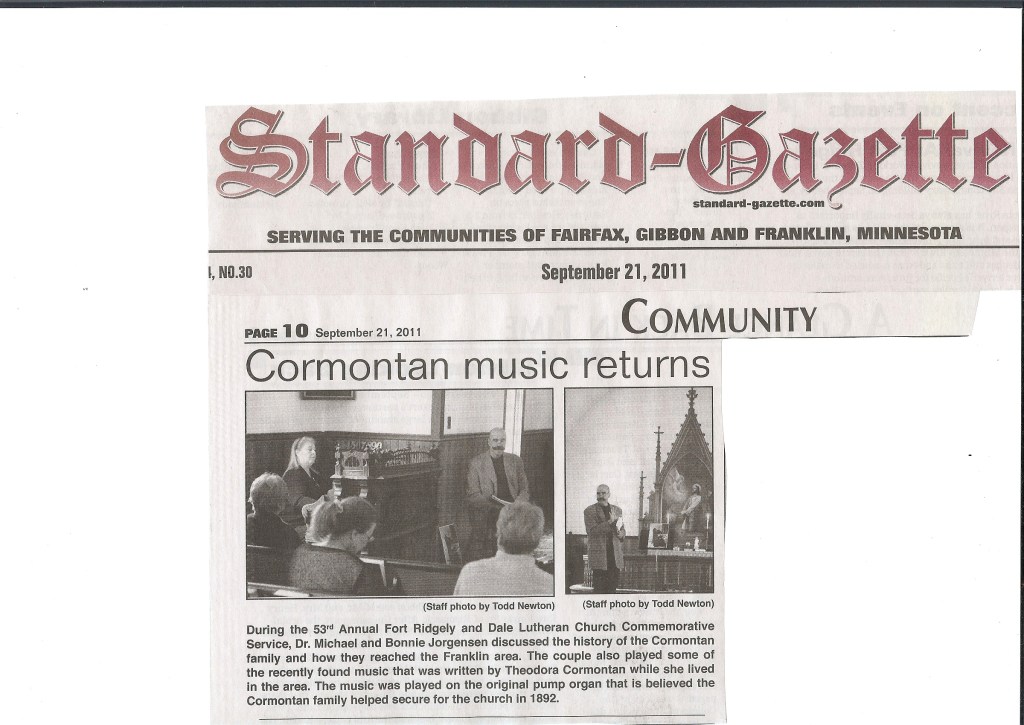
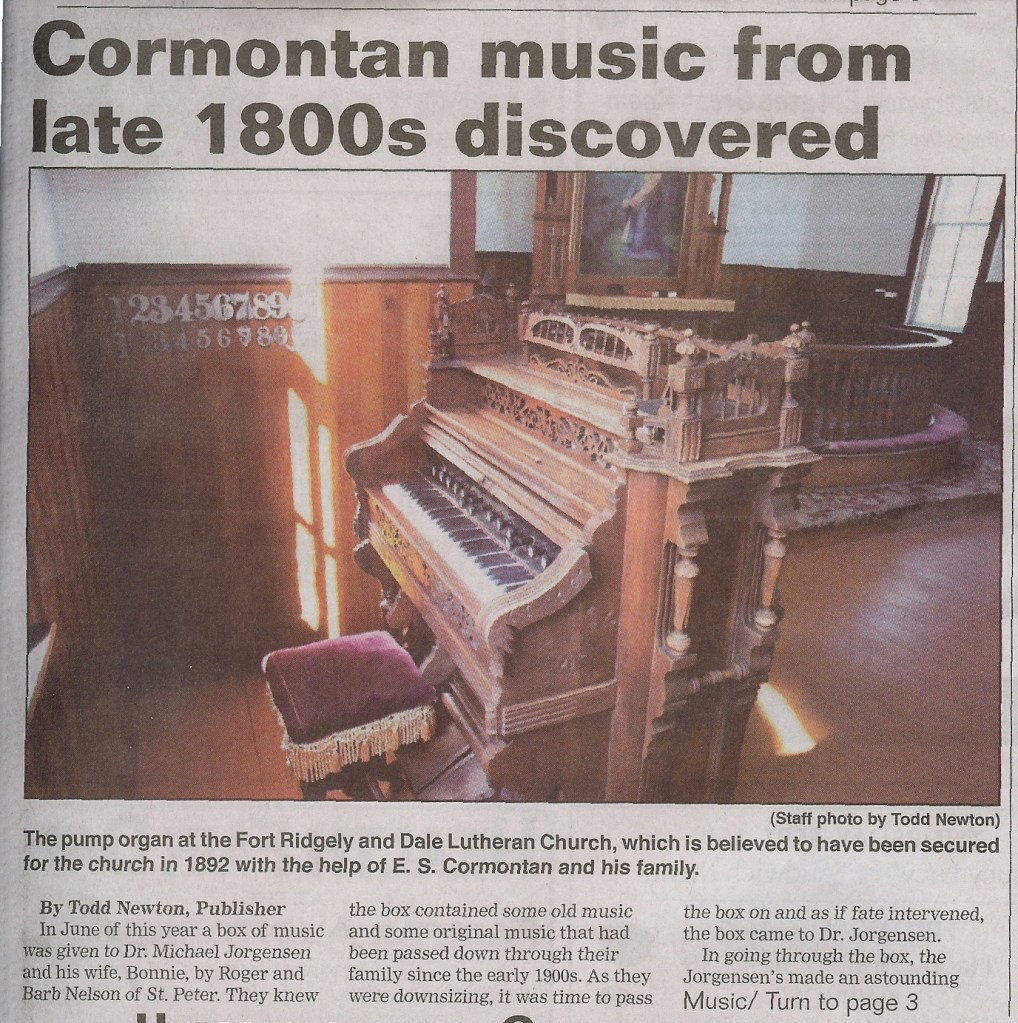
(above) Two pages from the September 21, 2011 edition of the Standard-Gazette, reporting on the first public performance the Jorgensens gave of music by Theodora Cormontan.
The Cormontan music that Bonnie and Michael rediscovered includes six piano solos published in the United States and approximately 125 manuscript scores (the exact number depends on how several incomplete works are counted). The vast majority of the manuscripts are piano solo, but there are a few hymns, works for the organ, vocal solos, and vocal duets as well. Almost all the manuscripts are in ink and stand as completed works. Theodora may have sent these copies to potential publishers and/or used them as performance copies. There are a few works in pencil that seem to be draft copies.
It appears that about 25% of the compositions were written in Europe and 75% in the United States. Most have no markings to indicate when they were composed, so determining where her music was written is an educated guess based on some dates and opus numbers as well as titles written in English compared to titles written in Norwegian. Music written on paper with the marking “Made in Germany” appear to have been late compositions. Theodora dated a few of her works. Of the music we found, the earliest dated manuscript is 1876 and the latest from 1908, though cataloging numbers she assigned to most of her manuscripts seem to indicate she was still composing at least until 1913. Kari Michaelsen writes that Theodora’s first published works date from 1875 (in Norway). The last published work in the Jorgensen collection dates from 1905 (in the United States), so it appears that Theodora’s activity as a composer spanned from approximately 1870 (when she was 30) to 1915. A small percentage of Theodora’s manuscripts have opus numbers. Many of these numbers seem to indicate compositions that were published. It appears that opus numbers through the 40s were assigned to works by Theodora that were published in Europe, mostly by her own publishing company in Arendal, Norway. Opus numbers in the 50s were published in the United States (including Minneapolis, Philadelphia, and Chicago). However, there are several unpublished manuscripts with much higher opus numbers, going as high as Op. 140.
Theodora also assigned what might be described as a catalog number to approximately 3/4 of her compositions in manuscript. These numbers range from the 200s to the 900s. Works assigned lower numbers were written earlier than works with higher numbers. There are enough manuscripts with catalog numbers that appear with (and correlate with) dated manuscripts to permit a general dating of all of Cormontan’s manuscripts with catalog numbers.
Theodora In Arendal
The following newspaper article was electronically translated and edited from the original Norwegian. The author, Jan Hartvig Henriksen, was a music professor. He held the position of Rector at the Agder Music Conservatory, which is now part of the Norwegian public regional college system. Editorial comments included below are bracketed.
The pastor’s daughter: a singer and music publisher By Jan Hartvig Henriksen
[From page 6 of the Wednesday, February 8, 1984 edition of the Agderposten, published in Arendal, Norway. Arendal is the city where Theodora Cormontan lived from the age of seven until she immigrated to the U.S. at the age of 46].
A striking feature in musical history is the relatively small number of women composers. In the past it was acceptable for women to play the piano, but they were expected to run households, not to compose music.
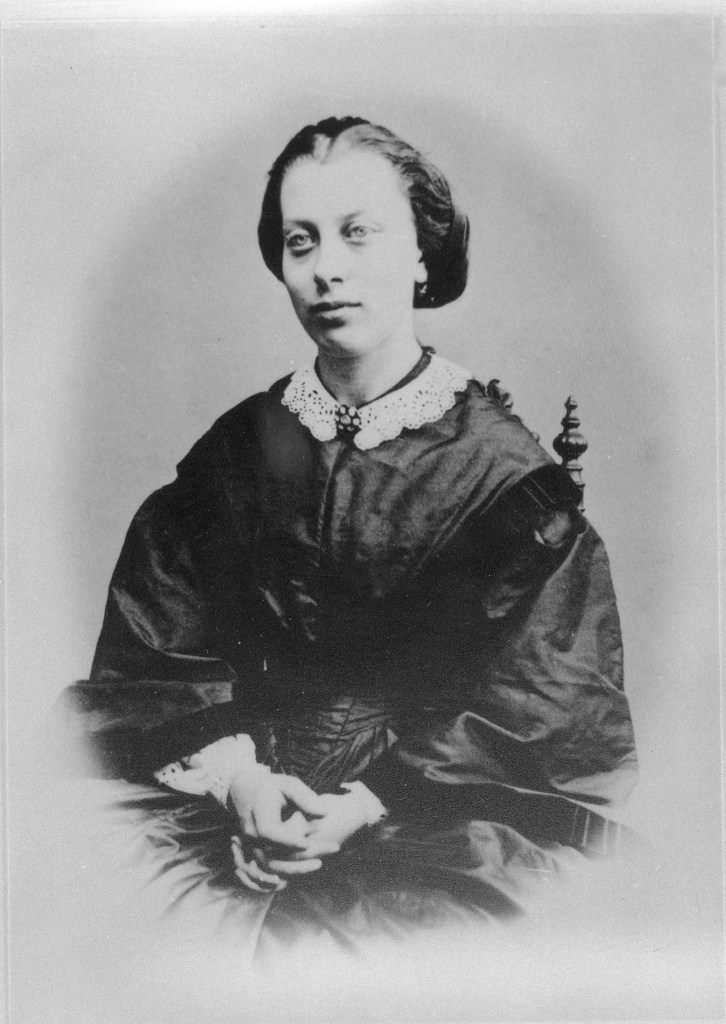
(above) Theodora Cormontan, probably around 1860.
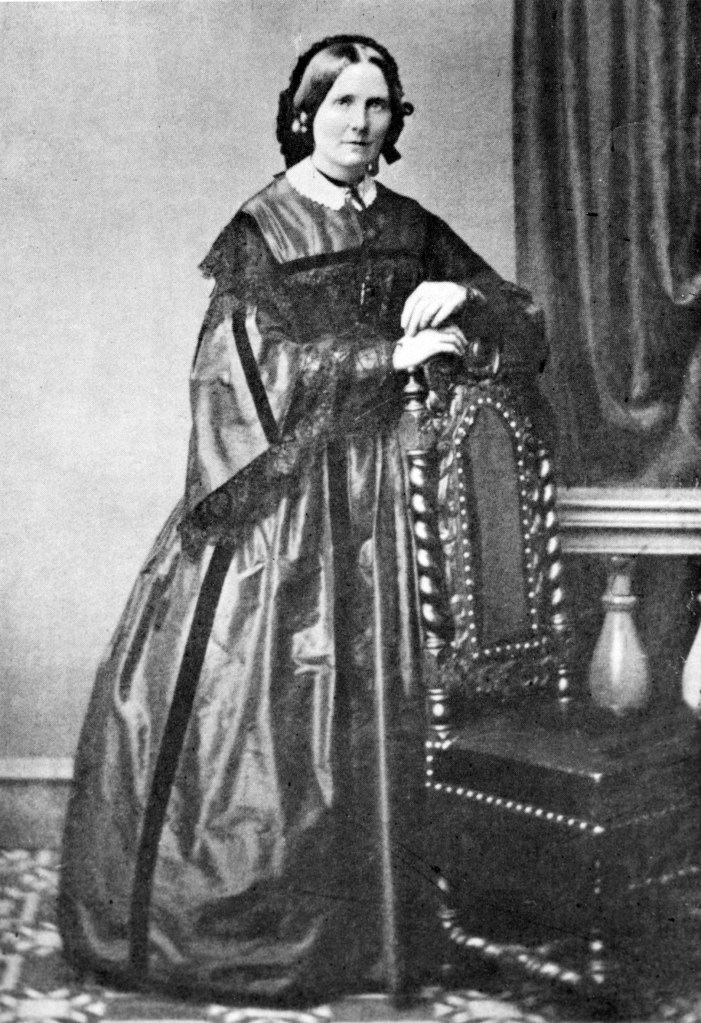
(above) Sophie Dedekam, around 1865.
So, it is somewhat surprising that in the 19th century of Arendal, Norway’s music history the only two published compositions by native residents that were widely performed were by women: Sophie Dedekam and Theodora Nicoline Cormontan. There have been a number of professional musicians and organists in Arendal who can be traced back to before 1723. Many of them were trained and competent musicians, some of them amazingly versatile, but they have written few compositions, and as far as I could ascertain, none of them were published composers until the organist Olsen, but he came after these two women [The organist Olsen is Alfred Theodor Olsen, organist for Trinity Church in Arendal from 1886-1936].
Today there are probably even fewer who know the name Theodora Cormontan than who have heard of Sophie Dedekam. But, Cormontan has written a song that many [Norwegian] people know, # 268 – “Høgt frå den himmelske klåre” – harmonized by Fartein Valen. [The Cormontan hymn, loosely translated as “High from the clear heavens,” is hymn #487 in the current edition of the Norwegian hymnal. In this edition it is no longer harmonized by Valen]. Except that both women–to the extent that they are remembered –are only known for one song each, they were quite different, both in their background and their music.
Sophie Dedekam ran in the circles of high society, with balls and parties and theatre. She performed at institutions like the Dramatic Society and the Musical Society, exclusive venues which typically produced at best a modest level of artistic expression.
Theodora was 20 years younger than Sophie, and was influenced differently by the mid-century cultural and social revolution in Norway. This national breakthrough after 1840 facilitated more popular cultural expressions. Choirs and choruses made up of the middle classes emerged.
Another influence was the religious revivals in Arendal around 1850, inspiring the growth of independent congregations. The town was visited by the evangelist-singer Oscar Ahnfeldt, along with Lina Sandell. They made such an apparent impression on the young clergyman’s daughter that one of her most beautiful songs, “Det døende Barn” [“The dying children”] with text by Hans Christian Andersen, has such an unmistakable resemblance to the Ahnfeldt-Sandell hymn “Day by Day” that it could be characterized as plagiarism. Sophie Dedekam was also deeply religious and affected by the pietistic wave. But she had grown up with Danish vaudeville songs and singing popular music.
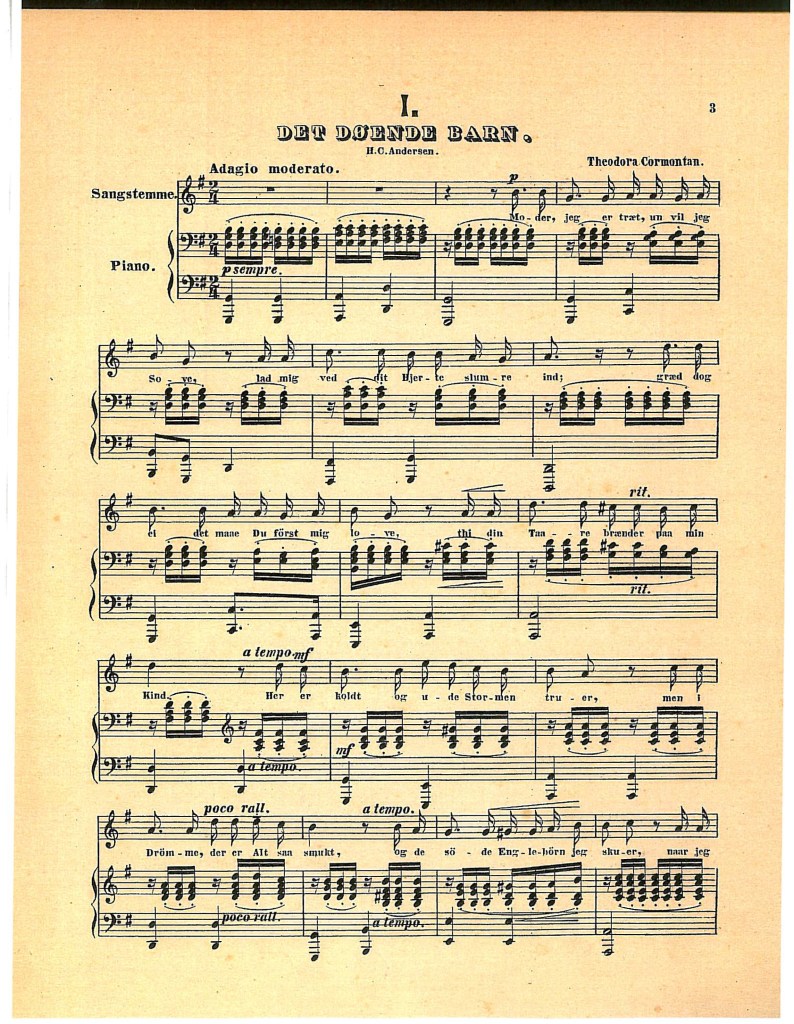
(above) This is the first page of “Det døende Barn.” I would not describe it as plagiaism.
Theodora came to Arendal when her father, Even Meldal Schjelderup Cormontan, was appointed as Trinity Church’s parish priest in 1847. Theodora was the second youngest of seven children, having been born in Beitstad in 1840.
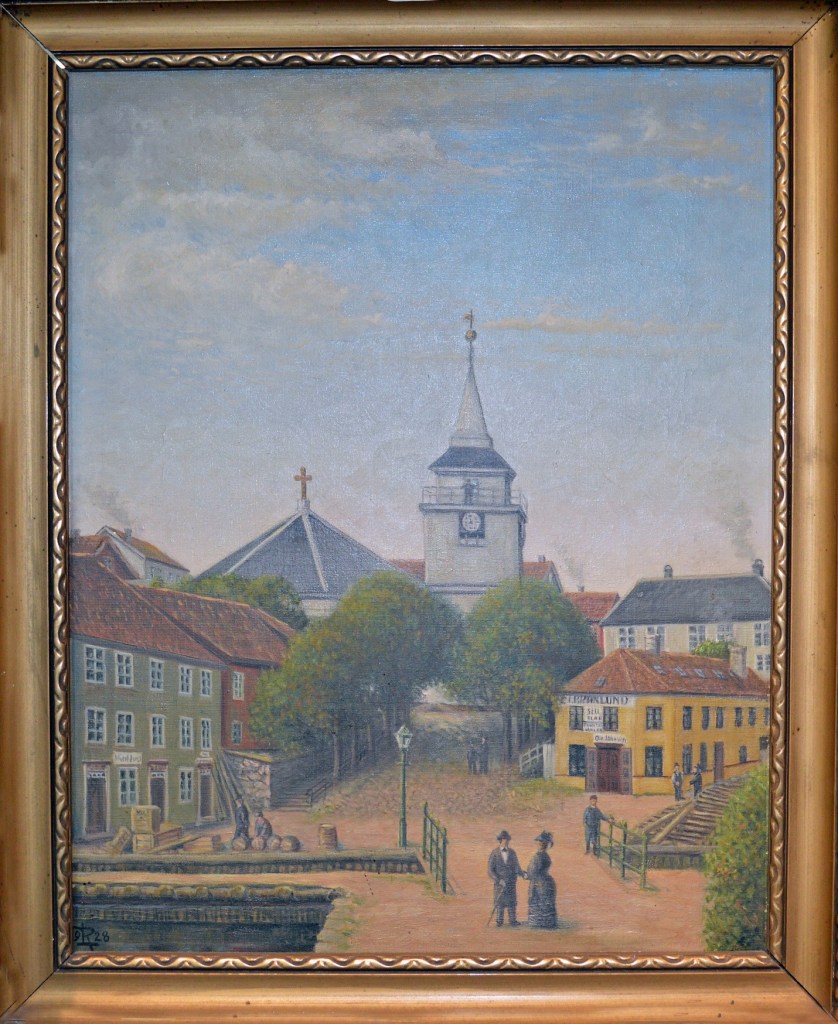
(above) A painting that shows what the Trinity Church (Trefoldighetskirken) looked like during the time Pastor Cormontan served there.
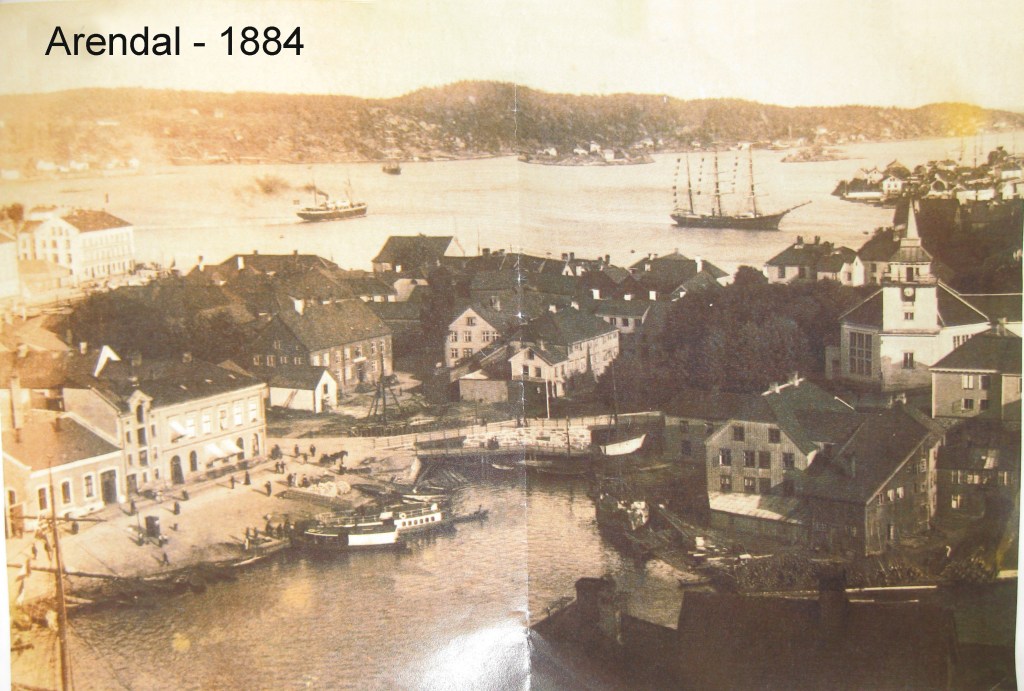
(below) This photograph shows the Trinity Chruch on the right. The grove of trees next to it is where the new Trinity Church would be built by 1888. Just to the left of the trees is where the Cormontans lived.
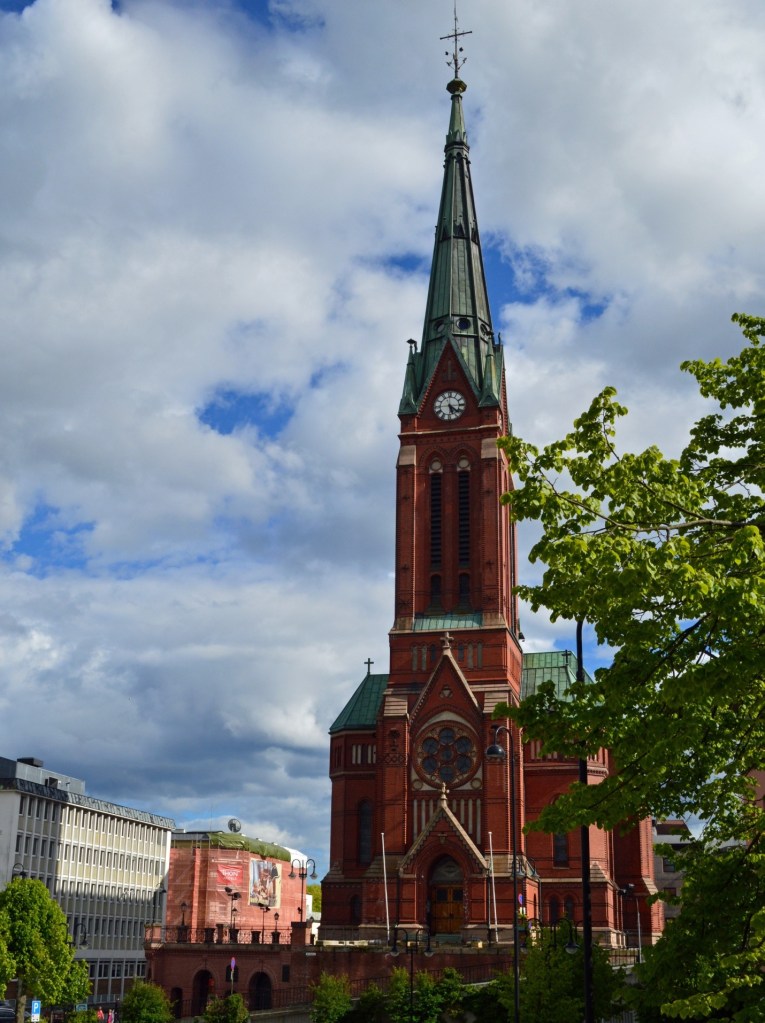
(above) The Trinity Church in Arendal in 2015. The Thon Hotel (the building being remodeled to the left of the church) was the site of the Cormontan home.
Her last name does not sound Norwegian, but Theodora’s father was born in Øvrebø, Norway, himself the son of a priest. His Danish grandfather’s last name was Hansen. The grandfather came from Hjerteberg in Stege, Denmark. The Latin equivalent for Hjerteberg [Danish for “Heart of the Mountain”] is Cor Montan–Cormontan.
Not a lot is known about Theodora’s childhood, but it is fairly certain that she received her musical education from the town musician, the organist F.W. Thoschlag. As evidence, the name of the organist’s oldest daughter, Felicita, frequently appears with Theodora’s in concert programs. Two years younger than Theodora, Felicita was likely her close friend. Theodora preferred singing to playing the organ, and she also likely studied voice with Thoschlag, who was an excellent singer and appeared on one of Ole Bull’s concerts in Arendal performing Schubert’s “Erlkønig!”
In the years 1863-1865 Theodora studied music in Copenhagen. She almost certainly received instruction in music composition at that time, for her songs and piano pieces demonstrate a skill beyond an amateur’s. In the next 20 years she made her presence felt in Arendal’s music scene. She held regular concerts, often with the assistance of the city choir or the Arendal Hornmusikk Association [Theodora performed beyond Arendal. She lived in and gave concerts in Copenhagen in 1867-1868 and conducted an extensive performance tour of Norway in 1869. See “Theodora Sings: 1866-1869” for more information.]
She also started a music lending library business, like her teacher Thoschlag. It is amazing to see both the scope of her music rental collection and the breadth of repertoire it contained. I do not know exactly how many numbers it covered, but some remnants of the library have come into my possession, and the highest numbered of the library is 11,858! This includes piano sheet music for two and four hands, chamber music, songs, opera and song collections, and symphony scores, including the complete works of Mozart and Beethoven!
Who would borrow scores of Beethoven’s symphonies in Arendal in the 1870’s and 1880’s? Well, the prosperity of the city during this time has not been equaled before or since. But one still might ask: was there a market for this music, or was the lady a romantic collector without a completely realistic view of the demands of the marketplace?
In fact, she simply had great ambitions! She started her own music publishing company in Arendal! And it was not primarily in order to realize a dream of seeing her name on the title page entwined by decorative arabesques; no, she already had a number of compositions published by a recognized publishing house [Warmuth] before she started her own. The music she published used materials of high quality, like the music published in Leipzig. She published her own songs and piano pieces, and also issued a series of songs by Sophie Dedekam, as well as a number of songs by Caroline Schytte Jensen, who wrote “Three cute babies with blue eyes” and “Waiting for father!” While Sophie Dedekam limited her output to songs, Theodora displayed her versatility by also writing for the piano. She was also more productive than Dedekam. Opus 46 is the highest opus number I have seen registered, but many of her opuses consist of several songs, so the total number of her compositions is significantly higher. I have not been able to track down everything she wrote, but the 12 solo songs, three duets, nine piano solos, and her hymn “ Høgt frå den himmelske klåre “ gives a pretty good picture of her output. [Of course, when Henriksen wrote this article, he was unaware that Cormontan had published piano solos and hymns in the U.S. that she did not publish in Europe, not to mention the approximately 125 works she composed–that we know of–that were never published]. She had a penchant for Hans Christian Andersen, and his texts must have resonated with her, for they provide the words to some of the best songs she wrote. She also chose texts by Jørgen Moe, Henrik Ibsen, Christian Winter, and Thomas Moore.
A nationalistic tone is not prominent in Theodora Cormontan’s music, although she was influenced by the nationalism in the music of Nordraak, Kjerulf and Grieg. Only in her Op. 3 does she make a nationalistic reference, in “Blandt Fjeldene”[“Among Mountains”] that is described under the title as being in the style of two folk songs for piano. [There are numerous pieces that display strong nationalism among her manuscripts]. “Blandt Fjeldene“ is dedicated to Mrs. Agathe Backer Grøndahl, and it is not impossible that the two may have met when Agathe was in Arendal to visit her cousin, postmaster Nils Backer. [A new, revised version of a movement from this work can be found in the manuscripts]. Cormontan also wrote fantasies and paraphrases based on hymns, including”Kjærlighed er Livets Kilde” [“Love is the Source of Life”], “Fred til Bod for bittert Savn” [“Peace to the Source of bitter Loss”] and “Herre Jesu Christ” [“Lord Jesus Christ”].
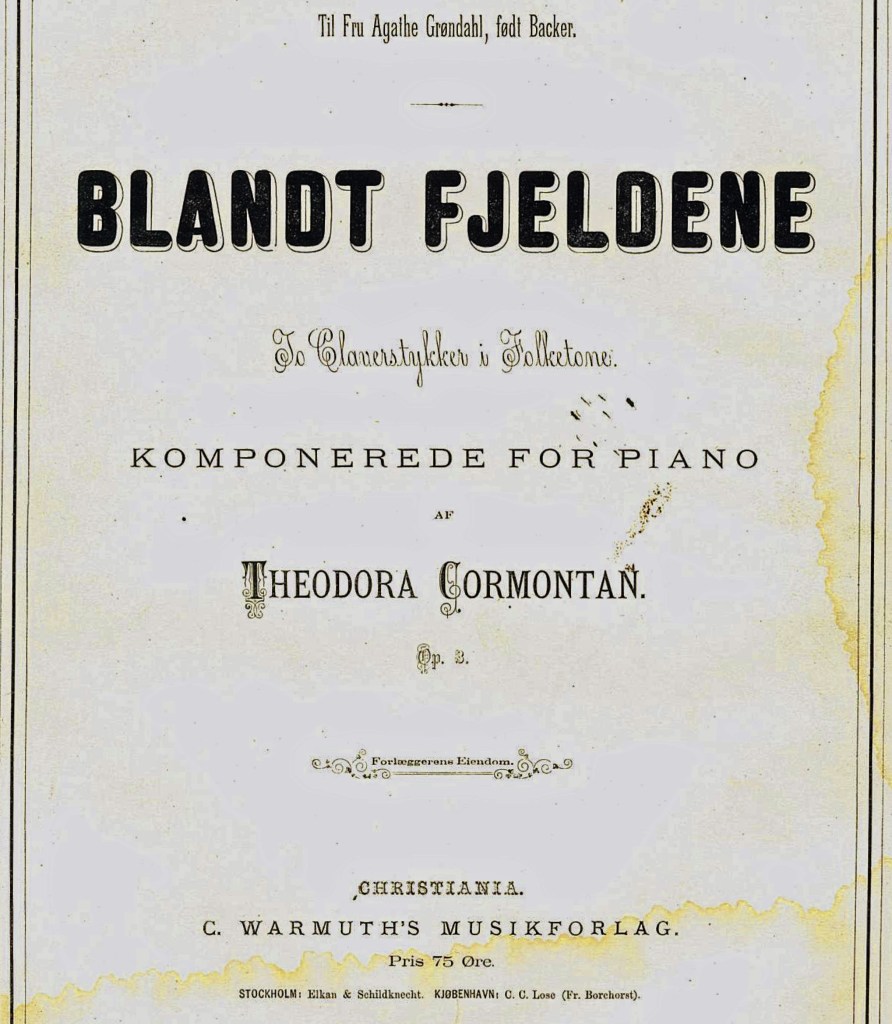
(above) A copy of the front cover of Cormontan’s one piano piece published by Warmuth, Blandt Fjeldene.
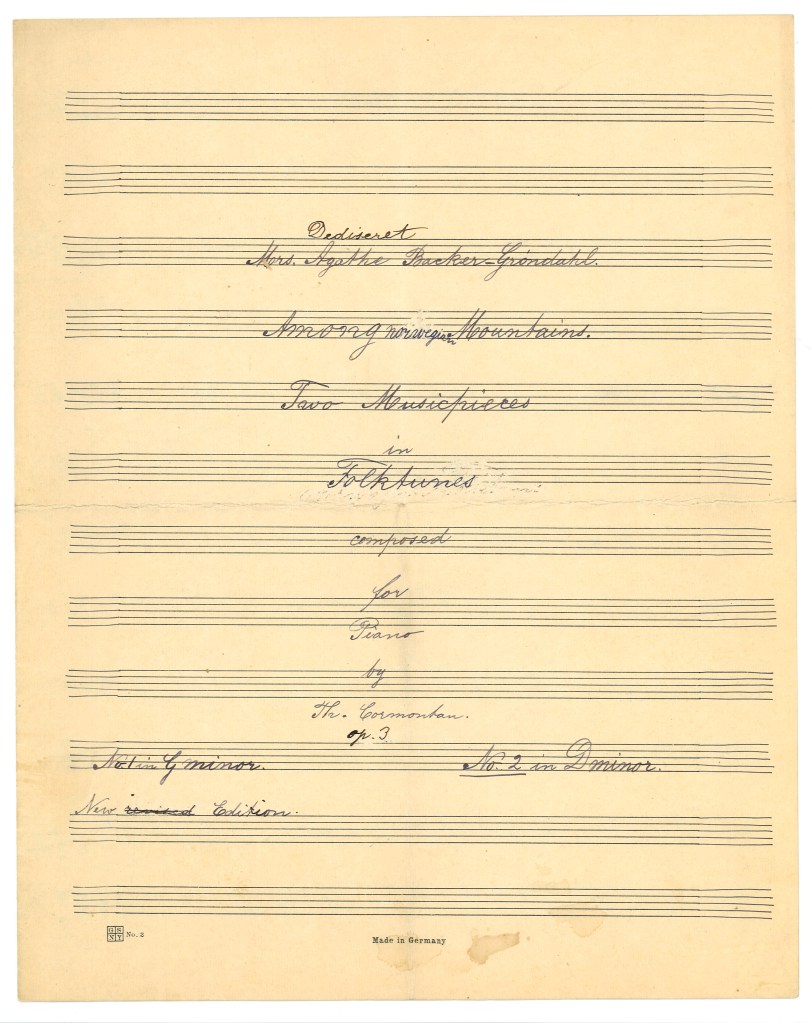
She composed two marches for the popular music scene. Her “Honnør-Marsch for norske Turnere”[“Honors March for Norwegian Turners”] is dedicated to the Arendal Turner Association, a group that had its own band for many years [This piece is also in our manuscript collection. To cite a speaker quoted in the 9/12/1900 edition of the New Ulm Review “Turners admire and foster art, literature, music, physical culture and free thought.”]. The other is nothing less than the “Norske Turneres National-Festmarsch” [“Norwegian National Turners Festive March”], obviously aiming at a wide audience. It is dedicated to the Norwegian Turners. She advertised that the various versions of the piece include piano 2 hands, piano 4 hands, piano and flute, piano and violin, piano and cornet, brass sextet and large orchestra, and military band! The most representative version Cormontan published was printed in glittering red and gold and looks like a diploma. She also published the “Norsk Konge-Polonaise”[“Norwegian King Polonaise”] for King Oscar II, with a powerful showcase trio section that is a paraphrase of the King’s song. Theodora Cormontan does not show original and distinctive compositional talent. It is fairly conventional, and can sometimes seem like plagiarism. The opening of her “Norsk Konge-Polonaise”is so blatantly borrowed from Chopin’s Polonaise in A major that it must involve a deliberate quote–she obviously knew a lot of music. But, at its best, she has a pianistic sweep of design that is quite effective in her piano pieces, and several of her songs are marked by sincerity and a genuine feeling that make them quite persuasive. [Professor Henriksen only had access to the music Theodora published in Norway. The best of her unpublished manuscript compositions display, in my opinion, significantly more original and distinctive compositional talent than Theodora revealed in any of her music published in Norway, with the possible exception of a few of her songs. Additionally, I believe she was original and distinctive just by being a woman composer. As a woman in 19th century Norway, she had to work through pervasive and restrictive societal conventions that no male composer encountered].
Theodora Cormontan’s ambitious music company did not enjoy a long life in Arendal. We can only guess at the reasons why. But, it is a fact that the city’s golden age of the 1870’s was succeeded in the following decade by a serious depression, with sailing ships put out of business and an economic crisis [three Arendal banks went bankrupt in 1886, resulting in Theodora and her father losing all the money they had in two of those banks].
Old Cormontan must have been a tenacious and persevering clergyman. He was for some years the Provst [a position of regional authority in the Church of Norway] of Nedenes diocese, and did not step down from his position in his parish church until 1882, when he was 85 years old and had preached for 57 years!
There is a painting from the old church where he looms as the patriarch with his two daughters, Theodora and Eivinda, in their permanent seats in the choir. The two musical girls obviously sang in the church choir for the old Provst. The rest of the children had emigrated.
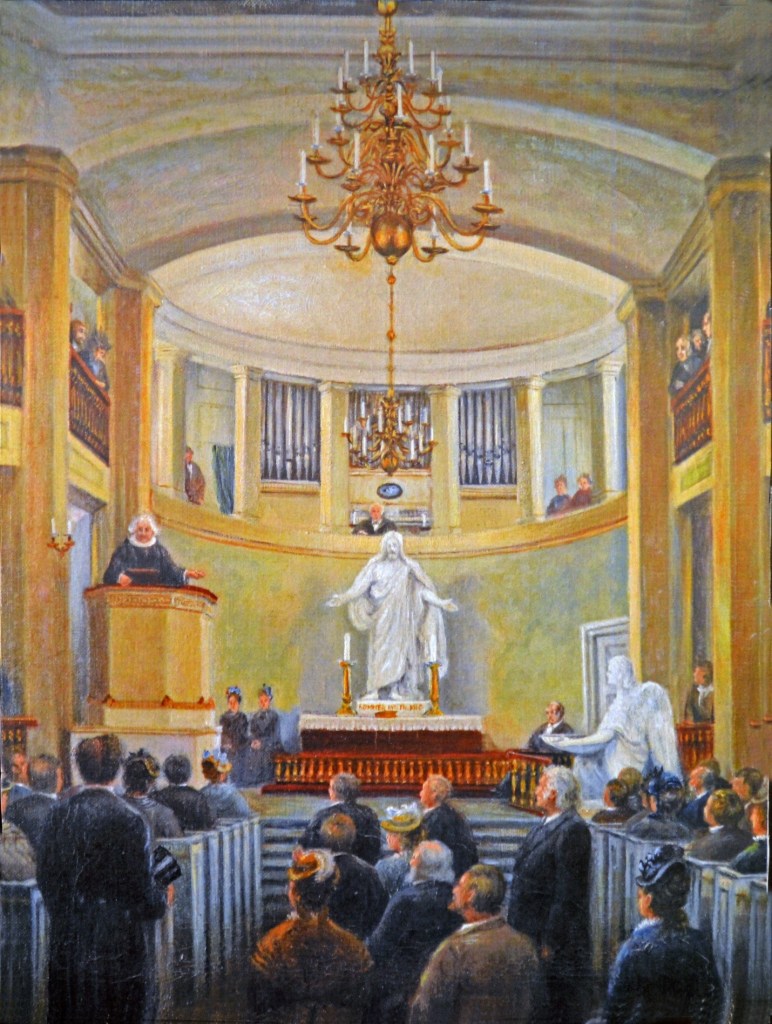
(above) This is a copy of the painting referenced by Henriksen, painted in 1928 by Leonard Rickhard. This digitalized photograph was taken at the KUBEN Museum in Arendal in 2015.
In 1887 the 89 year old father boarded the steamship Hekla with his two daughters to spend their last years together with the surviving children in Franklin, [Minnesota], USA. The Provst died in 1892 [1893], and his unmarried daughter worked for many years as a music teacher. Theodora Cormontan appears to have lived until about 1920. [Theodora Cormontan died on October 26, 1922].
Theodora Sings 1866-1869
In 1865 Theodora Cormontan left her musical studies in Copenhagen to return home to Arendal, Norway, almost certainly in response to the death of her mother on March 5 of that year. She remained at home with her father and older sister for a time, almost certainly to provide a level of support previously provided by her mother. Theodora’s father, Provst Even Cormontan, held an important position in the Lutheran State Church of Norway that would have required an efficiently run home to enable him to effectively execute his duties. This domestic support may have been beyond the ability of Theodora’s older sister Eivinda, who already lived at the residence. Eivinda never left home and may have had some special needs that also required attention. The responsibility fell to the next oldest daughter, Theodora. Her younger sister Marie would eventually marry and immigrate to the United States.
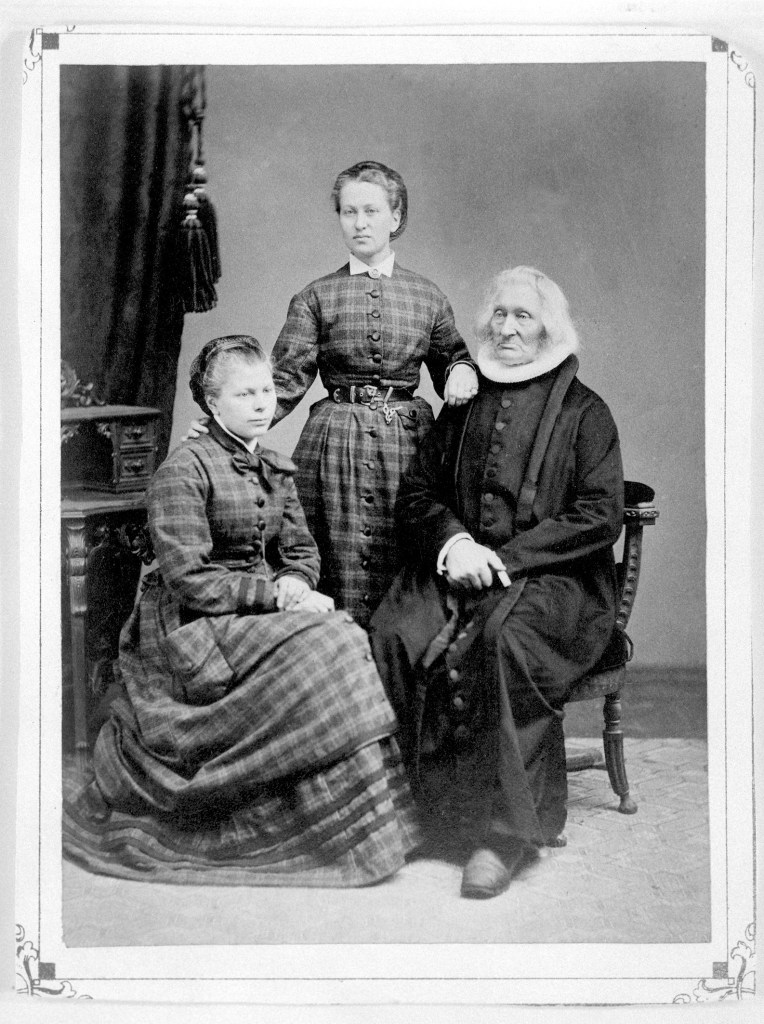
(above) Theodora (standing) with her sister Eivinda and her father Even. This picture probably dates from shortly after Theodora returned home in 1865. In this picture Theodora has literally been placed in a central position, with one hand on her sister and the other on her father. Also, look at the three expressions. I could be wrong, but I read resignation in Eivinda, sorrow in Even, and an almost fierce determination in Theodora. This picture is one reason I believe Theodora assumed a leadership role when she returned home in 1865.
Though needed at home (at least, apparently, in 1865 and most of 1866), Theodora’s father clearly supported her aspirations to be a professional musician, as he had supported her musical education. Theodora initially engaged in local performances, but also looked to teach, perform, and compose well beyond Arendal.
The November 17, 1866 issue of the Drammen Blad newspaper indicates that Theodora would be performing in the capital of Norway (at that time called Christiania): “Miss Cormontan from Arendal, who lived in Copenhagen for several years and enjoyed singing solos there, and who is reportedly already a very advanced singer, endowed with a beautiful and sonorous voice, is said to be engaged by the opera company at the Christiania Theater.”
While her engagement with the company appears to have been brief, this announcement reflects that Theodora was highly regarded as a singer and was determinedly working to expand her musical horizon to the extent that she was recognized and assessed positively in the nation’s capital less than two years after moving back to her home town.
Theodora Cormontan returned to Denmark to perform in February of 1867. The Copenhagen Dags-Telegraphen noted that she sang (“with applause”) “Il Baccio,” probably composed by Arditi.
In March she sang in a concert offered by violinist Miska Hauser, as announced in the March 11, 1867 edition of the Copenhagen Adressecomptoirs Efterretninger. The concert was offered in the Casino’s small hall. The Casino was built in 1848 by Tivoli Gardens founder Georg Carstensen. Edvard Grieg’s Piano Concerto in A minor received its world premiere there on April 3, 1869. The Casino Theatre closed in 1939 and was demolished in 1960.
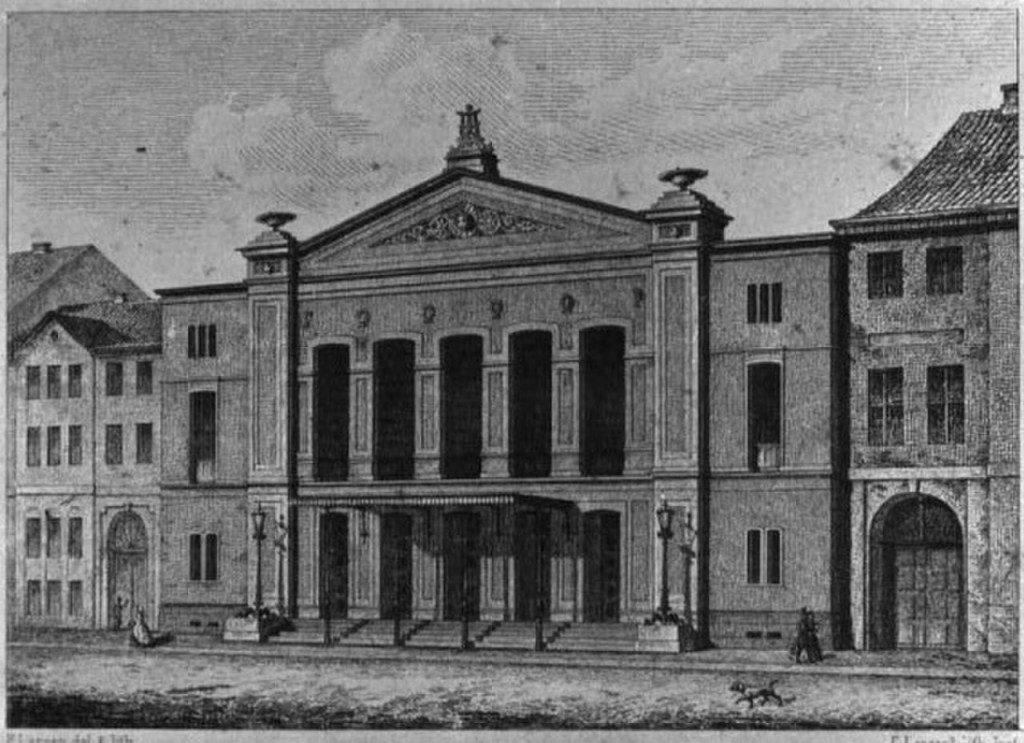
(above) The main entrance of the Casino Theatre
The program (words bolded in the original source) included:
1. Concert piece, composed and performed by M. Hauser.
2. Weber, recitative and aria from Der Freischütz, performed by Miss Cormontan.
3. a) Eensomhed b) Eventyr c) Andagt, composed and performed by M. Hauser.
4. Heller, Fantasy for Piano performed by Mr. Anton Rée.
5. a) Aria, composed in 1720 by Pietro Loeotelli di Bergamo b) Ungersk rapsodie performed by M. Hauser
6. Norwegian Folksongs, sung by Miss Cormontan.
7. a) Vuggevise b) Fuglen I Træet, composed and performed by M. Hauser.
The March 11 Flyveposten newspaper also promoted the Hauser concert and mentioned Theodora as a participant.
The March 13, 1867 edition of the Folkets Avis, published in Copenhegen, reviewed the Miska Hauser concert. At the end it mentioned Theodora, saying “Miss Cormontan” won strong applause for her performance of “some songs.”
The March 13 edition of the Copenhagen Dagbladet also offered a review of the Miska Hauser concert. After writing about Hauser, the article continued: “Miska Hauser was assisted by Mr. Anton Rée and Miss Cormontan. The former’s excellent piano playing deserved the enthusiastic response it enjoyed. Miss Cormontan also reaped applause for her performance of the recitative and aria from Der Freischütz and Norwegian folksongs. The applause was not undeserved, but Miss Cormontan has hardly enough of a voice to perform the aria from Der Freischütz with the proper dramatic life. The different moods were not clearly enough reflected in her performance. Admittedly, it is difficult to reproduce operatic drama at a concert, and Miss Caroline Lehmann’s performance recently has made Miss Cormontan’s task even more difficult, since it is not easy to not compare the two.”
Miska Hauser (1822-1887) was an Austrian violinist and composer. He studied with Kreutzer. He toured extensively, performing in Australia, North and South America, Russia, India, Egypt, and throughout Europe. Anton Hartvig Rée (1820-1886) was a Danish pianist.

(above) Miska Hauser
The March 25th Copenhegen Dagbladet reviewed a concert in which Theodora sang. In the middle of the review it discusses Cormontan, saying: “Miss Cormontan, who is well known to the audience from [Miska] Hauser’s last concert, sang a few Norwegian songs, of which Kjerulf’s “Ræven lurer” (The Fox is lurking) was especially excellent . . .” This Halfdan Kjerulf song is likely “Og ræven lå under birkerod” (“And the fox lay under the birch root”), his setting of a poem by Bjørnstjerne Bjørnson.
The size of Theodora’s voice again emerged as a concern in an article in the April 15, 1867 edition of the Kongelig Privilegeret Aarhuus Stifts-Tidende. After mentioning other singers, the article concluded: “Miss Cormontan has been heard singing here several times, but her voice was not found strong enough.”
Theodora expressed her intent to live and teach in Copenhagen in the August 26, 1867 edition of the Copenhagen Adressecomptoirs Efterretninger: “Music Lessons. Upon moving here to live, the undersigned wishes to give music lessons in singing. Please contact me at my home, St. Pederstæde 30, 2nd Floor, between 3 and 5 in the afternoon. Theodora Cormontan”
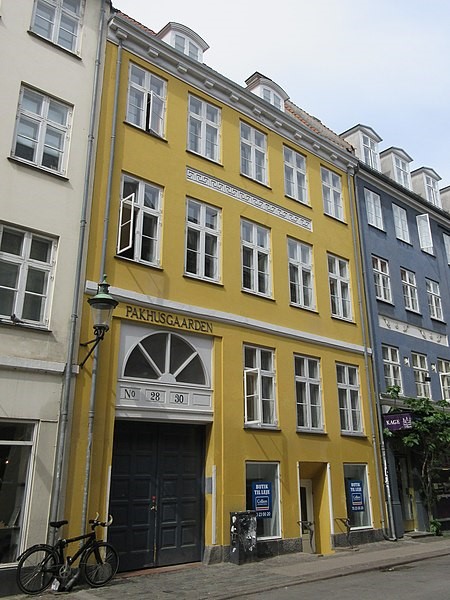
(above) Pakhusgaarden is a Neoclassical property located at Sankt Peders Stræde No. 28/30 in the Latin Quarter of central Copenhagen. The building, built in 1797-1798, was listed on the Danish registry of protected buildings and places in 1959. (picture taken in 2017)
The December 5, 1867 edition of the Flyveposten announced a concert at the Casino’s smaller hall that evening featuring the Norwegian pianist Erikka Lie “with kind assistance” by Miss Th. Cormontan, opera singer N. Simonsen, and violinist Anton Svendsen. The notice included the program:
1. Chopin, F.: Concert for Piano and Orchestra in f minor.
2. a) Finsk Folkesang. b) Kjerulf, H.: O vidste Du bare, sung by Miss Th. Cormontan.
3. Nordraak, R.: Scherzo-Capriccio, for Piano. Gade, N.W.: Folkedandse for Piano.
4. Wieniawski: Legende for Violin, performed by Mr. Anton Svendsen.
5. Weber, C.M.: Introduction and Polonaise for Piano and Orchestra in E Major.
6. Heise, P.: Sange med Piano, performed by Mr. N. Simonsen.
7. Liszt, F.: Concert-Waltz after Gounod’s “Faust” for Piano.
The concert was announced on December 5 and reviewed on December 7 in the Copenhagen Dags-Telegraphen. The section related to Theodora translates as follows: “The artist [Lie] was assisted by Miss Cormontan, who has now taken up permanent residence here in the city to teach singing, and whose pleasant voice and beautiful presentation we had the opportunity to hear at various concerts last season. On Thursday she presented quite beautifully a Finnish folk song and “O vidste Du bare” by Kjerulf. The not entirely perfect intonation may have been due to a recent illness.”
Erika Røring Møinichen Lie Nissen was a Norwegian pianist and music teacher who lived from 1845-1903. She studied piano with Halfdan Kjerulf, as did Agatha Backer Grøndahl, and the two women lived in the same boarding house in Berlin while they studied with Theodor Kullak. She made her concert debut in Berlin in 1866 to rave reviews and toured extensively before retiring in 1874 to marry, teach music, and perform locally in Oslo. Lie traveled to Paris in 1868 to study with Thomas Tellefsen, probably focusing on the music of Chopin. Since I believe Theodora studied with Tellefsen, it is possible she helped Lie make this connection. N. Simonsen was likely Niels Juel Simonsen (1846-1906), a Danish baritone who frequently performed songs by Edvard Grieg. The Danish violinist and music educator Anton Svendsen (1846-1930) was born and died in Copenhagen. He was a teacher at the Royal Danish Academy of Music and played with the Neruda Quartet.
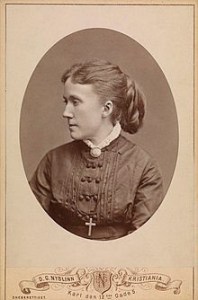
(above) Erikka Lie (Erika Røring Møinichen Lie Nissen)
Early 1868 found Theodora giving a performance where she was the featured artist, as reported in Copenhagen’s Fædrelandet newspaper’s January 30, 1868 edition: “Next week Miss Cormontan from Norway will give a concert in the smaller hall of the Casino. She will be joined by Miss Erikka Lie and Mr. Anton Rée.” The January 31 edition of the Copenhagen Dags-Telegraphen also announced this concert. There appears to be no published review in existance, at least online.
Cormontan apparently lived in Copenhagen for about a year. The Copenhagen Adressecomptoirs Efterretninger ran an ad for her as a voice teacher at the same address as listed above in its April 28, April 29, May 13, May 22, August 31, and September 1, 1868 editions.
The Berlingske Politiske og Avertissemenstidende reported in its 8/25/1868 edition a concert that would take place the next day at the Klampenborg Badeanstalt–the Klampenborg Bathhouse. The facility consisted of a main building, a spa, a concert hall, several cottages, and bathing establishments. The performance included violinist Schradeck, pianist Kleinnickel, cellist Gowa and Miss Cormontan (no first names were mentioned). The program included (words bolded in the original source):
1) Mendelssohn. Allegro and Scherzo for Piano, Violin and Cello.
2) På Roines Strand (On Roines Beach), Finnish Folksong (Miss Cormontan.)
3) Ernst, H. Fantasy on a Theme from “Othello” for Violin (Mr. Schradeck.)
4) a. Chopin. Nocturne for Piano b. Schumann. Fantasy for Piano c. Heller, St. Tarantella for Piano (Mr. Kleinnickel.)
5) a. Du kommer (You are Coming). b. Kjerulf, H. Paa Fjeldet (On the Mountain). (Miss Cormontan.)
6) a. Bach, J.S. Aria for Cello. b. Musette. Dance from the 1700s. (Mr. Gowa.)
7) Andante and Finale for Piano, Violin, and Cello.
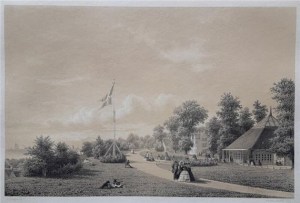
(above) Klampenborg Badeanstalt by Carl Emil Baagøe (the work dates around 1860-1870)
The August 25, 1868 editions of the Flyveposten and the Copenhagen Dagbladet also announced this concert. A review of the performance in the August 28th Dags-Telegraphen noted that “Miss Cormontan” gave “a pleasant performance that was rewarded by the audience with deserved applause.” The August 28, 1868 Flyveposten was less positive, noting: “Miss Cormontan was less fortunate this evening, possibly as a result of her not being well.”
The violinist Schradeck may have been Henry Schradieck (1846-1918). The German violinist, composer, and music pedagogue wrote a series of etude books that are still in use today. Cellist Albert Gowa (1843-1919) was born and died in Hamburg. Nothing can be found online for the pianist Kleinnickel, but his name indicates he was German as well.
The August 28th edition of the Berlingske Politiske og Avertissemenstidende not only advertised Theodora’s voice teaching, but also with whom she was studying: “Miss Cormontan, who has often with applause performed at concerts here and has trained under Dr. Carl Helsted’s guidance, has now taken up permanent residence here and, according to a standing notice, offers her guidance in singing.”
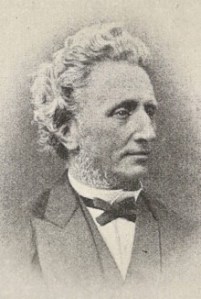
(above) Dr. Carl Helsted
Carl Helsted (1818-1904) was a famous Danish voice teacher as well as composer. Nina Hagerup (1845-1935), first cousin and future wife of Edvard Grieg, moved to Copenhagen from Norway when she was 8 and studied singing with Helsted from age 10 into the mid-1860’s. Edvard and Nina were married in Copenhagen in June of 1867. It seems quite possible that Theodora knew both Nina and Edvard and attended the wedding.
Theodora Cormontan on Tour
By 1869 Theodora Cormontan had left Denmark to conduct a concert tour in Norway.
The Tuesday, 3/2/1869 edition of the Kristianssands Stiftsavis og Adresse-Contors Efterretninger newspaper announced an upcoming concert in Kristiansand, Norway (today the city name is spelled with one “s”) featuring Theodora Cormontan: “On Sunday, our musical audience will have the opportunity to get acquainted with a young Norwegian singer, Miss Cormontan from Arendal, who intends to give a concert here. She has this past winter given several concerts with great applause in her hometown and must be in possession of an exceedingly beautiful and well-educated voice, so it is assumed that our audience has a real pleasure in store. As we hereby tentatively announce the concert, we allow ourselves to recommend the subscription list, which will be included this week, to the attention of the audience [see below].”
The book “Til glede for byen: Konsertvirksomheten I Kristianssand 1780-1900” (“To the delight of the city: concerts in Kristiansand 1780-1900”) by Frank Høgberg, notes this concert offered by Cormontan in Kristiansand on March 7, 1869. He quotes the March 6th Stiftsavis og Adressecontors Efterreninger announcing the program and the location of the concert:
Theodora Cormontan
Presents on Sunday, March 7th at 7:30 p.m.
At Klubselskabet “Foreningens” Lokale [Club Company “Association” Location]
A Concert
Program
1. Gounod. Jewel Aria from “Faust,” sung in concert version.
2. Beethoven. Overture to “Egmont” on Piano.
3. Verdi. Cavatina from “Il Trovatore,” sung in concert version.
4. Beriot. Air Varié No. 6 for Violin and Piano.
5. Arditi. “L’Ardita [Magnetic Waltz], ” sung in concert version.
6. Composition for Piano
7. Pacius. Ballade, sung in concert version.
Ticket price 40 Sk. Tickets will be held at the entrance, which opens at 7:00 p.m.
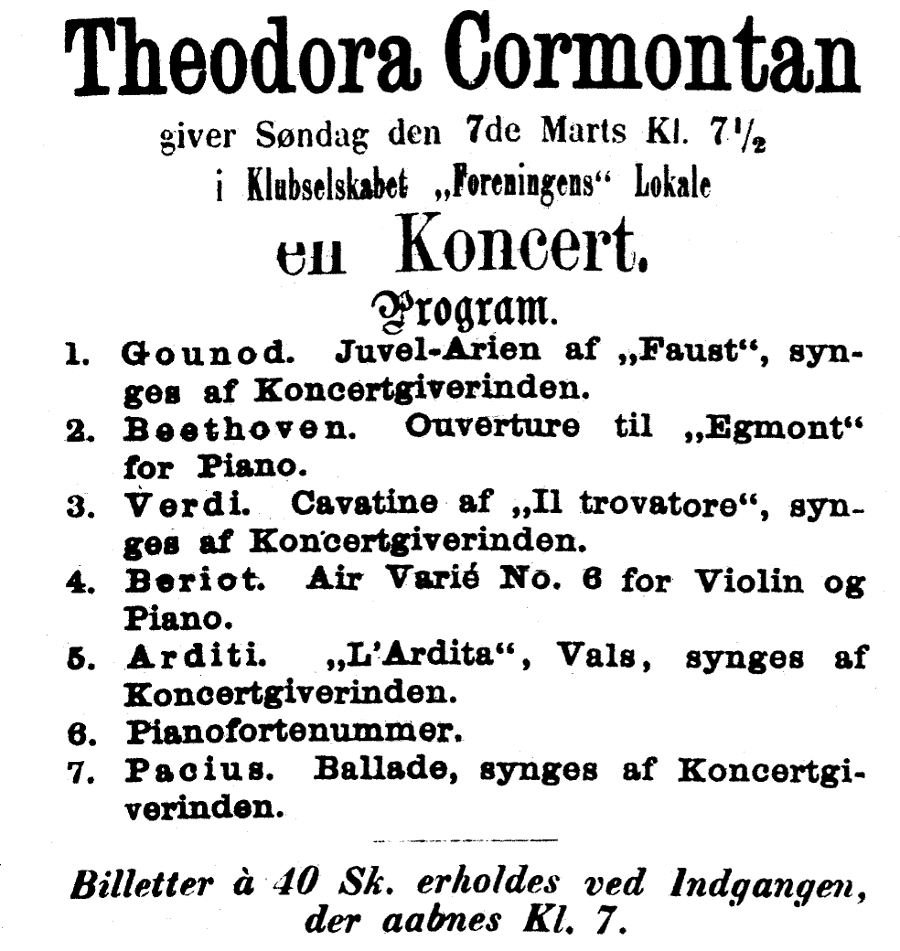
(above) A copy of the original concert program.
The announcement does not identify the other musicians who would be performing with the soprano soloist. It also does not clarify if the piano solos are performed by Cormontan or if the composition for piano might be an original composition by Theodora. The first confirmed public performance of one of her compositions comes from 1872.
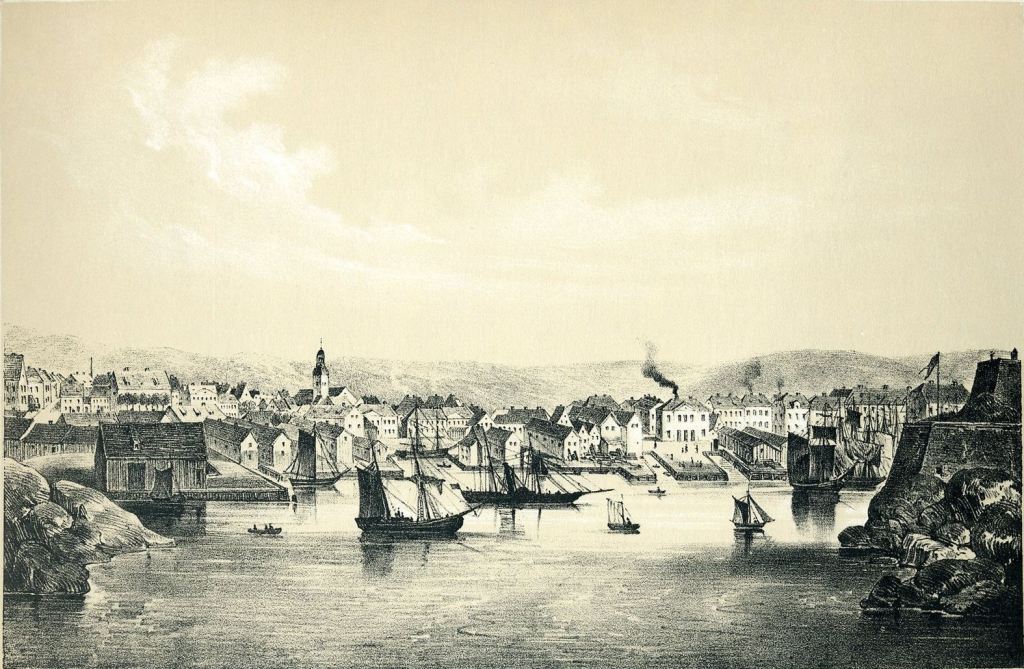
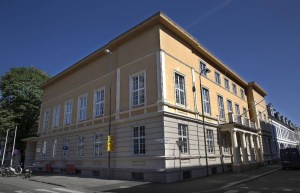
(above) A drawing of Kristiansand from around the time Cormontan performed there. Also, a 2014 picture of the Klubskelskabet “Foreningens.” This men’s club has been in existence since 1824.
The March 6th edition of the paper also ran the following: “Let us remind you of the concert announced for tomorrow evening featuring Miss Cormontan that will be given at the ‘Association.’ We have been told that Miss Cormontan offered several concerts in Copenhagen last year, where she previously received a fine education. She has received a glowing reception for fine concerts in Arendal and Grimstad, where they reported that she is a singer of more than ordinary talent.”
This last sentence alludes to the beginning of an 1869 concert tour of Norway by Theodora Cormontan. Grimstad is between Arendal and Kristiansand on the southern coast of Norway. Cormontan would continue along the coast to present a concert in Stavanger in April of 1869 and concerts in Bergen in April and May of that year. An article in the June 4, 1925 issue of the Trondheim Dagposten noted that Cormontan presented concerts in that city on May 31 and June 3, 1869. From there she would continue to Larvik for a July performance.
A review of the Kristiansand concert appeared in the paper on March 9th. Not unlike many reviews today, only a portion of the article addressed the actual performance. The anonymous author spent the first part of the review expressing disappointment that only about 70 people attended Theodora’s concert. The author wrote:
“When a guest artist comes to our city to give a concert, it is seldom that the performer is rewarded by a full auditorium. It is usually only a solid, little band of Music Friends who arrive, since they would not neglect any opportunity to enjoy a musical performance, something that escapes the everyday crowd; the large crowd seems to consider concerts as something that are irrelevant, and stays away. Only when someone with a great reputation and great fame performs do large audiences appear. They don’t attend when someone less well known performs.”
The reviewer eventually discussed Theodora’s performance, and wrote: “The concert featured a singer in possession of a full, rich and sonorous soprano voice of a rare and pleasant character. Her singing reflected favorably upon her training; we would particularly note her beautiful and correct intonation. Of the numbers presented, her performance of the Cavatina from Il Trovatore and the Magnetic Waltz brought special joy. The Ballade by Pacius seemed to us, however, to be less beautifully sung. All the numbers were received with lively applause that was so powerful that the singer visibly shuddered, and at the end of the concert was moved to tears.”
The Sunday, April 18, 1869 edition of the Bergensposten reported under Various News: “The singer Miss Cormontan, who has given concerts in major cities along the coast, has now come here to Bergen, and intends to give concerts in the coming week.”
The Bergens Tidende newspaper announced two concerts Theodora would give in Bergen and listed the program for each concert:
Theodora Cormontan gives on Thursday, April 29th [1869] with kind assistance a concert in The Workers Union Hall.
Program
1st Part
1. Scene and Aria from “La Traviata” by Verdi, Sung by the Concert giver
2. Alpenrosen, Solo for Violin, by [François] Schubert
3. Cavatina from “Lucia di Lammermoor” by Donizetti, Sung by the Concert giver
2nd Part
4. Ilma, Waltz by Arditi, Sung by the Concert giver
5. Grand Quintet for Piano, Violin, Viola, Cello & Bass by Hummel
a) Allegro resolute
b) Menuetto
c) Largo & Finale allegro
6. a) Vaffsång by Taubert, b) O vidste Du bare by Kjerulf, Sung by the Concert giver
[Ticket prices are listed]. Concert begins at 8 o’clock.
Theodora Cormontan gives on Tuesday, May 4th in The Workers Union Hall with kind assistance her second and final concert.
Program
1st Part
1. Cavatina from “Barber of Seville” by Rossini, Sung by the Concert giver
2. Grand Duo for Violin and Piano on a Theme from “Il Trovatore” by Gregoir & Leonard
3. Grand Waltz by Venzano, Sung by the Concert giver
Final Part
4. Aria from “Robert le diable” by Meyerbeer, Sung by the Concert giver
5. Duo concertante for Violin and Piano on a Theme from “Ermani” by Gregoir & Leonard
6. a) Min Elskte, jeg er bunden, b) Venevil by Kjerulf, Sung by the Concert giver
[Ticket prices are listed]. Concert begins at 8 o’clock.
The newspaper did not list the collaborative musicians for either concert.
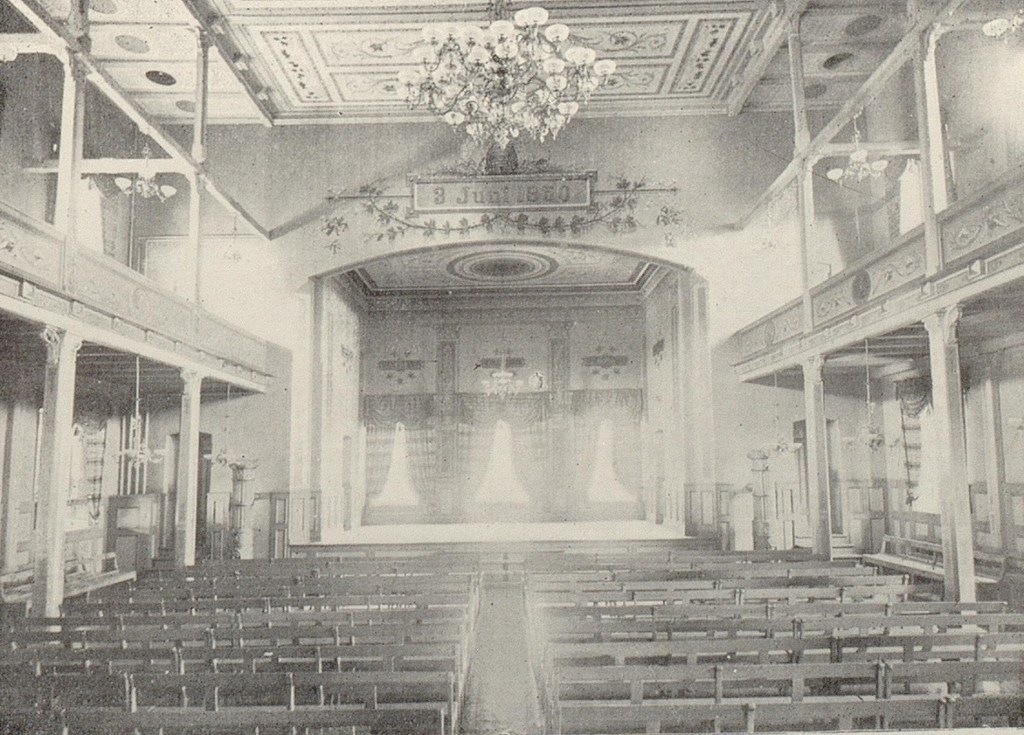
(above) The Workers Union Hall (Arbeiderforenings Festivitetslokale) in Bergen
The April 30, 1869 edition of the Bergens Tidende reviewed the first vocal recital by Theodora Cormontan, presented the previous evening. Though challenging to translate, it is clearly a negative review.
The author begins by commenting on the small audience and the problematic acoustics, and then observes that Cormontan possesses “a pretty big soprano voice of considerable sonority and rather sympathetic timber.” After this, everything becomes critical. Only her upper range possesses positive qualities; her middle voice loses volume and is somewhat covered and hoarse. She has numerous technical difficulties, including intonation and diction. Her singing lacks artistry and individuality. She has a poor technical and artistic ear. The reviewer concludes that she has a lot of work to do before she becomes an artist.
The May 15, 1869 edition of the Bergensposten noted that Miss Cormontan was tentatively scheduled to give a concert in Aalesund. Ålesund/Aalesund is a port town on the west coast of Norway north of Bergen. On June 2 the same paper wrote that “Miss Cormontan gave a concert in Kristianssund for a small but discriminating audience.”
After her concerts in Trondheim on May 31 and June 3, Theodora performed in Larvik, as noted on the front page of the July 13, 1869 issue of the Jarlsberg og Larviks Amtstidende: “The singer Miss Theodora Cormontan gives a concert tonight in the Gymnasium, the contents of which may be found in the program. We have seen Miss Cormontan’s appearance mentioned in a very appreciative way both in Copenhagen and in domestic newspapers, and we therefore believe that the audience will have the opportunity to spend a pleasant evening by hearing her.”
Page 3 listed the program:
1. Orchestra number.
2. Cavatina from “The Barber of Seville” by Rossini.
3. Aria from “Robert [le diable] – -Meyerbeer.
4. Orchestra number.
5. L’Ardita, Valse – – Arditi.
6. a) O, vidste Du bare – -Kjerulf.
b) Jag ar en nordisk flicka – -Jakobson.
None of the other performers, including the orchestra, are named.
Cormontan’s touring activity may have been impacted by the onset of a serious illness that was noted in the August 20, 1872 edition of the Jarlsberg og Larviks Armstidende newspaper. The concerts that constituted her 1869 tour were her last performances reported in newspapers (found so far) until an appearance early in 1872 in Arendal. The tour appears to be the only one she ever conducted. She may have stopped at first for health reasons and then never toured again because of her busy career as a performer, composer, and music publisher in her hometown.
Arendal II 1870-1887
The National Library of Norway posts scans of Norwegian newspapers from the 1870s-1880s that reveal information about Theodora Cormontan as a music distributer, a music publisher, a music performer, and a composer in Arendal. The following news items from the period are arranged mostly in chronological order. The electronic translations are often from a Gothic/Fraktur script, so 100% accuracy is not guaranteed.
Vestlandske Tidende, 9/12/1871 and 9/14/1871: “Singing Lessons.
Teaching in Song is given by the undersigned. 48 Skill. [Shillings] an Hour. Pupils are received every morning from 10 – 12. Theodora Cormontan.”
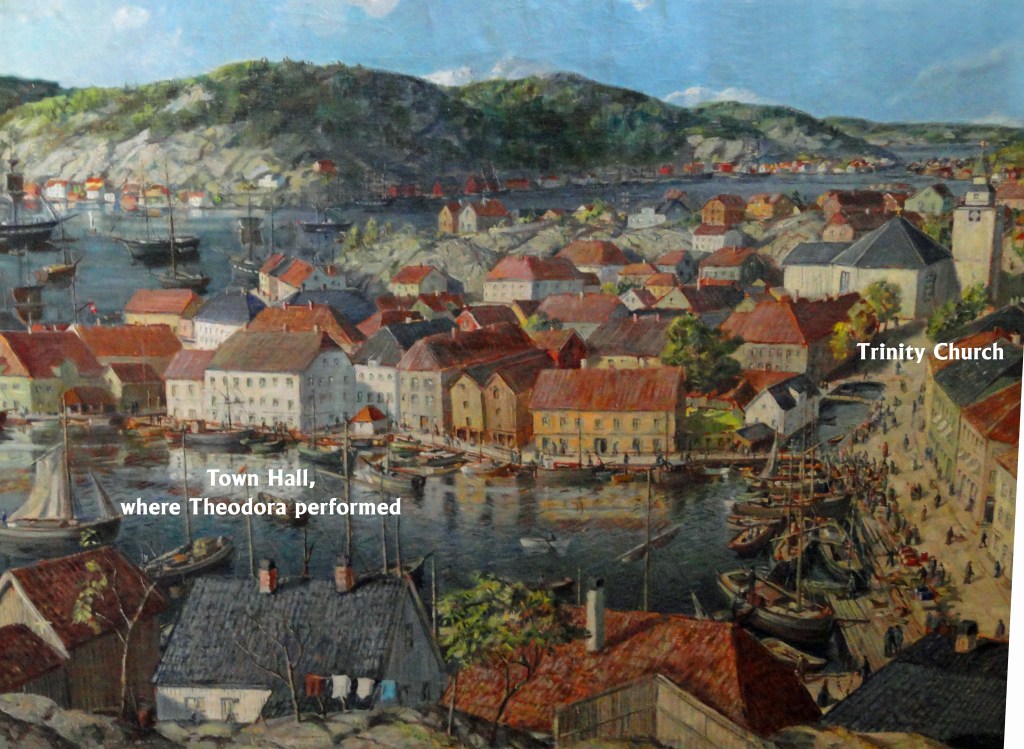
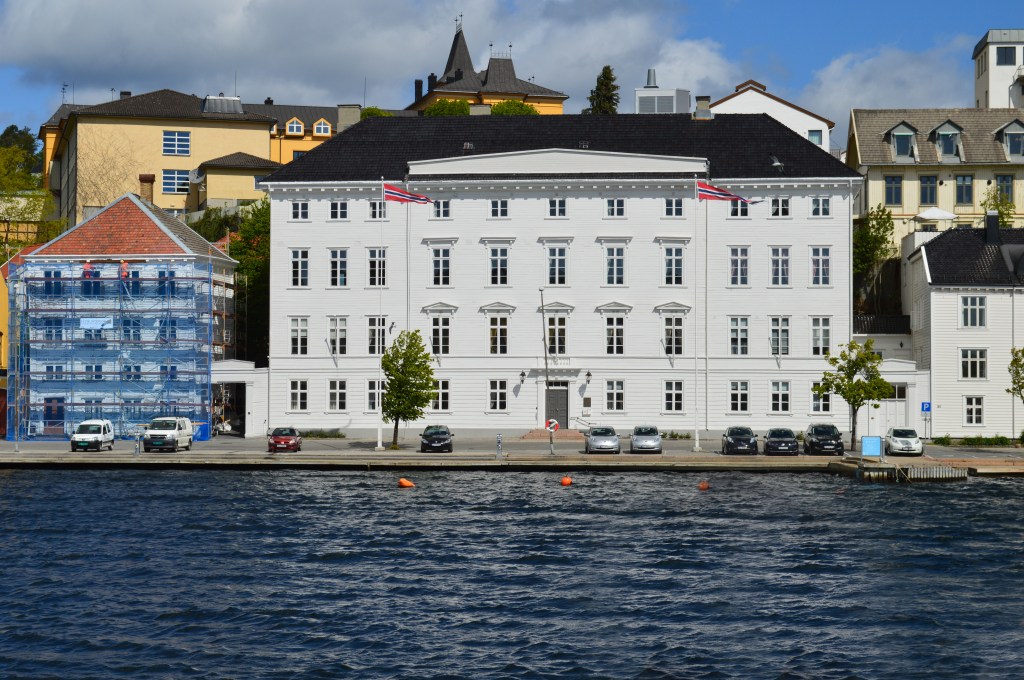
Vestlandske Tidende, 12/28/1871: “Theodora Cormontan will give a concert in the Festival Room on Tuesday, January 9, joined by several other musicians.” This room is probably the large hall on the third floor of the Old Town Hall where Cormontan presented numerous concerts. The concert was announced several times.
(below) A painting showing the location of the Town Hall in relation to the Trinity Church. Below that is a picture of the Old Town Hall from 2015.
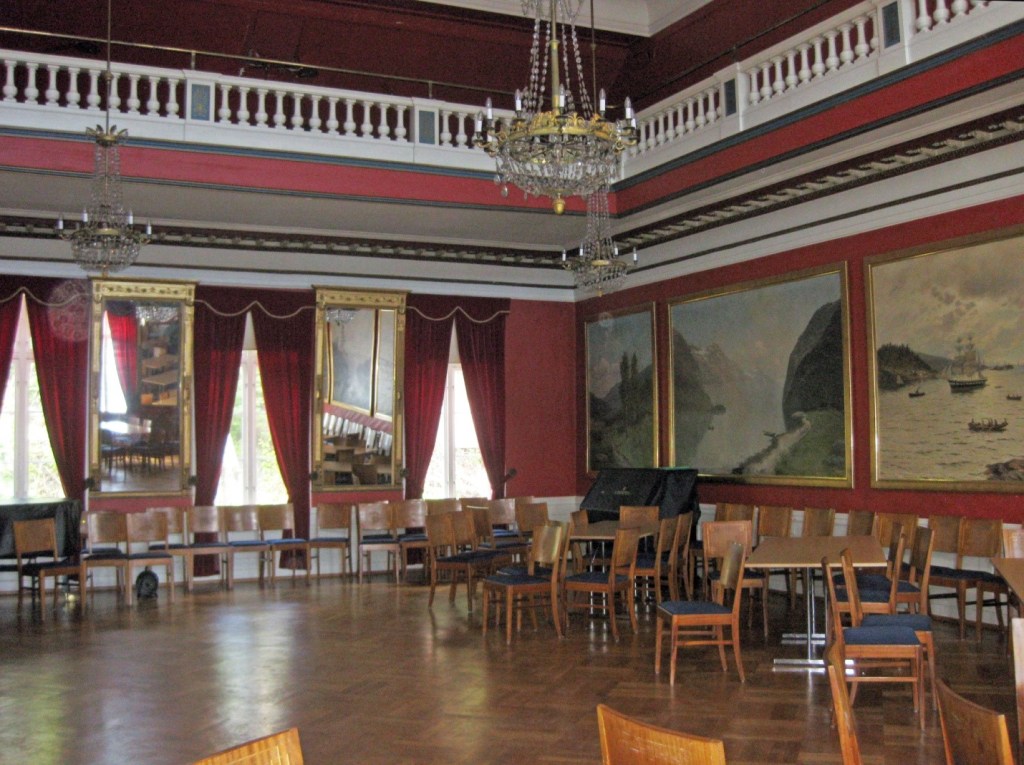
(Above) The large hall in the Old Town Hall. Picture taken in 2015
The January 11, 1872 edition of the Vestlandske Tidende included a brief review: “The Concert previously announced by Miss Cormontan was given on Tuesday to a very good house. The numbers performed by the concert hostess were all greeted with lively applause . . .”
Though she only toured extensively once, Theodora still performed outside of Arendal. The following news item records her appearance with Christian Teilman, a Norwegian organist, pianist, and composer who lived from 1843 to 1909. Significantly, this is the earliest report found so far of Theodora performing her own compositions in a public performance. This article is from page two of the Jarlsberg og Larviks Armstidende newspaper from Saturday, August 17, 1872: “One of our more talented, younger musicians, the pianist Christian Teilman, plans on Monday to give a concert in the Gymnastics Room here [Larvik]. Mr. Teilman will be pleasantly remembered by our music-loving audience from a concert he gave here a few years ago, and we are therefore confident that he will be met with approval. We believe the audience will be interested to learn that Mr. Teilman in recent years has resided in Stockholm to further his education at the Academy of Music and during his stay has won much acclaim both as a composer and a Greek scholar . . . Miss Theodora Cormontan will assist on some of the pieces, including a couple of her own compositions.”
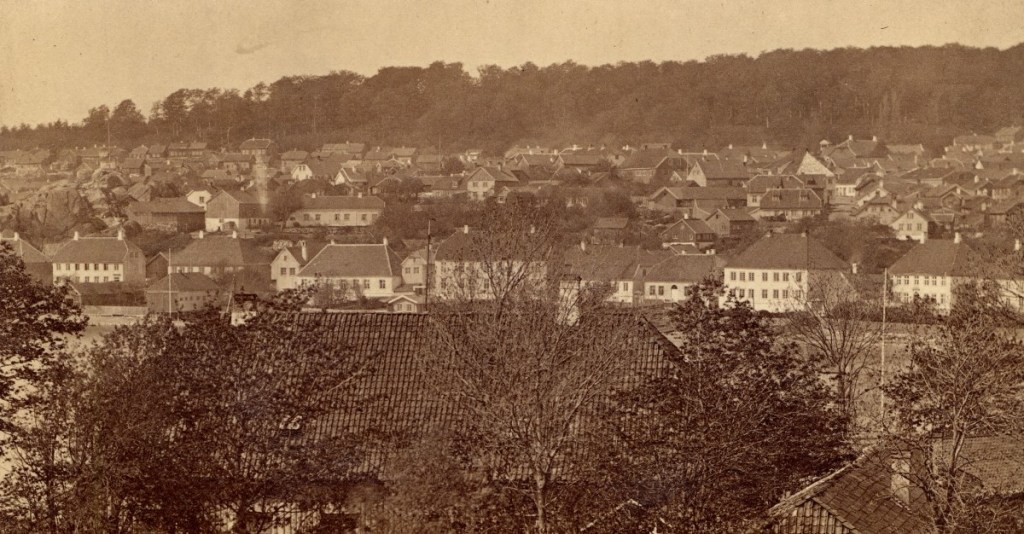
(above) The main street of Larvik around 1866
The following advertisement ran several times in the same newspaper during August of 1872: “Pianist Christian Teilman presents with the kind assistance of Miss Theodora Cormontan and others a concert on Monday, August 19 in the Gymnastics Room.” A review of the concert appeared in the August 20th edition of the newspaper. It mentions a serious illness from which Theodora had recovered. This illness may account for the fact that no mention has been found so far of her performing in 1870 or 1871: “Despite the summer heat and the unfortunate room in which pianist Dr. Teilman had to give his concert, a large audience gathered to hear it. Dr. Teilman’s playing has, according to those who previously heard him, continued to grow since he was here a year ago, and the audience therefore rewarded him with frequent applause. Miss Cormontan sang on some of the romances. She has for some years been prevented from performing by a long and dangerous illness, but it turned out last night that she is still in possession of a clean and full voice and received lively applause for her beautiful and tasteful singing.”
Theodora was apparently willing to stay in the area for an extended period. She ran the following advertisement several times in August editions of the Jarlsberg og Larviks Amstidende: “Music lessons. If a sufficient number of pupils register, the undersigned intends to settle down here as a teacher of singing and harmony. Further information has been left at this newspaper and at Preutz and Lund’s bookstores. Meet me in person at Miss Bulls Gaard, Langerstrand. Theodora Cormontan.” All of her previous ads as a music teacher in Copenhagen only mention voice. Now she has added harmony. This may mean she studied theory and composition from someone during the time she was recovering from her illness–possibly the town musician, Friedrich Wilhelm Thoschlag. She appears to have begun composing sometime during 1870-1872.
The Jarlsberg og Larviks Amstidende was a newspaper published in Larvik, Norway from 1834-1940. Larvik is on the coast about 80 miles northeast of Cormontan’s hometown of Arendal.
Vestlanske Tidende, 11/5/1872: Cormontan announces in this Arendal newspaper that she is taking students for piano, singing, and theory lessons, so she appears to have abandonded the idea of living in Larvik, and she is continuing to teach music theory.
Vestlandske Tidende, 9/17/1874: Theodora Cormontan advertises that she has begun offering music lessons in Arendal and is accepting new students.
Advertisements listing Cormontan compositions published by Warmuth Music appear in the Aftenposten as early as September 16, 1874. Other issues that promote her music published by Warmuth include May 19, 1875; May 25, 1875; December 15, 1879; and December 17, 1879. Notably, the April 27, 1885 edition features an ad promoting her music now published by the Theodora Cormontan Publishing Co. of Arendal.
Other Norwegian newspapers where Cormontan’s published music is advertised include:
Vestlandske Tidende: 1/9/1874, 8/29/1874, 9/1/1874
Dagbladet: 9/16/1874, 12/13/1879, 12/15/1879
Fredriksstad Tilskuer: 2/10/1876, 7/9/1876, 7/18/1876
Grimstad Adressetidende: 5/9/1877, 9/29/1880
Hedemarkens Amtstidende: 12/18/1875, 12/22/1875
Lillesands-Posten: 3/16/1877
VG (Verdens Gang): 12/18/1879
The 12/18/1875 edition of the Dagbladet provides a brief review of Cormontan’s opus 3, “Blandt fjeldene”–which means “Among the Mountains.” This is the only Cormontan piano composition Warmuth published. One may wonder why Warmuth made the decision to subsequently only publish songs by Theodora and whether this played a part in her opening her own music publishing business where she published a number of her own piano works. The review seems mixed. If I am translating it correctly, the author indicates that the piece captures the beauty of the Norwegian mountains but “is difficult to play.”
Cormontan began her own publishing company in 1879, but it would appear that she notified Warmuth Publishing of her intentions to start her own business as early as 1877, prompting the following from the Lillesands-Posten of 3/23/1877: “Notice!! Miss Theodora Cormontan of Arendal will still be provided with the newest Music from my Music Store and orders will be executed and presented to her as soon as possible. Carl Warmouths [sic] Music Establishment, Christiania [now Oslo].”
With the following announcement, Theodora Cormontan added a new facet to her music business. From the Grimsrad Adressetidende, 3/14/1877: “With reference to the following news item, we draw attention to the fact that Miss Theodora Cormontan in Arendal has been accepted as a sales representative for the Brødrene Hals Piano Factory.” The rest of the article discussed the previous representative, who had passed away.
About a year later, Cormontan would run her own piano sales advertisement. From the Grimsrad Adressetidende 2/20/1878: “Piano Warehouse. As an approved sales representative for Brødrene Hals Piano Factory, I have pianos for sale. These instruments, recommended by leading music authorities, are provided directly from the factory. Theodora Cormontan. Arendal.”
Brødrene Hals was a Norwegian piano manufacturer in Christiania in the 1800s-early 1900s. They produced the first upright piano in Norway, published music, and ran a music agency. The Hals brothers were Karl (1822-1898) and Petter (1823-1871).
Grimstad Adressetidende, 2/12/1878: “With reference to the above Advertisement [on the same page] we allow ourselves to draw attention to the fact that Miss Theodora Cormontan in Arendal is exempt from paying commissions to the Brødrene Hals Factory.”
Vestlandske Tidende, 4/20/1883: “J.O. Engh will be here in a few days to tune pianos; please contact Miss Cormontan.” This ad also ran in the 9/18/1884 edition.
The 12/23/1883 Vestlandske Tidende runs an advertisement with the headline “Christmas Music News!” Most significantly, the ad promotes several works by Cormontan not noted by Kari Michelsen in her book Musikkhandel I Norge. The apparently lost compositions include: “Havfruens Sang. Lyrisk Tonestykke” as well as 4 Fant.Transcriptioner– “No. 1, Her vil ties, her vil bies,” “No. 2, Den store, hvide Flok vi se,” and “No. 3, dybe, stille, stærke, milde.” The fourth piece, “Fred til Bod for bitter Savn” is noted by Michelsen. The first of the four fantasies, “Her vil ties, her vil bies,” was among the manuscripts donated to the National Library of Norway in 2015. The other titles are unknown.
Vestlandske Tidende, 11/28/1884: Theodora advertises that new music has arrived at her store.
The January 2, 1885 edition of the Arendal-based Agderposten ran a significant advertisement for Cormontan’s publishing company. Titled “Music News,” the ad listed a number of Theodora’s piano music and vocal music compositions for sale, as well as compositions by Caroline Schytte-Jensen.
Agderposten, 2/6/1885: The paper advertises that tickets for a concert featuring Dorothea Brønlund can be purchased at Cormontan’s music store.
Lillesands Posten, 7/30/1885: The paper reported on a large gathering of Turners (gymnasts) and at the end of the article wrote “It should not be forgotten that during the festival they repeatedly performed Miss Theodora Cormontan’s composition ‘Honnor Marsch,’ dedicated to the Arendal Turners association, which won much applause.”
Vestlandske Tidende, 10/30/1885: “New Music. From Th. Cormontans Music Publishing Company has come out: Honor March for Norwegian Turners, composed and created for Arendal’s Turners Association by Theodora Cormontan, price 50 øre. The march, composed for piano, is beautiful and catchy, and not difficult to play. It is also arranged for brass instruments—it looks really good.”
Vestlandske Tidende, 12/19/1885, 12/22/1885: An ad with the headline “Christmas exhibition” appears. In this ad Cormontan lists music she has for sale, including her own compositions and music by Caroline Schytte-Jensen. The ad also notes two songs by Sophie Dedekam: “En Aften ved Alsteren” and “Sympathier.”
Arendal Agderposten, 2/10/1886: A Mrs. Anna Michelsen offers an evening of musical entertainment at the theatre “with kind assistance.” The program features Theodora Cormontan’s “Honnør-Marsch” as well as works by Mendelssohn, Mozart, and other noted composers. This programming reflects a high degree of respect and support for Theodora as a composer, at least in her hometown of Arendal.
Arendal Agderposten, 3/17/1886: The following concert announcement documents that Theodora Cormontan composed in larger forms than reflected in the scores we found in St. Peter, Minnesota. Here we find that she composed the music to what is essentially a one-act opera. Although the article doesn’t say, we can assume that the work was accompanied by the orchestra that also performed on the program. Knowing about this composition adds credence to the theory that Cormontan desired to compose in larger forms; to compete and be considered with the same respect as men composers: “’Lark.’ Singspiel in 1 act by M. V. Brun [Brun wrote the play in 1868]. The music is composed by Theodora Cormontan. The characters include: Maria, a florist; her brother Andreas, a gardener; Lord Olboy, Box, [and other characters]. The action takes place in Maria’s Flower Shop. The Tunernes Music Association, assisted by the Dilettant Association, present an Evening Entertainment at 8 p.m. on Friday, March 19, 1886 in the Theater.” The program included music by the Turners band and orchestra. “Lark” was the featured work of the evening. Reserved seating cost 1.25 Kr., unreserved cost 1 Kr. Tickets could be purchased at the homes of Hans Rummelhoff and P.N. Jacobsen, or at the door beginning at 7 p.m. the evening of the performance.
Arendal Agderposten, 5/28/1886: “Notice! A very good organ-harmonium with a beautiful, rich tone and walnut case is for sale at a low price at Th. Cormontan’s Music Store.”
The Fredriksstad Tilskuer announced in its 6/12/1886 edition that two marches by Theodora Cormontan and one by “organist Borg” had been composed for the Turner Festival. One of Cormontan’s marches “is dedicated to the Turner Association and will be played in the Festival procession.”
Arendal Agderposten, 6/16/1886: “New Music issued today: Theodora Cormontan: op. 46. ‘National-Festmarsch,’ composed for the occasion of the National Turnfest in Fredrikshald and dedicated to Norway’s Turners. Piano 2-hand 0.75. Piano 4-hand 1.25. Th. Cormontan’s Music Publishing.”
Theodora’s name appeared in a list of donations for victims of a fire in the Kragerø region northeast of Arendal, as reported in the July 22, 1886 edition of the Vestmar newspaper. Theodora donated 10 kroner. Cormontan’s own home (the rectory for the Trinity Church where her father had been pastor) would burn down the next year.
Arendal Agderposten, 8/7/1886: “New piano strings have arrived at T. Cormontan’s music store.”
Arendal Agderposten, 1/29/1887: An advertisement placed by C.O. Bye announces a concert in the Theater on Monday, January 31. The program includes a band performing Cormontan’s “Norske Turneres National-Festmarsch.” C.O. Bye arranged a horn sextet version of the National-Festmarsch, as noted on the cover of the score. The piece was published in several other versions, including for band and for orchestra. C.O. Bye briefly served as the conductor of the Arendal City Orchestra, founded in 1884 as the “Turners Music Association” and still in existence. Alfred Theodor Olson took over the conducting position in 1886, as well as becoming the organist at the Trinity Church in Arendal that same year.
Arendal Agderposten, 4/18/1887: “The Brødr. Hals piano tuner will be required beginning this week. Bids for piano tuning are closed at Miss Th. Cormontan.”
By this time, with her home destroyed by fire and her money gone because of the Arendal Depression and bank fraud, Theodora was preparing to sail to the USA with her father and sister to join siblings in Minnesota.
Cormontan Publishing Co.
The following is an electronically translated and edited version of a portion of Kari Michelsen’s “Musikkhandel i Norge” (“Music Publishers in Norway”), published in 2010 by the U. of Oslo, pp 216-218.
“The Music Publisher
I have recorded 18 titles released by Cormontan’s music publishing company, all probably published between 1879 and 1886. These titles represent three composers, all female: Sophie Dedekam, daughter of the wealthy merchant and mayor Morten Dedekam in Arendal; Caroline Schytte Jensen, pastor’s wife and mother of Gabriel Scott, and Theodora herself. The compositions are predominantly for piano or voice and piano. The cover designs were elaborate, with the music printed in the German style and retailers in Copenhagen as well as several Norwegian cities.”
“Music Rental Library
The usual way to number a music lending library was to start with number 1 and continue throughout the library with the contents organized by instrument type. Some of the original works listed in the catalog from Theodora Cormontan’s lending library are lost, but the Aust-Agder Historical Center in Arendal has preserved about 270 volumes. When the individuals who archived the rental library created a list of contents for it, they retained – fortunately for us – the library’s original numbering system. It appears that Theodora Cormontan decided from the start that piano music should have the number series 1-10000, vocal music the 10000-11000 series, and chamber music the 11000+ series. The highest number in the piano area is 8279. It is uncertain if she truly amassed this much music because so much of the library is lost. Vocal music starting with No. 10,000 has the highest recorded composition of No. 11,950. We can assume from this that her lending library was significantly smaller than 11,950 volumes, perhaps around 11,000 volumes total. Most of Cormontan’s published music was released in Sweden, Denmark, Germany and Russia in the 1870’s, 1881, and 1884. This leads to the assumption that the rental library started simultaneously with her publishing company, i.e the end of the 1870’s.”
“Theodora immigrated to the United States in 1887, but the catalog of the Aust-Agder Historical Center contains music that was not published until 1890, 1896, and ca. 1900. This music – 14 pieces in all – has no rental library numbers. The explanation seems quite simple: there is a subsequent owner who has included them in the original library without bothering to continue any numbering. This new owner is unknown. What remained of the library came to the Aust-Agder Cultural History Center in 1962. Theodora Cormontan was also a diligent composer and most of her works were released through her own publishing company. A hymn tune composed in 1877, ‘Høyt fra det himmelske høye’ (‘Loudly from the Heavenly High’) is still sung, as well as her musical setting of ‘Aftendæmring’ (‘Evening /Twilight’), a setting of a Hans Christian Andersen poem.”
An advertisement placed by Theodora Cormontan in the March 16, 1877 edition of the Lillesands-Posten publicizes her Music Rental Library, meaning that this branch of her business was in operation several years before she began publishing music in 1879. In the ad she notes that her library contains 8000-9000 works. She quotes subscription rates for the library: patrons could subscribe annually, semiannually, quarterly, monthly, weekly, or daily, with different rates for each kind of subscription. The library was open from 9-1 Monday-Friday. She had a catalog listing about 4000 works from the library, with her ad stating that the next catalog would be published as soon as possible. She also advertised that she was a representative for Carl Warmouth [sic] Music in Christiania (now Oslo), and that she carried new music by that publisher and could also take orders for music published by them.
An advertisement from the September 11, 1880 edition of the Grimstad Adressetidende provides more information on aspects of Cormontan’s business:
“Th. Cormontan’s Music Store
From beginners to advanced students, the most diverse Teaching Music is available for piano, voice, strings and wind instruments.
Educational music, etudes, exercises, sonatas, light works, salon pieces, and vocal music are available in a wide selection of high-quality choices in the most economical editions. Additionally, I recommend my Music Lending Library. Music rentals at the lowest cost. New Catalog featuring new music. Enrollments anytime.
Manuscript paper, violin strings, pianos.
Theodora Cormontan, Arendal.”
The Arendal Depression (Arendalskrakket) of October, 1886 compelled Theodora Cormontan to close the doors on her business and attempt to liquidate her assets, as documented in this advertisement from the Nadenæs Amtstidende, Feb. 5, 1887: “Cash Only. Owing to the end of my music publishing and distribution business, I am selling music for piano, voice, harmonium, guitar, zither, instrumental, strings, etc. Cash only receives a 25% discount. Th. Cormontan, Arendal.” The ad ran several times.
During the same period a similar ad ran several times in the Vestlandske Tidende. This ad included the following: “My debtors are requested to pay their debt to me before the end of February.”
Sacred Heart 1887-1889
Theodora Cormontan in Sacred Heart, Minnesota and in court (1887-1889)
Provst Even Cormontan, Eivinda, and Theodora left Norway on May 27, 1887, sailing on the steamship Hekla from Kristiansand. The trio announced the completion of their Atlantic crossing to the members of the Trinity Church in the June 24, 1887 edition of the Vestlandske Tidende: “Arendal’s Congregation! Happily and safely arrived in New York, our warmest greetings are sent. E. [Even] Cormontan, Eyvinda [sic] Cormontan, Theodora Cormontan. New York, June 6, 1887.” As they sailed into the harbor, one would imagine they saw the Statue of Liberty, which had been dedicated on October 28, 1886.
They arrived in Sacred Heart, Minnesota later in the summer of 1887. The three stayed in the house of Theodora’s younger sister Marie and her husband Edward Lyders. Brother C.G.V. lived in Franklin, Minnesota where he owned and ran the Franklin Drug Store, the first pharmacy and first pharmacist in that town. He was probably busy building the house in which his father Even and his sisters Eivinda and Theodora would live. Their brother Hans, a carpenter, was likely helping C.G.V., though he didn’t come to live in Franklin until sometime after the others.
The earliest newspaper references to Theodora Cormontan appear in the August 20th edition of the Granite Falls Tribune in a section called “Sacred Heart Gleanings.” The first noted that she “will give a Musical and Vocal Concert in the near future.” The second, amusingly corroborating her good physical health at the time, stated “Theodora, Bert [the relation of this person to Theodora is unknown] and Dr. Lyders [Theodora’s brother in law], with the aid of a bowie knife, seven revolvers, a shot gun and a brick bat succeeded in bringing a skunk to grief on Main St. early Thursday morning.”
In its November 8, 1887 edition, the Tribune reviewed a performance Cormontan gave a few weeks earlier. “The concert given by Miss Theo. Cormontan Oct 21st, consisted of some fine music, vocal and instrumental. She sang Norwegian, Swedish, English, German and Italian, some of these pieces being of her own composition. She was encored several times and applauded, the audience appreciating her rendering of the fine music, and should she give another concert at this place, she would undoubtedly have a full house.”
Theodora, Marie, and Marie’s daughter Louisa presented a recital (as reported in the first issue of the Renville News Weekly) on November 4, 1887. Later in November the Granite Falls Tribune reported that they planned to give a concert at Montevideo at a future date, and “we assure those who attend that they will be more than pleased with this favorite lady of music and song.”
During this same month Theodora advertised in the Granite Falls Tribune: “Miss Theodora Cormontan. Teacher in vocal and instrumental music. A limited number of scholars wanted at Granite Falls. Satisfaction guaranteed and terms moderate. Address, Granite Falls Tribune.” On November 29, 1887 a second ad appeared on the front page: “MUSIC. All wishing to take lessons in music, instrumental and vocal, will be received by Mrs. Bordewick. I will be in Granite Falls every Saturday. THEODORA CORMONTAN.”
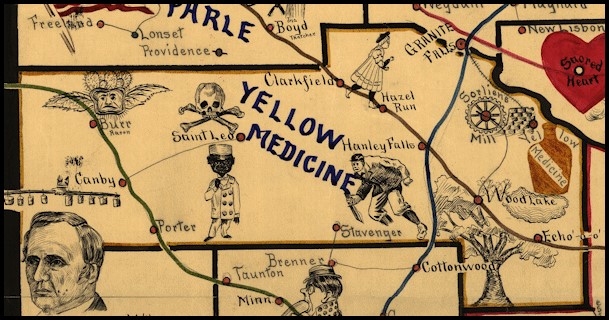
(above) 1898 Yellow Medicine County Railroad Map. Granite Falls and Sacred Heart are in the upper right hand corner.
On the following fateful Saturday, December 3, Theodora waited at the Granite Falls railway station (after a day of teaching) for a Chicago, Milwaukee and St. Paul Railway Company train to arrive to take her back to Sacred Heart. The train was probably running about a half hour late, pulling into the station around 3:30 or 4:00 p.m. and stopping to get water, load and unload baggage, and to take on passengers while others got off. While conflicting testimony exists in the court documents, it appears the following took place: Since it was likely her first time taking this train, Theodora accidentally began boarding the “Smoker,” the car for men. The brakeman notified her that she was getting on the wrong car and beckoned for her to board the next car, sometimes called the first-class car but usually referred to in the court documents as the “ladies car.” The baggage man and the express man probably saw her trying to board the first time and then failed to see her being told to enter a different car, since the conductor testified in a deposition that they told him it was all clear to proceed. As Theodora got on the steps, with the brakeman at the top of the steps into the car, the train began to move. Theodora lost her balance. The brakeman, probably in an effort to make sure she did not fall under the wheels of the train, but unable to fight gravity and pull her toward him, grabbed her by the arm and waist and tossed her away from the train back on the depot. Thrown in such a manner, and wearing an ankle-length skirt, it is virtually certain that she ended up falling awkwardly as the train continued down the tracks. Shaken but probably not immediately feeling the adverse effects of the fall, she took a freight train back to Sacred Heart that evening.
In her deposition for the case, Marie Lyders reported that when Theodora returned home she “looked sick and excited. She went to bed early, not long after coming home. She did not sleep in the night from pains, and from that day she grew worse and worse, she could not walk without a cane around the house and could not go out. She was confined to her bed two or three days as far as I remember at first, and from that time on she was confined to her bed a part of nearly every day, not coming from her bed until noon and some days not being able to at all. She was not able to go out of the house from this time on as long as she was with me.” With her condition not improving, the family took Theodora to Minneapolis in February of 1888 to be examined by a specialist. On March 1, 1888 Marie reported that Theodora was loaded on a sled, propped up by pillows so she could sit up, and driven 35 miles to Franklin to live with her brother C.G.V.
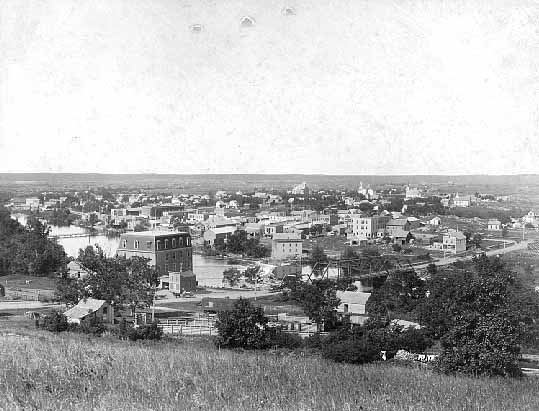
(above) Early postcard of Granite Falls, Minnesota
The Complaint filed by the plaintiff for her October, 1889 civil trial testified that Theodora had suffered injuries to her spine, her spinal cord, and to nerves emanating from the spinal cord, and “That by reason of said injuries so received as aforesaid, she has ever since said day been, and still is, suffering great pains of body and mind, and has become partly paralyzed; and plaintiff is informed and believes and so charges the fact to be, that said injuries so by her received are of a permanent nature, and that she will always be and remain sick, sore, paralyzed and lame, and that the same are incurable and permanent injuries.” For these reasons, as well as lost wages from being unable to teach music for almost two years and the specter of maybe never teaching again, Theodora sued the Chicago, Milwaukee and St. Paul Railway Company in a case that went to the U.S. Circuit Court in St. Paul Minnesota on October 1, 1889.
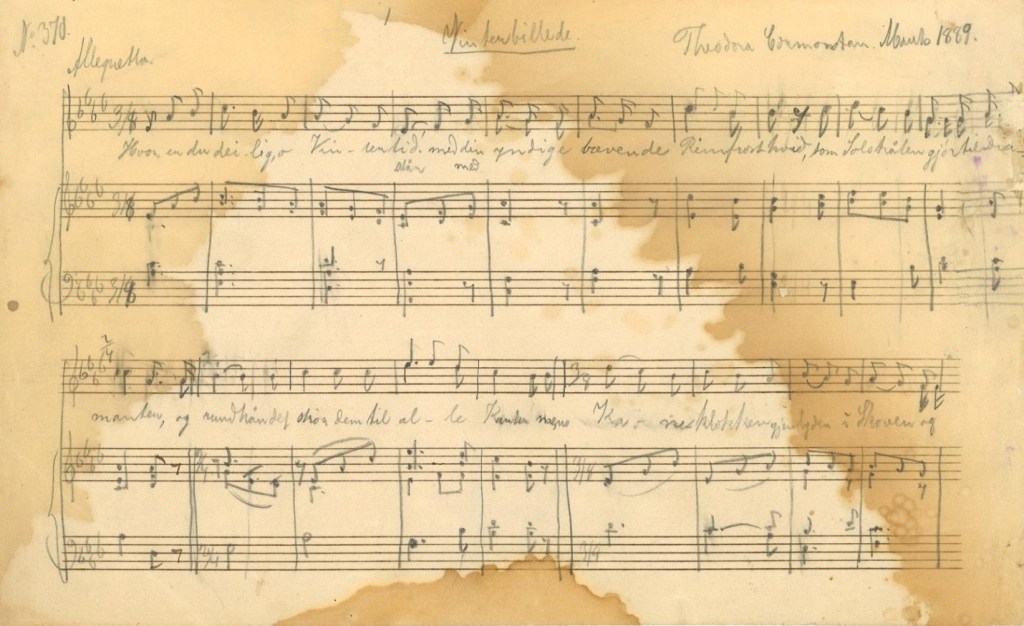
(above) “Vinterbillede” (Winter Scene), an incomplete composition from March 1889, the month Theodora learned her case was being removed from the District Court to the U.S. Circuit Court in St. Paul, Minnesota
This is how the St. Paul Daily Globe described the pending case on 6/4/1889, p. 2: “Theodora Cormonran [sic] has begun suit in the United States district court against the Chicago, Milwaukee & St. Paul Railroad company to recover $25,300 for personal injuries sustained while a passenger on the Milwaukee road. On Dec. 3, 1887, Miss Cormontan, then a school teacher, attempted to board a train at Sacred Heart, Minn., [she actually was in Granite Falls] and while so doing the train started up and threw her violently to the platform, permanently injuring her spine and nerves. She claims to be a permanent invalid and paralyzed, and asks $5,000 special damage for disability to pursue her profession and $20,000 for the injuries.”
After a jury of 12 men was selected for the trial, an interpreter for Theodora was sworn in. Theodora was likely somewhat fluent in English, but probably needed help to understand completely what was happening. Theodora was the only witness that first day, and her sister Eivinda (also with the aid of an interpreter) was the only witness the second day. C.G.V. Cormontan also testified for the plaintiff, as did Louisa Lyders, Dr. Jones (the specialist from Minneapolis), and Edward and Marie Lyders (via deposition, since Sacred Heart is over 100 miles from St. Paul). The defense took less than a day to present its case.
On Saturday, October 5, Eivinda was recalled to the stand for the plaintiff, as was Theodora on her own behalf. The attorneys summed up the case for their respective clients, and the jury was charged with determining a verdict. It apparently did not take the jury long to deliberate, since they reached a decision that same day. Since the next day was a Sunday, Theodora had to wait until Monday morning, October 7, to learn that the jury found in her favor and awarded her $5000 in damages.
It is unknown what long-term impact the injury had on Theodora. By 1892 we note through newspaper accounts that Theodora was playing a pump organ, directing choirs, and teaching music lessons in a neighboring town. Does this mean she completely recovered from her accident? That is doubtful. While there were reports of her singing in recital in 1887 before December 3, no reports have been found of her singing in public after that date. She could sit and execute her other professional activities, but she would want to stand as a singer. Joy S. Yakura writes in a 1996 report on spinal cord injuries in “American Rehabilitation” that “The greatest recovery occurs in the first 6 months following injury with a plateau in rate of recovery occurring at approximately 9 months post-injury.” It was almost two years after her accident that Theodora appeared in court, and her Complaint testified that she continued to experience pain and partial paralysis. It appears that for the rest of her life Theodora Cormontan endured some level of chronic pain and experienced significant mobility issues (at best, walking unaided with difficulty), and that with advancing age her condition deteriorated so that by the end of her life she was confined to a wheelchair.
We believe the following three pictures are of Theodora Cormontan. They were all taken at the Aase Haugen Home near Decorah, Iowa. The first was found in a picture album given to Rev. Otto Schmidt for Christmas in 1917, the year Theodora and her sister arrived at the Home. Written beneath the picture is the title “Cormontan sisters,” so we have a positive identification for this photograph. We clearly recognize Eivinda on the right, so it must be Theodora on the left. This picture documents that Theodora can still stand under her own power in the fall of 1917.
The second picture is taken on the front porch of the Home. The picture is unidentified, but after careful scrutiny we believe it is Theodora. We think this was taken later, around 1920. Here she is seated, and we may be able to see the handle of a cane behind the chair, perhaps indicating that Theodora’s mobility has declined since she entered the Home.
The picture on the bottom we believe is the last picture of Theodora–maybe taken the year she died–1922. There is also no identification with this picture, but we are virtually certain that Theodora is the woman in the wheelchair. Eivinda is standing directly behind Theodora. (Notice, for example, how Eivinda is holding her hands in front of her just as she does in the picture from 1917).
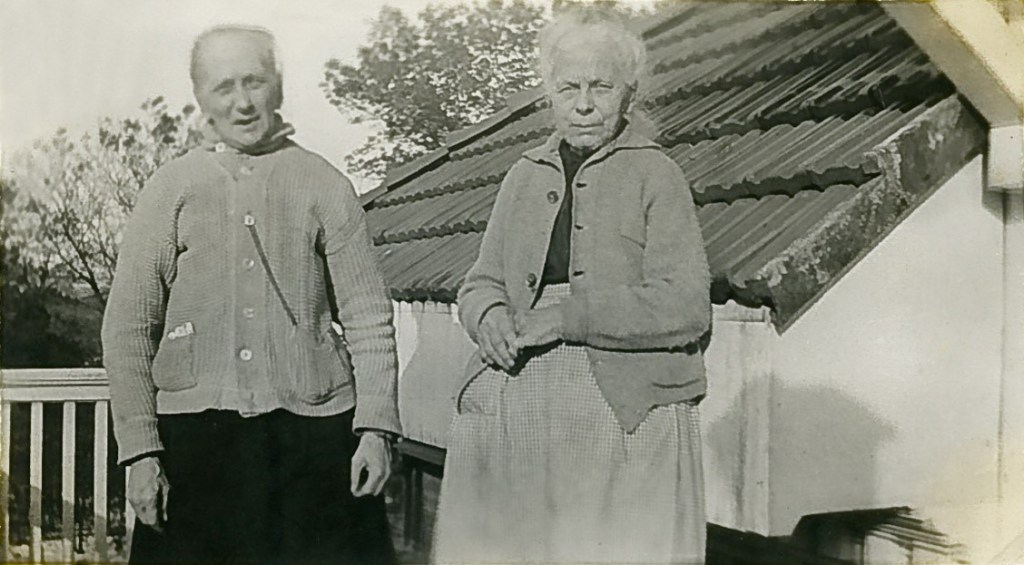
(above) Theodora and Eivinda in 1917 at the Aase Haugen Home
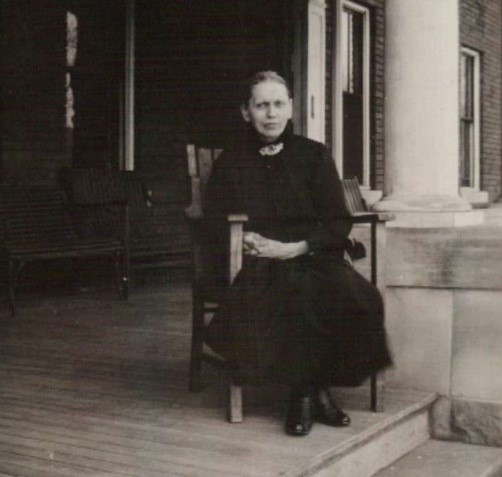
(above) Theodora around 1920
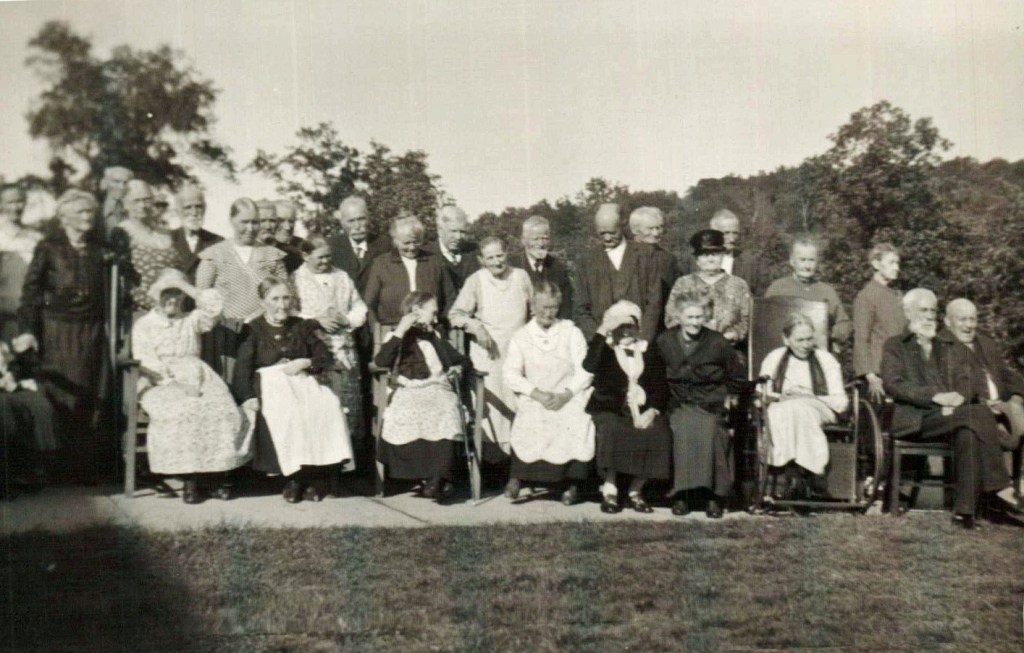
(above) Theodora in wheelchair, Eivinda behind her, possibly in 1922
The most extensive American newspaper report of the results of the trial (discovered so far) appears in the Minneapolis North, a Scandinavian newspaper written in English that began publication a few months before the trial. It reported: “A hotly contested personal injury case a few days ago was won by Mr. Jno. Arctander, whose client Miss Theodora Cormontan sued the Ch. Milw. & St. P.R.R. Co. for injuries received by being pushed from one of the trains of the defendant. The award was $5,000. Miss Cormontan, who is an accomplished musician, several compositions of her own having been published in Norway, is a daughter of the venerable Rev. Cormontan, now 91 years old and living with a son in Renville Co. Minn., since his arrival in this country from Norway about two years ago.”
An article of similar length appeared in the November 11, 1889 edition of the Stavanger Amtstidende og Adresseavis, a Norwegian newspaper. An electronic translation reads:
“5000 Dollars Damages. Miss Theodora Cormontan, daughter of former Provst Cormontan from Arendal, immigrated to America and, according to a Norwegian-American newspaper there, established a reputation as a fine musical talent. She settled in Sacred Heart [MN], where she quickly began teaching music lessons to many students. After she fell from a moving train, she received a back injury that resulted in few days when she could walk without a cane. On her behalf the Norwegian-born lawyer John W. Arctander brought action for damages against the railroad company, and after 8 days of litigation, the jury awarded Miss Cormontan the compensation of $5,000. A Norwegian who happened to be one of the jurymen was very happy that this showed how ‘smart’ American lawyers can quickly draw straws.”
I’m not sure what that last statement means, but the jurist was clearly pleased with the results.
This is how the Arendal paper Vestlandske Tidende covered the story in its November 7, 1889 edition [electronically translated]: “Many Norwegians from the old country remember Miss Theodora Cormontan, who was a star in Norway’s musical heavens and performed both as a pianist and singer. When her father, Provst Cormontan from Arendal, retired and immigrated to America to be with his daughter [Marie], Theodora accompanied him to Sacred Heart [Minnesota]. Her musical reputation preceded her, and after only 3 months she had many pupils. One day, however, when she was about to board a Chicago, Milwaukee and St Paul’s train, it started moving and she fell. At first she thought she had escaped with just a scare, but it turned out later that she had injured her back so that she could not walk without a cane. She then approached our talented compatriot, lawyer John W. Arctander, who took on her case. The case was brought before the U. S. Circuit Court in St. Paul and was prosecuted for 8 days. The railroad company, with three fine lawyers and fine paid doctors, did everything to escape justice. Every malicious legal trick was used, but Arctander, as usual, dealt with them successfully. He spoke to the jury with power and knew how to get the truth out of those opposing him and his client. The jury awarded Miss Cormontan a settlement of $5000.00. Mr. Arctander continues to win one victory after the other, and many poor countrymen can thank him for receiving justice over the rich corporations. One of the jurymen happened to be Norwegian. After the decision was handed down, he went to Arctander and shook his hand as he excitedly exclaimed ‘I am proud to be a Norwegian when I hear how a compatriot can measure up and defeat these ‘smart’ American lawyers.”
And here is how the case was reported in the November 15, 1889 edition of the Bergens Tidende, again electronically translated: “Miss Cormontan from Arendal, living in America, was traveling on the Chicago, Milwaukee and St. Paul Railroad, but as she was to step up into the coach, the train began to move and she fell. At first she assumed she had escaped injury, but it turned out later that she had injured her back, so that she could not walk without a cane. She turned to the attorney John W. Arctander, who brought a liability case against the railroad company. The case was heard by the U. S. Circuit Court in St. Paul and ran for 8 days. The railroad company, with its three lawyers and paid doctors as witnesses, did everything it could to win the case. The defense used all possible legal ploys but Arctander, as usual, was more than equal to every situation. He spoke with his usual vigor to the jury and they saw the truth he presented as opposed to the clearly biased defense. The jury awarded Miss Cormontan damages amounting to $5000.”
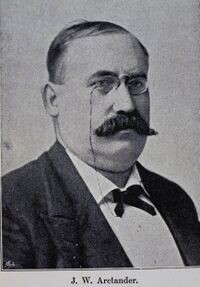
John William Arctander (1849-1920) was born in Sweden, received a university education in Norway, and immigrated to the United States in 1871. He relocated to Minnesota in 1874, and was admitted to the bar shortly thereafter. He set up shop in Minneapolis in 1880 and developed a large practice, especially in criminal law. In 1875 he wrote a handbook on the laws of Minnesota in Norwegian. Arctander Township of Kandiyohi County, Minnesota was organized in 1879 and named after him.
[The following items relating to the Cormontan and Lyders families appeared in the Renville, MN Weekly News]
6/6/1888: “Mr. [C.G.V.] Cormontan, of Franklin, is the guest of his sister Mrs. Lyders.”
7/11/1888: “Misses Inga Field and S. [Louisa?] Lyders will spend a couple days at Franklin and Beaver Falls this week.”
7/18/1888: “Misses Lyders and Field have returned from their visit to Franklin and Beaver Falls.”
8/8/1888: “Mr. [C.G.V.] Cormontan, formerly of this place but now of Franklin, greeted old friends here one day last week.”
9/5/1888: “Messrs. Monson, [Hans] Cormontan and Owens have taken the contract to repair the Lutheran church which was struck by lightning some time since.”
6/21/1889: “Dr. Lyders of Sacred Heart was a Franklin visitor the forepart of this week. C. V. Cormontan took a pleasure trip to St. Paul Thursday and returned Saturday.”
7/6/1889: “Mrs. Lyders has returned from her visit in Franklin.
Miss Louise Lyders is back from Minneapolis for a visit with her folks. She is studying music there.”
10/2/1889: “Misses Eivinda and Theodora Cormontan are in St. Paul attending court. Theodora Cormontan has brought suit against the Chicago, Milwaukee & St. Paul Railroad Company for damages on account of injuries received at Granite Falls about two years ago, when it is alleged she was pushed off the train by a brakeman.”
As noted in “The History of Franklin Minnesota 1880-1990” (compiled by Ruby Deming): “In March, 1888 a petition was granted for the incorporation of the Village of Franklin, which meant the forming of a government. The first election of city officials was held in May, 1888. The first meeting of the village council was held May 21, 1888.” C.G.V. Cormontan was one of three councilmen elected. The village council met in Cormontan’s drug store until 1890.
District Court Case
Cormontan vs. Chicago, Milwaukee & St. Paul Railway Company
Information On the District Civil Court Case of Theodora Cormontan vs. the Chicago, Milwaukee & St. Paul Railway Company (Feb.-March, 1889).
George A. Arctander, of the firm Arctander and Arctander, served the Summons and Complaint to the C, M, and SP Railroad Co. on 2/21/1889.
The Complaint, filed by Pierce, Arctander & Nickell, reported that on December 3, 1887, Theodora Cormontan had purchased a ticket from the railroad to travel from Granite Falls, MN to Sacred Heart, MN. Theodora was “by the defendant invited to board and go upon a certain passenger train of said defendant.” Then, after Theodora “had stepped on to the steps of one of the said coaches, but before she had reached the door of said coach, defendant well knowing that plaintiff was still ascending said steps, carelessly and negligently started said train of coaches with a violent jerk, causing the plaintiff to stagger and lose her hold on the railing attached to said steps and to lose her balance; and that the said defendant then and there by its agents and servants in charge of said train negligently, carelessly, unlawfully and violently pushed plaintiff off said train, while the same was in motion, and on to the depot platform; so that plaintiff, without any fault or negligence on her part whatsoever, fell down and struck the planks of said platform with great force and violence, and then and there . . . received serious injuries to her spine and her spinal chord [sic], and to the nerves emanating from said spinal chord. That by reason of said injuries so received as aforesaid, she has ever since said day been, and still is, suffering great pains of body and mind, and has become partly paralyzed; and plaintiff is informed and believes and so charges the fact to be, that said injuries so by her received are of a permanent nature, and that she will always be and remain sick, sore, paralyzed and lame, and that the same are incurable and permanent injuries.”
The Complaint indicates that Theodora had incurred $300 in medical bills. It then continued that at the time of the injury, December 3, 1887, “this plaintiff was a music teacher by profession, and was able to earn and did earn prior to said time of being injured, in her profession, the sum of Fifty Dollars per month. That by reason of said injuries plaintiff has been wholly prevented from attending to her duties as such music teacher, or to practice her profession at all; and she is informed and believes that she will for all time to come be prevented from earning anything, either in her said profession, or otherwise, to her damage in the sum of $5,000.” The complaint added an additional $20,000 request for damages, bringing the total demand against the defendant to $25,300 in addition to court costs.
W.H. Norris, representing the Defendant, presented an Answer to the Summons and Complaint on 2/27/1889. In the Answer, Norris contends that Theodora was “guilty of gross carelessness and negligence on her own part . . .” The accident was solely her fault because “she did not attempt to board said train while it was stationary at said depot and station for the purpose of receiving and discharging passengers, but did carelessly and negligently approach said train after the same had started therefrom, and carelessly, negligently and recklessly attempted to board the said train while it was in motion away from said station and depot; That while she was so attempting, another person, not in any manner a servant, or under the authority or control of this defendant, coming hastily out of and from said train, ran against and staggered the said Plaintiff, who was then and there consequently about to fall between and under the cars of said moving train, but was then and there caught and saved from so falling by one of the servants of this Defendant, employed upon said train, without any bodily injury whatever other or further than the slight shock or strain, if any, occasioned by the facts and circumstances hereinbefore alleged.”
On 2/27/1889 the Chicago, Milwaukee & St. Paul Railway Company offered Theodora Cormontan $500 to settle out of court. The offer was apparently rejected. On March 2, 1889, Judge William Lochren ordered the case removed from District Court to the Circuit Court of the United States for the District of Minnesota. The same Complaint and Answer used in the District Court case appeared in the Circuit Court. On October 7, 1889 a jury found in favor of Theodora Cormontan and awarded her $5,000 in damages.
(above) The building where Theodora Cormontan’s court case took place.
Circuit Court Transcript
Circuit Court Case Transcript
“U.S. Circuit Court Case for the District of Minnesota. Case D-630. Theodora Cormontan vs. The Chicago, Milwaukee and St. Paul Railway Company. Tuesday, October 1, 1889 to Monday, October 7, 1889.”
The Notary Public for Yellow Medicine County, State of Minnesota, took the depositions of E.O. Lyders (Edward, brother-in-law of Theodora), Mrs. E.O. Lyders (noted as Maria in the deposition but the correct spelling of her name is Marie, younger sister of Theodora), and A.H. Anderson (a witness to the incident). These witnesses supplied written depositions because they lived in Sacred Heart, more than 100 miles from the city of St. Paul. The three had been subpoenaed on March 26, 1889 by O.T. Ramsland. Haldor Larson was also listed to give his testimony, but there is no record of that in the file. It appears that Larson testified in court the following October. The depositions took place in the Notary Public’s office in Granite Falls on April 4, 1889. Jno. (John) Arctander represented the plaintiff. W.H. Norris was notified for the defense, but George C. Squires served as counsel for the defense that day. The law firm of Flandreau, Squires and Cutcheon represented the railroad company at the trial.
The following is a transcription of the deposition of Andrew H. Anderson. It is handwritten in cursive and not always legible. Anything inserted to clarify is placed in brackets [ ]. A few minor editorial changes are included to make the text easier to understand.
The Notary Public swore in Mr. Anderson and Mr. Arctander began the questioning.
Q What is your name, occupation, and residence?
A A.H. Anderson from the town of Hawk Creek, County of Renville, State of Minnesota.
Q Do you hold any office of public trust?
A County Commission’s and Constable.
Q Do you know plaintiff Theodora Cormontan?
A I do.
Q Did you see her on the third day of December, 1887? If so, at what place, about what time of day, and under what circumstances?
A I came from Montevideo on the third day of December on defendant’s passenger train to Granite Falls. The train was about one half hour late. As I came to Granite Falls the train of course stopped at the depot platform of Granite Falls station. I stood up [at the] front end of the ladies car as the train stopped and there I jumped off on to the platform and saw the plaintiff trying to get on to the front platform of the smoker and the brakeman beckoned her to come over to the next car and she did so. When she got there she got on the rear end of the smoker. She had one foot on the lower step and one foot on the second step of the car, and then the train started to move. Then the brakeman came and grabbed hold of her and tossed her back on the depot platform. I suppose he was a brakeman as he had a brakeman’s cap on, he acted as brakeman coming down on the train. He got hold of her in some shape or other and tossed her back onto the depot platform from the car.
Q How did she come down on the platform–with what speed and in what manner?
A Can’t say what speed but think she came down in a pretty gentle fair [?–text is illegible] way in one respect.
Q State whether she came down suddenly or not.
A Well, not so very quick, [?–illegible] pretty quick, not exactly as if she had been thrown off.
Q What did the train do?
A The train started off–went right along.
Q Did you go with the train?
A No, I got left.
Q Why did you get left?
A I got left because I was standing looking at her getting thrown off.
Q After the brakeman had put the plaintiff off did he say anything? If so, what was it?
(Objected to as incompetent, irrelevant and immaterial)
A He said to me “You can get on.”
Q What was plaintiff’s appearance immediately after this happened?
A Well, she looked to be excited.
Q To what extent?
A Couldn’t say to what extent.
Q How far were you away from and in what direction did you look when she stepped on to the car steps and when she was put as you have testified?
A I was about between two and three feet, couldn’t say which. I looked towards her.
Q State whether or no the train was in motion at the time that the plaintiff stepped from the depot platform on to the car steps.
A It was not.
Q State whether or no there was any one else on those steps of that car at the time that the plaintiff went on except the plaintiff and the brakeman.
A There was not.
Q Do you know anyone who was present at the depot platform at the time this happened near the source of the accident?
A I do, but don’t know the name of them.
Q Was Holdor Larson there?
A Yes, he was there.
Q Do you know whether or no he was sober or intoxicated at the time?
(Objected as incompetent, irrelevant and immaterial)
A He didn’t look like he was sober.
At this point the counsel for the defense begins questioning Anderson.
Q You say that plaintiff had got on to the steps of the car before it started, is that so?
A Yes sir.
Q How did the train start?
A It started like passenger trains usually start–it started quietly–there was no jerk about as far as I could see–I was not on it.
Q Did you see anything that made it necessary for the brakeman to take hold of the plaintiff?
A I did not.
Q Whereabouts did he take hold of her?
A Am not quite sure but think he took hold of her by one arm and around the waist.
Q How did she alight on the platform?
A On her feet.
Q At that time that she alighted on her feet on the platform was the brakeman supporting her with his arms?
A No sir.
Q Where was the brakeman when she alighted on the platform?
A He jumped on the front platform of the ladies car.
Q Then, as I understand you, she did not fall down on the platform at all?
A Not that I could see.
Q Where did she go after she got on the platform after the train started?
A I suppose she walked into the depot, I did not see her go in but found her there.
Q Why didn’t you see her if you were only two or three feet away?
A I was watching the train.
Q How long were you watching the train before you looked back to where she was?
A I can’t say how long.
Q But when you turned around she had gone into the depot, had she not?
A Yes sir, or had got there in some way.
Q Did you go from Granite Falls that same day with the plaintiff on a freight train to Sacred Heart?
A Yes I did. The passenger train arrived at Granite Falls between 3 and 4 o’clock in the afternoon and the freight train went to Sacred Heart in the evening of the same day.
Q Did the plaintiff complain of being hurt at all at the time she stepped off the passenger train or while you were on your way to Sacred Heart that evening?
A I didn’t talk with her on the freight train. She felt kind of bad in the depot at Granite Falls but she didn’t say much to me. We were not well acquainted; had only met once or twice.
Q Who did she talk with?
A She might have talked to a good many for all I know. There was lots in the depot.
Q Did you hear her talk to anyone in the depot at Granite Falls?
A To no one except me.
Q What did she say to you?
A She thought it was queer that they would throw her off in that way–wanted to know if I knew any reason for it.
Q But she didn’t complain of being hurt at all, did she?
A Not that I heard.
Q Do you remember of making a statement as to how this accident occurred in the month of May after it did occur [in other words, in May of 1888]?
A No sir, I do not.
Q Do you know Mr. Jno [John] McDonnell?
A I have seen him once before at my place.
Q About when was that?
A Am not sure of the time but think it must have been in July because I was hauling hay from a stack–probably it may have been in May.
Q Did you make a statement at that time of how this accident occurred?
A Yes I did, as close as I could get at it at that time, but he [McDonnell] came on to me pretty quick. I was busy and didn’t have time to think.
Q Did not Mr. McDonnell write down your statement and read it over to you after he had written it?
A Yes he did.
Q And did you not sign the statement after it had been read over to you then and there?
A Yes I did.
(Papers shown witness)
Q Is this the statement you signed and is this your signature?
A It is my signature and the statement is all right except one thing–which is that it says that the train started before plaintiff got on the steps and it should state “after she got on the steps.”
(The paper referred to by witness is now offered as part of his Cross Examination and is handwitnessed [?–the term is illegible] and marked Exhibit “A.” The language used in this paper may not be the same as used in [?–text is illegible] statement but its meaning is about the same)
Q As I understand you then this written statement contains a correct statement of what happened in the time of the accident except that you now think that the train was not moving at the time that she got on to the steps of the car?
A There is something more than that is wrong.
Q What else is then wrong about this written statement?
(Witness now reads the written statement again)
A The statement doesn’t say that she was on the steps, but says that she attempted to get on. I stated at the time I gave the statement that she was on the steps. It also says that the brakeman jumped on the near end of the hind coach. I said that he jumped on the front step of the ladies coach. And it also says that he took hold of her in a gentlemanly manner. I don’t think he did. It says that I could have seen if anything happened to her–something might have happened without my seeing it.
Q Excepting in these particulars which you have mentioned is this written statement correct?
A Well, as far as I know it is.
Q After you had made this statement to Mr. McDonnell in May 1888, when did you next talk about this accident and to whom?
A After making this statement I did not talk about it for a long time, until I had thought it further over, and at no time since I made this statement. I had not thought about it from the time of the accident.
Q Did you not at that time tell Mr. McDonnell that you had had a letter from the plaintiff’s attorney asking you to give a statement of the facts in the case?
A I don’t remember–I have so many letters–
Q When and with whom did you next talk about the accident after seeing Mr. McDonnell?
A I talked with a good many of my neighbors. I can’t say who was the first one.
Q Did you ever talk with the plaintiff about the accident since its occurrence?
A No, I did not. Haven’t seen her since that I know of.
Q When did you first talk with the plaintiff’s attorney about the accident?
A Today.
Q When if ever did you write to the plaintiff’s attorney about the accident?
A June 5th, 1888.
Q How did you come to write to him?
A He wrote to me about a statement as your fellow did and I wouldn’t do it. Thought there was no use in giving statements all around the world and get nothing for it. I had something else to do.
Re-Direct Examination
Q This written statement says amongst other things she stepped off the car on to the depot platform. State whether or no that is correct.
A She didn’t step off, the brakeman took and heaved [?–the word looks like “heaved” but is unclear] her back on to the platform. She didn’t do it herself.
Q Did you write this statement to the defendant yourself or is it your handwriting?
A No sir, I did not. He wrote it and read it to me.
Q Did you read it yourself before you signed it or at that time after you signed it?
A I don’t recollect whether I did or not.
Q What is your best impression as to whether you read it or not?
A My best recollection is that I did not read it.
Q When was the talk and where was the paper written?
A At my farm in front of the barn on a big rock.
Re-cross Examination
Q But you have read over the statement now carefully before giving your testimony in relation to it?
A Yes.
The following is a transcription of the statement that A.H. Anderson gave to Mr. McDonnell on May 5, 1888. It is marked as Exhibit “A.”
“I was at C M & St P depot at Granite Falls on Dec. 3, 1887. I saw Miss Cormontan when she attempted to get on board the passenger train going east. She first attempted to get on to forward end of Smoking car, the brakeman called to her to come to the next car which was the Ladies car. The train was moving at this time, but very slow, just so you could see it move. Breakman stood on the depot platform. She came back and attempted to get on rear end of Smoking car. The breakman took hold of her by the arm in a gentlemanly manner and she stepped off the car on to the depot platform. She was standing on the first step of the rear end of the Smoking car–she got frightened and stood still on the depot platform. The breakman jumped on to the hind car. The train was going slow at this time. The brakeman called to me and said you get on. I intended to go on the train but thought the train would stop for the lady to get on, but it did not. She did not fall and was injured in no way that I could see. I stood within three feet of her and could have seen if anything happened to her. I talked with her after the train pulled out. She did not say that she got hurt, but said that she got scared. I came back with her on a freight train the same evening. She did not say anything to me about being hurt. I do not think the lady was injured in any way and do not see how she could have been injured. This statement contains all I know about the matter. A.H. Anderson.”
The following is a transcription of the deposition of Mrs. E.O. Lyders, taken 4/4/1889. The Notary Public swore her in and Mr. Arctander began the questioning.
Q What is your full name, residence, and your relationship to plaintiff?
A Maria [her name is correctly spelled “Marie” but would have been pronounced “Maria” in Norwegian] J. Lyders. Sacred Heart, Minn. I am a sister to the plaintiff, Theodora Cormontan.
Q Do you remember the day she was hurt at Granite Falls?
A December 3rd, 1887.
Q Where did she live at the time?
A At my house.
Q How long had she lived in your house prior to the 3rd day of Dec., 1887?
A From the first day of June, 1887. [It appears that this date is inaccurate. The Norwegian newspaper Stavanger Amtstidende og Adresseavis wrote the following (computer translated to English) in its June 2, 1887 edition: “Emigration. The Thingvalla steamship Hekla departed Friday evening from Christiansand to New York with 930 emigrants, including women and children. Of this number 535 (235 Swedes and 300 Danes) boarded in Copenhagen, 275 in Christiania and about 120 in Christiansand. Among the Christiansand passengers were old Provst Cormontan from Arendal and his two daughters.” June 2 was a Thursday in 1887, so it appears the Hekla sailed on Friday, May 27. This would make it impossible for the three Cormontans to have arrived in Sacred Heart, MN by June 1. Perhaps Maria (Marie) meant July 1 or late June. Theodora is first mentioned in the August 20, 1887 edition of the Granite Falls Tribune, so she clearly arrived in Sacred Heart in the summer of 1887.]
Q And how long did she continue to live with you?
A To the first of March, 1888.
Q What was the state of her health prior to the 3rd of Dec., 1887 while she lived with you?
A Good.
Q State whether or no she had or not during the time she lived with you been sick in any way.
A No sir. She could and did walk from three to five miles a day.
Q Were you at home when she came home on the evening of Dec. 3, 1887 [the document actually says 1888 here] and if so what was her condition then and what was it after then during the time she lived at your house?
A She came home in the evening after the light was lighted and looked sick and excited. She went to bed early, not long after coming home. She did not sleep in the night from pains, and from that day she grew worse and worse, she could not walk without a cane around the house and could not go out. She was confined to her bed two or three days as far as I remember at first, and from that time on she was confined to her bed a part of nearly every day, not coming from her bed until noon and some days not being able to at all. She was not able to go out of the house from this time on as long as she was with me.
Q Why did she use a cane in walking?
A She could not walk without using the cane before her to lean on. Her [?–an illegible word is omitted here] grew worse and worse until she left my house.
Q What was her business at the time she got hurt?
A Music teacher.
Q Do you know whether or no she had a large class at the time?
A I know she had several pupils.
Q Do you know whether she could give any lessons after being hurt?
A No, she could not.
Q Where has she been since March first, 1888?
A With her brother in Franklin.
Cross Examination
Q What physician did the plaintiff have while with you?
A Not any until we took her to Minneapolis in February to Dr. Jones.
Q How long was she under Dr. Jones’ care?
A I don’t know.
Q How long were you in Minneapolis with the plaintiff under Dr. Jones’ care?
A Seven or eight days.
Q Did Dr. Jones visit her at your house before she left?
A No sir.
Q Did she go from your house to Franklin?
A Yes, she went in a sled. We had to carry her in the sled. Franklin is 35 miles from my house. We had to put pillows around her so she could sit up.
Q How did she happen to go from your house to live with her brother?
A To live with him.
[Then the Notary Public swore in E.O. Lyders for a brief deposition.]
Q What is your business and place of residence?
A Druggist and I live at Sacred Heart, Minnesota and am a husband of the last witness.
Q What was the general state of health of plaintiff while she lived at your house up to the third day of Dec., 1887?
A Good. She had not been sick or ailing at all during that time.
Pierce, Arctander and Nickell, attorneys for the plaintiff, presented a Notice of Trial to W.H. Norris, attorney for the defense, on May 29, 1889. The trial was originally scheduled to begin on June 11, 1889. It actually began on October 1, 1889.
The following deposition was taken on September 18, 1889. It contains the testimony of defense witness Peter T. Waters by Notary Public F.W. Root. The defense and the plaintiff were represented by the attorneys that represented them in the subsequent trial. While he provided a deposition, it appears that Mr. Waters also testified at the trial.
Q What is your name?
A Peter T. Waters.
Q You reside where?
A In Minneapolis, Minnesota.
Q You were the conductor of a passenger train on the Hastings and Dakota division of the defendant’s railroad on December 3, 1887?
A I was running a passenger train about that time.
Q On the arrival of that train at Granite Falls on December 3, 1887, at about one thirty o’clock p. m., did you make a stop at Granite Falls?
A Yes, sir; we always stop there for water and at the station.
Q Did you make the usual stop at Granite Falls at that time?
A I would not say as to that–sometimes it was necessary to stop longer than others.
Q You stopped at Granite Falls that day?
A Oh, certainly.
Q You stopped and unloaded baggage and loaded baggage and express?
A Yes, sir.
Q After that had been done, did you look up and down the platform to see that everything was ready to give the signal to go ahead?
Objected to as leading. Question withdrawn.
Q What did you do after you had made the stop there on this day?
A After we stopped, I got off the baggage car and walked along the platform and stood there a minute or two, and asked the baggage man if he was ready, and he said “Yes,” and I suppose I asked the Express man the same thing, and his answer was “Yes,” and after calling “All aboard” twice, I gave the signal to the engineer to go ahead.
Q Before giving that signal, did you look up and down the platform?
Objected to as leading.
A Yes, sir.
Q Was the train clear before you gave the order to go ahead?
A Yes, sir.
Q At that time you gave the order to go ahead, was there anybody getting on or off the train?
A There was not.
Cross examination.
Q Where were you in reference to the engine when you gave the signal at this particular time?
A Right near the baggage car–the second car from the engine. The mail and express car is the first car–the baggage car is separate. First express and mail, then baggage car, then the smoker, and then the first-class car–and I stood up at the head end of the baggage car–the end nearest to the engine–when I gave the signal.
Q Did you stand at this same place from the time the train stopped till you gave the signal?
A I came off the hind end of the baggage car and then went to the front end.
Q Before giving the signal you did not go back to the other cars?
A No, sir. I just asked the baggage man if he was all ready, and he said “Yes.”
Q Have you any distinct recollection of what took place on this 3rd day of December, except just as usual?
A No, sir; I have no more distinct recollection of what took place there at Granite Falls on that day than on any other day.
Q When you testified, then, in regard to what you did and under what circumstances you started the train, you meant only to say, what you usually did?
A I know what I did.
Q Do you know what you did that particular day?
A I remember distinctly what I did, because my brakeman called my attention to the occurrence. The brakeman told me about a lady’s falling off the platform.
Q You did not see anything what took place there at that time?
A No, sir.
Q Then you don’t know, of your own knowledge, whether this lady attempted to board this train before or after it started?
A No, sir.
Q When you gave the signal–
A No, sir.
Q Now, from where you stood when you gave your signal, at the front end of the baggage car, could you see down the platform?
A Yes, sir.
Q Could you see on to the platform of the ladies car from where you stood?
A No, sir, not the rear platform.
Q Could you see the front platform?
A Yes, sir.
Q How far from the platform of the baggage car did you stand on the depot platform?
A I couldn’t tell–it might have been four, five or six feet.
Q Do you remember distinctly about it?
A No, sir.
Q Do you remember seeing a lady on that day attempting to board the front end of the smoker, and you told her to go down and go to the hind car?
A Yes, sir, I recollect that.
Q That was while you were standing still, wasn’t it?
A Yes, sir.
Q And that was before the train was started?
A Certainly.
Q How long after that before you started the train?
A I couldn’t tell.
Q After you had told this lady to go to the further car, she came down the platform of the smoker and went down towards the platform of the first class car?
A I don’t remember.
Q You don’t remember whether this lady went back or not?
A No, sir.
Q Do you know the plaintiff in this action when you see her?
A No, sir.
Q You don’t know, from your own knowledge, whether or not this woman was on the steps going up to the platform of the car when you gave the signal to start?
A No, sir.
Redirect.
Q You say you were standing anywhere from five to six feet back from the train on the depot platform when you gave the signal?
A It might have been–probably not so far.
Q And you looked up to see if the train was clear of passengers before you gave the signal to move?
A Certainly, there was time if she got in.
Q And all you know about the occurrence was what the brakeman stated to you after the train had got some distance beyond Granite Falls station?
A Yes, sir–pretty near to Minnesota Falls.
Q I understand you to say, in answer to the question of plaintiff’s counsel, that the brakeman said that the woman didn’t fall?
Objected to as incompetent, immaterial and irrelevant.
A Yes, sir; that is what the brakeman told me.
Re- Cross Examination.
Q That train going east that day was considerably late, wasn’t it?
A I don’t remember anything about whether it was late or not.
On September 18, 1889, George Arctander traveled to Franklin, Minnesota and served subpoenas to C.G.V. Cormontan and Eivinda Cormontan, brother and sister of Theodora Cormontan. The next day in Minneapolis he subpoenaed Dr. J.T. Moore and Dr. W.A. Jones. Dr. Jones saw Theodora regarding her injuries in Feb. of 1888. Dr. Moore and Dr. Jones appear to have been associates at St. Barnabas Hospital in Minneapolis as noted on p. 158 of the Medical Standard from 1891. Also on the 19th, Jno. Arctander served a subpoena to John P. Flaten (this person is unknown, but was likely a witness) in Dennison, Minnesota. The next day in Minneapolis he served subpoenas to Geo. A. Arctander (an attorney for the plaintiff–perhaps he was also a witness) and Louisa Lyders (daughter of Theodora’s sister Marie).
The following is a transcription of the term minutes for the trial. Editorial comments are in brackets.
United States Circuit Court, for the District of Minnesota. Term Minutes, June Term. A. D. 1889. Oct. 1, 1889. D Law 630. Theodora Cormanton [sic] vs. Chicago, Milwaukee & St. Paul Railway Company.
Hon. R. R. Nelson, Judge
This cause being regularly called for trial the plaintiff appears by her attorney John W. Arctander. And the defendant by its attorneys Flandrau, Squires and Cutcheon. Thereupon upon motion of plaintiff’s said attorney it is ordered that a jury come to-wit; Frank Ayd [another document in the file notes the place of residence of each juror. Mr. Ayd was from St. Paul], Wm. Leip [White Bear], Cyrus Smith [Clearwater], E.H. Judson [St. Paul], Aljer Rines [Princeton], Henry C. Taylor [Lakeland], P.H. Weiss [St. Paul], Oscar Tourson [Castle Rock], W.S. Crawford [Morristown], J.W. Eastman [Minneapolis], Henry Smith [St. Paul], and George R. Holmes [St. Paul], twelve good and lawful men who are duly sworn to try the issues joined herein.
And the trial of the same is proceeded with as follows;
John W. Arctander opens the case for the plaintiff.
C. Bolenback is sworn and examined on behalf of the plaintiff. [This is probably the interpreter hired for the first day of the trial. This person is referred to as “Baumback” in other documents in the case file].
Theodora Cormontan sworn and examined through the interpreter on her own behalf.
And the trial of said cause not being concluded at the hour of adjournment it is ordered that further proceedings herein be and they are hereby postponed until tomorrow morning at 10 o’clock.
October 2, 1889
This day again come the parties herein by their respective attorneys and the jury sworn to try this cause. There upon the further trial of the same is proceeded with as follows, to-wit;
Gert Gjertson is sworn as interpreter.
Eivinda Cormontan is sworn and examined through the interpreter on behalf of the plaintiff.
And the trial of said cause not being concluded at the hour of adjournment it is ordered that further proceedings herein be and they are hereby postponed until tomorrow morning at 10 o’clock.
October 3, 1889
This day again come the parties herein by their respective attorneys and the jury sworn to try this cause. There upon the further trial of the same is proceeded with as follows, to-wit;
John B. Flaten sworn and examined for plaintiff.
Geo. A. Arctander sworn and examined for plaintiff.
C.G.V. Cormontan sworn and examined for plaintiff.
Dr. W.A. Jones sworn and examined for plaintiff.
Louisa Lerdero sworn and examined for plaintiff.
Dr. J.T. Moore sworn and examined for plaintiff.
And the trial of said cause not being concluded at the hour of adjournment it is ordered that further proceedings herein be and they are hereby postponed until tomorrow morning at 10 o’clock.
October 4, 1889
This day again come the parties herein by their respective attorneys and the jury sworn to try this cause. There upon the further trial of the same is proceeded with as follows, to-wit;
O. Quereman sworn and examined for plaintiff.
J.A. Berkey sworn and examined for plaintiff.
And here the plaintiff rests.
Thereupon C.E. Flandrau opens the case for defendant.
C.A. Sibley sworn and examined for the defendant.
J. A. Weaver sworn and examined for the defendant.
P.H. White sworn and examined for the defendant.
H. Larson sworn and examined for the defendant.
Ernest Gilmore sworn and examined for the defendant.
Thomas Kemp sworn and examined for the defendant.
John Blake sworn and examined for the defendant.
W.K. Hopkins sworn and examined for the defendant.
Miss Carrie Peterson sworn and examined for the defendant.
Dr. J.A. Stone sworn and examined for the defendant.
Dr. C.E. Riggs sworn and examined for the defendant.
And here the defendant rests.
And the trial of said cause not being concluded at the hour of adjournment it is ordered that further proceedings herein be and they are hereby postponed until tomorrow morning at 10 o’clock.
October 5, 1889
This day again come the parties herein by their respective attorneys and the jury sworn to try this cause. There upon the further trial of the same is proceeded with as follows, to-wit;
Eivinda Cormontan recalled and examined on behalf of plaintiff.
Theodora Cormontan recalled and examined on her own behalf.
And here both parties rest.
C.E. Flandrau sums up for the defendant.
J.W. Arctander sums up for the plaintiff.
The court instructs the jury and they retire to consider of their verdict with the instructions that if they agree upon a verdict before the incoming of Court Monday [the next day being Sunday] they shall place the same under seal and return it into Court by their Foreman.
[The following is a transcript of the defendant’s requests to charge to the jury before their deliberation. All three charges were delivered to the jury]:
1st. The plaintiff cannot recover in this action unless the jury find from the evidence that the defendant was guilty of some negligence which was the cause of the plaintiff’s injuries.
2nd. The plaintiff cannot recover in this action if the jury find from the evidence that the plaintiff was guilty of any negligence which contributed to the infliction of any injury which she may have received.
3rd. If the jury find from the evidence that the plaintiff attempted to get upon the train when the same was in motion, and such attempt in any way contributed to produce her injuries, she cannot recover and your verdict must be for the defendant.
Continuation of Term Minutes. October 7, 1889
This day come the parties herein by their respective attorneys, and the jury in this cause having been heretofore instructed by the Court and retired to consider of their verdict, now after due consultation concerning the same and being fully advised in the premises, they find and return into court by their foreman their sealed verdict in the words and figures as follows, to-wit;
“We the jury in the action of Theodora Cormontan, plaintiff, vs. the Chicago, Milwaukee and St. Paul Railway Company, defendant, find for the plaintiff in the sum of Five thousand dollars ($5,000.00). John W. Eastman, Foreman, Oct. 5, 1889.” [Note that it appears the jury reached its verdict in the time remaining on the previous Saturday–October 5–after Eivinda and Theodora had been recalled and both attorneys had presented their summations.]
It is therefore considered ordered and adjudged by the court that the above named plaintiff do have and recover of and from the above named defendant the aforesaid sum of Five thousand dollars ($5000) so found to be due by the jury besides her costs and disbursements herein to be taxed, and that she have execution therefor. Thereupon, upon motion of defendant’s attorneys it is ordered that execution herein be and it is hereby stayed for a period of forty-two days with leave to present a motion for a new trial.
Post Trial
The defense did not ask for a new trial but they did challenge some of the court costs charged to them, including fees charged for mileage for the interpreters, some charges related to the depositions taken for the plaintiff, and the cost of a drawing used to illustrate a point for the plaintiff. This last objection was allowed.
The defendant was left to pay for the clerk’s fees, the notary fees, and all the witness fees for the plaintiff. Eivinda and C.G.V. Cormontan were both given credit for devoting 16 days to the trial and for traveling 210 miles. Witness John P. Flaten also was credited for 16 days. Louisa Lyders was credited for 14 days and 20 miles (she was 18 and attending school in Minneapolis at the time); and Drs. Jones and Moore, as well as Geo. Arctander, for 12 days. Other witnesses required fewer days, with A.H. Anderson, E.O. Lyders, and Marie Lyders all credited with one day for their depositions. Including the fees for the interpreters, docket fees, and the fees related to the depositions, the total cost was $311.85. It appears the final bill, including the principal and interest as well as all fees, came to $5535.57, and was paid in full by The Chicago, Milwaukee and St. Paul Railway Company on Nov. 21, 1889.
Fort Ridgely And Dale Book
Ft. Ridgely and Dale Ministerial Book: 1883-1929
Information regarding Theodora Cormontan’s activity is documented in local newspapers in 1887, and her trial received coverage in some Twin Cities newspapers in 1889. Reports on her activity may also be found in the Morton, Minnesota paper and other newspapers in south central Minnesota starting in 1891.
For the years between 1888 and 1891, however, the main source of information we have located is in the Ft. Ridgely and Dale Ministerial Book, 1883-1929, currently archived at Central Lutheran Church between Franklin, Minnesota and Fairfax, Minnesota. We had the opportunity to look at this document in September, 2011, and scanned pages where we found the name “Cormontan.” A microfilm copy of the book, as well as minutes of meetings from the Ft. Ridgely and Dale Church, are located at the Minnesota Historical Society, microfilm reel M678 53 [ALC 138].
Most of the entries appear to have been made by Reverend Nils P. Xavier, the first resident pastor of Fort Ridgely and Dale church, who served there from 7/31/1876 until 5/12/1891. Born in Kautokeino, Finnmark, Norway in 1839, Reverend Xavier immigrated to the United States with his wife Amanda and their three young children in 1873. After 1891 he served congregations in Iowa and Washington. Reverend Parelius H. Rognlie followed Reverend Xavier and served from 7/22/1891 until the fall of 1928. Rognlie was born near Trondheim, Norway in 1858 and graduated from Luther Theological Seminary in 1891.
The Ministerial Book indicates that C.G.V. Cormontan (Theodora’s brother) joined the church on August 15, 1886. Her father (Provst Even Cormontan), her older sister Eivinda, and Theodora joined on October 27, 1887. This appears to be corroborated by a newspaper article in the Renville News Weekly from November 18, 1887, stating that Provst Cormontan and his two daughters had returned to Sacred Heart (where they were staying temporarily with Theodora’s younger sister Marie) after a week’s visit to Franklin. Marie and Theodora’s brother Hans also joined the church at a later date. (see below)
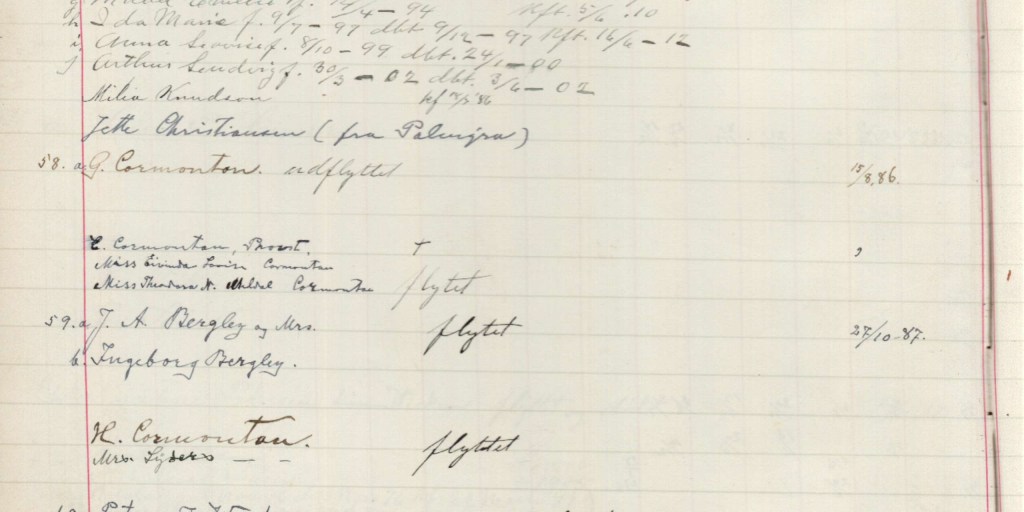
Fort Ridgely and Dale Ministerial Book
On one of the first pages we find that C.G.V. served as an officer in the church. The minutes from the Dale Church (Ft. Ridgely and Dale were technically two churches, though they shared a worship space and pastor) confirm that C.G.V. served as secretary in 1886-1887 as well as several years as treasurer, beginning in 1889. (see below)
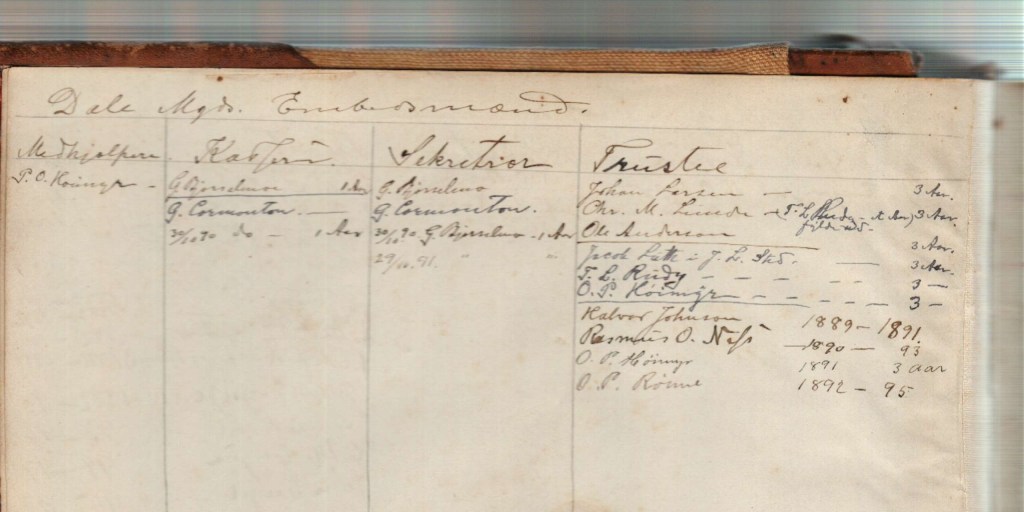
On several pages we find the names of members of the Cormontan family. In one entry it appears Hans was the godfather for a baptism: “Døbte fadderes.” On another page with the heading “Fordscestede” (“When they were buried”) we see Rev. Cormontan’s burial noted.
July 15, 1886: The first mention of Rev. Xavier writing about “Apotheker Cormontan I Franklin” (Pharmacist Cormontan from Franklin).
November 6, 1887: Rev. Xavier mentions 89 year old Provst Cormontan. Xavier discusses the sermon the Provst gave on 11/1/1887 at Ft. Ridgely and Dale Church on John 14:27. (This passage of scripture is also mentioned by Rev. Parelius Rognlie in his article about Provst Cormontan’s All Saints Day sermon that Rognlie wrote in 1893). Xavier mentions that Cormontan is from Arendal.
April 3, 1888 (see below): Rev. Xavier calls on the house of old (“gamle”) Provst Cormontan and “Miss Dora” Cormontan. He shares Holy Communion with them. He writes “My wish has been fulfilled—God keeps His promises—thanks to God!” (“Gud ske lov!”). April 3 would have been a little over a month after Theodora arrived in Franklin from Sacred Heart (on approximately 3/1/1888).
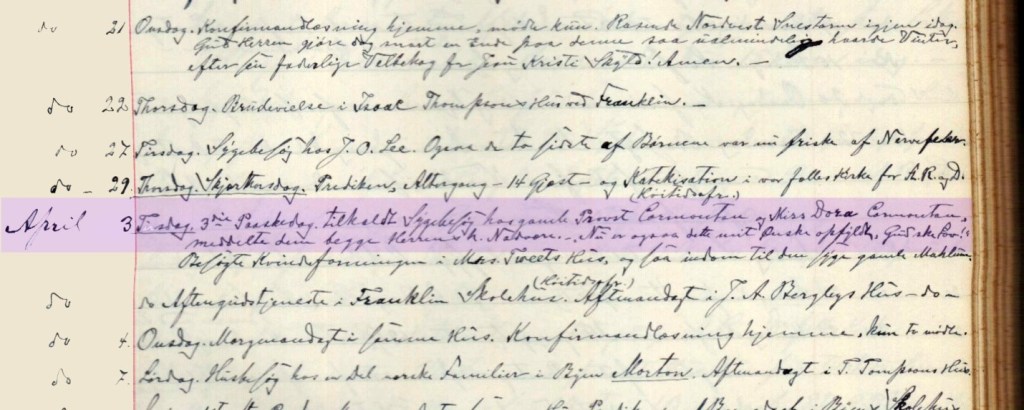
December 5, 1888: It appears the pastor visited Provst Cormontan and gave Holy Communion to his daughter Theodora and to him. April 23, 1889 (see below): Rev. Xavier visits Provst Cormontan and daughter Theodora. The adjective before “Datter” appears to be “sygelige,” or “sickly” in Danish/Norwegian.
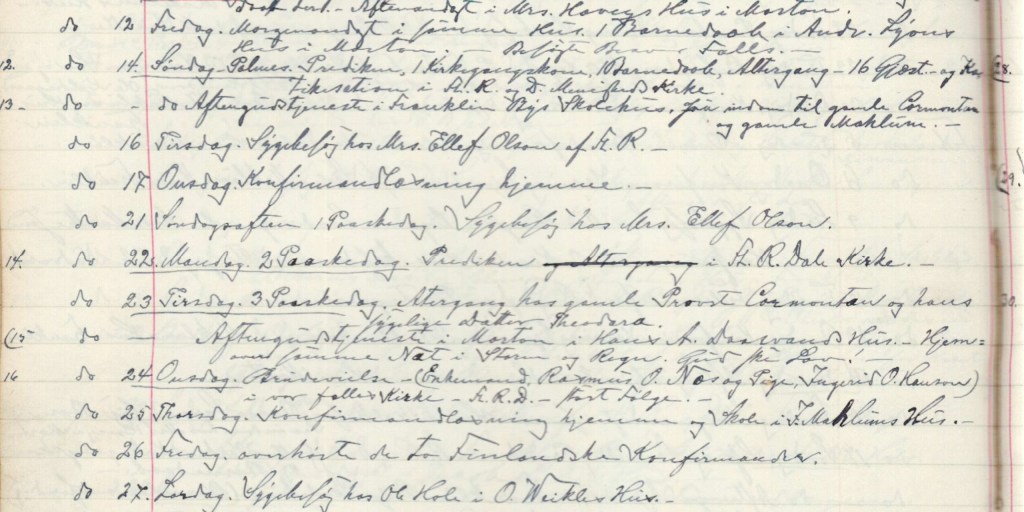
March 6, 1890: Rev. Xavier notes a visit to “almost 92 year old” Provst Cormontan and “Datter Theodora” and gives communion to the whole family. At the end of the entry the pastor writes “Gud velsigne i Jesu Navn”–“God bless in Jesus’ Name!”
August 8, 1890: It appears the Reverend visited Provst Cormontan and gave Holy Communion to all the members of the household. At the end of the entry Pastor Xavier writes “May the communion bring God’s blessing on the old Provst and on the hearts of his children.”
January 6, 1891 (see below): Rev. Xavier notes a Women’s Association/Ladies Aid meeting at the Cormontan residence that the pastor attended. (“Kvindeforeningen”: Women’s Association).
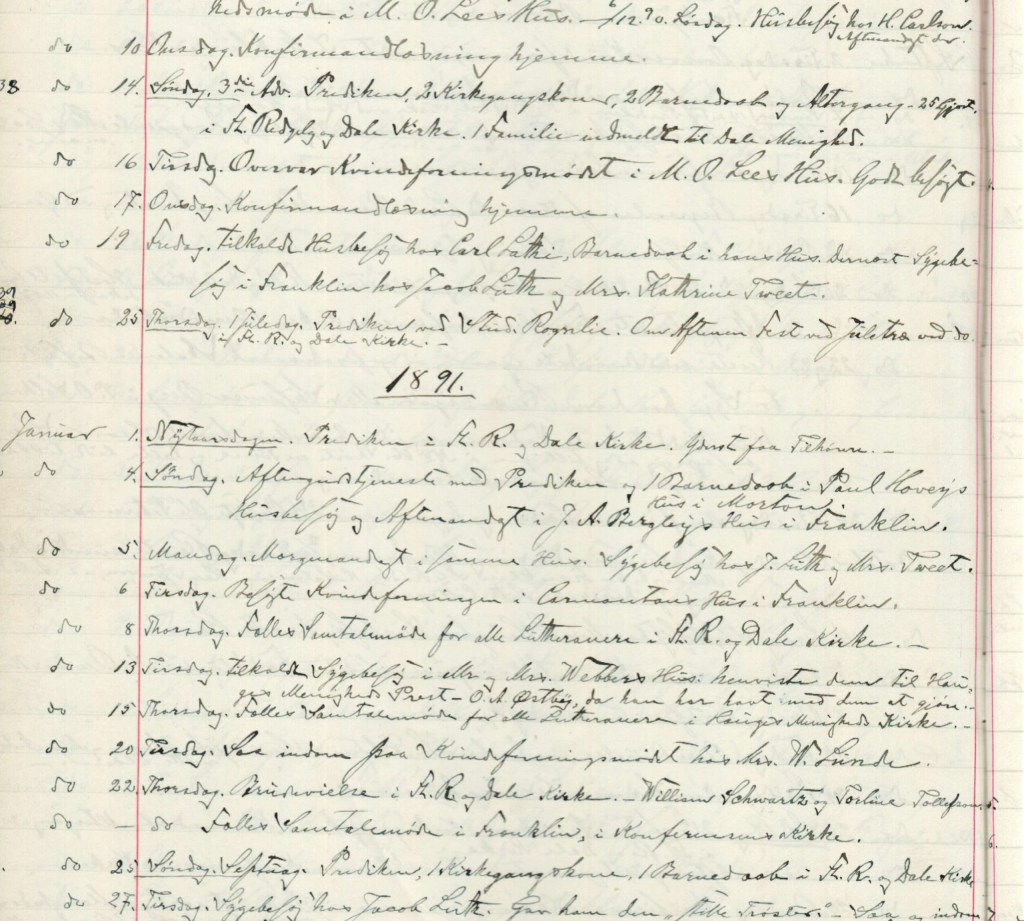
April 9, 1891: This entry is hard to read. It looks like all the members of the family are present and receive communion. The note ends with “God’s blessings!”
April 23, 1892: It appears Reverend Parelius H. Rognlie (who followed Reverend Xavier at Ft. Ridgely and Dale Church) is making a “sick call” to Provst Cormontan. Reverend Rognlie served from 7/22/1891 until the fall of 1928.
February 21, 1893: Contains a reference to Provst Cormontan’s burial.
Title page of records (see below). This is the title page of the “Ministerial Book for Ft. Ridgely and Dale Norwegian Evangelical Lutheran Church. Begyndt (began) Jan. 1, 1883-1929.”
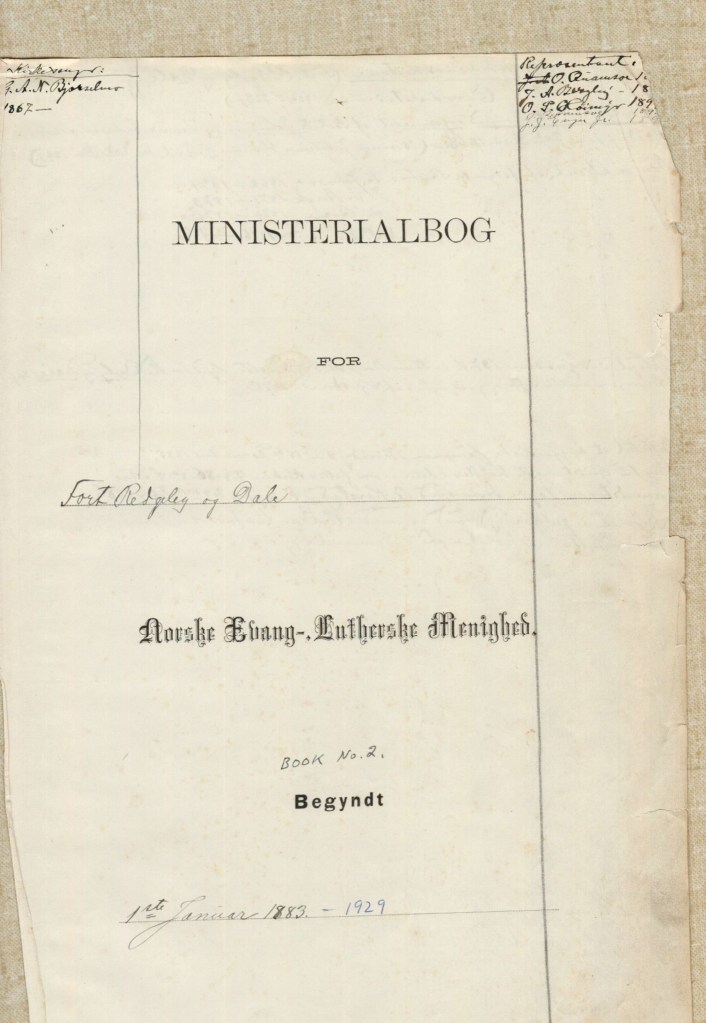
The following are selected entries from Dale Church minutes between 1886-1899. These minutes may be found at the Minnesota Historical Society, microfilm reel M67853 [ALC 138]. Each entry below starts with the page number:
P87: May, 1886. Along with another man, G. (Gottfred–C.G.V.) Cormontan is elected to examine the accounting records for the church and to report their findings at a later meeting. In other business that day the committee agreed to accept the offer of Johannes Enger to do interior work on the church provided the church supply the materials needed and give him a contract for his work.
P90: “G. Cormontan valgtes til sekretær . . .” (“G. Cormotnan elected secretary . . .” ) on 10/27/1886.
In a meeting dated March 14, 1887: Ole Quamso and G. Cormontan are elected to review some aspect of church business and report the outcome of their review at a future meeting. G. Cormontan is the secretary of this meeting.
P93: A. Norum is noted as Secretary in a meeting on 4/14/1887.
P100: 5/2/1889. G. Cormontan holds the position of “kasserer” (treasurer). The committee voted for two people to attend the Synod meeting and that each man be given 50 cents for traveling expenses.
P106: 10/29/1891. The first mention I find of Rev. Parelius Rognlie. C.G.V. Cormontan appears to continue as treasurer.
P108: 10/27/1892. C.G.V. Cormontan continues as treasurer. The church appears at this time to typically have two business meetings a year; one in October and one in May.
P109: 5/3/1892. The first mention of “Miss Cormontan” named to “spille orgelet” (“play the organ”). She is also referred to as “Organist.” The Cormontans secured an organ for the church in January of 1892, so it is probable that the church did not have an organ before that, making her the first organist for the church. At this meeting the committee began negotiations regarding what compensation an organist should receive, but they did not finish that day and moved to continue the discussion at the next meeting.
P112: 5/2/1893. Hans Cormontan is mentioned in the minutes, as is “Organist Fröken (Miss) Cormontan.” It appears that Hans was unanimously approved to join the congregation. News articles from the period and the 1895 Minnesota Census corroborate that Hans stayed for a time in Sacred Heart after Even, Eivinda, and Theodora joined C.G.V. in Franklin.
P113: 5/1/1893 (date unclear). G. Cormontan is no longer treasurer.
P114: 5/1/1893. The congregation asks Theodora Cormontan to again serve the combined congregations as Organist for an annual salary of $25.00. The committee also decided to purchase one Lindeman Choral Book and that this piece of church property would be in the possession of the organist.
P116: 10/26/1893: G. Cormontan resumes the role of treasurer.
P117: Probably still 10/26/1893, but hard to read. Hans Cormontan is mentioned in the minutes. It appears he may have been named as a congregational representative to the synod.
P118: 5/7/1895. There appears to be a new treasurer. T. Cormontan continues as organist.
P119: 10/31/1895. G. Cormontan is mentioned, perhaps as treasurer, but text is too light to read.
P121: 5/6/96. “Mis. T. Cormontan” is Organist. G. Cormontan is not treasurer.
P122: 11/6/1896. G. Cormontan is given some responsibility to the Bandon District. Bandon Township is located just north of Camp Township, where the church is located.
P124: 5/4/1897. G. Cormontan is named to some position (“revisener”–I can’t read the word) along with L. Enger. Perhaps the word is “revisioner,” meaning “revision.” Maybe these men were charged with some kind of revision work, perhaps revising the governing documents of the congregation.
P126: 5/3/1898. G. Cormontan, L. Enger, and Theodora Cormontan are named to continue in the same positions as the previous year.
P128: 12/15/1898. Hans Cormontan is named as a member of a three-person committee to join with a committee from the Ft. Ridgely church to determine what improvements to the parsonage were necessary. Church meetings appear to have increased to about four times a year.
P129: 2/20/1899. It appears Gjetta Havolin becomes the new organist. This seems to be a fairly sudden, mid-church year replacement. It corresponds with the date that C.G.V. Cormontan sold his drug store, and seems to indicate that this was a rather sudden decision.
Citing another source with salient information:
The “Ottende ordentlige Synodemøde” (“Report on the 8th special Synod meeting”) for the Minnesota District of the Norwegian Evangelical Church in America (published in Decorah, Iowa) noted that G. Cormontan attended as a guest representing the Dale Church. The meeting took place in Sacred Heart, MN on May 30-June 5, 1888.
Franklin Minnesota 1891-1895
Starting in 1891, local newspapers begin to provide a surprisingly detailed picture of the activities of the Cormontan family in Franklin, Minnesota, including Theodora. All of the area papers of this period carry a section of local news that provides information on the people in surrounding communities. While only one edition of a Franklin newspaper exists from the 1890’s, information about Franklin and its residents appears frequently in the Morton Enterprise. This section of the Morton paper is often called the “Franklin Department.”
The local news found in the Morton Enterprise, as well as the Renville Star Farmer and the People’s Watchman (published in Olivia, MN) provides a fairly rich description of what the Cormontan family, especially Theodora and her older brother C.G.V., did professionally and personally. We learn that Theodora played the reed organ in two area churches, conducted numerous vocal ensembles, taught music lessons in several communities, and played the piano in a variety of venues. We learn of her musical involvement in connection with the ministry of Reverend Parelius Rognlie, who served at the Ft. Ridgely and Dale Church where the Cormontan family were members as well as other area churches that belonged to the Norwegian Synod.
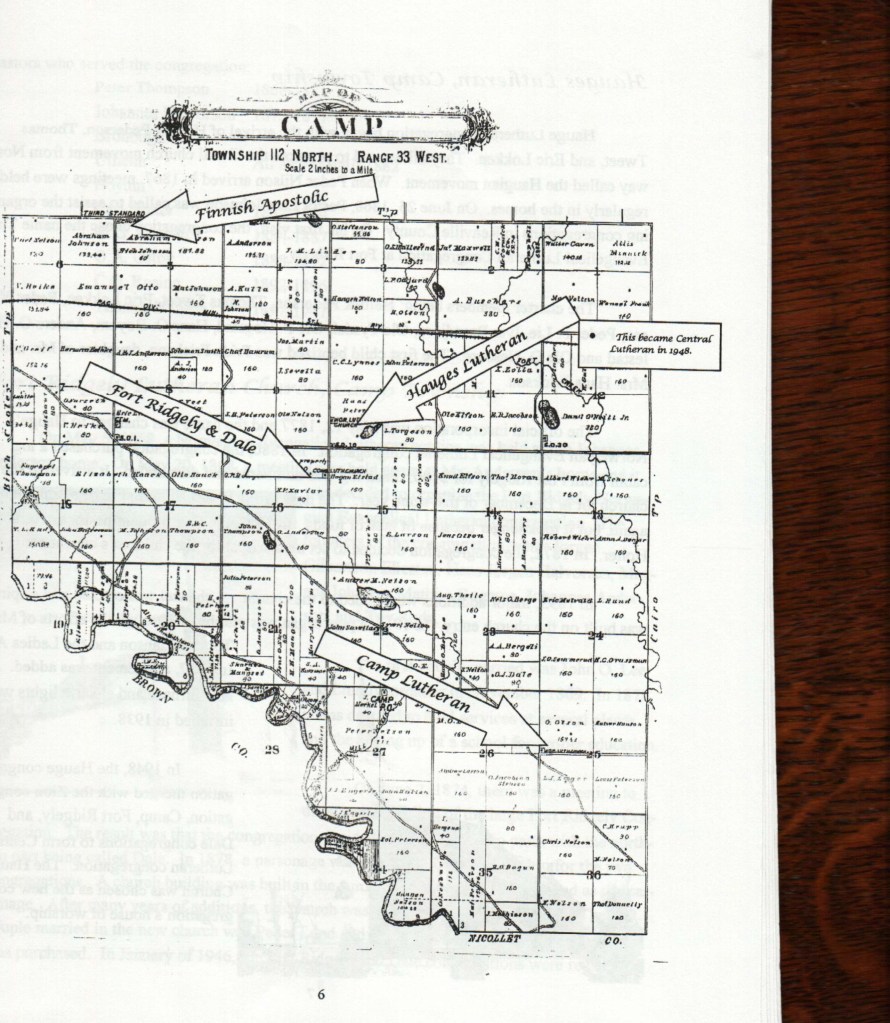
(above) A map of Camp Township showing the location of Ft. Ridgely and Dale Church and Camp Church. Fort Ridgely and Dale merged with Hauges Lutheran in 1948 to form Central Lutheran. The Hauges Church was chosen as the place to hold services because it has a basement. This church continues to be active. Camp Lutheran Church no longer exists.
Theodora Cormontan played the organ at both of these churches.
We see a close relationship between the Cormontan family in Franklin and their younger sister Marie Cormontan Lyders, as well as with Marie’s husband Edward (a pharmacist like C.G.V.) and their children. We learn that Edward and other members of the Lyders family would help C.G.V. run the Franklin Drug Store as needed, and that the families visited each other, celebrated happy events, and mourned the loss of departed loved ones together. The railroad, the scene of Theodora’s debilitating injury in 1887, now serves as the means by which she can travel to neighboring communities to teach piano, voice, and organ, and facilitates family visits and other professional trips.
The following material includes the news items regarding the Cormontan and Lyders families between 1891-1895, as well as some related pictures. Enjoy!
Newspaper articles regarding the Cormontan family in Franklin, MN (1891-1899)
The following material comes from microfilm copies of newspapers located in the Renville County Historical Museum in Morton, Minnesota and the Minnesota Historical Society in St. Paul, Minnesota. The only extant, salient edition of the Franklin paper dates from 9/19/1891. The earliest edition of the Morton Enterprise from this period is the 4/17/1891 edition. Other newspapers quoted below include the Renville Star Farmer and the People’s Watchman. Editorial comments are bracketed.
From the “Franklin News,” 9/19/1891:
[big print] “Drug Store” [small print] “An elegant assortment of Lamps, China Ware, Toliet Articles, Choice Perfume, Toys, Smoker’s Articles and other things too numerous to mention.” [big print] “A full line of Drugs, Books and stationery. Wall Paper from 15 to 60 cents a roll. C.G.V. Cormontan”
[From the same edition, under Here and There]: “C.G.V. Cormontan has a fine lot of fancy goods and chinaware.”
The remaining articles are from the “Morton Enterprise” (a weekly newspaper published in Morton, MN), unless noted otherwise.
4/17/1891: A similarly worded advertisement to the one above appears. It runs every week until July, 1891.
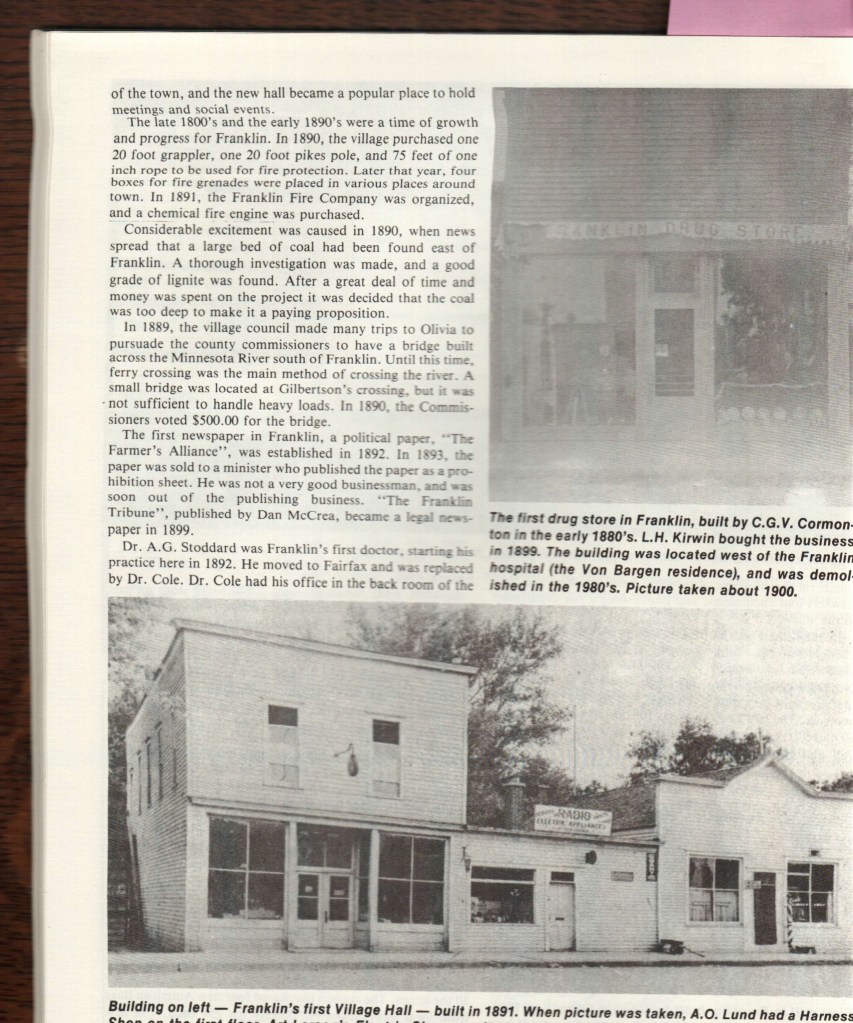
(above) A scan from a booklet of Franklin history showing the original Franklin Drug Store (the top right picture) built and operated by C.G.V. Cormontan from the mid 1880’s until 1899.
5/22/1891: “We have a case of erysipeias in town. The patient is at Mr. Cormontan’s under the care of Dr. Stoddard.” This is a rare bacterial infection. It normally affects only the legs or the face.
9/11/1891: The Cormontan ad resumes until October, 1891. This was the last ad I found for the drug store. The ad is similar to the other except for: “Call on me for the best qualities of castor and lard oils.”
9/16/1891: “Mrs. Lyders, from Sacred Heart is staying with Mr. Cormontan for a few days. Her father, Mr. E. Cormontan, has been quite sick, but is improving.” Mrs. Lyders is Marie Cormontan Lyders, Theodora’s younger sister. Her husband was Edward O. Lyders, mentioned below.
1/1/1892: “Mr. Cormontan has a new organ in his store which is to go to the Lutheran church.”
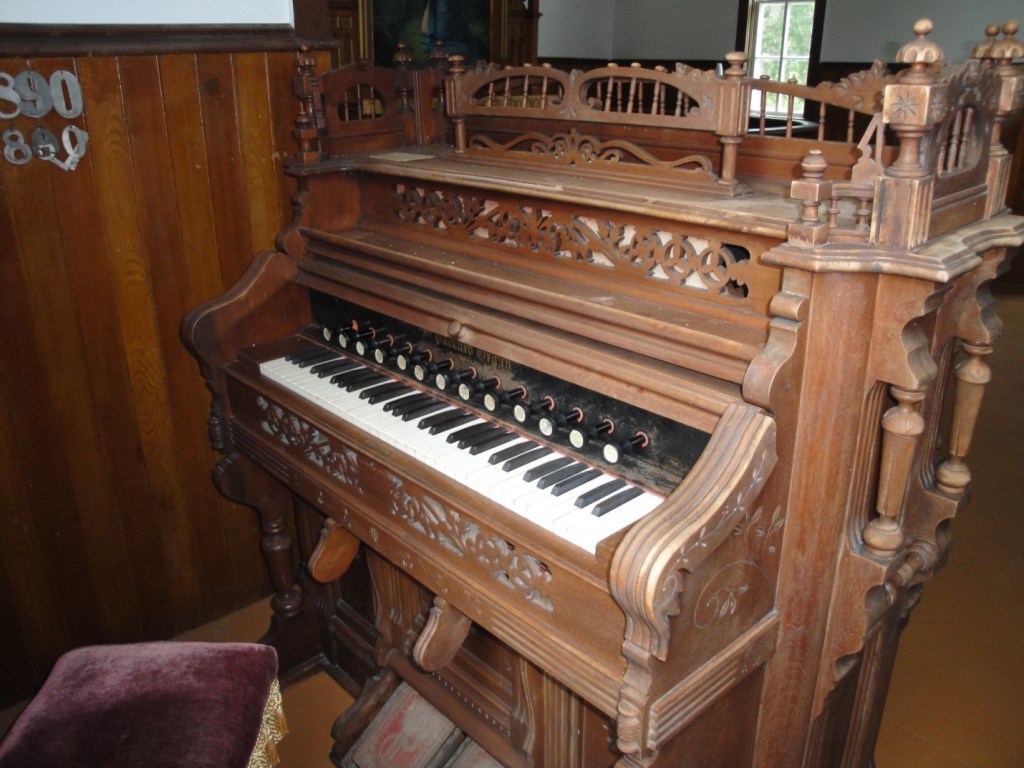
(above) This is the organ in the Ft. Ridgely and Dale Church that the Cormontan family secured in 1892.
1/15/1892 (page 1): C.G.V. Cormontan is elected as a state text book agent for 1892-1893.
1/29/1892 (Town Talk): “Mr. Cormontan, the Franklin druggist was doing business in town Tuesday. Mr. Cormontan is said to be one of the best pharmacists in the northwest.”
2/19/1892: “C.G.V. Cormontan went to the Cities on the 16th for business.”
4/15/1892: “Mr. Cormontan was called by telegram to Fosston to the sick bed of his brother, Dr. [Magnus] Cormontan of that place. He started Thursday. Dr. Lyders of Sacred Heart was sent for to take charge of the drug store during Mr. Cormontan’s absence. The Dr. says, if any are sick to call on him, he can either kill or cure. If you have any ailments go and see him, he will do you well. Mrs. Lyders also accompanied the doctor for a visit.”
4/15: “The Franklin choir which has been trained by Miss Cormontan sang at Rev. Rognlies’ church, in Camp last Sunday, and those who heard them pronounce the singing excellent. The lady is certainly an excellent teacher in vocal as well as instrumental music.”
4/22/1892: “O. Quamsoe, Iver Mahlum, Hans Cormontan, J.H. Scott, John Foley and Mr. More were chosen delegates to the convention at Renville next Saturday.”
4/22: “Mr. Cormontan came home from the west [Fosston] Thursday accompanied by his brother, Dr. Cormontan.”
4/29/1892: “Dr. Cormontan left for his home on the 28th.”
4/29: “Mrs. Wicken has been on the sick list and is still confined to her bed, but under the care of Dr. Lyders is now improving. The doctor has quite a few calls here.”
5/13/1892: “Prof. Swerdrup of Minneapolis will speak at Hauges church and Rev. Sorenson at Camp next Sunday. Miss Theodora Cormontan will play at the latter. She is engaged to play the organ there for one year, so now she has two churches to play in.”
7/22/1892, The Thirteen Towns newspaper of Fosston, MN (in the Local, Semi-Local, and Otherwise section): “Dr. [Magnus] Carmonton [sic] died at his residence in this place yesterday morning after a long and painful illness.”
7/29/1892: “Mr. Cormontan, the Franklin druggist, was transacting business in our village [Morton] one day last week.”
7/29 (Town Talk): “Miss Cormontan, the music teacher of Franklin, was in town [Morton] last Friday, giving some of our young ladies lessons. She has taken steps to organize a class here.”
8/19/1892: “Miss Cormontan of Franklin, was in town the latter part of last week giving music lessons. Miss Cormontan now has a class of about fifty pupils and still increasing. She is a very accomplished musician.”
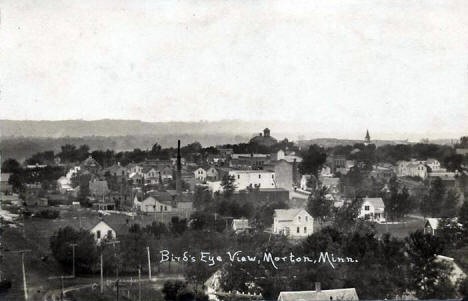
(above) Morton, MN around 1910.
10/7/1892: “The singing association of this place [Franklin], led by Miss Theodora Cormontan, have their regular practice three times a week, and they are now becoming quite good singers.”
10/21/1892 (Town Talk): “Miss Cormontan, of Franklin, was in town the fore part of the week, giving music lessons.”
Renville Star Farmer, 2/17/1893: “Rev. Cormontan of Franklin died last Monday at the age of 95 years. His daughter, Mrs. Lyders and family started for Franklin Thursday to attend the funeral. We sympathize with the relatives.”
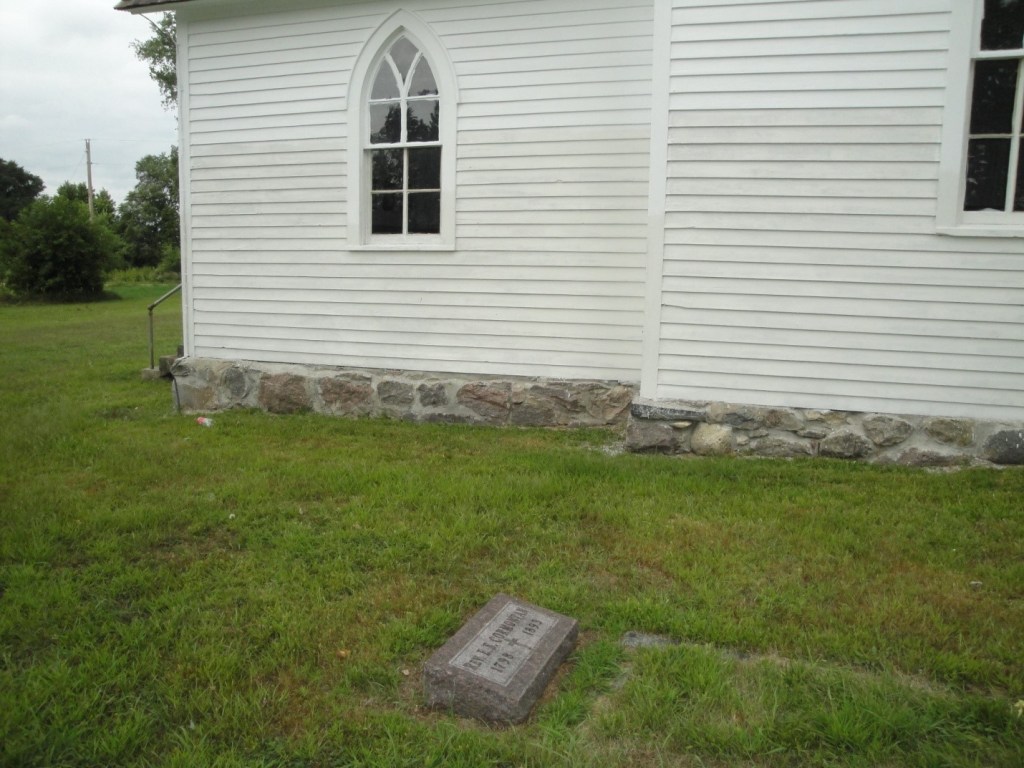
(above) The grave of Rev. E.S. Cormontan, located in a place of honor right next to the altar window of the Ft. Ridgely and Dale Church.
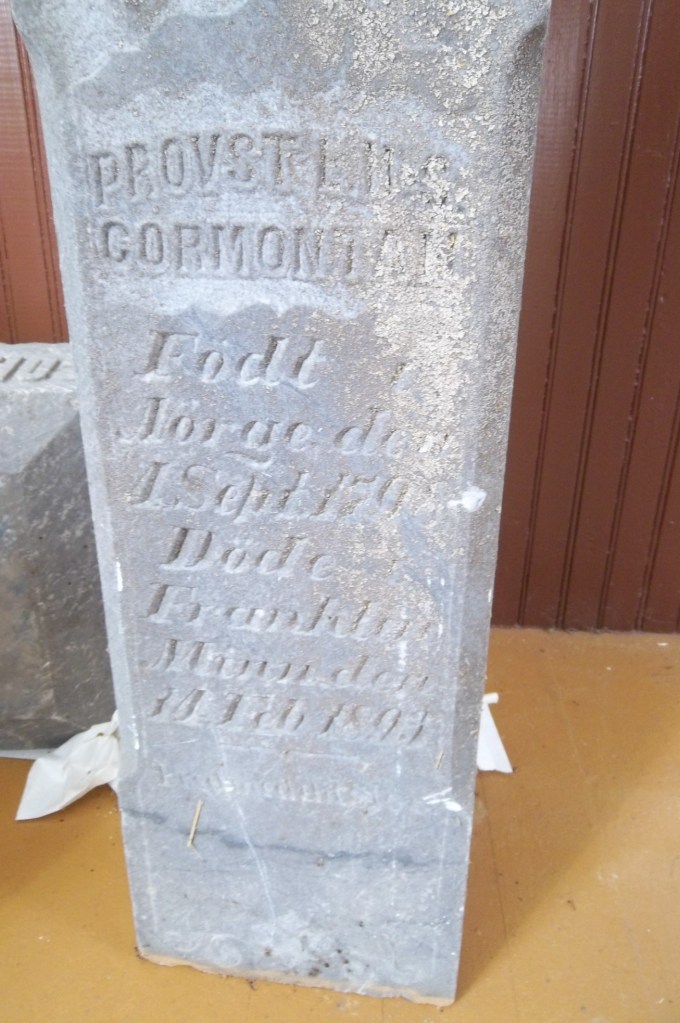
(above) The original tombstone for Rev. (Provst) E.M.S. Cormontan. This picture was taken in the back room of the church. It’s hard to see in this picture, but at the base of the stone it says “Fred med dit støv,” which means “Peace to your dust” or “Peace to your remains.”
RSF, 2/24/1893: “E.O. Lyders and family drove to Franklin Sunday.”
2/24/1893: “Dr. Lyders and family passed through town [Morton] Sunday en route to Franklin to attend Rev. Cormontan’s funeral.”
5/19/1893: “C.G.V. Cormontan and Miss Eivinda took the train for the cities last Monday to make visits and purchases. Dr. Lyders of Sacred Heart, is attending the drug store while Cormontan is absent.”
RSF, 6/2/1893: “Miss Henrietta Lyders [one of Marie’s daughters] and Edward Monson will be married at Sacred Heart tomorrow evening.”
6/2/1893: “Several of our citizens have received invitations to the wedding of Dr. Lyders to one of Sacred Heart’s fair daughters, next Saturday. Misses Eivinda and Theodora Cormontan took the train for that place Wednesday.” This article refers to the marriage of Dr. Edward and Marie Lyders’ daughter Henrietta to Edward Monson in Sacred Heart on June 3, 1893.
6/2: “The Rognlie Camp church [this refers to Rev. Parelius Rognlie, also the pastor of the Fort Ridgely and Dale church and Palmyra church] was dedicated. The choir from Franklin assisted in the singing.”
9/1/1893: “A children’s festival was held in the grove near Rognlie’s parsonage last Sunday. After a basket dinner the time was taken up by Rev. Rognlie, music by Miss Cormontan, and a few songs by the choir. The afternoon was spent very pleasantly.”

(above) Ft. Ridgely and Dale Church near Franklin, MN. Photo courtesy of Doug Ohman of Pioneer Photography and used with his permission.
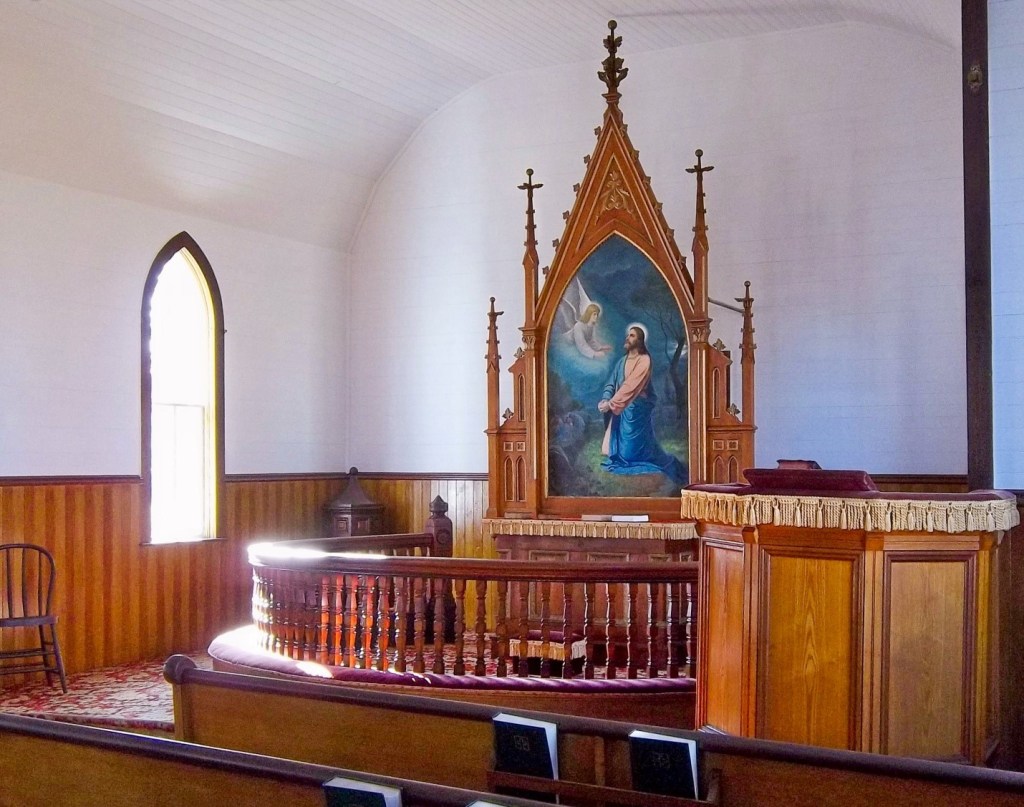
(above) The interior of the Ft. Ridgely and Dale Church.
9/22/1893: Theodora Cormontan and her choir assisted with music and singing at confirmation services at Rev. Rognlie’s church in Palmyra.
New Ulm, MN Review, 11/8/93: “Tomorrow evening, November 9th, there will be a rare musical recital at Turner Hall in which Miss Grace Watson, a soprano of reputation, will be the leading figure, assisted by Miss Theodore [sic] Cormontan as accompanist. Miss Watson is a graduate of the musical conservatory of Northfield and also of Boston and is spoken of by the papers as a singer of rare power. She will be ably assisted by local talent in recitation and songs, and altogether the program is apt to be such as our people would like. Seats are now being offered for sale at Alwin’s Drug Store.” It is uncertain if Cormontan actually performed on this concert. A review of the performance in the 11/15 edition of the New Ulm paper did not mention her by name, and it reported “She [Watson] was assisted by Miss Belle Chollar in piano accompaniments and recitations.”
The Cormontan family appears to be financially stable in this period, with their faith and their denomination a central part of their lives. The “Evangelisk luthersk kirketidende,” in volume 20 on page 318, reports that they contributed $5.00 to support the Norwegian Synod.
3/9/1894: “Mr. Carl Christianson, the clerk at Cormontan’s drug store, took a trip home to Palmyra last Saturday and will return in a few days.”
3/9: “Miss Lyders of Sacred Heart is the guest of the Cormontan family.”
4/6/1894: “The Temperance Lecture by Rev. C.O. Rosing last Sunday was very interesting and was listened to by a large audience. The Franklin church choir rendered a couple of very pretty songs.”
5/4/1894: “Miss Louisa Lyders returned to Sacred Heart Saturday after spending a month with the Cormontan family.”
10/17/1894: “Mrs. Lyders from Sacred Heart has been visiting with Cormontans the last week and Dr. Lyders came on a visit on the 10th and left with his wife for Sacred Heart on the 11th.”
12/26/1894, St. Paul Daily Globe, page 1: (headline) “Wedding of an Editor.” (beneath the headline) “Andrew Bromstad and Miss Louise Lyders were quietly married at the home of the bride’s parents Saturday evening. Mr. Bromstad is editor and proprietor of the Sacred Heart Bladet [a Norwegian language newspaper]. Miss Lyders is a daughter of Dr. E.O. Lyders, and is one of the most popular young ladies of this city.”
1/18/1895 (Sacred Heart): “Miss Evinda Lyders returned to her work in Franklin, Thursday, after a visit with parents at this place.”
RSF, 1/18/1895: “Miss Evinda Lyders returned to Franklin Wednesday.”
RSF, 2/22/1895: “Miss Effie Lyders left here [Sacred Heart] Tuesday for Franklin, where she intends to stay for some time.”
3/1/1895 (Franklin Department): “Miss Effie Lyders of Sacred Heart is visiting her sister, Miss Evinda, and also the Cormontan family.”
Theodora Cormontan’s accomplishments as a composer were noted outside of Minnesota. The following article appeared in the Decorah, Iowa Posten on April 2, 1895. This notable Norwegian language newspaper began in 1874 and continued in publication until 1972. The following is an electronic translation of Fraktur Gothic script:
“Music Literature
The Thompson Co.’s Publishers recently published two new compositions by Miss Theodora Cormontan, one of many well-known composers represented by the company.
The titles of the pieces are ‘The Dream, Waltz Caprice’ and ‘Polka Fantasia over Swedish Song, op 54.’ Each costs 40 Cents. Both of these compositions have much in common with most American light and lively dance melodies.
There are not many Norwegian composers in this country, and it is very gratifying when someone pursues this calling. Publishers who would publish such works should be supported.
Miss Cormontan is not a beginner; she has released several compositions before, and some of her songs are what those who speak English would call ‘gems.’
All orders should be addressed to Miss Theodora Cormontan, Franklin, Renville County, Minnesota.”
4/26/1895 (Franklin Department): “The choir from Palmyra spent Sunday at Franklin and sang with the Franklin choir at the town hall.”
4/26/ (Franklin Department): “Miss Theodora Cormontan will give a concert at the Townhall, May 4th, at 7:30 p.m., and will be assisted by the boy violinist, Master Albert Rudd, of Minneapolis. He is only 12 years old and is a wonder and well worth the admission alone. The Franklin choir will give several vocal selections. Miss Cormontan is too well known to need our recommendation. Secure your tickets early as the hall will be crowded, it will be a rare treat which seldom comes our way. Tickets for sale at the Drug Store.”
Albert Rudd went on to play in the first concert of the Minneapolis Symphony Orchestra in November of 1903. After several years he left to conduct the Orpheum Theatre Orchestra. He returned to play violin in the Minneapolis Symphony Orchestra in the 1930’s-1940’s after what John K. Sherman described (in “Music and Maestros: The Story of the Minneapolis Symphony Orchestra”) as “a career of many years as the city’s best known theater orchestra leader and violinist.”
5/10/1895 (Franklin Department): “The concert seems to have satisfied the audience that was there, and they are all speaking well of Master Rudd, the little violinist. There would have been room for more in the hall but some preferred to listen from outside.”
5/17/1895 (Franklin Department): “Miss Cormontan with the assistance of the Franklin and Palmyra choirs will hold a concert at Palmyra on the 17th of May.”
5/17 (Franklin Department): “Miss Lyders and Mrs. Monson of Sacred Heart, have been visiting with the Cormontans this week.”
RSF, 5/24/1895: “The Misses Evinda and Effie Lyders came home from Franklin Thursday of last week.”
7/26/1895 (Franklin): “Druggist Cormontan has been ill this week.”
8/9/1895 (Franklin): “Miss Theodora Cormontan is back from New Ulm.”
RSF, 11/1/1895: “Mr. Cormontan of Franklin visited with Dr. Lyders’ folks Tuesday.”
RSF, 12/13/1895: “Miss Cormontan of Franklin is a guest at the Lyders mansion.”
Rognlie Collection 1895
The Rognlie Collection, with information on Theodora Cormontan
In 2020, descendants of Reverend Parelius Rognlie donated his papers to the Norwegian-American Historical Association (NAHA), home to one of North America’s oldest and largest ethnic manuscript collections. The Collection Name is Rev. Parelius H. Rognlie papers, 1870-2000. The Collection Number is NAHA2020/015.
The Parelius H. Rognlie papers consist of photographs, correspondence, sermons, notebooks, and other records. It also contains photographs of Pastor Nils Xavier. Both Xavier and Rognlie served at the Fort Ridgely and Dale Church during the time the Cormontan family were members. The holdings also include pictures and at least one document related to Theodora Cormontan.
1895 Program
The Morton Enterprise newspaper announced on May 17, 1895 that Theodora Cormontan would be performing that day with the Franklin and Palmyra choirs in Palmyra, Minnesota. The Palmyra Choir had traveled to Franklin the previous month to perform with the Franklin Choir. Theodora prepared and conducted both ensembles.
The Rognlie Papers include a copy of the program for this performance. This is the only program found so far that tells what Cormontan performed in a concert in the United States. The program is remarkable on several levels. One must remember that this area was called “The Northwest” at this time and was a newly developing, sparsely populated prairie. The sophistication of the music performed that day would have been a very rare treat in this region. It reflects well on Theodora that so many people in two towns were willing to spend significant time during lives of great challenges to learn the music by rote and to travel the twelve mile distance between Palmyra and Franklin in wagons. This is an incredibly ambitious program that must have taken perseverance by Theodora to accomplish. The people of the two communities must have thought a great deal of her to join in this endeavor.
I also believe that the penciled in notes on the program reflect that Pastor Rognlie spoke during the concert and referenced Theodora’s past challenges related to her serious injury in 1887 and her triumph to be able to perform such a demanding concert in 1895. I believe that moving the concert from May 12 to May 17 so that it corresponded with Syttende Mai was designed to add to the celebratory atmosphere.
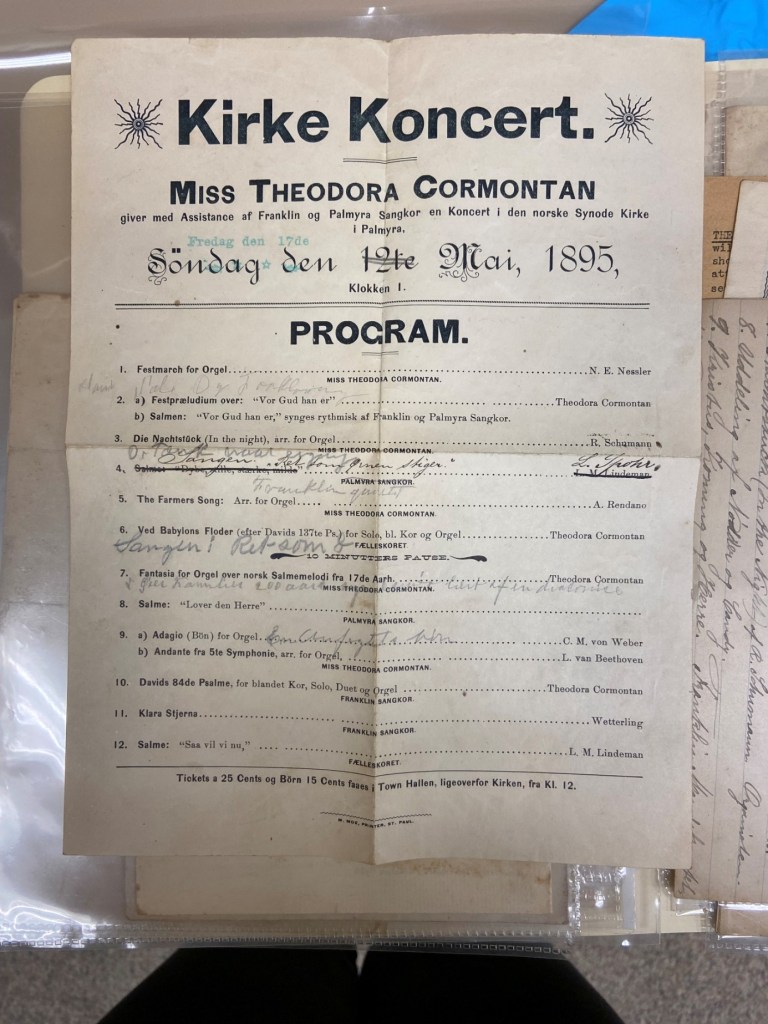
The following is a translation of the program and notes elaborating on the information contained in the program.
[Translation]
Church Concert.
Miss Theodora Cormontan
gives a concert with the assistance of the Franklin and the Palmyra Choirs in the Norwegian Synod Church in Palmyra
Friday, the 17th of May, 1895,
1 o’clock.
Program.
1. Festive March for Organ . . . . . . . . . . . . . .N.E. Nessler
Miss Theodora Cormontan
2. a) Festival Prelude to: “A Mighty Fortress is Our God” Theodora Cormontan
b) Hymn: “A Mighty Fortress is Our God,” sung rhythmically by the Franklin and Palmyra Choirs.
3. In the Night, arr. for Organ . . . . . . . . . . . .R. Schumann
Miss Theodora Cormontan
4. Song: “As the eagle soars” . . . . . . . . .L. Spohr
Franklin Quartet
5. The Farmer’s Song: arr. for Organ . . . . .A. Rendano
Miss Theodora Cormontan
6. By the Waters of Babylon (after David’s 137th Psalm) for Solo, Mixed Choir and Organ. . . . .Theodora Cormontan
Combined Choirs
-10 minute intermission-
7. Fantasia for Organ over a Norwegian hymn tune from the 17th century . . . Theodora Cormontan
Miss Theodora Cormontan
8. Hymn: “Praise to the Lord” . . . . . . . . . . . . . . . . .
Palmyra Choir
9. a) Adagio (good [?]) for Organ . . . . . . . . . . C. M. von Weber
b) Andante from Symphony #5, arr. for Organ . . . . L. van Beethoven
10. David’s 84th Psalm, for mixed choir, Solo, Duet and Organ . .
Theodora Cormontan
Franklin Choir
11. Clearest Star . . . . . . . . . . . . . . . . . . . .Wetterling
Franklin Choir
12. Hymn: “And Now We Must Bid One Another Farewell” . . . L. M. Lindeman
Combined Choirs
Tickets at 25 cents and children 15 cents are available in the Town Hall, directly opposite the church, from 12 o’clock
Notes
The numbered paragraphs below correspond with the numbers for the works on the program.
The concert appears to have originally been scheduled for the previous Sunday, but was moved to Friday, May 17th. May 17 is Syttende Mai, or Constitution Day, a Norwegian holiday when Norway celebrates its independence after more than 400 years under Danish rule. There were three primary Norwegian Lutheran Synods in 1895: Norwegian, United, and Hauges. The Norwegian Synod was the most formal and conservative of the three.
1. The composer is probably Viktor E. Nessler (1841-1890), a composer who worked mostly in Leipzig.
2. The pencil notes written on the program are almost certainly in the hand of Parelius Rognlie. I can’t read this one, except for the word “og,” which means “and,” so not much help. Perhaps he introduced each work and these were his notes.
“Vor Gud han er [saa fast en borg]” is the Norwegian translation by M.B. Landstad of Martin Luther’s “A Mighy Fortress.” “Synges rythmisk” means “sung rhythmically.” Perhaps this means sung in a version more like the hymn’s original rhythm than what is found in most contemporary hymnals. Theodora Cormontan composed a prelude and choral work based on “A Mighty Fortress is Our God” and credited herself on the program for this arrangement/new work. This original composition is lost. The choral piece was sung by both the Franklin, Minnesota choir and the Palmyra, Minnesota choir. Rev. Parelius Rognlie was pastor at churches for both towns, known today as the Ft. Ridgely and Dale Lutheran Church near Franklin and the Palmyra American Lutheran Church in Palmyra.
3. The composition is by Robert Schumann (1810-1856) and performed on the organ by Theodora Cormontan. It is apparently taken from Schumann’s “4 Nachtstücke, Op. 23,” composed for piano.
4. “Ret som ørnen stiger [As the eagle soars]” is by Louis Spohr (1784-1859) for TTBB (tenors and basses). The Norwegian text was written by Johan Diederich Behrens (1820-1890). The original German title is “Wie ein stolzer Adler (Like a proud Eagle).” The original German text was written by Heinrich Schütz in 1840 (note: this is not the famous composer of the same name who lived in the 17th century). The piece was sung by the Franklin Quartet, which may have been the male quartet that included Cormontan’s brother C.G.V. singing bass. The pencil writing above the title appears to say “Or tenk naar engang.” This likely refers to the hymn “O tænk, naar engang samles skal.” The text to this hymn is by Wilhelm Andreas Wexels (1797-1866). The English translation by George Taylor Rygh is “O Happy Day, When We Shall Stand.” Might this refer to Theodora overcoming mobility issues after her train accident of 1887? The melody is credited to Nikolaus Herman (c. 1480-1561). The writing in ink appears to be in the hand of Theodora Cormontan.
5. “The Farmers Song” appears to have originally been titled “Message de la paysanne” (“Message from the Peasant.”) Another source calls it “The Peasant’s Song.” This is the only title to be found on the internet by Rendano, an obscure composer. This version was arranged for organ.
6. “Ved Babylons Floder (By the Waters of Babylon)” was performed by the combined Franklin and Palmyra choirs (“fælleskoret” literally translates as “the community choir.”) This original composition by Theodora Cormontan is lost. The writing in pencil may say “Sangen i ret som” which appears to mean “the song in court.” Could this possibly refer to Theodora’s court case of 1889?
7. This is another Cormontan composition that is lost. I can’t read the pencil writing, but it mentions 200 years, so appears to be in reference to the hymn tune Cormontan used as her source material.
8. This hymn is a translation of the German hymn text “Lobe den Herren” by Joachim Neander, published in 1680. The translator is unknown. The melody Neander used is likely based on a folk melody.
9. Here Theodora Cormontan presents two classical works on the organ. The first is by the German composer Carl Maria von Weber (1786-1826). I do not find an Adagio written by Weber for solo organ. There is an Adagio for piano and cello and an Adagio and Rondo for harmonichord or reed organ & orchestra. Or perhaps this is an organ transcription of an Adagio for piano. The second piece is a transcription of the second movement from the 5th Symphony by a contemporary of Weber, Ludwig van Beethoven (1770-1827). Again, I am just guessing at what the pencil writing says, but it may be “En anfegtits hen” which translates as “A contested one.”
10. Sadly, another lost work by Theodora Cormontan. Scored for mixed (SATB) choir, soloist, duet, and organ, it is written for larger forces than any of her scores that still exist. Psalm 84 begins “How amiable are your dwellings, O Lord of Hosts! My soul yearns, even faints, for the courts of the Lord; my heart and my flesh cry out for the living God.”
11. The text and music to “Klara stjärna (Clearest Star)” are by Hampus Gustaf Wilhelm Wetterling (1830-1870). The first stanza of the Swedish lyrics, translated by Dr. Alf Lunder Knudsen read ”Clearest star you who shineth, Shim’ring in the dark blue sky—Do not hide your eye from me To the dwelling where you dazzle I yearn to go from this earth’s masses Gentle star up to thee.”
12. The full title of the hymn is “Saa vil vi nu sige hverandre Farvel (And Now We Must Bid One Another Farewell” with the tune by L. M. Lindeman (1812-1887) and text believed to be by Martha Clausen (1815-1846) with an English translation by G. T. Rygh (1860-1942). Ludvig Mathis Lindeman was a Norwegian composer and organist, most noted for compiling Norwegian folk music. Martha Clausen was a Danish immigrant, the wife of the first pastor in Muskego, Wisconsin. She died there at the age of 25. George Taylor Rygh was an author, editor, and ordained Lutheran pastor.
1895 Pictures
Parelius Rognlie married Marie Gullerud in Zumbrota, Minnesota on Thursday, June 13, 1895. A wedding reception was subsequently held at the Fort Ridgely and Dale church between Frankin and Fairfax, MN, probably still in June of 1895. This would have been about a month after the May 17th concert.
An unidentified photographer was called on to memorialize the festive occasion. Everyone in attendance was asked to pose on the lawn in front of the parsonage. I believe the two pictures from the Rognlie Papers include the Cormontan family. While the photographs do not identify anyone, I believe I have located the Cormontans, including Theodora, in the two pictures. If I am correct, these are the only photos of the family found thus far during their time in the USA, until pictures were taken of Theodora and Eivinda in 1917.
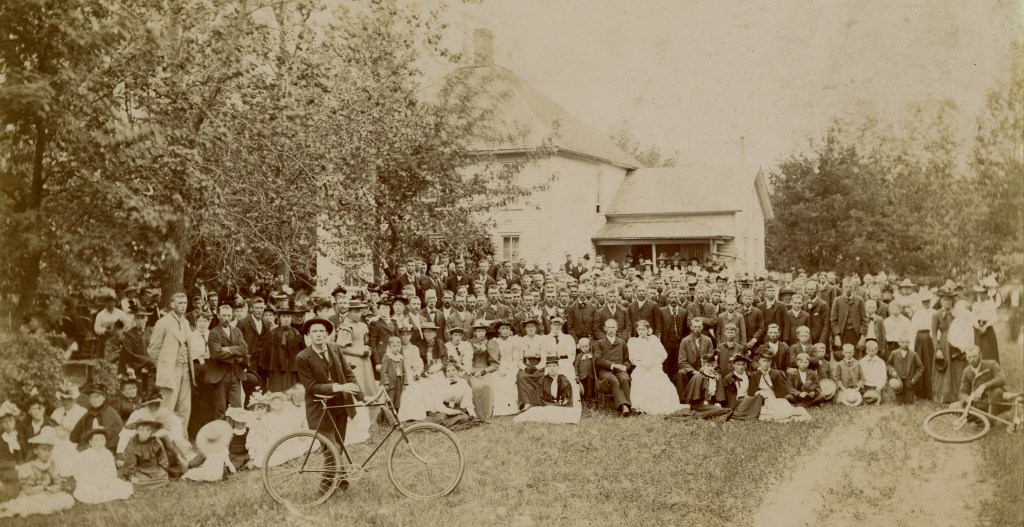
(above) Here’s the first Rognlie picture with everyone who attended the wedding reception. The church is out of view to our left. Marie and Parelius (the newlyweds) are seated in the front row. Directly behind them I believe we can find Hans and C.G.V. Cormontan. Eivinda and Theodora are just to the right of the man with the bicycle in the left foreground.
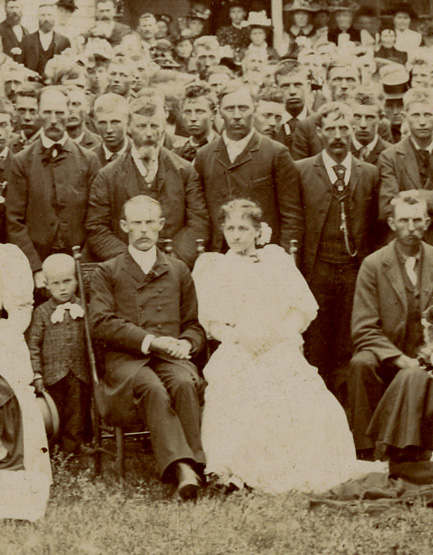
(above) A closer view. Hans is standing directly behind Parelius and C.G.V. is directly behind Marie. In June of 1895 Hans was 69 years old and C.G.V. was 59.
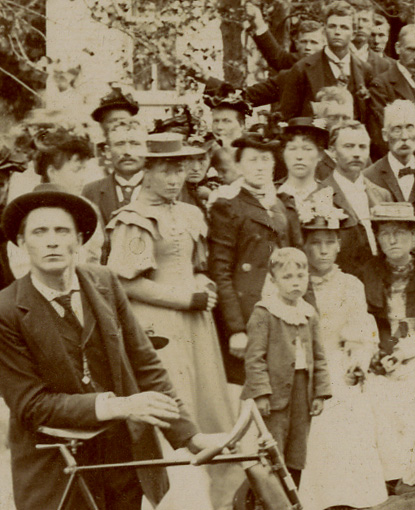
(above) A closer view of Eivinda and Theodora to the right of the man with the bicycle. Eivinda is wearing a lightly colored dress and hat. Notice the position of her hands, a pose we have seen in other pictures. Theodora is the next person over with the dark jacket and hat. She stands with a distinctly erect posture, perhaps because of her spinal injury in 1887. At this time Eivinda was 57 years old and Theodora was 55.
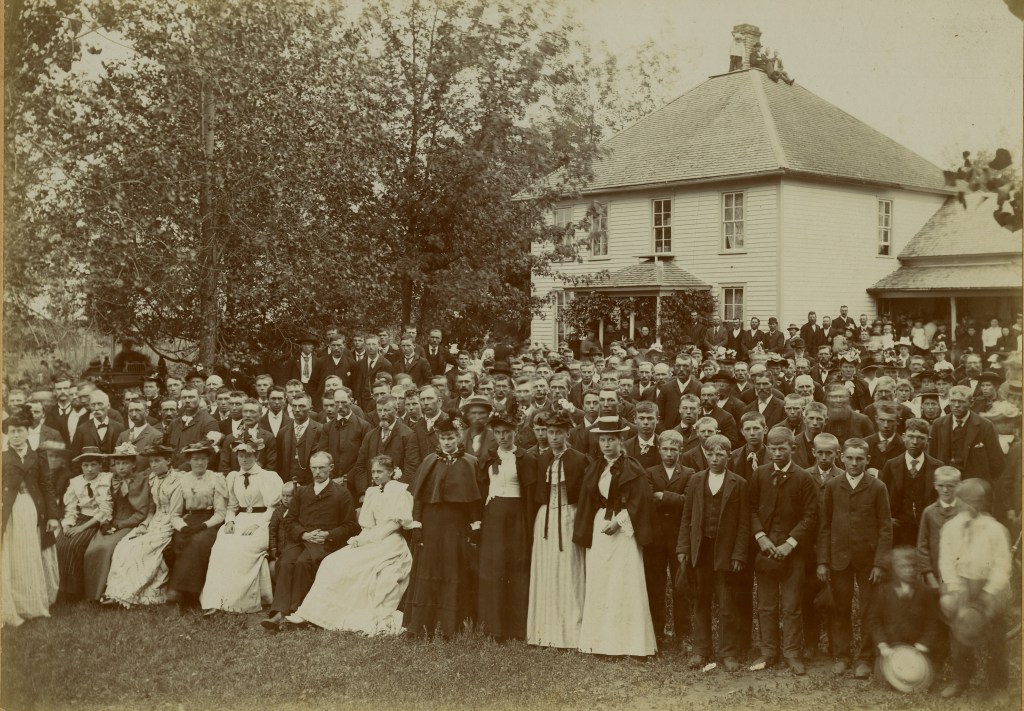
(above) This is the second of two pictures taken at the Rognlie wedding reception. The photographer has drawn closer to the subjects, apparently to capture a clearer image of the family and of the leaders of the church, several of whom are lined up in the row behind the wedding couple. While most of the people are in the same postion they held in the first picture, a few are moved. This includes Theodora, who was moved forward from the second row and is barely included at the left edge of the picture. As the director of music in the church, she held a leadership postion and was included in the second photograph. Eivinda is not included in this picture.
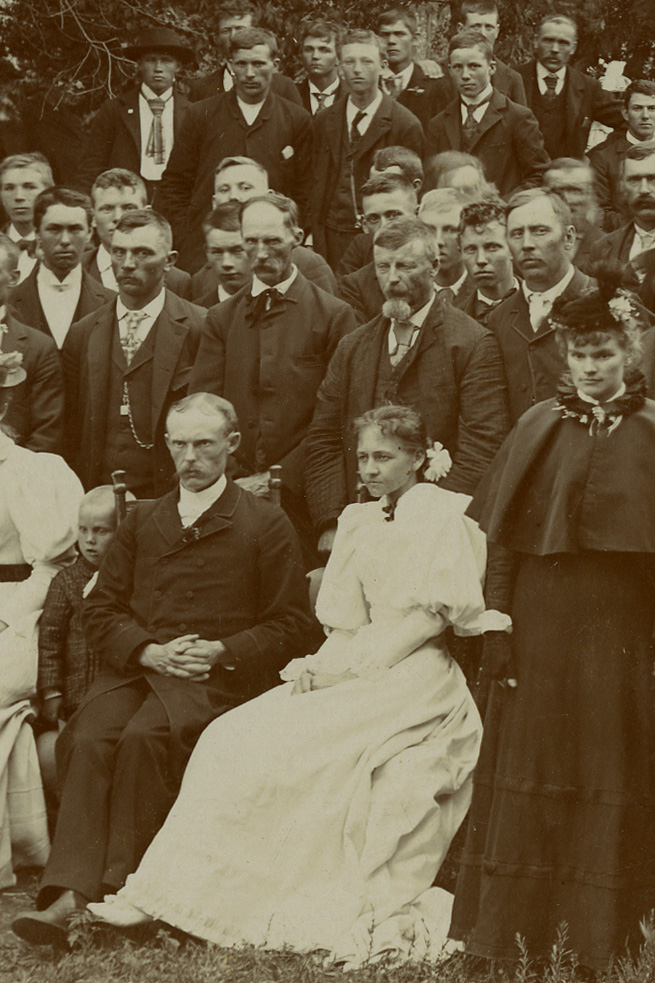
(above) A close-up of Hans and C.G.V. from the second photo.
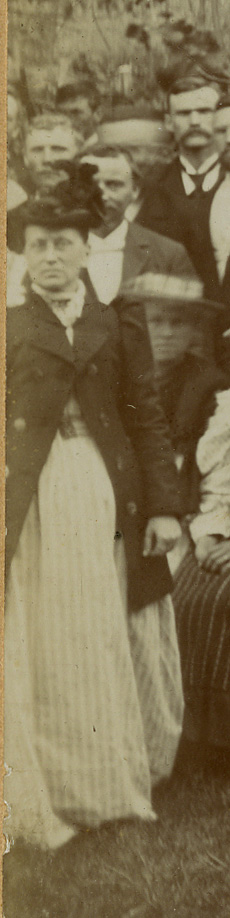
(above) A closer look at Theodora from the second picture.
Franklin Minnesota 1896-1899
The following contains information on Cormontan family activity between 1896-1899 in Franklin, culled from area newspapers. We continue to be amazed at how much information we found in the area papers during that time and how they provide a fairly detailed description of the events in the Cormontan household. You can learn more about Theodora’s male quartet, her team of horses that ran off, and why the family was visited so often by one of its nieces!
Renville Star Farmer (RSF), 1/10/1896: “Miss Cormontan, of Franklin, is visiting with Dr. Lyders folks.”
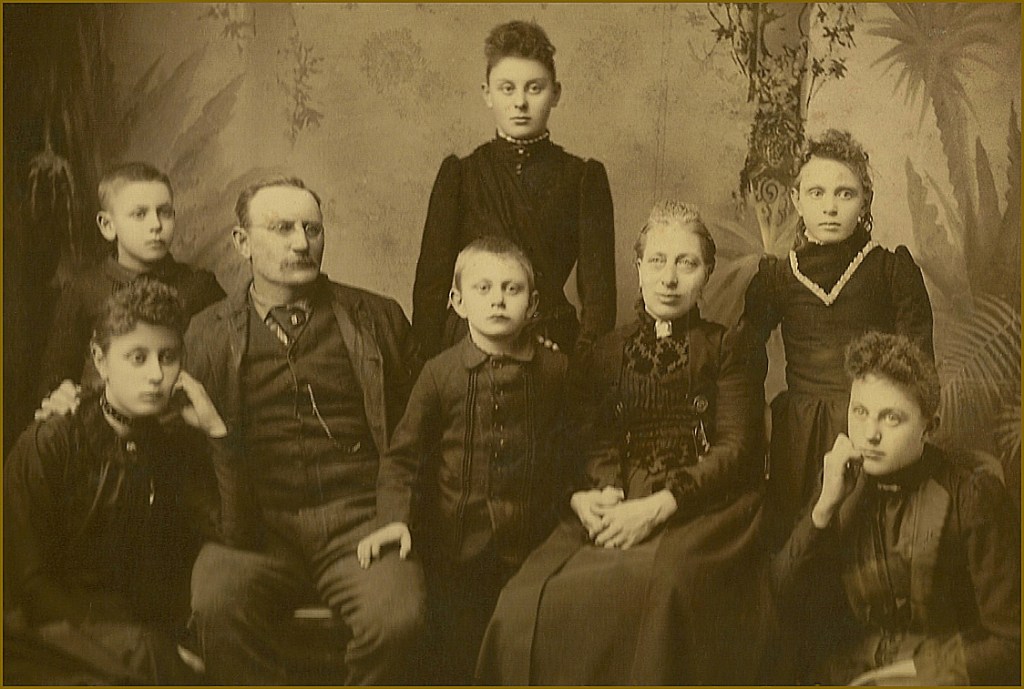
(above) Lyders family picture: Edward Orla and Marie Josephine Cormontan Lyders (Theodora’s younger sister). Children (from left to right): Louise, Edward, Carl, Evinda, Henrietta, Effy (Josephine). The photograph dates from the early 1890’s.
The following information documents financial difficulties experienced by Theodora’s brother and head of the household, pharmacist C.G.V. Cormontan. This challenge with creditors would manifest itself again in 1900.
From the St. Paul Globe, 5/16/1896, page 9: “Notice is hereby given, that on the 20th day of April, 1896, at the village of Franklin, Renville county [sic], Minnesota, C.G.V. Carmontan [sic] made, executed and delivered to the undersigned a Deed of Assignment, in trust for the benefit of his creditors, of all his stock of drugs, merchandise, and other property not exempt by law from sale on execution. Notice is further given that the assets of said Insolvent as shown by his Inventory returned and filed in court show property of a total value of $1397. 64-100, and the schedule of liabilities filed by said Insolvent amount in all to the sum of $935. 36-100. Creditors are requested to send in paper proofs of claim before June 20th, 1896. H.M. AUNE, Assignee. Redwood Falls, Minn. W.J. McLeod, Attorney for Assignee.”
The May, 1896 edition of the Western Druggist (Volume 18) also reported on page 237 that “Hans M. Aune has been appointed assignee for C.G.V. Cormorton [sic], druggist, of Franklin; liabilities, $600; assets, $1,100.”
More regarding C.G.V.’s insolvency from The Redwood Gazette out of Redwood Falls, MN, 5/7/1896: “On Friday last Hans M. Aune of this city was appointed assignee of C.G.V. Cormonton [sic], a druggist of Franklin, Renville county. The scheduled assetts [sic] of Mr. Cormonton are $1,000 while the liabilities are placed at $600.” 5/21/1896: “The drug store of E.V.G. Cormonton [sic], insolvent, at Franklin, will be sold at public auction by Assignee H.M. Aune at 3 o’clock p.m., June 3d [sic].” 6/11/1896: “Attorney McLeod and Assignee Aune returned from Franklin Wednesday afternoon. While in Franklin Mr. Aune sold the assigned stock of C.V.G. Cormonton, druggist of that place, to C.W. Woodbury, a wealthy resident of the same town. The stock brought $570. Other assets of Cormonton will send the total to $590. The total liabilities are about $900. The estate will not quite pay 50 cents on the dollar.”
The purchaser of the assigned stock, Charles Wesley Woodbury (1823-1908), moved to Franklin in 1885. He started a creamery and cheese business there and helped build the first flour mill in Franklin. The Woodbury family papers were donated to the Minnesota History Museum. In them we learn Mr. Woodbury knew C.G.V. by at least 1892, when his wife Martha recorded in her diary on February 22 “Mr. Carmonton [sic] calld [sic] on money affairs.” Did this indicate early financial difficulties? A letter from Charles and Martha’s oldest daughter Alice to her brother Charles Jr., dated June 21, 1896, offers this: “Comorton [sic] failed and Dar [a nickname for her father] bought him out at auction. Had to as Gomorton [sic] owed him $150 and couldn’t pay it thinks it will take about a year to get out of it. He gives Cormorton $25.00 per month as clerk.”
So, it appears Woodbury now owned the store, or at least its stock, and hired Cormontan to work there. Woodbury was now significantly involved in the operation of the drug store. In 1899 newspapers note that Cormontan sold his drug store, so the exact ownership of the business is unclear.
Morton Enterprise (ME) 6/12/1896 (Franklin): “Seventy-eight excursion tickets were sold at Franklin. This must be a tally for our station agent as we understand he sold the highest number on the line. Mr. and Mrs. C.W. Parsons and two of their children, C.G.V. Cormontan, E.S. Johnson, Wm. Rudrick, Ed. Anderson and others were among the excursionists.”
RSF, 6/26/1896: “Mrs. E.O. Lyders and daughter Evinda drove over to Franklin Monday on a few days visit with relatives.”
ME, 7/31/1896 (Franklin): “Dr. Hirch [sic] from New Ulm visited with Cormontan family the fore part of the week. The Dr. will be here again on a professional call on the 10th of August.” C.G.V. Cormontan visited the Hirsch family in February of 1897 (see below) and Dr. Hirsch was in Franklin again in October of 1897. Dr. Christian Johan B. Hirsch was the son of Christian Leuthäuser Hirsch and the brother of Louise Augusta Hirsch Cormontan–Theodora’s mother. That would make Dr. Hirsch Theodora’s first cousin.
New Ulm Review, 2/3/1897: “Mr. Cormonton [sic] of Franklin called on the family of Dr. Hirsch the forepart of the week.”
ME, 7/30/1897 (Franklin): “Ed Monson and family and Mrs. Lyders, of Sacred Heart, came down Sunday to visit with the Cormontans. Mr. Monson is one of the leading candidates for the Sacred Heart post office.”
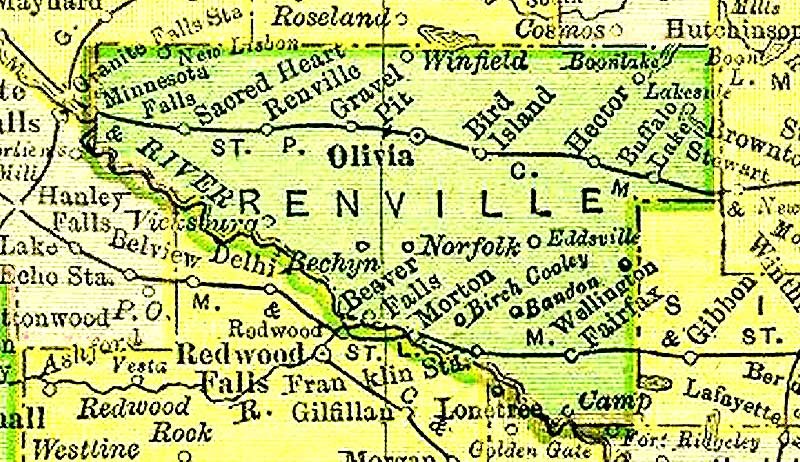
(above) 1895 map of Renville County, Minnesota. Sacred Heart is located in the northwest corner of the county. Franklin (listed as Franklin Sta.[tion] on the map) is located near the Minnesota River on the southern border of the county. Morton is the next town to the west of Franklin on the Milwaukee and St. Louis railroad line, and Beaver Falls is just west of Morton. Theodora taught music lessons in Franklin, Morton, and Beaver Falls.
People’s Watchman (PW–published in Sacred Heart), 8/3/1897: “Even Cormontan [the son of Magnus Cormontan, Theodora’s late brother], a young tyro of Franklin, was visiting Mr. Lyders’ people this last week.” Even apprenticed as a pharmacist with C.G.V. for several years, first in Franklin and then in Madelia, Minnesota. He is noted as being a member of the household in the 1900 census.
ME, 8/6/1897 (Franklin): “Mrs. Olson and children, of Minneapolis, who have been visiting Bergley’s the past two months returned home last Monday. Miss Martha, during her stay here, taken music lessons of [sic] Miss Cormontan.”
ME, 8/13/1897 (Franklin): “A couple of tramps stole a calf out of Cormontan’s barn one night last week, but the dogs made such a noise that it woke them up in time to catch the calf. Such tramps ought to be salted down for keeping and it is about time that people refuse those kind of men food and we would soon get rid of them.”
ME, 9/3/1897 (Franklin): “C.G.V. Cormontan went to New Ulm Saturday to take in the Brown County Fair, and from there to the cities. Miss Lyders, of Sacred Heart, acted as prescription clerk in the absence of C.G.V.”
ME, 10/15/1897 (County Seat News) [Beaver Falls]: “Miss Cormontan, of Franklin, who has a class in music at Morton, will extend her work as far as Beaver and will make weekly trips to this place hereafter. Miss C. has a rare musical ability, and those wishing instruction will do well to consult her.”
ME, 10/15/1897 (Franklin): “Miss Eivinda Cormontan came home Saturday from a five week’s visit at Sacred Heart and Appleton. She has been on a recreative trip and feels much improved.”
ME, 10/15/1897: “Mrs. Wichman, of Beaver Falls, visited our village Tuesday and we understand the lady secured the services of Miss Cormontan as music teacher for Beaver Falls parties.”
ME, 10/15/1897: “Miss Cormontan’s team took a trip all by themselves Wednesday morning as they were hitched up the driver delayed little [sic] and the team started first down to the church in Camp and down in the bottom they turned around and started back for home coming back on the prairie. Henry Mangset caught them and brought them back to Franklin. Nothing was broken or out of kilter although they had met many teams on the trip.”
ME, 10/29/97 (Franklin): “Dr. and Mrs. Hirsch of New Ulm spent a day here last week.”
ME, 10/29/1897 (Franklin): “Miss Cormontan has commenced teaching music at Beaver Falls. We understand she has eight scholars for piano and a dozen for vocal instruction. The lady speaks very highly of Beaver Falls people and says she finds them like the people she associated with in the Old Country. We do not know whether this speaks best for the Beaverites or the old country. We, also, have found those we are acquainted with at the county seat very pleasant and sociable. It is right, the best training should prevail at the capitol city.” From Wikipedia: Beaver Falls Township is a township in Renville County, Minnesota, United States. The population was 331 at the 2000 census. There was once a town called Beaver Falls that was the original Renville County seat. The seat was moved to Olivia and the town has since been abandoned. All that remains today is a cemetery and a county park.
ME, 11/5/1897 (Franklin): “Mrs. Lyders from Sacred Heart is here on a visit with the Cormontans. Miss Theodore [?] Franzen, a Danish dentist, accompanied her and will remain here a few days. She has the reputation of being a first-class dentist.”
ME, 11/12/ 1897 (County Seat News) [Beaver Falls]: “Miss Cormontan will begin a term of vocal music next Friday evening at the school house, and it is hoped that all who can, will join the class.”
ME, 11/19/1897 (Franklin): The following was included in an entry on the Ladies Aid Society of Rev. Rognlie’s congregation holding a social the previous Tuesday: “Miss Cormontan’s quartette rendered several songs which were well received. It was the first entertainment they have arranged, but we hope it will not be the last.”
ME, 12/17/1897 (Franklin): “Mrs. Miller had the misfortune to thrust a knife into the palm of her hand recently while digging molasses candy loose from a pan. An artery was severed, but Druggist Cormontan succeeded in stopping the bleeding and bandaged it up.”
ME, 12/24/1997 (County Seat News): “Miss Cormontan will not be here with her music class this week, on account of holiday festivities in Franklin.”
ME, 12/24 (Franklin): “The Christmas tree at Rognlie’s church will not be given until one week from next Sunday. Big preparations are being made and a good time is expected. The male quartette of Franklin, consisting of Peter Wickin, Iver Mahlum, J.A. Bergely and C.G.V. Cormontan will render several selections besides having a mixed choir.”
ME, 1/7/1898: “At the wedding of Louis Enger’s house, on the 29th of December, the commodious house was packed with the guests, not less than fifty families being invited, and the event was certainly a social one. A fine musical program was rendered by Miss Cormontan, of Franklin, the Misses Hanson, of Camp, and others.”
ME, 2/1/1898: “C.G.V. Cormontan celebrated his 62nd birthday on the 1st.”
Fairfax Crescent (FC, published in Fairfax MN), 2/4/1898 in the Franklin Newslet section: “Rev. Rognlie gave a lecture on ‘Church History’ in the Synod church of this place [Ft. Ridgely and Dale], Wednesday at 4 p.m.”
PW, 2/9/1898: “Miss Evinda Lyders is at present in Franklin, this county, where she is helping her two aunts, the Misses Cormontan. She will remain for several weeks.” Note that this is one of Marie Lyders’ daughters from Sacred Heart, not Theodora’s sister Eivinda–there is a slightly different spelling of the name. You will notice Evinda is a frequent visitor to Franklin. Is it because she is so close to her aunts and uncles? Keep reading . . .
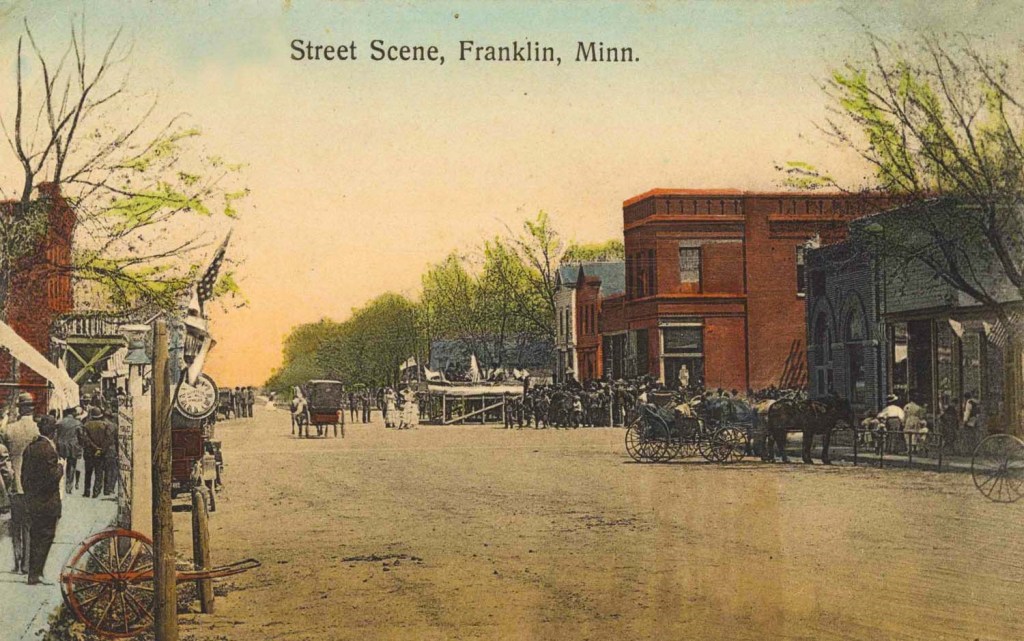
(above) An early color tinted postcard of Franklin, Minnesota, Main Street.
ME, 3/4/1898: “A goodly number of voters turned out to the caucus last Friday evening.” C.G.V. Cormontan was nominated as a councilman. His election was announced in the 3/18 edition.
FC, 3/11/98: Under Elections, it is noted that C.G.V Cormontan is elected as a trustee for the town of Franklin.
The last edition in March, 1898 of the Morton Enterprise notes the plan to build the Concordia Church, a church where Rev. Rognlie, in the History of Renville County, listed Hans and C.G.V. Cormontan among the founders.
PW, 4/20/1898: “Miss Evinda Lyders returned from Franklin last Wednesday and expects to remain at her home in Sacred Heart.”
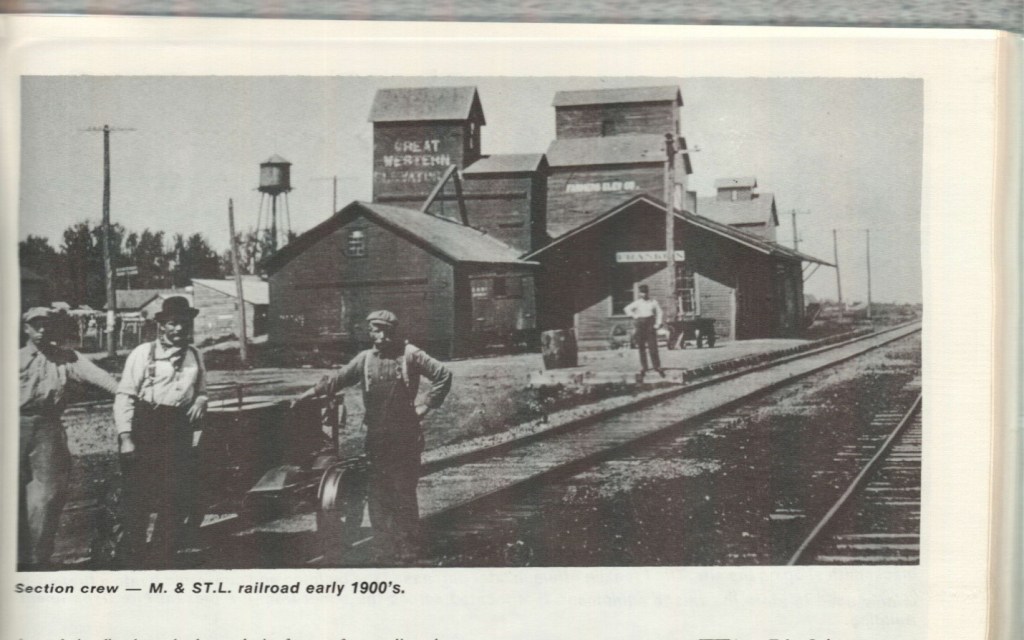
(above): Franklin Train Station.
ME, 4/29/1898: A campfire and the organizing of a Woman’s Relief Corp–apparently in response to the Spanish American War–was held in the Franklin town hall on Tuesday evening, April 19th. “The Franklin male quartette, under the direction of Miss Theodora Cormontan, furnished several vocal selections which were well received and encouraged.”
ME, 5/6/1898: The annual business meeting at Rev. Rognlie’s church in Camp took place. Officers were elected. Miss Cormontan was named to continue as organist.
ME, 5/13/1898: “Druggist Cormontan and sister Eivinda went to Olivia last Sunday, the guests of Mr. and Mrs. Ed Munson.”
PW, 5/18/1898: “An Old Settler Gone. Dr. Edward Orla Lyders died suddenly last Sunday forenoon at 9:45 o’clock from heart failure. He had been in poor health for several years, so the end did not come unexpected. About two weeks ago he felt the first attack of the disease which ultimately caused his death. Dr. Setnan who was in attendance pronounced it asthma of the heart. He had repeated attacks of the disease during the last fourteen days, and suffered terribly; the last attack, which caused his death, lasted about one-half hour.
Dr. Lyders is one of the old settlers here, having been identified with the interests of this village and been a factor in its development during a residence of eighteen years, running a drug store and practicing the profession of medicine.
He was born in Roskilde, Denmark, August 14th, 1844. As a young lad he went to Norway and worked there for a number of years in drug stores studying pharmacy. In 1870 he was married to Miss Marie Cormontan and immigrated three years afterwards to this country, arriving in Chicago where he lived two years. Removed to Iowa in 1875 and lived there four years, two years respectively in the villages of Elgin and St. Olaf.
He was buried yesterday from the Norwegian Lutheran church, on the same date as he arrived in Sacred Heart eighteen years ago.
A wife and six children live to mourn the loss of a devoted husband and kind father, and the sympathy of the whole community is with them, in their sad bereavement.”
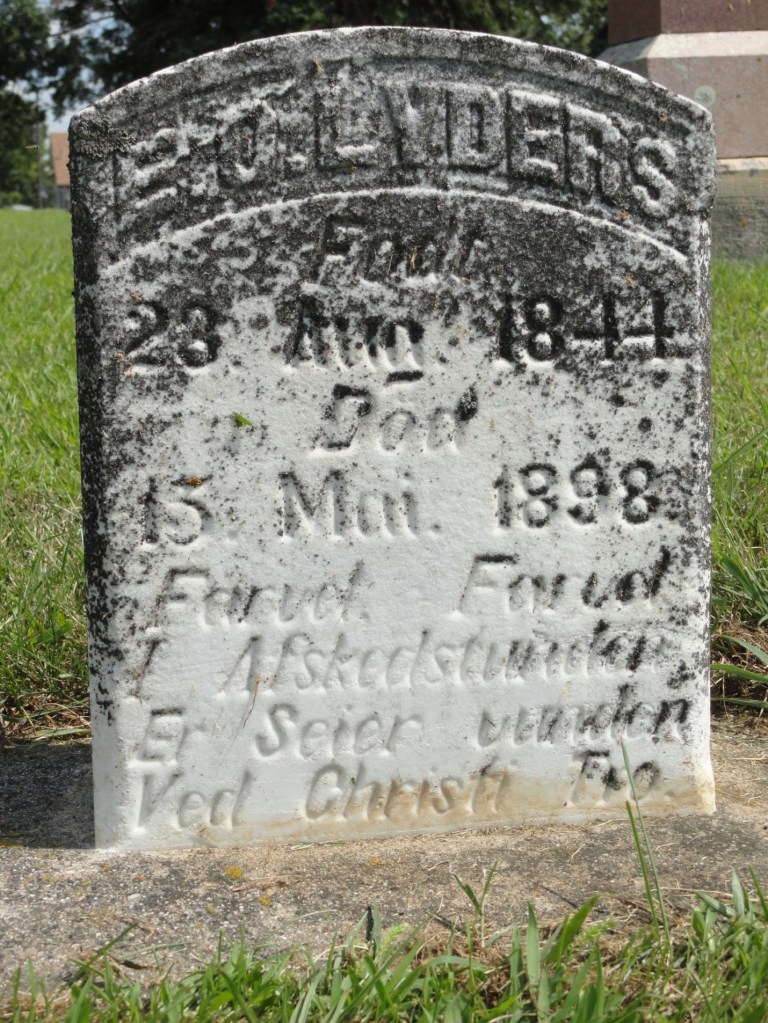
(above) The grave of Dr. E.O. Lyders. I believe the bottom of the marker translates as: “Goodbye, goodbye at parting time. Victory is won by faith in Christ.”
ME, 5/20/1898: “Messrs. C.G.V. and Hans Cormontan and sister Eivinda went to Sacred Heart Monday to attend the funeral of their brother-in-law, E.O. Lyders. He died of heart disease Sunday.” It is assumed that Theodora was ill or was out of town, perhaps conducting business related to her music career.
PW, 5/25/1898: “The two Messrs. Cormontan and Miss Cormontan of Franklin were at the funeral of their brother-in-law, Dr. Lyders. They returned to Franklin on Thursday.”
ME, 5/27/1898: “Messrs. Hans and C.G.V. and Miss Eivinda Cormontan returned from Sacred Heart Thursday.”
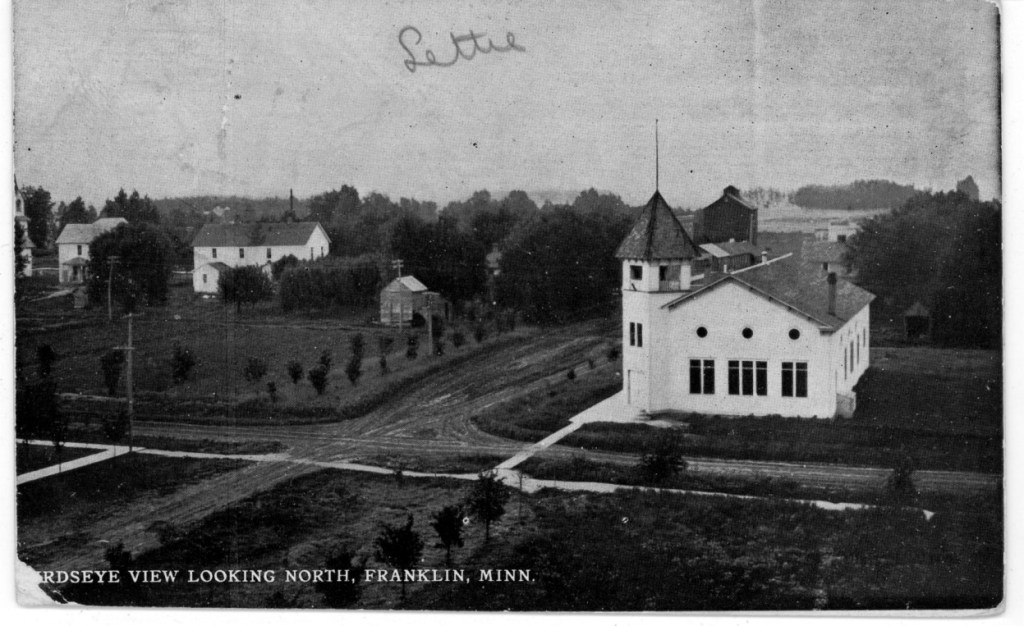
(above) From 1908. The new Town Hall is in the foreground on the right.
ME, 8/19/1898: “A party was given at the Cormontan house last Friday evening in honor of their niece Miss Evinda Lyders, of Sacred Heart. Ice cream and cake were served at 8:30. Those present were the Misses Nell and Net Coffy, Clara Johnson and Tessie Sampson, of this place, and Miss Mamie Henry, of St. Paul. All report a good time.”
ME, 8/19/1898: “Miss Evinda Lyders, who has been visiting at the Cormontan house, returned to Sacred Heart Wednesday.”
PW, 8/24/1898: “Miss Evinda Lyders has returned from Franklin.”
PW, 10/26/1898: “Evan Cormontan of Franklin, who visited with Mrs. Lyders the past two weeks, returned Saturday [to Franklin].”
PW, 11/16/1898: “Miss Evinda Lyders is visiting at Franklin.”
As may be seen below, two newspapers report in January of 1899 that C.G.V. has purchased the Lyders drug store in Sacred Heart and will run the business, while another notes that he has sold his drug store in Franklin. A month later two newspapers report that he has purchased the Madelia Drug Co. in Madelia, MN and will run it. What happened?
PW, 1/11/1899: “Mrs. E.O. Lyders has sold her drugstore to Mr. Cormontan of Franklin. He will take possession of the business in about two weeks.”
Fairfax Standard (FS), 1/19/1899, in the Neighborly Notes section under “Franklin”: “A fact that many will regret to learn is that C.G.V. Cormontan has sold his drug business and will cease to reside in the village of Franklin, having accepted the position of druggist in the store of the deceased Dr. Lyders of Sacred Heart.”
ME, 1/13/1899 Town Talk: “It is learned that L. Kirwan, manager of the City Drug Store in Morton, has purchased the Cormontan Drug Store and will remove to Franklin.”
FS, 2/16/1899: “C.G.V. Cormontan returned this week from Madelia, Minn. where he has purchased a drug store.”
Madelia Messenger (MM), 2/17/1899: “Mr. C.G.V. Cormontan of Franklin, Minn., has purchased the business of the Madelia Drug Company from Noyes Bros. & Cutler. He is now in possession. We wish him success in his business and a pleasant sojourn among us.”
The Bulletin of Pharmacy reports that Edwin Nordstrom became the proprietor of the Sacred Heart Drug Store in 1893. Research at the Sacred Heart Museum reveals that the town’s Property Taxes and Transactions records from 1899 show that Marie did not sell the drug store to C.G.V. that year. Mr. Nordstrom eventually became the owner. Was there a plan for C.G.V. to buy the Sacred Heart drug store (resulting in his selling the Franklin Drug Store) that fell through after the newspapers reported it had happened? Is this why he had to buy the Madelia drug store? Did the financial problems C.G.V. experienced in 1896 compel his sister Marie (Mrs. E.O. Lyders) not to consummate the business transaction? I don’t know the answers to these questions. What is known is that Mr. Kirwan still owned and operated the Franklin Drug Store for at least the next fifteen years, and C.G.V. only owned the Madelia Drug Co. for about 18 months before it folded and he declared bankruptcy.
PW, 1/11/1899: “Miss Evinda Lyders has gone to Franklin where she will spend a few weeks with friends and relatives.”
PW, 1/18/1899: “Misses Baeda Hough and Evinda Lyders are in Franklin, the guests of the Misses Cormontans.”
The 1/27/1899 edition of the Minneapolis Tribune reported that C.G.V. was a visitor to town. Might this trip have been in relation to his business transactions?
FS, 2/23/1899: “The Cormontan family left for their new home in Madelia, last Monday and Tuesday, where C.G.V. will again engage in drug business. We wish him success.”
PW, 10/25/1999: “Married. At the home of the bride’s mother in this village [Sacred Heart] Wednesday, Oct. 25, at 3 p.m., Miss Evinda Lyders, to Mr. N.B. Tweet, Rev. Berg officiating. The wedding was a quiet affair, only a few friends and relatives being present. Miss Lyders is well known to the people of Sacred Heart, having lived here with her parents for several years. Mr. Tweet has been a merchant in Franklin the past few years.” So it appears it was more than just close familial ties that compelled Evinda to visit Franklin with some regularity! The couple eventually moved to Alaska and settled there. The Alaska Mining Hall of Fame website notes that they created a family-owned company that mined gold in Alaska. Evinda and her husband Nicholas (the N.B. in the item above) were named members of the Alaska Mining Hall of Fame in 2010.
Madelia Minnesota 1899-1902
With the following item from the Madelia Messenger newspaper, we learn that C.G.V. Cormontan has made his second major business transaction in early 1899, having already sold his own drug store in Franklin, MN. Note the three languages spoken in his new location:
Madelia Messenger (MM), 2/17/1899: “Having bought the Madelia Drug company’s store we wish to announce to the people of Madelia and vicinity that we will put in a first-class stock of drugs and will give special attention to the prescription trade. We speak English, German, and Scandinavian.
MADELIA DRUG COMPANY,
C.G.V. Cormontan, Proprietor.”
Now that she has moved to a new location, Theodora Cormontan needs to rebuild her roster of music students. She starts in March and April of 1899 by advertising in the newspaper, looking to develop “musical scholars” in the nearby towns of Hanska and Linden as well as in Madelia:
MM, 3/17/99 (advertisement):
“MUSIC!
Miss Theodora Cormontan, Composer and Music Teacher. Pupil of Europe’s Greatest Musicians.
Piano,
Organ
Vocal.
For further information call at MADELIA DRUG CO’S Store, or at Ingram’s new residence.”
MM, spring 1899 (?)—(before 1902), advertisement:
“MUSIC.
Theodora Cormontan
Pupil of Europe’s Greatest Musicians.
Gives instruction on
PIANO,
ORGAN
and VOCAL.
. . . .The newest and best methods . . . .
Vocal Culture, Mathilde Marchesi’s
Italian Singing Method/
Address:
405 Shepard Street, Madelia, Minn.
Wednesdays at Linden, at Mrs. A. Larsen’s.
Fridays at Hanska at Mrs. F. Chambard’s”
MM, 4/14/99 (advertisement):
“MUSIC!
Miss Theodora Cormontan, teacher of . . . . . .
Piano,
Organ,
Vocal
Music,
Vocal
Culture.
At Ingram’s new residence on Shepard street.”
In October of 1899 she branches out by beginning to advertise her published compositions. We found copies of the works listed below among the manuscripts we discovered in 2011:
MM, 10/3/99 (advertisement):
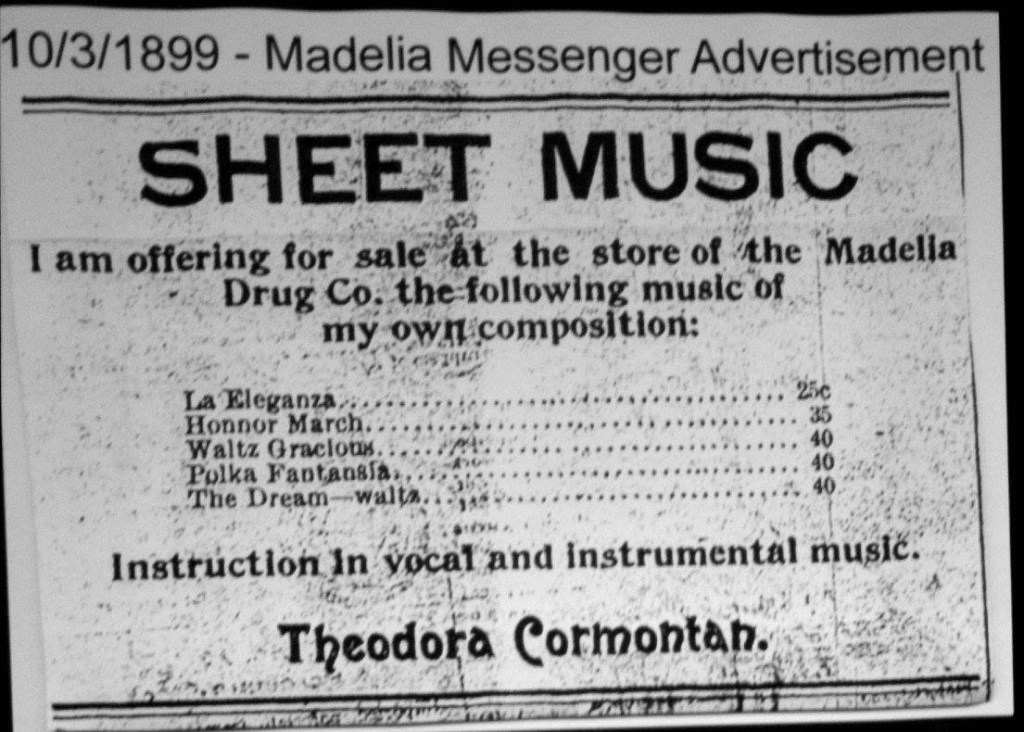
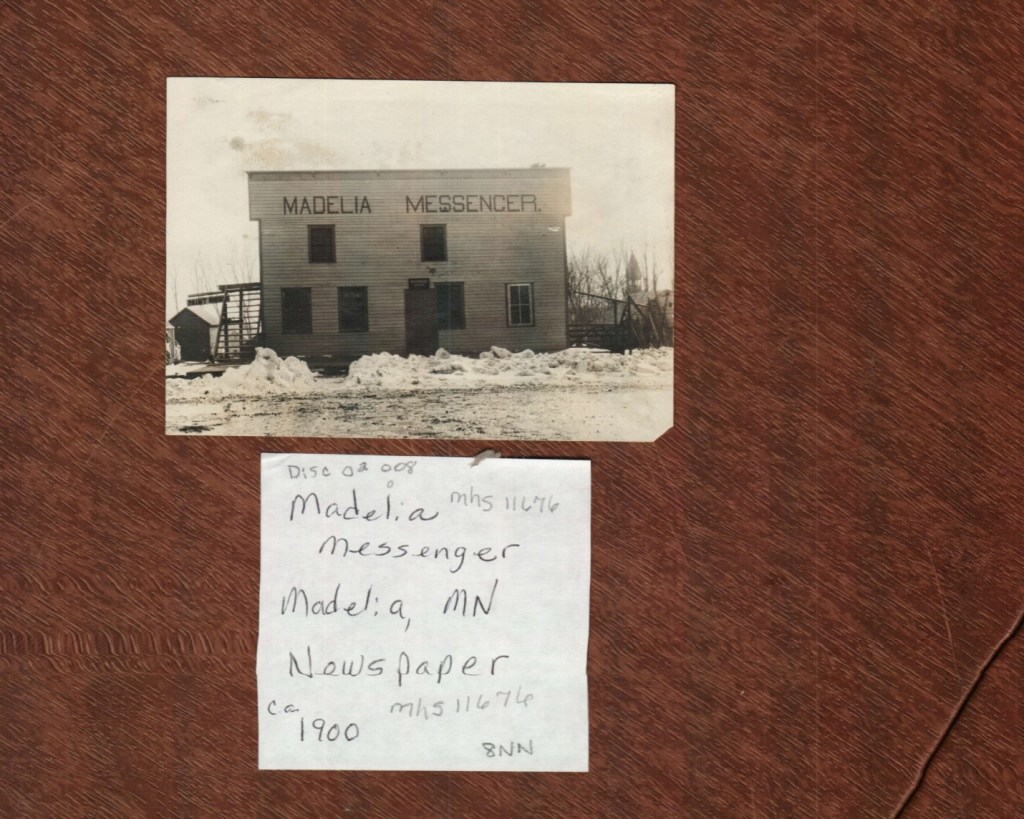
(above): the Madelia Messenger office around 1900
C.G.V. Cormontan also advertised his new business. Beginning in the 2/24/1899 edition of the Madelia Messenger the following copy appears: “Madelia Drug Company, Madelia, Minn. We always carry in stock a full line of pure drugs and medicines and all things usually found in a first-class drug store. Prescriptions a specialty.”
Apparently in response to Cormontan’s ad, competing Bill’s Brothers Drug Store ran an ad on March 24, 1899 that began: “Pure drugs may not mean anything. Some drugs may be pure, but if not fresh they are worse than useless . . .”
Shortly after this, the text of the Madelia Drug Store ads change to read:
“PRESCRITPIONS Filled by us mean just what the doctor prescribed. They will be
ACCURATELY Filled with the greatest of care. We do not substitute. Bring in your prescriptions to be
FILLED. Madelia Drug Co.”
The following items appear in the Madelia papers in 1899:
Madelia Messenger (MM) 3/24: “Druggist Cormontan’s team made a lively run last Saturday, dumping out the four or five persons in the party and then had things its own way. No one was hurt.”
(MM) 5/12: “The progress that her scholars are making stamps Miss Cormontan as a music teacher of superior merit. Madelia is very fortunate in having so talented a teacher.”
Madelia Times (MT) 5/26: The following item announces a festival celebrating the 40th anniversary of the founding of the Lutheran churches in Rosendale and Linden and the 25th anniversary of the founding of Madelia West Church, all started by Rev. Lars Green. “An elaborate program of music by choirs and other musical organizations is being prepared. The Madelia choir is practicing faithfully under the direction of Miss Cormontan.”
(MM) 10/3: “Miss Cormontan is not only a music teacher of the very first class but is also a composer of fine music. She is offering some of her compositions for sale, see her ad. She now has a class of twenty two scholars, and from a personal knowledge we can say some of them are making very rapid progress.”
The following is the most extensive newspaper article we have found regarding any of the members of the Cormontan family while they were alive. The special edition of the Madelia Times newspaper where this item appeared featured numerous businesses in Madelia:
Madelia Times, 12/15/1899:
“C.G.V. Cormontan, manager of the Madelia Drug Company.
In Europe the pharmacist confines himself to compounding drugs and filling prescriptions, while in America the druggist, to thoroughly understand his business, must possess manifold qualifications in order to cope with the diversified pharmaceutical preparations constantly produced.
Mr. Cormontan came to this country from Norway in 1872, and he is a druggist of twenty-seven years’ experience. He is a registered pharmacist and came to Madelia eight months ago and bought out the drug store, located first door west of the Watonwan County Bank, and the building is 24×75 feet. [The address is 32 West Main in Madelia.]
Only the most reliable class of goods are [sic] handled in this line and particular care is taken to insure their freshness. Everything conceivable in the way of toilet goods may be found here in choicest selection, and when you want to invest in articles in this class, inspect the stock here found, and if you turn away dissatisfied it will be the fault of the manufacturer who failed to produce anything of your wants rather than him who carried the assortment.
We all take pleasure in good penmanship; but beautiful script characters do not appear in pleasing review unless traced upon a good grade of dainty note paper, and when you want to avail yourself of the latest and best stationery, call on C.G.V. Cormontan. Oils both for lubricating and illuminating purposes are kept constantly on hand. Wall paper of the latest and best designs [is] here in complete array, and some exceptionally low prices will be found in this especial line of goods. Miscellaneous books and all school supplies are purchased here.
The long distance telephone is located here.
E. Cormontan is the clerk. Personally these men are of a high order of intelligence, full of energy and honorable to an eminent degree, and they are valuable adjuncts to the business as well as the social circles of the place.”
The E. Cormontan of the last paragraph is Evan (Even) Cormontan, the son of C.G.V. Cormontan’s older brother Magnus. Magnus died in Fosston, MN in 1892 and Evan subsequently apprenticed with his uncle. The U.S. Census of 1900 notes that Evan is 19 years old and living with the Cormontan family. Evan worked as a pharmacist in Bemidji in 1909 before returning to Fosston in 1910 to be a pharmacist in that town for several decades.
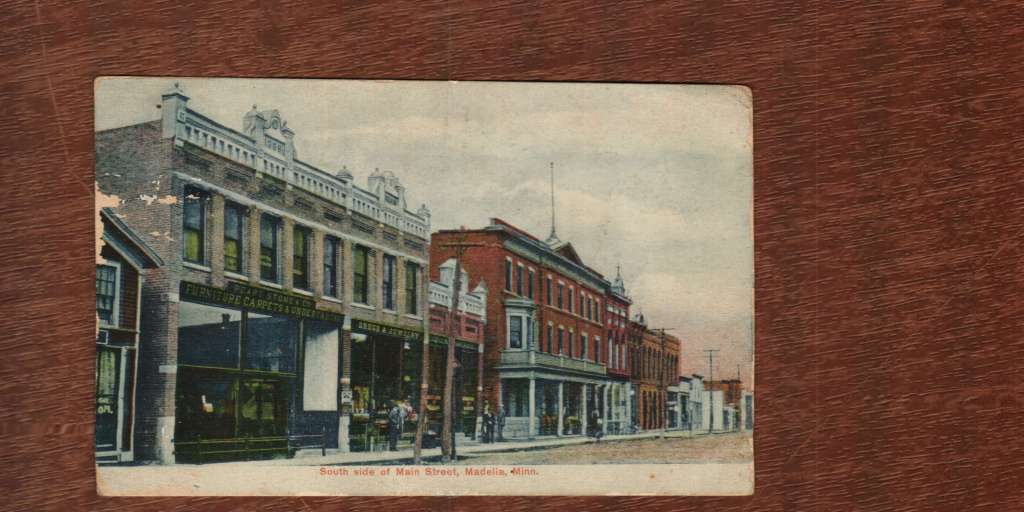
(above) South side of Main Street, Madelia in 1907. The Madelia Drug Co. was located in the orange-ish building next to the red building.
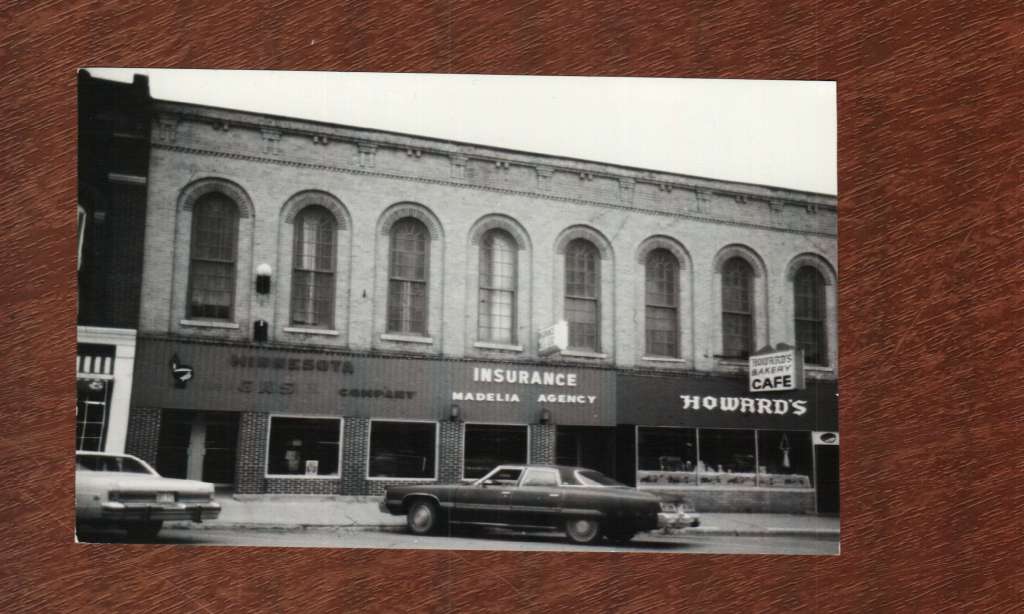
(above) A closer look at the Madelia Drug Co. location, functioning as Howard’s Cafe from 1966-1983.
The Madelia Drug Co. runs what appears to be its first ad in the Madelia Times in December of 1899: “Holiday Goods. A complete line of albums of all kinds, celluloid novelties, fancy crockery, work boxes, toilet cases, glove and handkerchief boxes, etc, etc. Call in and see us. Madelia Drug Co.”
Another ad appeared beginning in the 1/19/1900 edition of the Madelia Times: “Madelia Drug Co. Drugs and Medicines, Proprietary Preparations, Sundries, etc. Prescriptions filled Day or Night. Standard Sheet Music. “
C.G.V. also ran a new ad for the drug store that first ran in the 1/19/1900 edition of the Madelia Messenger on page 6: “Madelia Drug Co. Doubt is never allowed to enter our Prescription department. There are no doubtful drugs in it–Hurry and carelessness are never allowed to cast doubt upon the medicines we dispense. We do all in our power to furnish drugs that will secure the results that are desired by your physician. Taking cheap drugs is false economy. We promise you the best. Give us your patronage and we will guarantee satisfaction.”
In the 2/9/1900 edition Madelia Drug Co. advertises that it is the sole agent of Tudor & Co.’s eyeglasses and that eyes will be examined free at the store on 2/14 and 2/15.
MT 1/26/1900, News of the Week Local and County: “One of the most interesting and amusing entertainments of its kind that has been given for a long time was that at the Christian church last Friday evening. The program consisted chiefly of five unique and forcible moving tableaux accompanied by music, each representing different scenes. Miss Theodora Cormontan was organist. At the close the audience went to the basement by way of the new door near the main entrance, where refreshments were served.”
MT 2/23/1900, Local: “Evan Cormontan and Frank Thompson were out to Truman the first of the week.”
Another new ad first ran in the April 20, 1900 edition of the Madelia Times: “When cleaning house–You should use ammonia. It is one of the best cleaners known. 10 cents worth of our AMMONIA, 26 DEGREES BAUM [sic], diluted with rain water, makes one gallon of cleaning fluid. We GUARANTEE it to be better and stronger than what is known as Household Ammonia, sold in bottles at 10 cents a quart. Quite a difference in the cost, isn’t there? Try it. Your money back if you want it. The low prices of our Chamois Skins, Sponges, etc. do not mean poor quality. We aim to give large values at little cost. Madelia Drug Co.”
MM 5/11/1900 Local Paragraphs: “Mr. Cormontan’s team got the start of him Sunday and jerked him down, injuring his shoulder to a certain extent, and badly demolishing the buggy.”
Unfortunately for the Cormontan family, Bill’s Drug Store, established in 1870 and the first drug store in the county, was already a fixture in Madelia. C.G.V.’s drug store would be neither the first nor the last to come and go in Madelia, unable to compete with Bill’s. The following items document the business and financial failure:
MM 6/8/1900, The Local Layout: “The Madelia Drug Store has again fallen into the hand of Noyes Bros. and Cutler, wholesale druggists of St. Paul, Mr. Cormontan having to give up to pressure of severe competition. J.W. Bowen is in charge.”
MT 6/29/1900, News of the Week: “The hearing in the Cormontan bankruptcy case was held in Mankato yesterday. D. [Dudley] G. D’Evelyn was appointed trustee.” D’Evelyn made his living buying and selling real estate. He was also the City Recorder in 1900.
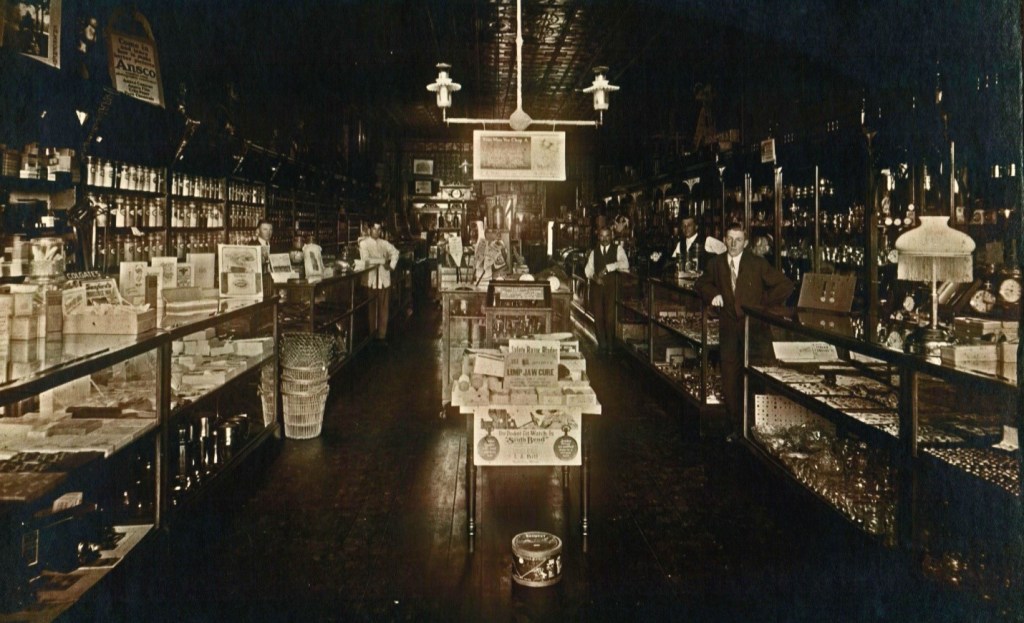
(above) Here is a picture of the interior of Bill’s Drug Store from around 1910. On the back of the picture the gentlemen are identified from left to right as Clifford Lewis, Carl Segar, Mr. Bill (J.J.), Mr. Denkhoff, and Dyar Bill.
MM 6/8/1900, The Local Layout: (regarding information on the 1900 high school commencement exercises) “Thanks are due Miss Cormontan for training the class in their school song.”
MM 7/13/1900, The Local Layout: “The long distance telephone, which has been located in the Madelia Drug Co.’s store, will be removed to the central exchange office next week. The Drug Co.’s store will receive an overhauling and will be restocked and opened for business in a few days.”
MM 7/20/1900, The Local Layout: “Messrs. Cormontan and sisters have moved into and are now to be found at home in the Ed. Noonan residence.” Another item in the paper noted that Mr. Noonan and family moved to Truman, MN where his business was located.
MM 8/9/1900, The Local Layout: “C.G.V. Cormontan has accepted a situation with the Ryan Drug Company St. Paul, and left yesterday to go to work selling goods on the road. The family will remain here at present.” The Madelia Times also reported this in its 8/10 edition.
MM 9/14/1900, The Local Layout: “E. [Evan] Cormontan was in the cities a couple of days last week.”
The 9/7/1900 edition of the Madelia Messenger reports that Dr. Douglas F. Wood has moved from Faribault, MN to Hanska to practice medicine. By the following week Dr. Wood has located his office and residence on Main Street in Hanska. The paper said that he was very busy and expected to establish a drug store. Joined by his brother, Dr. G.W. Wood of Faribault, the paper wrote on 10/26/1900 that the Woods Drug Store opened on October 25. The paper did not report who was acting as the pharmacist, but it was probably C.G.V. His employment there is documented by February of 1901, as noted in the following:
MT 2/22/1901, News of the Week, Local and County: “C.G.V. Cormontan, who is in a drug store in Hanska, visited with relatives here [Madelia] last Sunday.”
MM 4/12/1901, The Local Layout: “C.G.V. Cormontan, who has charge of the Wood Bros. drug store at Hanska was in Madelia visiting with his sisters and brother.” The Hanska section in the same edition also noted the visit.
MM 6/21/1901, The Local Layout: “Miss Theodora Cormontan will be in Linden, every Wednesday, with Mrs. A. Larson and in Hanska, with Mrs. Fred Chambard, every Friday. See her for instruction in music.”
MT 6/28/01 Hanska: “C.G. Cormontan was a business visitor at New Ulm Monday.”
MM 7/16/1901, The Local Layout: “E.H. [Evan] Cormontan who has been working at the Times office left Saturday morning for Two Harbors, Minn., to work in the office of the Iron Trade Journal.” The Times also reported this.
MM 1/3/1902, City Locals (regarding a “Christmas entertainment” at the East Lutheran Church): “Several organ solos given by Miss Cormontan were nicely executed and were well received.”
St. James Gazette, 3/28/1902: “Theodora Cormontan, pupil of Europe’s greatest musicians, will be in St. James on Wednesday and Thursday, April 2nd and 3rd to give instruction on piano, organ and vocal music. Call and see her at M.G. Fossum’s residence.”
MM 4/4/1902, Personal and Otherwise: “Miss Cormontan has organized a music class in St. James. The St. James people appreciate a good music teacher.”
Theodora, Eivinda, and Hans would join C.G.V. in Hanska in June of 1902:
New Ulm Review, 5/21/1902, Hanska (from the Herald): “The Misses Cormontan have taken the Meese rooms and will occupy them about the fifteenth of June. Miss Theodora Cormontan is a music teacher. They come here [Hanska] from Madelia.”
Madelia Times, 5/23/1902, “Yourself and Others”: “The Hanska Herald says the Cormontan family has engaged rooms and will move to Hanska, the middle of next month.”
Madelia Times, 6/13/1902: The Cormontan family expects to move to Hanska, tomorrow, to make their home there for the future.
Madelia Messenger, 6/20/1902, “Grist of the Week”: “Miss Theodora Cormontan and brother Hans moved their household effects to Hanska last Saturday, where they will take up their residence with a brother living there. Miss Cormontan will give music lessons in Madelia Thursdays and Saturdays.”
The move compels Theodora to change her advertising. Now she is visiting Madelia and living in Hanska. The ad featured below dates from November, 1902, but contains the same copy she used in June:
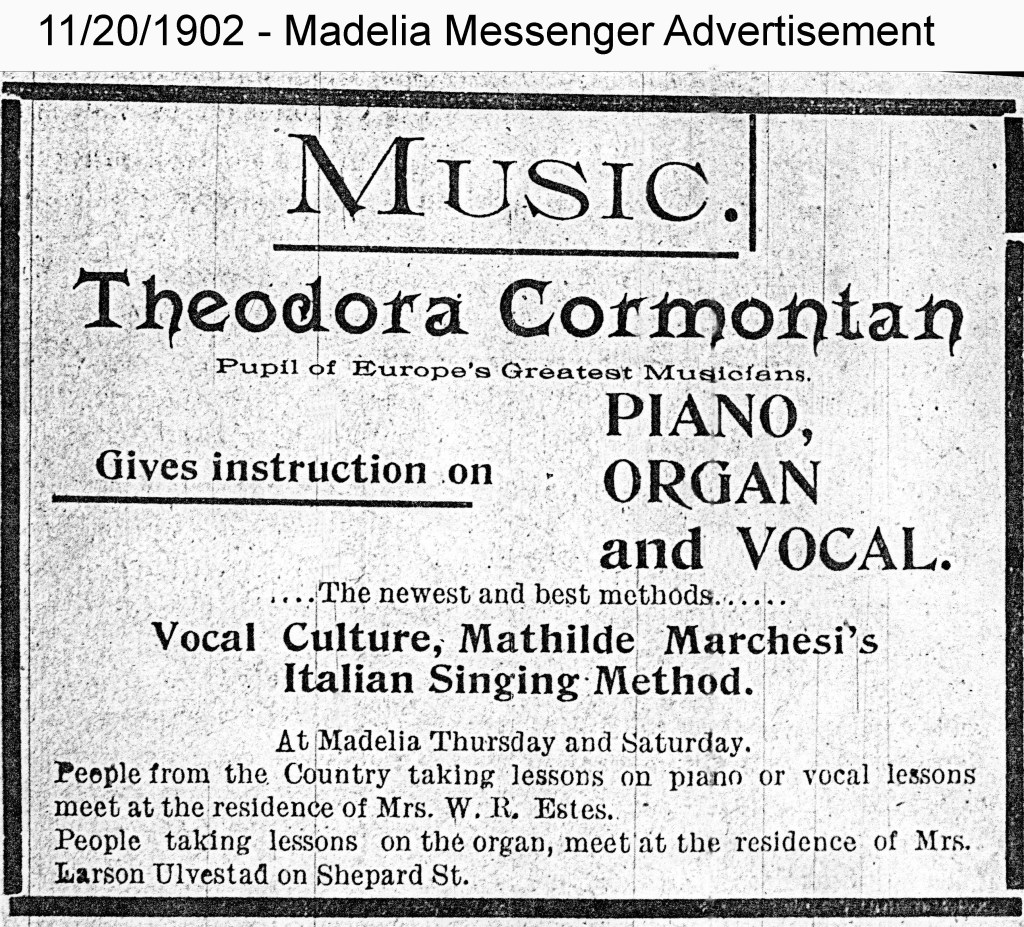
MM, 7/25/02 (advertisement):
“Theodora Cormontan
Gives instruction on
Piano, Organ and Vocal.
At Madelia
Thursday and Saturday.”
From this point the Cormontan family receives less coverage in the newspapers. It also appears that they never fully recover from the business failure and subsequent bankruptcy. C.G.V. no longer owns his own drug store. The Brown County Directory of 1901 notes that he is a clerk for Douglas and George Wood and the Woods Brothers Drug Store.
We know that the family belonged to Madelia West (now Trinity) Lutheran Church in Madelia. An article in the December 15, 1899 issue of the Madelia Times reports that the church has a congregation of about 75 families and notes “As a church it is conservative and strong.”
Here is a scan of the Madelia West Ministerial Book from 1900–#13 on the list is “G. Carmangtang” and #44 is “Miss Carmontang.”
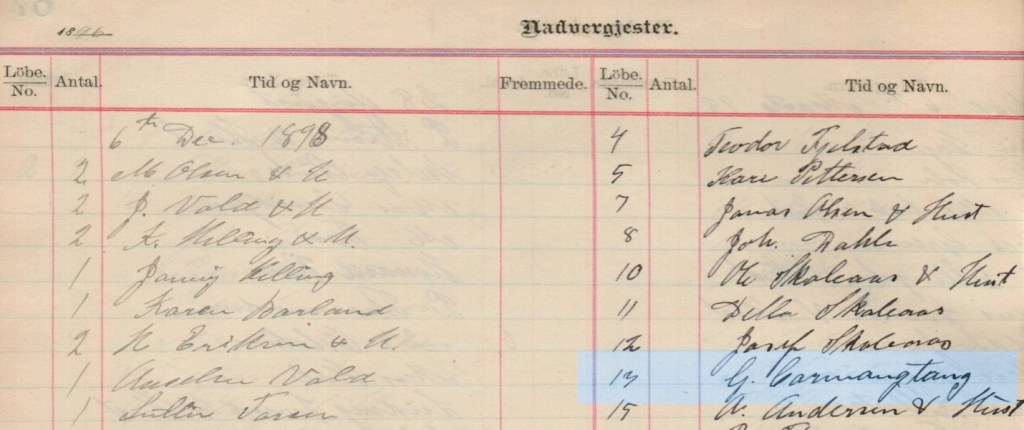
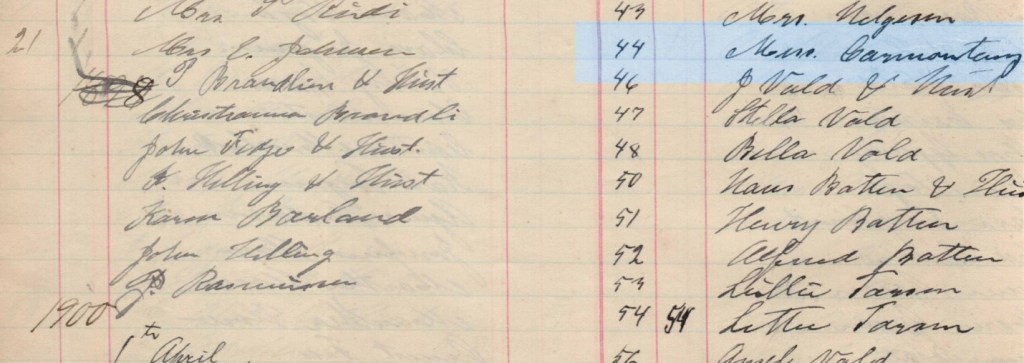
We close this section with a picture of Madelia West Lutheran Church taken early in the 20th century. The church was razed in 1950 and the current Trinity Church was erected in the same location:

Hanska Minnesota 1902-1905
By 1901, C.G.V. worked as a pharmacist/clerk for Woods Drug Store in Hanska, Minnesota. The 1901 Northwestern Druggist noted that “Mr. Cormoton [sic], representing Wood Bros., of Hanska,” attended the Brown County Retail Druggists association meeting in New Ulm, MN on Thursday, September 26th, 1901.
The rest of the family temporarily remained in Madelia, but the siblings found opportunities to visit each other, as contemporary newspapers noted:
Madelia Times (MT) 7/19/1901, Hanska: “C.G.V. Cormontan Sundayed with relatives and friends in Madelia.”
Madelia Messenger(MM) 10/11/1901 Hanska: “C.G. Cormontan was in Madelia Sunday.”
(MM) 10/25/1901 Hanska: “Miss Cormontan of Madelia was in the village last week visiting her brother C.G. Cormontan.”
(MM) 12/20/1901 Hanska: “C.G.V. Cormontan entertained his brother and sisters from Madelia last Sunday.”
(MM) 1/24/1902 Hanska: “Miss Theodora Cormontan and brother, of Madelia, Sundayed with C.G.V. Cormontan, their brother.”
(MM) 3/21/1902 Hanska: “C.G.V. Cormontan spent Sunday with his brother and sisters in Madelia.”
Theodora also taught in Hanska in 1901:
(MM) 7/16/1901 Hanska: “Miss Cormontan of Madelia was in the village Friday. She has organized a large musical class which she is teaching.”
In 1902 the rest of the family joined C.G.V. Cormontan in Hanska. The following picture, reportedly taken in Hanska during their 4th of July festivities of 1903, shows how the Woods Drug Store appeared while C.G.V. worked there. The drug store is to the right of the Torgrimson & Synsteby Furtiture and Undertaking store (!). Actually, the business combination of building furniture and coffins was common during this time.
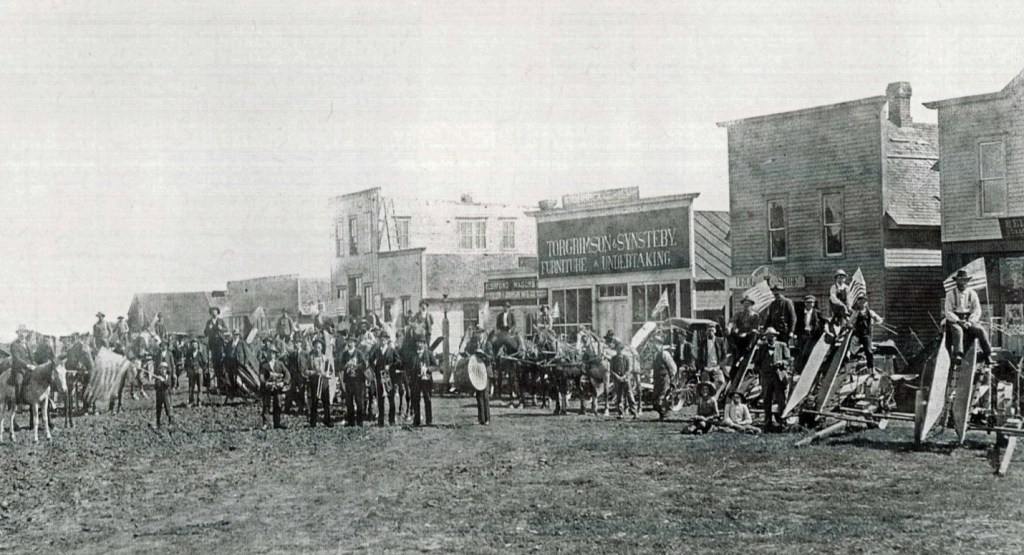
The family joined the Lake Hanska Lutheran Church on April 26, 1903. In the scan below from the church’s ministerial book, note that Hans and C.G.V. have their last name included, while Theodora and Eivinda get a “Do,” which stands for “Ditto.”
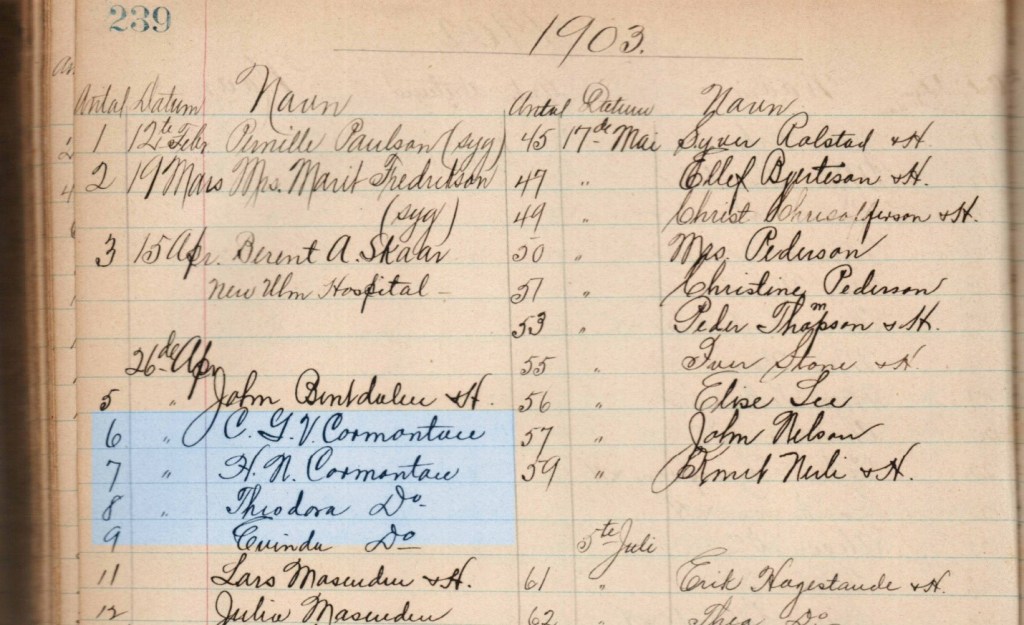
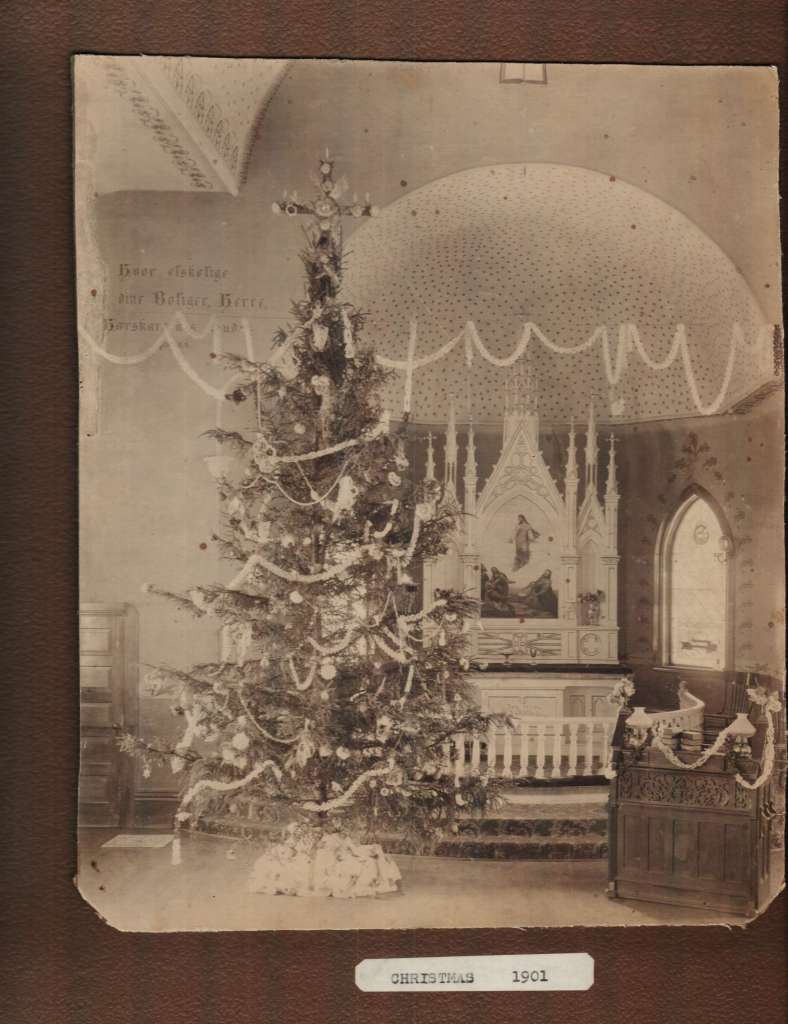
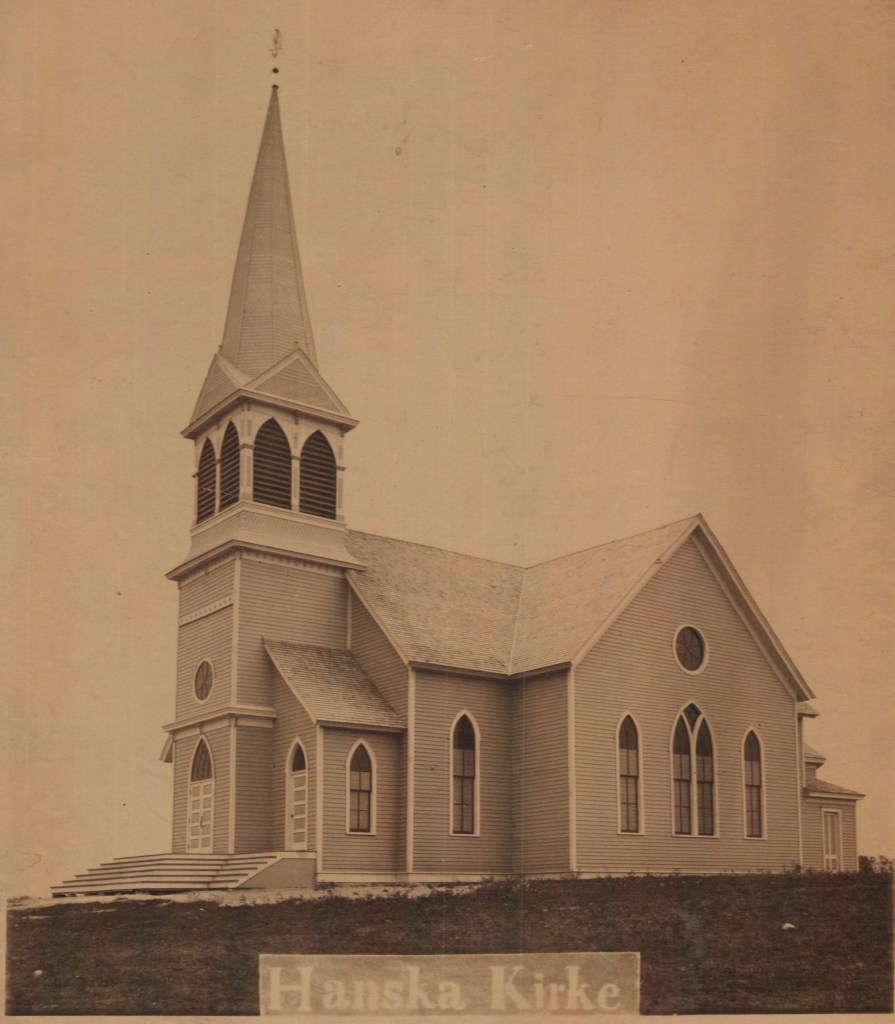
Thanks are extended to Hanska native Joel Botten for the following information regarding Zion Lutheran Church in Hanska. Joel was one of the members of the group who traveled to Norway in 2015 to return the music of Theodora Cormontan to her native land.
From the “Fiftieth Anniversary of Zion Lutheran Church” booklet, published in 1953: “The original meeting for establishing a Lutheran Congregation in Hanska was held on November 29, 1903, at the H. V. Anderson home. Pastor G.O. Skaret, pastor of the Lake Hanska Congregation at the time, first formulated the idea of establishing a congregation in town. Heretofore the Methodist Congregation was the only denomination in Hanska. There were thirteen original members who showed a great deal of enthusiasm in Rev. Skaret’s meeting.”
Hans Cormontan was one of the thirteen original members. The group selected the name Zion’s Scandinavian Lutheran for the new church. At the first meeting Hans Cormontan was elected as a deacon along with Christ Ahlness, Joel Botten’s great-grandfather. In 1904 the church organized a Sunday School, with C.G.V. Cormontan as one of the teachers. The public school allowed the Sunday School to use the school building from 11 a.m.-12 noon every Sunday.
The Cormontan family received two mentions in the Hanska paper during 1903. These reflect that C.G.V. stayed active as a professional and that Theodora continued to perform:
Hanska Herald 10/19/1903 Local News: “C.G.V. Cormontan took in the Druggist Convention at New Ulm Tuesday.”
Hanska Herald 12/25/1903: “Miss Cormontan” played the prelude and a “closing instrumental” for the Lutheran Ladies’ Society Christmas program in the school house.
The Madelia Times-Messenger ran the following under “Hanska” in its 10/2/1903 edition:
“On Saturday evening Mr. Hans Cormontan returned from the country quite late and left his team in front of the house without tying them while he went to get a lantern. When Mr. Cormontan emerged from the house the team was gone. [A] Search was made but was of no avail. They were found Sunday morning in Chambard pasture north of the school house. One horse was scratched a little but otherwise no damage was done.”
(below) Here’s a picture of the school house from about this time:
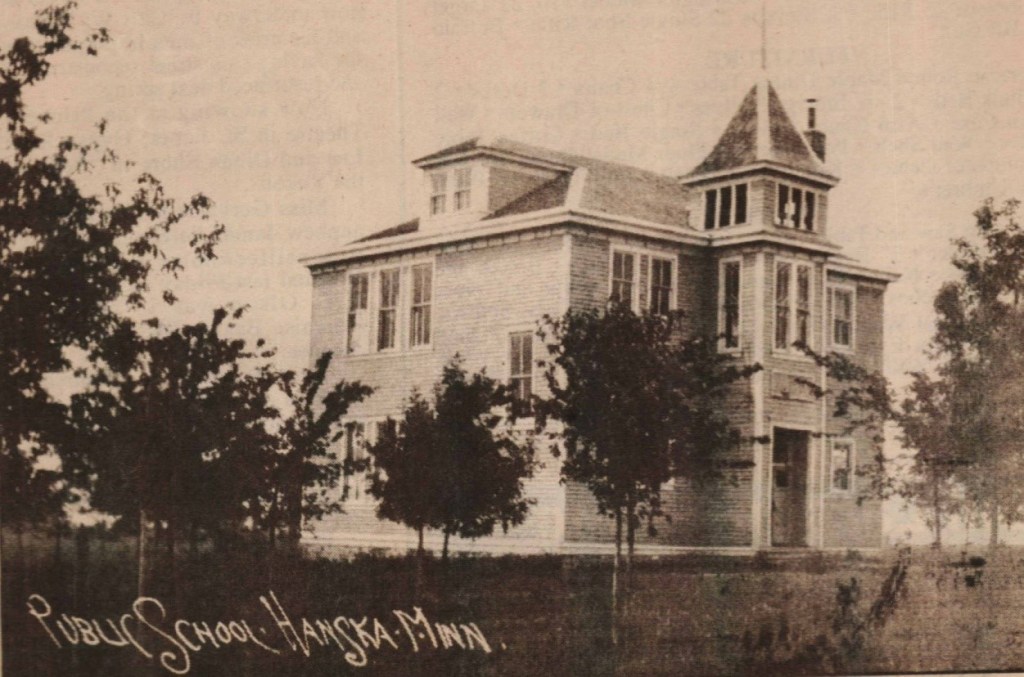
Theodora continued to compose. One of our favorite concert openers, “In a Rush,” dates from 1904.
By this time C.G.V., for unknown reasons, was ready to move again, as noted below:
Hanska Herald 1/29/1904, Local News: “C.G.V. Cormontan, who for the past three years has had charge of the drug store here, resigned his position Wednesday and will leave Saturday for Kennedy Kitson Co., where he has accepted a like position at that place. Mr. Cormontan is a graduate from the college in Norway of pharmacy and chemistry and has many years experience.”
Hanska Herald 2/5/1904, Local news: “C.G.V. Cormontan left Monday morning for Kennedy to take up his position at that place.”
This time the rest of the family would not follow. Perhaps the move was understood to be only temporary. Perhaps they thought it was too far north. Sometime before the end of 1904 Hans, Eivinda, and Theodora lived in Madelia.
(below) One more view of Hanska from around this period. The church in the center background is Zion Lutheran Church:
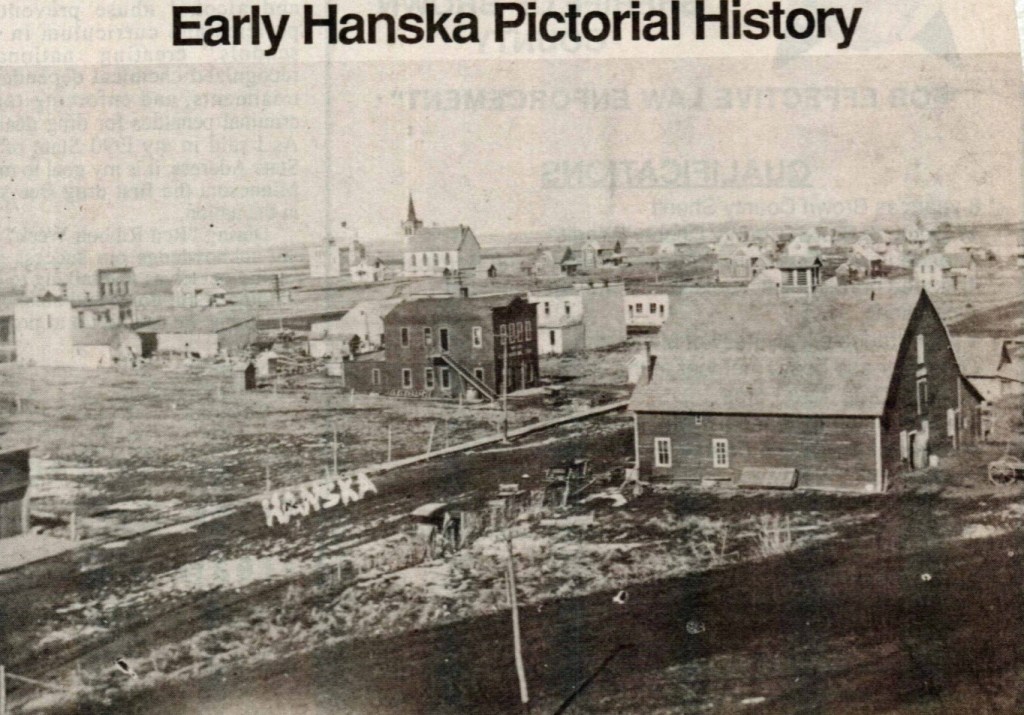
Madelia Minnesota II 1905-1908
By 1904 C.G.V. Cormontan works as a pharmacist in Kennedy in far northern Minnesota. Before the end of the year, the other three family members move back to Madelia. In the 1905 Minnesota census it appears that Theodora and Hans are in one location while Eivinda is in another; probably only temporarily. There is evidence that they returned to the West Lutheran Church to worship.
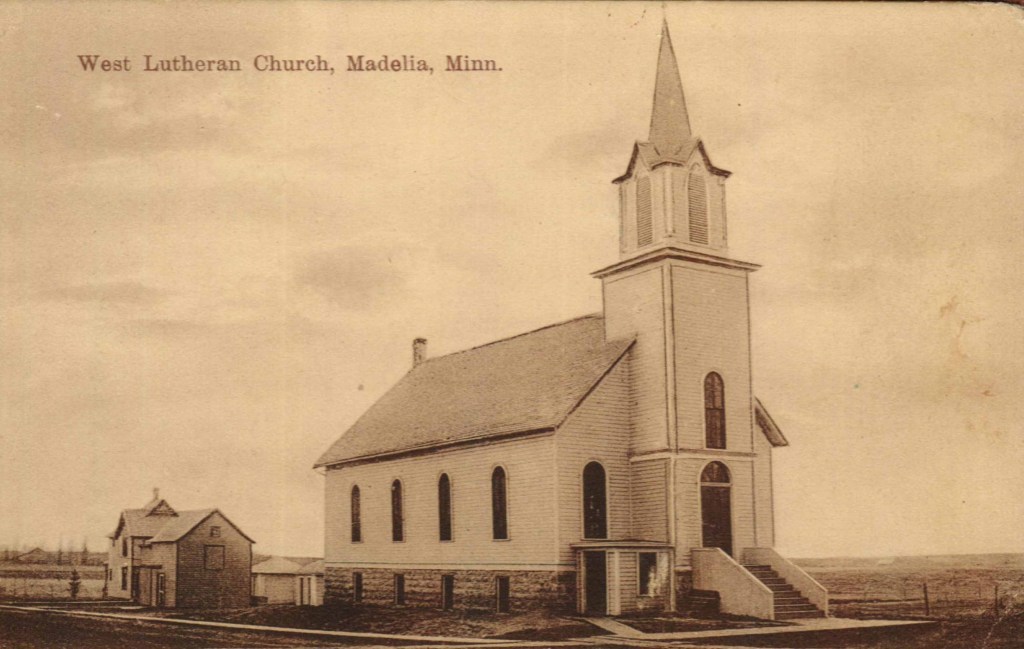

West Lutheran Church (above): the outside of the church, how the sanctuary looked while the Cormontan family attended, and their Pastor Lars E. Green.
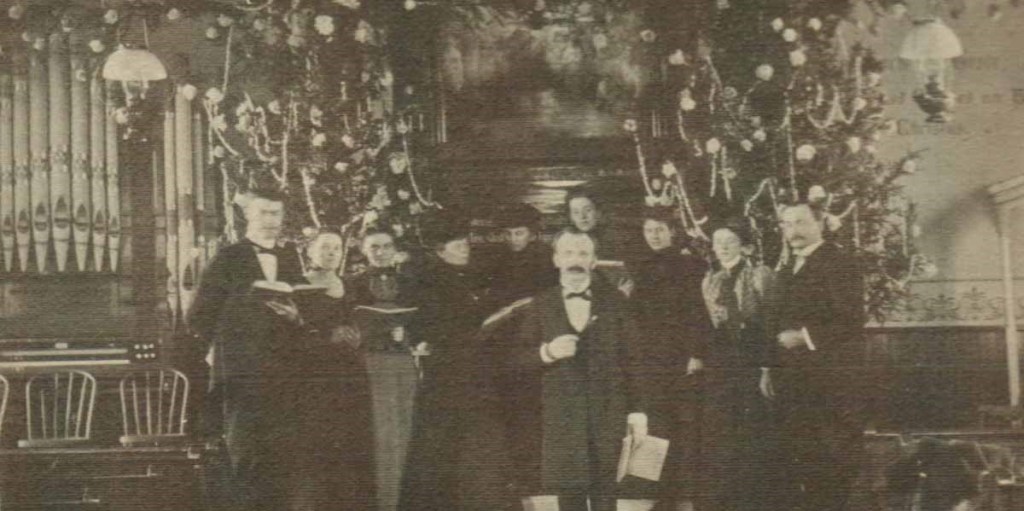
(above) The West Lutheran Church choir from 1900. Theodora conducted this choir in 1899 and perhaps at other times as well.
Once again Theodora would be compelled to use newspaper advertising to alert potential students of her new location:
Madelia Times-Messenger 10/28/1904, in the Local News section: “Theodora Cormontan, pupil of Europe’s greatest musicians, gives instruction on Piano, Organ and Vocal. Instrumental music is taught by the newest and best of methods. Vocal Culture, Mathilda Castorne Marchesi’s singing method. At Madelia Thursdays, Fridays and Saturdays. New scholars call on Mrs. M. Dossett or Mrs. J. Nielson.”
The ad ran through the rest of the year. In 12/2/1904 it appeared with a new last sentence: “New scholars can call on me at my home, the L.A. Dodge residence.” This ad continued through at least 9/8/1905. L.A. Dodge was Amos Linzee Dodge, son of George W. Dodge, a prominent livestock dealer in Madelia.
As information in the newspapers on Theodora grows more scarce, it helps to connect with her circumstances by noting some peripheral information discovered that still assists in understanding her life and her times. For example, at the Watonwan County Museum in Madelia we found a notebook used for piano lessons. This notebook belonged to Mabel Dodge, daughter of George W. and sister of L.A. Dodge. The Madelia Times newspaper noted that Miss Dodge was the class president of a group of seven who graduated from high school in 1900. The May 16, 1902 edition of the Madelia Messenger reports that she was graduating from Mankato MN Normal and would be teaching in Pipestone, MN in the fall. The 1905 census reported that she was in her mid-twenties and living with her parents. She taught second grade in the Madelia school system from 1905-1907, making $45.00 a month the first year and $47.50 the second.
The music book looks like it was used in the 1890’s: for example, on one page it appears to quote (fairly inaccurately) a line from Ethelbert Nevin’s “The Rosary,” published in 1898. It is possible that Mabel took some piano lessons from Theodora in the first decade of the 1900’s; it is almost certain they knew each other, since Theodora taught the school song to Mabel’s high school graduating class in addition to living in the home of Mabel’s brother.
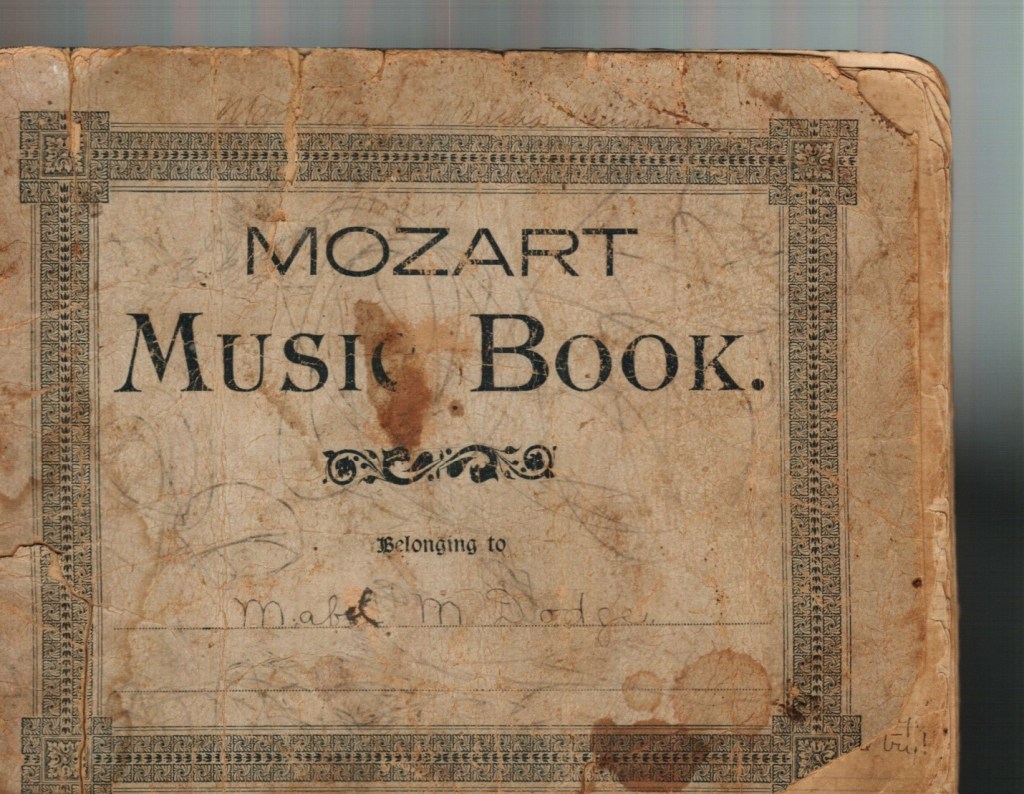
Theodora continued to compose and perform. While she certainly played more than the newspapers noted, she received two mentions during this second stay in Madelia:
Madelia TM 10/3/1905, Local News: “The song service of the Presbyterian church last Sunday morning given by the choir assisted by Miss Theodora Cormontan proved to be a musical treat such as is seldom heard in Madelia.”
Madelia TM 6/1/1906, front page: An article announces that Theodora Cormontan will play Schubert’s Serenade at the 18th annual commencement exercises for the Madelia High School on Monday, 6/4/1906 at 8:30 pm. Ten students graduated.
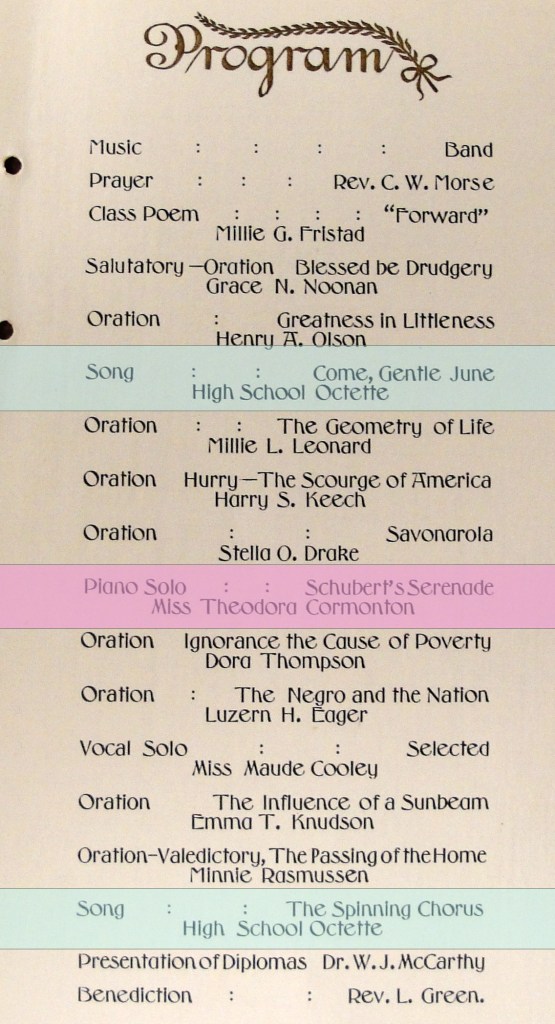
(above) A copy of the program for the 1906 graduation. Stella Drake (mentioned below) sang in the High School Octette.
As luck would have it, we found a photograph of the Madelia High School graduating class of 1906 at the Watonwan County Museum:
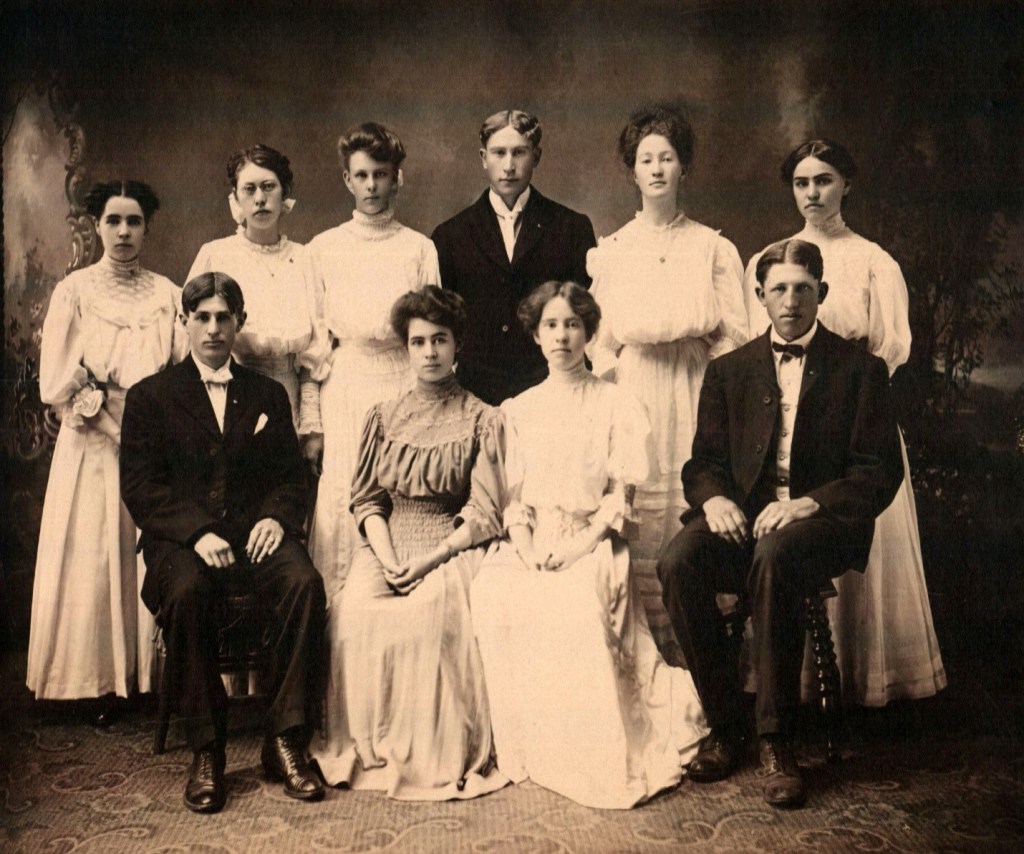
(Back row): Dora Thompson, Millie Leonard, Minne Rasmussen, Henry Olson, Stella Drake, Millie Fristad; (Front row): Harry Keech, Grace Noonan, Emma Knudson, Luzern Eager.
Contemporary Madelia newspapers reported that two of the graduates, Stella Drake and Emma Knudson, frequently played piano solos and collaborated on duets during the first decade of the 20th century. For example, they played a duet at the 1910 Madelia High School Alumni Banquet. It is quite possible that Theodora was invited to perform at the commencement because she gave piano lessons to Emma, Stella, and perhaps other members of the Class of 1906.
Meanwhile, C.G.V. received two 1906 mentions in the Kennedy, MN Star newspaper. The first noted that, though separated from his family, he still had friends who cared for him. The gift they gave may indicate concern about his financial situation as he grew older in the days before Social Security.
2/2/1906, Locals section, p 5: “A number of Mr. Cormington’s [sic] friends quietly gathered and going over to the drug store surprised the old gentleman and when the din had subsided, turned over to him a purse containing $10.00 in cash. The occasion was the celebration of Mr. Cormington’s seventieth birthday.”
The second item may reflect a continued restless spirit, or continuing financial worries:
5/4/06, Locals, p 5: “Mr. C.H. Cormonton [sic] has severed his connections with the drug store here and has been offered a position in Halstad [MN] which he accepted and for which he departed from here Wednesday. Mr. Cormonton has been in Kennedy over two years and we regret to see him leave, but wish him abundant success in his new position.”
The Halsted position apparently did not last long. By December, 1906, the Northwestern Druggist would report the following: “A.G. Cormanton [sic], of Madelia, is assisting in Chas. Leven’s store in St. James.”
The local paper would note this at a later date:
St. James Journal Gazette 11/8/1907 Overflow Local section: “C.G.V. Cormontan, formerly in the drug business at Madelia and Hanska, is assisting in Chas. Levens drug store. Mr. Cormontan is a registered pharmacist.”
C G.V. also worked as a druggist in nearby Hanska:
New Ulm Review 8/14/1907, under Notes from Hanska: “Mr. and Mrs. Ringnell have gone to North Branch for a month. Mr. Cormonton [sic] of Madelia and Everett Chambard are running the drug store in his absence.”
The Cormontan family would reside in St. James by early 1908.
St. James Minnesota 1908-1917
C.G.V. Cormontan was working as a pharmacist at the Chas. Levens drug store in St. James, Minnesota by 1907. According to the minutes of the Norwegian Evangelical Lutheran Church (now known as First Lutheran), Hans Cormontan was recorded as a member in January, 1908. The rest of the family was noted as “silent” members in those minutes. This order of membership is confirmed in the List of Church Members below. The church minutes also indicate that Hans was a church sexton in 1910 and Theodora was one of the organists in 1915. This likely indicates that she served as a musician there throughout the time the family retained membership in the church.
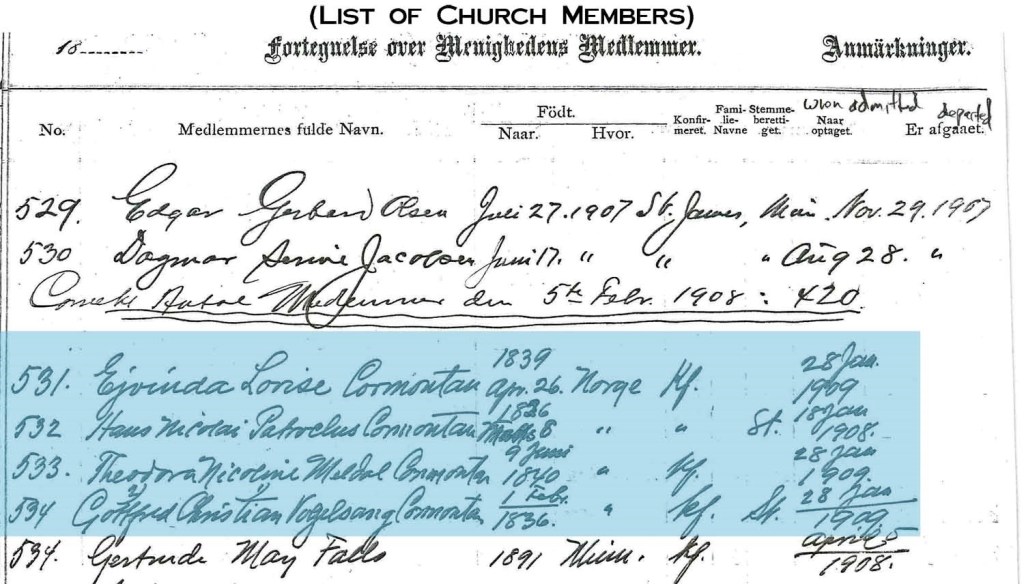
(above) A scan from the Norwegian Evangelical Lutheran/First Lutheran Church in St. James documents that at least three of the four family members joined the church on January 28, 1909, after having visited in 1908 and being designated “silent” members. Hans joined a year earlier. Note that the full names of all four family members are written out here–no “dittoes.” The First Lutheran Church was part of the United Synod, a change from the Norwegian Synod that had been the choice of the Cormontan family when they lived in Franklin. The Madelia West and Lake Hanska churches were also part of the United Synod when the Cormontan family was members.
The following picture dates from 1908:
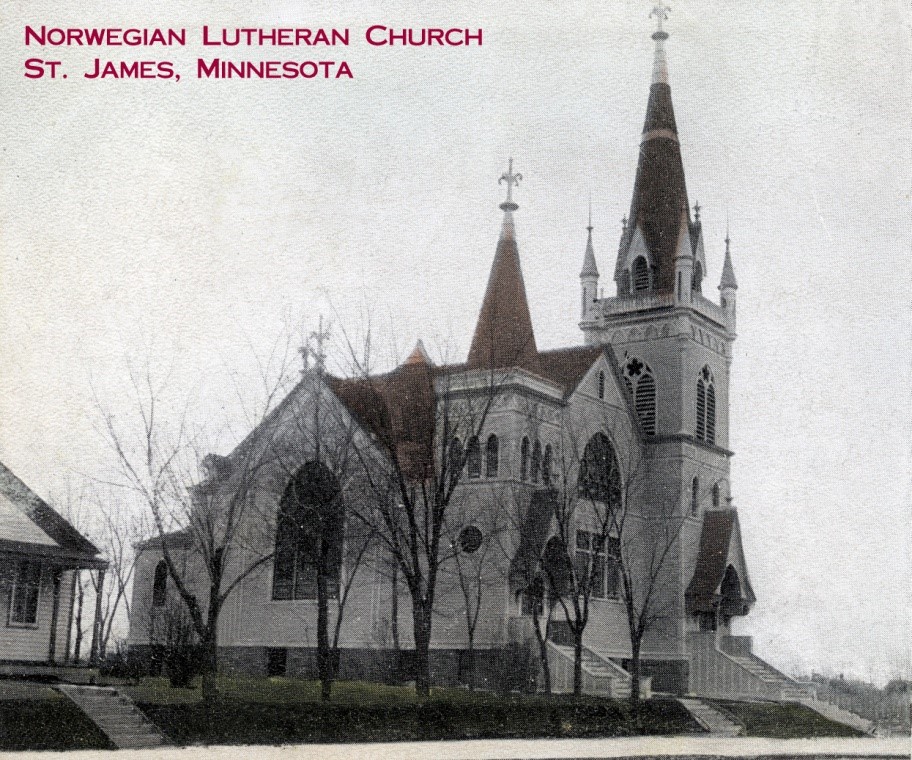
It may be assumed that Theodora continued teaching music in St. James, though there is no record of her advertising for students as she did in Madelia. While none of her manuscripts are dated later than 1908, one of them is a setting of a poem that was not published in the U.S. until 1909 while another is dedicated to a bride who married in 1913, so evidence indicates that Theodora continued to compose in St. James. She certainly continued to try to get her music published–two of her lost piano works were copyrighted with the Library of Congress in 1911.
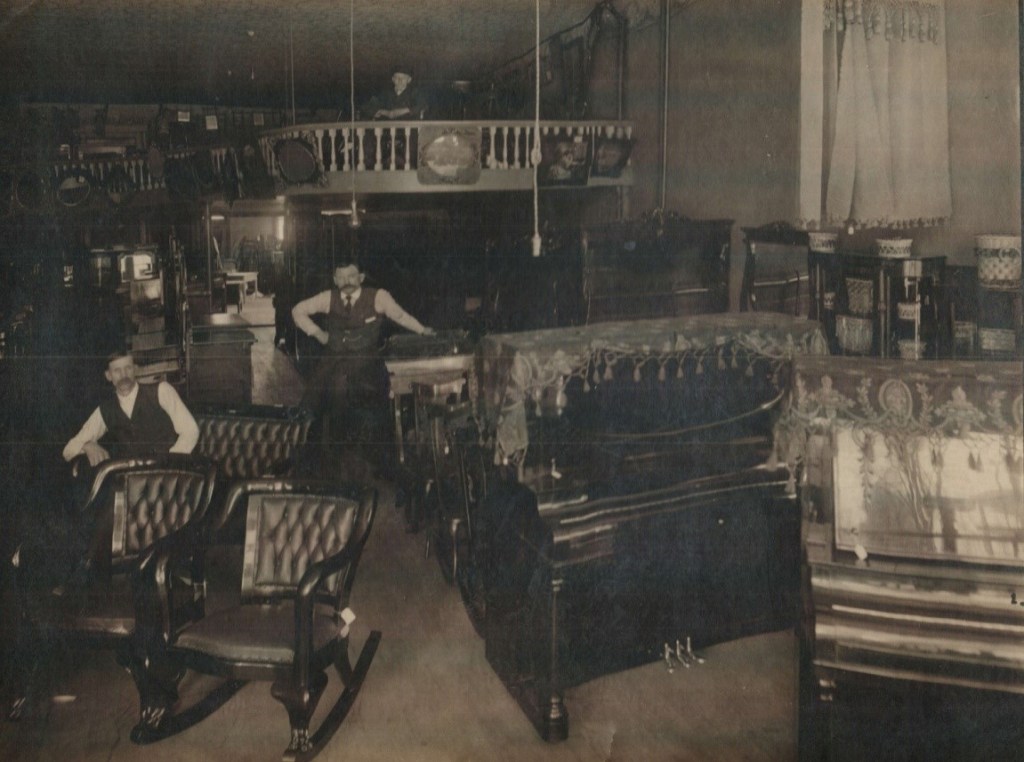
(above) The Wenstrom Furniture Store in St. James–the town’s first furniture store, located opposite the hospital. This picture was probably taken in 1905. Note that pianos are prominently featured. Owning and being able to play the piano was considered essential by many families at the turn of the century.
The 9/17/1909 edition of the St. James Journal Gazette noted on page 1 that a program would be offered on Tuesday, September 21 under the auspices of the “Mission Band” at the Norwegian Lutheran Church. The program included recitations, songs, a speech by Rev. L.P. Thorkveen, a Mission offering, and two piano solos by “Miss Cormontan.”
The last two public piano performances by Theodora to receive newspaper coverage took place in St. James early in 1910. In January she played a piano solo on two consecutive afternoons as part of a State Red Cross series of tuberculosis awareness and education meetings. The following is the order of the program (Cormontan played just before Dr. Pratt on both days):
Monday, January 24th [1910]
Afternoon—2:30 o’clock.
Presiding—Supt. H.L. Brown.
Introductory Remarks.
Chorus High School
Instrumental Music High School
Address Mr. C. Easton, Executive Sec. of State Red Cross, St. Paul.
Subject: “Local Work for Consumptives.”
Piano Solo Miss Theodora Cormonton [sic]
Address Dr. C.C. Pratt, Minneapolis
Later in the article (featured in the 1/22/1910 edition of the St. James Journal Gazette) it stated: “Miss Theodora Cormontan will render a piano solo at the State Board Exhibit both Monday and Tuesday afternoons. This number will be given just previous to Dr. Pratt’s lecture. Miss Cormontan is a pianist of rare ability. Her study under the greatest masters of Europe has made of her a player of ability, as well as a composer of piano music. All lovers of music and especially the ladies are urged to attend all the meetings.”
In the 2/5/1910 edition the paper noted that Theodora performed a piano solo in the Friday afternoon program at the 1910 Farmer’s Institute in St. James. While the men attended meetings, programs were provided for the women, featuring addresses on “Sanitation in the Home” and “Poultry Raising” as well as performances by Halverson’s Orchestra, a vocal duet team featuring Misses Flora Rasey and Georgine Minder, and the High School Girls’ Chorus in addition to Cormontan.
In 1910 Theodora, the youngest of the four unmarried siblings who live together, has turned 70. The advancing age of the family makes it increasingly difficult for them to stay economically viable. They also fade from mention in the local section of the paper, though they continue to be featured periodically:
St. James Journal-Gazette, 10/29/1910: “Theodora Cormontan was a Mankato visitor, yesterday.”
St. James JG, 5/23/1912, p. 1: [An article reports that the Levens Drug Store (“operating for many years”) and Hintgen Drug Store merge. The new firm is known as Hintgen Drug Co. It is not known if C.G.V. is still employed at the store or if this merger impacted his position. The Northwestern Druggist reports that Mr. Levens sold his interest in Hintgen Drug Co. in 1919.]
St. James JG, 3/13/1913 (Of Local Interest section): “C.G.V. Cormontan was a Madelia visitor, Tuesday.”
St. James JG, 4/11/1914 (Of Local Interest): “Miss Theodora Cormontan went to Ormsby, yesterday, to organize a new class in music.”
By the time this last item appears, Hans Cormontan has passed away. The First Lutheran Church records his death occurring on April 17, 1913, and this date is corroborated in a brief article in the 4/19/1913 edition of the St. James Plaindealer. No record of his death exists at the Watonwan County Courthouse. Theodora is almost 74, and this search for new students in Ornsby, a town about 11 miles from St. James, may reflect severe economic pressures on the remaining three family members.
As early as the 2/19/1909 edition of the St. James Journal Gazette, the Cormontan family is listed as being subsidized by the County Poor Fund. In 1908 C.G.V. was given ten stipends of $10.00 each, plus the family received some assistance on their fuel bills. It appears they subsequently received county welfare every year. The 2/3/1916 edition of the St. James Journal Gazette includes a Financial Statement of Watonwan County, MN for the fiscal year ending Dec. 31st, 1915. Under the heading “County Poor Disbursements Itemized” followed by the category “Relief” the first name listed is “Cormontan Family.” Beneath the name is this list:
S. Hage Lumber Co., fuel $26.15
P.N. Sterrie Co., merchandise $45.00
W.G. Manning, fuel $5.00
J.J. Schutz, house rent $30.00
P.N. Sterrie Co., merchandise $30.00
S. Hege Lumber Co., fuel $15.00
J.J. Schutz, house rent $30.00
W G. Manning, fuel $3.50
J.J. Schutz, house rent $13.00
J.J. Schutz, house rent $13.00
P.N. Sterrie Co., merchandise $60.00
J. . Schutz, house rent $26.00
Manning Fuel Co., fuel $25.50
S. Hage Lbr. Co., fuel $15.70
P N. Sterrie Co., merchandise $75.00
Total $403.55
The Death Certificate for C.G.V. Cormontan states that he died of pneumonia on June 13, 1917. Both C.G.V. and Hans were buried by the county in unmarked graves in Mt. Hope Cemetery in St. James. Less than two months after C.G.V.’s death Eivinda and Theodora would make their last move–this time to the Aase Haugen Home near Decorah, Iowa.

(above) The entrance to Mt. Hope Cemetery, taken in the 2010s.

(above) Reportedly the area of unmarked graves where Hans and C.G.V. were buried.
Aase Haugen Home Iowa 1917-1922
Aase Haugen’s life paralleled the life of Theodora Cormontan in some respects. Both were born in Norway: Theodora in 1840 and Aase in 1841. Both immigrated to the U. S., Aase to Iowa in 1854 and Theodora to Minnesota in 1887. At age 13, Aase took over the responsibility of caring for her father and the other children when her mother died during the family’s journey from Norway, while Theodora helped care for her father when her mother died in 1865. Due at least somewhat to familial responsibilities, neither woman married. Both survived the passing of their fathers and other siblings.
In contrast, the Haugen family enjoyed financial success as farmers while the Cormontan family experienced economic decline and poverty. In 1910, as the sole proprietor of a significant estate with no heirs, Aase willed the 240 acre farm located five miles southwest of Decorah, Iowa and the rest of her estate to the United Norwegian Lutheran Church of America to establish and maintain a home for seniors; the “Aase Haugen Home.”
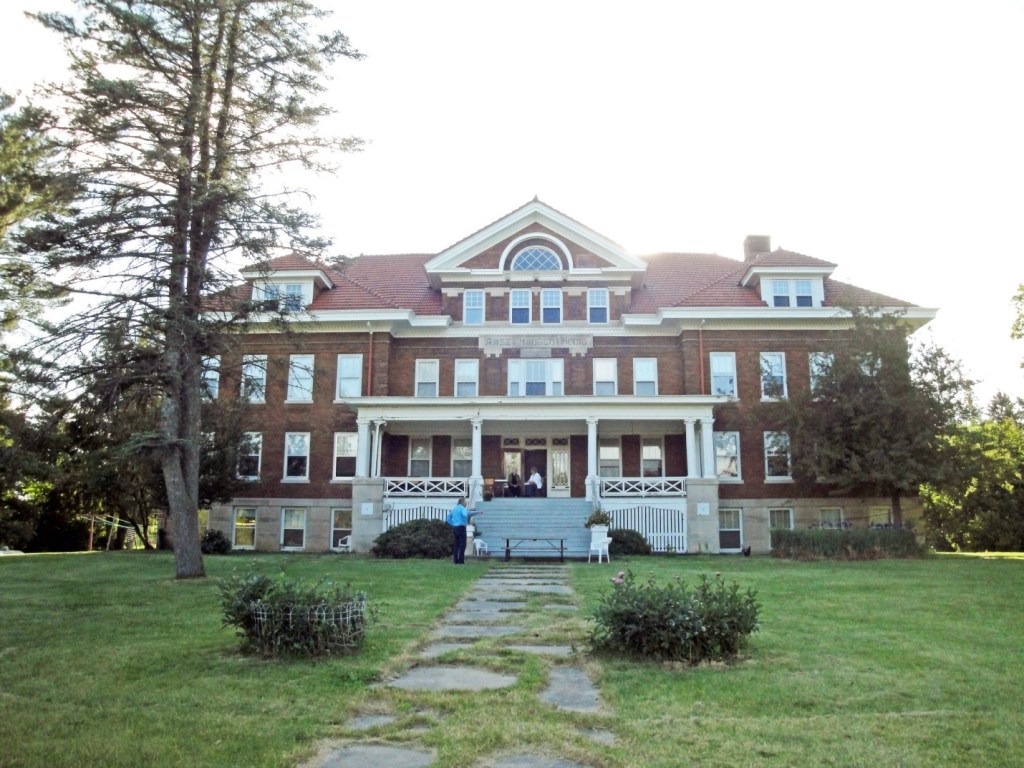
(above) A contemporary view of the Aase Haugen Home, now a private residence.
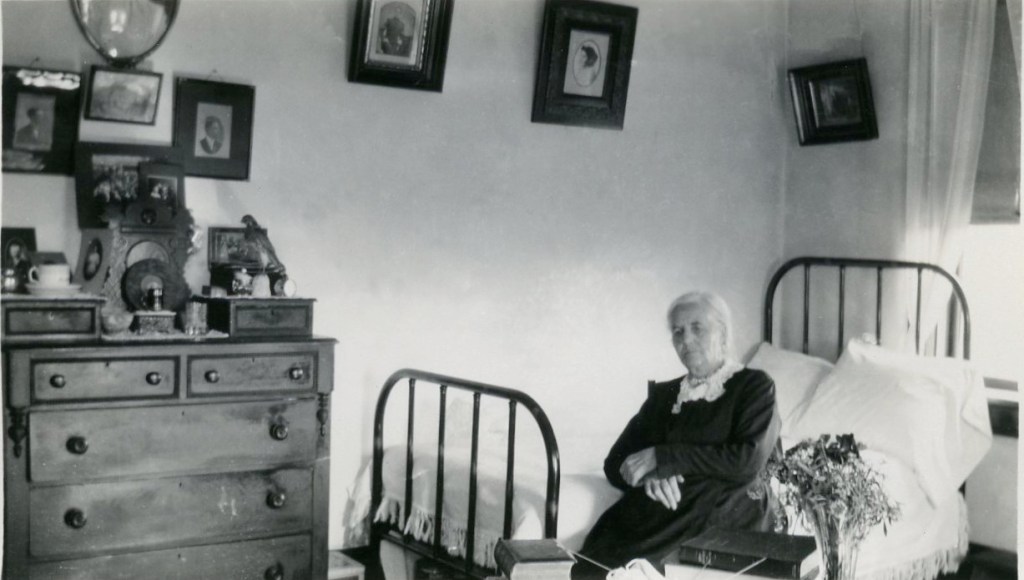
(above) The interior of a typical room at the Home while Theodora lived there.
In 1911 Rev. Otto Schmidt, pastor of Aase’s home church (Decorah Lutheran), organized and led a drive to collect donations to assist in making Aase’s vision a reality. A building that could house 50 residents was constructed on the farm site in 1914 and opened for operation in 1915. Rev. Schmidt resigned as pastor of the Decorah church to become the first superintendent of the Home, a position he held until 1944. In 1963 a new one-story senior residence was built in Decorah, and by 1974 the last of the residents of the Old Home had moved to the new facility.
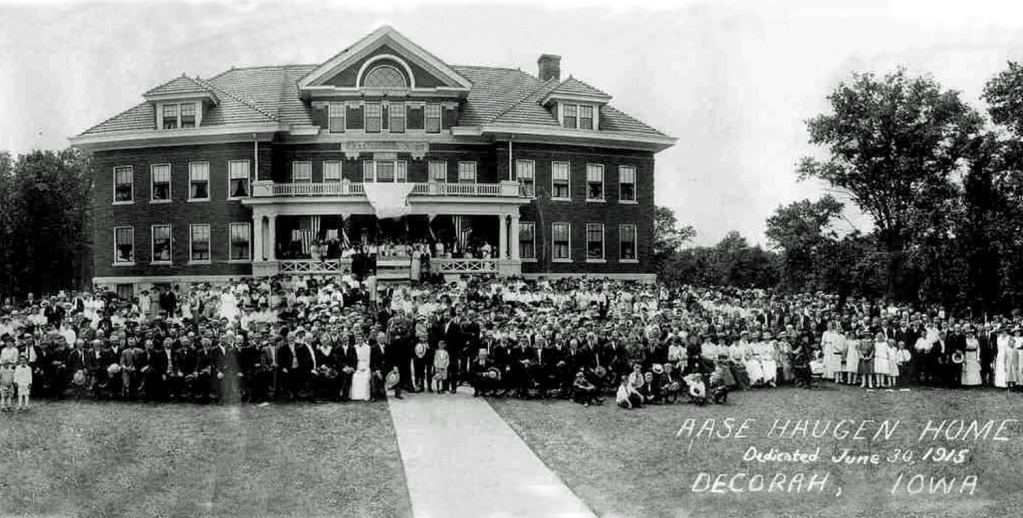
(above) A picture taken at the dedication of the Aase Haugen Home on June 30, 1915
Less than two months after their brother C.G.V. died, Theodora and Eivinda Cormontan became the 65th and 66th residents to enter the Home. Most of the people who lived there were first-generation Norwegian-Americans. Residents were encouraged to participate in the work that needed to be done on the fully-operational farm, and Theodora appears to have contributed to the music presented in chapel services conducted at the Home. One of the books from her personal library that came to us in 2011 was a Lindeman’s Koralbog, a Lutheran Church hymnal originally published in the 1870’s for use in the Church of Norway. Theodora’s signature may be found on the title page, and on the following page she wrote “Tilhorer [Property of] Theodora Cormontan. 1922. A.H.H. [Aase Haugen Home], Decorah, Iowa.”
Theodora Cormontan passed away at the Home on October 26, 1922, at the age of 82. The Winneshiek County Record of Death reports that she died of “Mitral Insufficiency.” This is a disorder of the heart in which the mitral valve does not close properly when the heart pumps out blood. It is the most common form of valvular heart disease. Probably due to errors in the Home records (see above), on her tombstone Theodora’s last name is misspelled and the year of her birth is wrong.
The following obituary appeared on page 2 of the November 1, 1922 edition of the Decorah Public Opinion: “Deaths at Old Peoples Home. Two deaths of aged inmates of the Old Peoples Home occurred last week. On Wednesday Mrs. Karen Bruhelle passed away, aged 86 years, and on Thursday Theodora Nicolin [sic] Cormonton [sic] passed away, aged 84 years [sic]. Both deaths were due to the infirmities of old age. The funeral services were held Saturday afternoon from the Old Peoples Home, and interment was in the Assa [sic] Haugen cemetery. Both women had been at the home for quite a while and came to the home from Minnesota and Wisconsin.”
It is likely that Rev. Schmidt officiated at the funeral and that the pastor’s wife, Mollie Helgerson Schmidt, was also present. Mollie was a musician and a friend of Theodora’s, and Theodora gave her original compositions and music library to Mollie before Theodora died. Theodora’s sister Eivinda died of a stroke on November 8, 1924. The attending physician for both Theodora and Eivinda was Dr. Trond N. Stabo (1870-1946). A first generation Norwegian-American, Dr. Stabo served on the Board of Trustees for Luther College in Decorah and was a Norwegian vice consul.
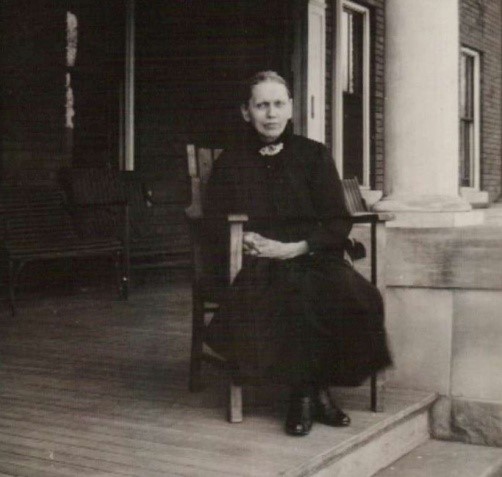
(above) Theodora Cormontan sitting on the front porch of the Aase Haugen Home circa 1920.
More information on Aase Haugen and the Aase Haugen Home:
*Aase walked ten miles round trip to study her confirmation lessons in the Lutheran faith. She’d had little schooling in Norway because girls were not taught arithmetic or writing at that time, but Aase was confirmed in 1856 at age 15 with academic honors.
*While still in her teens, Aase became engaged to another Norwegian immigrant, but her father forbid her to marry because she was needed to run his household and care for the younger children. Her suitor died shortly after this, and Aase wore the engagement ring he gave her for the rest of her life.
*By 1893 Aase was the only one left in her family. Describing this time, she said “The days and the years are dark and dreary.” Left with a sizable estate, she supported needy families and young men studying to become pastors. She gave $1,650 to the Decorah Lutheran Church for a new pipe organ. She died of cancer on August 13, 1910 at the age of 69.
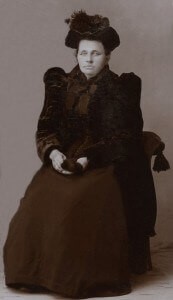
(above) Aase Haugen
*The 6/15/1911 edition of the Decorah Republican reported that the Home was originally planned for “the old women in this [Winneshiek] County.” The June 29 edition of the paper noted that there was some thought of locating the Home at the recently closed St. Ansgar Academy, but the Haugen farm was always the first choice.
*The Republican reported on 9/21/1911 that Aase Haugen’s will was being contested, even though she had been recognized as the sole heir by 1893. The challenge to the will was dropped before the end of 1912.
*In 1911 Rev. Otto Schmidt raised $32,500 in subscriptions to erect the Home, basically matching the estimated cost to build it. Schmidt resigned as pastor of the United Lutheran Church in Decorah by the end of March, 1915 to become the first administrator of the Home, and ably served in that capacity until his retirement in 1944. He was succeeded by Pastor T. T. Thompson (1944-1954) and Pastor Virgil C. Hougen (1954-1975). In 1974 the last residents moved into the new Aase Haugen facility in Decorah. In 1975 the original building was sold to the directors of the South Bear School, Dean Schwarz and John Nellermoe. Summer classes in pottery, painting, poetry, spinning, weaving and dyeing were offered for a number of years. Presently [2016] the Home is owned by Lane Schwarz and serves as the home for his family as well as for his parents, Dean and Gerry.
*The construction of the Aase Haugen Home began in 1914. The building was completed in nine months. The workers stayed in tents during the six-day work week. Building materials came by train and were hauled up the hill to the building site by mules.
*The first resident, Civil War veteran Ivar Brandt, moved into the Home in February, 1915. By March 9 of that year the Home had 10-12 residents, and the number increased to 26 by the end of the year.
*The Home had 70 rooms, 9 bathrooms, a large kitchen, a women’s dining room, a men’s dining room, a women’s sewing room, a men’s card playing room, a chapel, laundry room and nurses’ office. One of the Decorah papers reported in 3/4/1915 that the facility included “Oak furniture of a pleasing design,” two fourteen-foot dining tables, a boiler for heat, a ‘storage battery’ for lighting, an ‘inter telephone system,’ a hose attached to a water system on each floor to stop fires, and ‘a large power vacuum cleaner.’”
*From the 10/3/1917 edition of the Decorah Public Opinion: “The ‘boys’ of the AHH hereby wish to express their thanks and appreciation to the gentleman of Decorah who twice, so generously has remembered them with a box of cigars. The gentleman is an honored businessman of Decorah who has a warm heart for the Old Boys. They appreciate his kindness and join in wishing him success and a long life.”
 Theodora Cormontan