- Cormontan Geneology
- Reverend Even Meldal Schjelderup Cormontan
- Family Biographies
- University Grades
- Norwegian Pharmacists
- Dr. Christian Hirsch
- Friedrich Wilhelm Thoschlag
- Packard Organ
- Fort Ridgely Dale Church
- Rev. Nils Paul Xavier
- Rev. Parelius Rognlie
- Other Pastors & Churches
- The Schmidt Family
- More Dr. Hirsch
Cormontan Geneology
Name Derivation
Theodora Nicoline Meldal Cormontan was named after her great-grandparents on her mother’s side. Her two middle names are the last name of her maternal great-grandfather (Theodorus Bergmann Meldal ) and the first name of her maternal great-grandmother (Nicoline Paludan). Her first name is the feminine form of her great-grandfather’s first name (Theodorus).
The last name of Theodora’s great-great-grandfather was Hansen. He lived for a time in Hjertesberg i Stege, Denmark. Hjertesberg is a small hamlet about 3-4 miles from Stege, the largest town on the island of Møe in southeastern Denmark. Hansen changed his patronymic last name to take the name of the place where he lived. Additionally, he utilized the Latin equivalent of Hjertesberg, which is Cor montan. The two words translate as “Heart of the Mountain.”
Geneology
Paul Kristian Hansen Cormontan, b. 1725, d. January 20 1769: Theodora’s paternal great-grandfather. He served as a “klokker” for the state Lutheran church. A klokker was a lay person who assisted the minister before and during the worship service.
His wife and Cormontan’s paternalgreat-grandmother: Mette Christine Hertzberg, b. 1724.
Theodora’s maternal great-grandfather: Theodorus Bergmann Meldal b. June 23, 1735, d. August 8, 1786.
Her maternal great-grandmother: Nicoline Paludan b. August 14, 1749, d. April 24, 1815.
Hans Nicolai Cormontan (1755- 1827): Theodora’s paternal grandfather.
He was a parish priest of Undal, as well as a priest at St. Olav’s church of Avaldsnes (on the west coast of Norway) from 1807-1814. Hans Nicolai Cormontan married Nicoline Meldal , daughter of Theodorus Bergmann Meldal and Nicoline Paludan.
Nicoline Meldal (c. 1774-?): Theodora’s paternal grandmother.
Children of Hans Nicolai Cormontan and Nicoline Meldal:
Mette Cathrine Cormontan, b. 1795, d. 1880
Even Meldal Schjelderup Cormontan b. September 4, 1798, d. February 14, 1893
Even Meldal Schjelderup Cormontan (b. September 4, 1798 in Øvrebø, Vest-Agder, Norway, d. February 14, 1893 in Franklin, Renville County, Minnesota, USA): Theodora’s father. Even Meldal Schjelderup Cormontan was the parish priest of Trinity Church in Arendal, Norway from 1847 to 1882. Even Meldal Schjelderup Cormontan married Louise Augusta Hirsch , daughter of Patroclus von Hirsch (b. 1758, d. 1828) and Bolette Christine Müller (b. 1765, d. 1806).
Louise Augusta Hirsch (b. October 1, 1802 in Kristiana, d. March 5, 1865): Theodora’s mother
Children of Even Meldal Schjelderup Cormontan and Louise Augusta Hirsch:
*Hans Nicolai Patroclus Cormontan b. March 8, 1826, d. April 17, 1913 in St. James, MN
*Kirsten Bolette Nicoline Magna Cormontan b. 1827, d. 1828
*Stillborn son, 1829
*Magnus August Francke Cormontan b. July 6, 1831,d. July 21,1892 in Fosston, MN
*Einar Frithjof Cormontan b. September 27, 1833, d. November 23, 1856
*Gottfred Christian Vogelsang Cormontan b. February 1, 1836, d. June 13, 1917 in St. James, MN
*Eivinda Louise Cormontan b. April 26, 1838, d. November 8, 1924 in Decorah, IA
*Theodora Nicoline Meldal Cormontan b. June 9 1840, d. October 26, 1922 in Decorah, IA
*Josephine Marie Cormontan b. July 19, 1844, d. March 30, 1930 in Minneapolis, MN
Reverend Even Meldal Schjelderup Cormontan
Reverend Even Meldal Schjelderup Cormontan
1798-1893
(father of Theodora Cormontan)
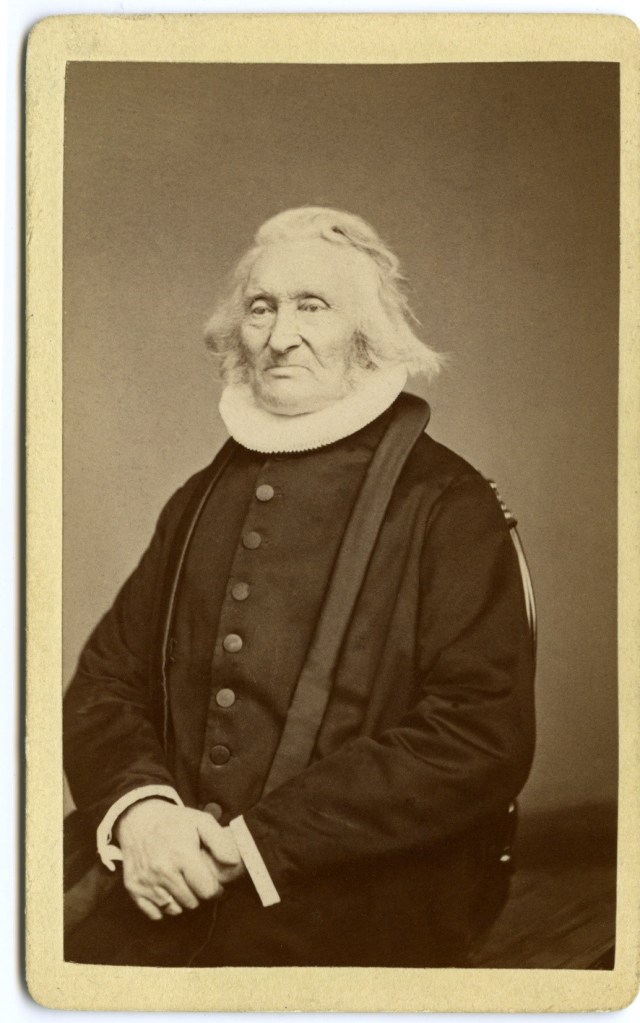
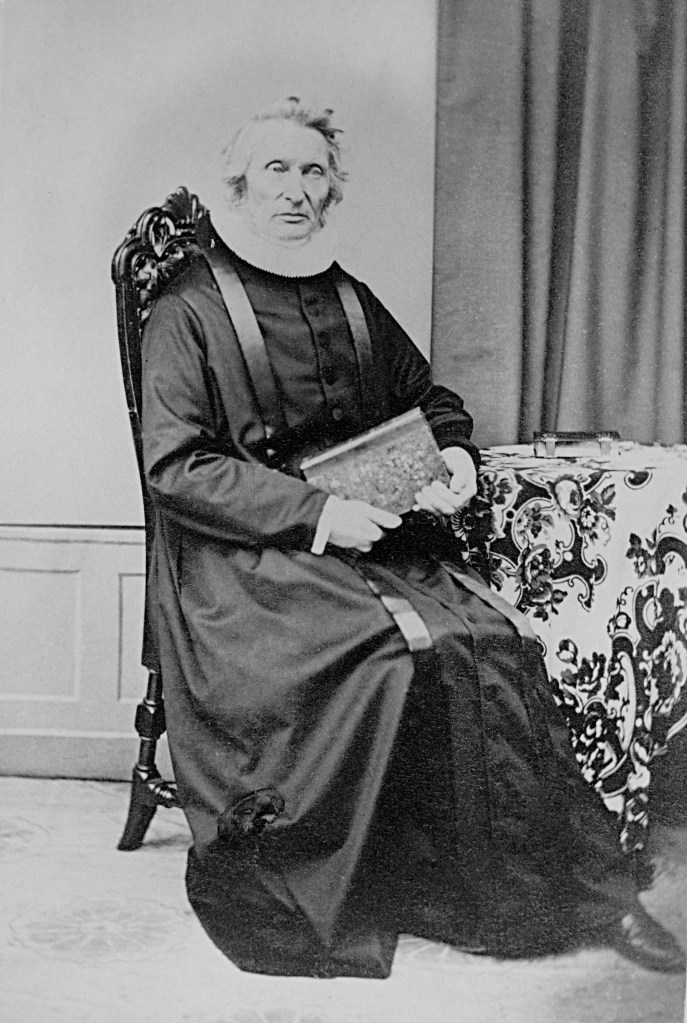
Even Cormontan was born in Øvrebø, Vest-Agder, Norway in 1798. He studied in Kristiansand and Bergen. He began advanced study in 1817, graduated with honors in Theology in 1824, and was ordained in 1825. Reverend Cormontan served at churches in Undal, Stranden, Søndmøre, and Beitstad before securing a position in 1847 as Priest at Trinity Lutheran Church (Trefoldighetskirken) in the southern coastal town of Arendal. In 1861 he was promoted to Provst (a position with regional administrative responsibilities in the Church of Norway). One of his tasks in this position was to implement the Education Act of 1860, including advocating for women teachers in the public schools. The amount of work required as Provst impacted his health and he subsequently relinquished some of his duties. In 1875 he celebrated 50 years in the ministry and retired in 1882.
In 1886 the parsonage in Arendal where Rev. Cormontan and his family still lived burned down. That same year an economic depression in Arendal caused the banks where the Cormontans saved their money to fail. In May of 1887 (as a result of these economic setbacks) Provst Cormontan (age 89) and his daughters Eivinda (age 48) and Theodora (age 46) boarded the steamer Hekla and immigrated to Minnesota where his other children had already located. He lived in Franklin with his four unmarried children (Hans, C.G.V., Eivinda and Theodora) and attended the Fort Ridgely and Dale Church.
The following is an electronic translation (with editing) of an article in the Arendal newspaper (the “Agderposten”) from November 30, 1974:
“Priest from the past
There lived many notable men and women in Arendal a hundred years ago. One of them was the town’s parish priest, Even Meldal Schelderup Cormontan. In his time he oversaw Arendal’s largest church.
Cormontan was born in Øvrebø Kristiansand in 1798 and earned his theological degree in 1824. After serving as priest at other locations, he came to Arendal in 1847 and was dean [provst] until 1881 in West Nedenes rectory.
The years Cormontan served as priest in Arendal were generally good and happy ones for the city. The sea provided an abundant livelihood for many. Government officials, including the parish priest, had a good relationship with the merchants and ship owners, and cultivated a profitable interaction.
There was significant religious upheaval from 1860 to 1870. A religious revival that started in the middle of the 19th century spread throughout Norway, including Arendal. This led some people to withdraw from the state church, with many joining the newly formed Methodist congregations or following Pastor Paul Wettergren, who founded the Lutheran independent congregation in Arendal in 1877.
Cormontan celebrated his fiftieth anniversary of service to the Church of Norway in 1875, an event that few priests ever experienced. He was honorably discharged in 1882, but his saga did not end there. In 1887, when he was 89 years old, he immigrated to America. Six years later, in 1893, he died in Franklin, Minnesota.”
On May 28, 1887, the Kragerø Tidende published a May 24 article from Arendal that reported: “Former Provst of Arendal, Cormontan, intends to emigrate to be with his children in America. On the occasion of his impending departure the Turners, the Turners Music Association, and the Workers Singing Association will bid him farewell Monday night.”
Next is an electronic translation of a paragraph in a book that was in the lobby of the Thon Hotel in Arendal in 2015. It supports what we learned about Provst Cormontan during a tour of the Trinity Church conducted by Kari and Jens Barland. Just before this translation the book talks about the “battle” between the established Lutheran Church of Norway (the state church) and the new religious denominations that were emerging in the 1860’s (Mormons, Methodists, and sectarian movements). Both sides took the position that “You are either with us or against us.” The book continues:
“Reverend Even Meldal Schelderup Cormontan saw things differently. He sought to reconcile divergent factions, refusing to burn bridges or push people away. He wanted to lead the church in a way that welcomed and served as many people as possible, while also awakening them spiritually. He wanted a missionary church with a spirit of the Enlightenment, perhaps because he was the descendent of clergy on both sides of his family and knew what was needed to lead the church into the future.”
The following elaborates on this topic. It is an electronic translation with editing from the following:
Roaming through three centuries: the 1800s (Part 2 0f 3)
By Olav Rune Ekeland Bastrup
On the Arendal 2023 website
Bastrup writes about church life in Arendal, Norway. In part two of a three part series Provst Even Cormontan plays an important role. Bastrup describes the religious turmoil in the town during the second part of the 19th century with the appearance of new denominations and philosophies of Christianity that challenged the established Lutheran State Church of Norway.
Arendal experienced strong economic growth beginning in the latter 1820’s, setting up disparity between rich and poor, a diminished influence by the state church, and a sense of spiritual and moral crisis. Being a seaport town that traded with the United States, Arendal experienced the importation of new, pietistic expressions of Christianity. A small colony of Mormons arrived in 1850. In 1868 United Methodist congregations were established, as well as the pietistic Arendal Home Mission, with the revivalist pastor Lars Oftedal as its leader. Oftedal was one of many revivalist preachers who came to Arendal with a new pietistic message of “Come to Jesus just as you are.” When Oftedal preached, Bastrup says the listeners “fell over and screamed in the middle of the Sermon—such was not exactly familiar with the state church.” Bastrup writes that Norway has never before or since experienced an evangelical preacher with such a “grip on the masses” as Lars Oftedal.
The State Church strongly rejected his work and sent out an edict that Oftedal should not be allowed to preach in any state church. All of the clergy in the Arendal area supported the State Church’s strong opposition to Oftedal except one: Pastor Even Cormontan. Though he was the opposite of Oftedal in personality, Cormontan intervened on his behalf and helped stabilize a potentially volatile situation.
Bastrup notes “Cormontan was artistically gifted. His daughter Theodora was later a famous musician and composer. He stands out as a mild and paternal government official . . .”
Cormontan was “an open, generous person” who recognized “clearer than any other clergyman in the district that the revival revealed a real need that the state church had to meet.” This resulted in Cormontan having a “friendly and inclusive” attitude toward the revival that so threatened his fellow clergymen. Therefore, despite the bishops’ ban on Oftedal preaching in a Lutheran church and the great tumult it caused, Pastor Cormontan invited Oftedal to preach Sunday after Sunday at Vespers in Cormontan’s Trinity Church.
Bastrup writes “Cormontan clearly saw how important it was that the Church be open to the religious need that the revival clearly revealed.” During the height of the most intense years of revival, an aging Pastor Cormontan brought in a chaplain to the Trinity Church with special responsibilities toward the people who embraced the revival.
The last Sunday service Provst Cormontan conducted at the Trinity Church before he retired was reported in the 2/13/1883 edition of the Oslo Budstikken: “The farewell sermon. Parish priest Cormontan said goodbye to Arendal’s congregation last Sunday after having served there for over 35 years. When the old Provost celebrated his fiftieth jubilee in office a few years ago, his congregation was unable to show its appreciation to the old shepherd of his flock in a meaningful way. So, on this occasion, Provost Cormontan received tangible evidence that his work has earned the lifelong affection and love of his congregation. A large number of members of the congregation brought him offerings, and after the service he was greeted at his home by the Commune Board [city officials], where the orator Sagsør Andersen represented them in bidding the Provost farewell.”
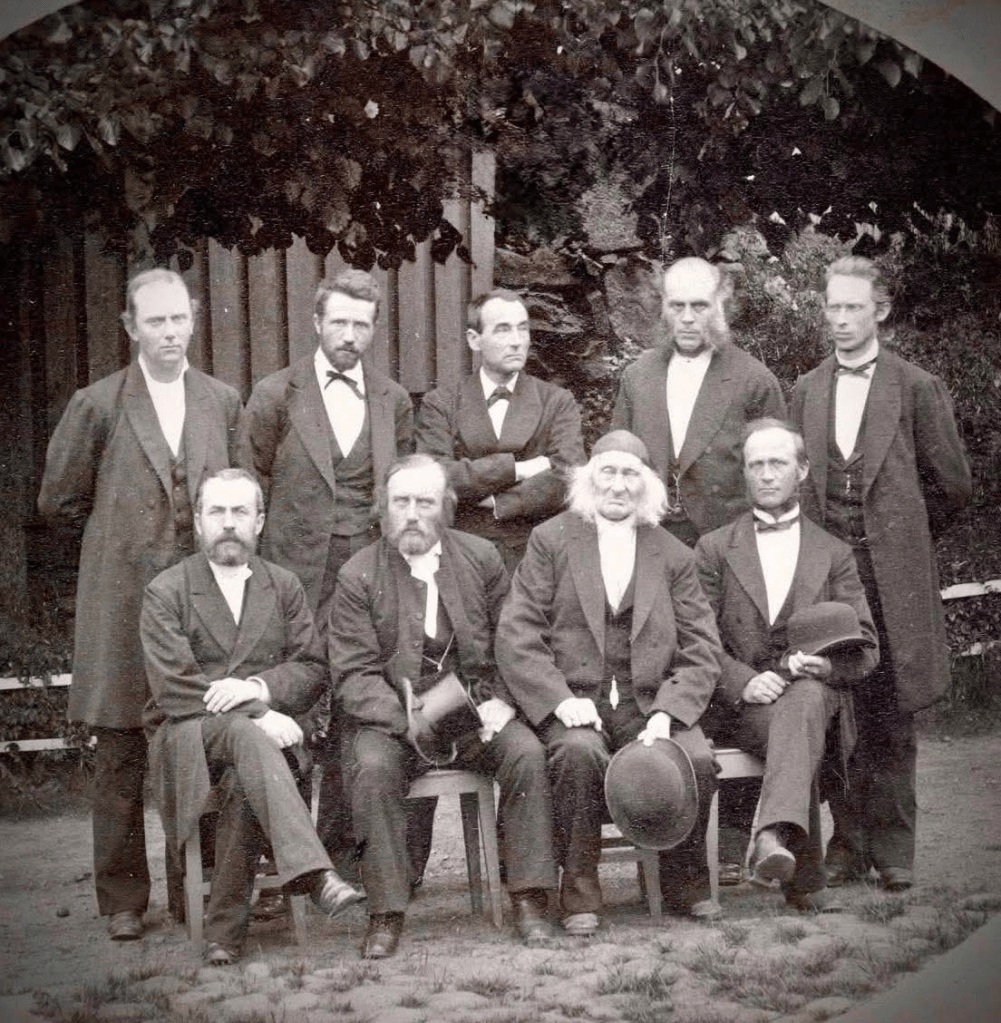
(above) This photo from July 23, 1884 shows members of the Arendal clergy attending the opening of a new church in Bjorbekk. Provst Cormontan, who had retired a year earlier, is seated in the front row, third from the left.
A recollection of Provst Cormontan appeared in the Dagen newspaper of Bergen on Monday, May 14, 1923. The article, titled “The church life in Arendal. A little history through 200 years. By mission priest A. Olsen” included the following:
“Provst Cormontan was a good and lovable man, who became known by everyone in the city during his long career. He was not a particularly renowned preacher in Norway, but he preached the full gospel of sin and grace. His sermons were written out and well done. He joined both the Home Mission and the Gentile Mission Society and spoke at their meetings. There were significant conflicts, especially toward the end of his service when the Free Church movement began, but I will write about that later.
I remember his farewell sermon in 1883, which I attended as a 14-year-old boy. It bore witness to a humble Christian confession when, as he was leaving, he felt how much he wanted to serve his Lord and Savior but at the same time felt how little he had accomplished. The words ‘Most of you I have baptized and confirmed, and many of you I have bound together through the holy bands of marriage,’ still ring in my ears. He also said ‘I hope my words as your pastor have led you forward on the path of salvation.’”
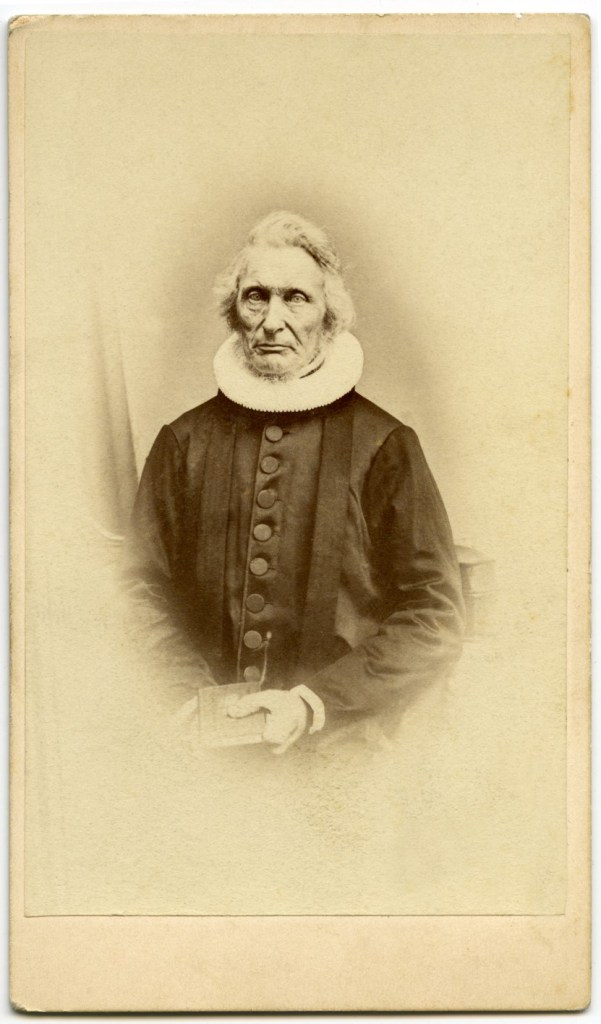
The following is an electronic translation (with editing) of a portion of the book “The Synod for the Evangelical Norwegian Lutheran Church in America.” Vol. 20, p. 154-155, published in Decorah, Iowa in 1893. The original article was submitted by Rev. Parelius Rognlie. Clarifications by the translator appear in brackets.
“Provst Even Meldal Schjelderup Cormontan died in Franklin, Renville Co., Minn., on February 14, 1893. He was born 4th September 1798 in Øvrebø, Vest-Agder, Norway, where His father, Hans Nicolai Cormontan, was priest.
In 1818 he became a student, and in 1824 he took the official theological examination at Christiania University, and on 5 May 1825 he was ordained and became the resident chaplain in Undal. In 1829, he traveled to Søndmøre, and 1834 to Beitstad, North Trøndelag, where he served until 1847, when he was called to Arendal. In 1862 he was named as Provst [a position of regional responsibility in the Church of Norway]. In 1865 he lost his dear wife – Louise Augusta, nee Hirsch, who had traveled by his side for 40 years, and with whom the Lord had given 9 children. He subsequently excused himself to become an Associate Provst, as the duties which were incumbent on him as Parish priest took all his time and energy.
He served as Parish priest in Arendal until 1882 when, at the age of 84, he retired after a long, rich, and blessed career of 57 years. In 1887, when he was 89, he traveled to the United States to spend his twilight years with his children. On All Saint’s Day in 1887 he spoke at the Fort Ridgely and Dale Church [between Fairfax and Franklin, MN] on Jesus’ words: ‘Peace I leave with you, my peace I give unto you, not as the World gives, I give unto you’ (John 14:27). The Word had a profound impact on all who were present, teaching the church community that the saving blood touched many a lost but precious brother and sister. This 89 year old man stood among us like a messenger of peace and faith from our Savior, yes from the Prince of Peace himself, Jesus Christ.
In his last year Provst Cormontan stayed mostly in bed and often suffered great pain: yet he never complained and thanked God dearly for everything. He read his precious Bible with a childlike devotion and, as his Body and Spirit failed and he slept often, while awake he spoke about ‘his old Congregations – for the many he had confirmed and taught by God’s Word about the way to salvation. And often he said: It will be so hard to miss any of them on Judgment Day before God and the Lamb’s throne.’ A few days before his death he said ‘I am with Him – ‘Here’, now let your servant depart in peace, as you said, for my eyes have seen your salvation.’ And also these Words: ‘Father, I long for your bliss.’ He remained, as always, exceedingly dear. God, in His grace, heard His faithful servant.
Four of his children [Hans, C.G.V., Eivinda, and Theodora] were present when he died – knowing his master’s joy and the eternal Sabbath rest – at the age of 94 years, 5 months, and 10 days. He was the oldest living citizen from the Christiania University. On Tuesday, 21st February [1893], he was laid to rest beside the Fort Ridgely and Dale Church. Many from the community were present, including Prof. Frich from Luther Seminary [Professor Johannes Bjerch Frich (1835-1908) became the chair of Theology in 1888] and Pastors I. Bergh [probably Johannes E. Bergh, the pastor of Rev. Cormontan’s youngest daughter Marie, who lived in Sacred Heart, and who apparently pastored at Fort Ridgely and Dale from 1871-1874] and L. Jerdee [he had probably been the pastor of Rev. Cormontan’s late son Magnus, who had lived in Fosston] as well as the undersigned [Pastor Rognlie].
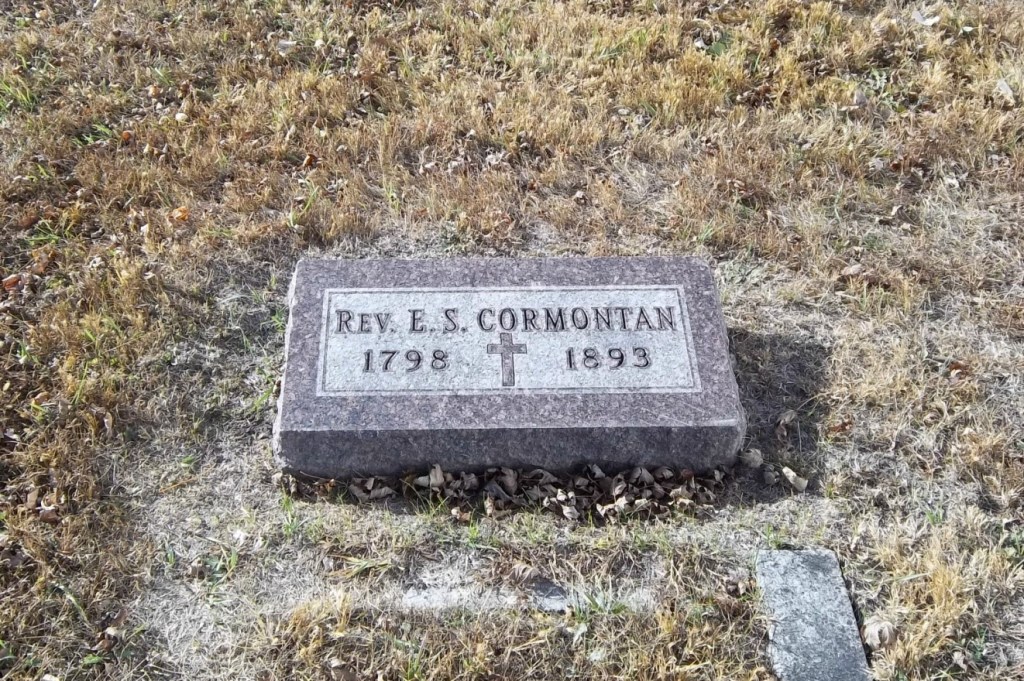
In the mourners first prayer we thanked God for having bestowed on his faithful but weary servant the rest about which he taught and for which he waited – for what God in him had given us as father, pastor, and brother- and said that we all heard a joyous voice of salvation in the highest heavens. Next were offered some verses of Provst Cormontan’s favorite hymn: “I Jesu søger jeg min fred” [“In Jesus I Seek My Peace”]. Pastor Bergh spoke on the words: “Blessed be God our Lord Jesus Christ, whose great mercy has given us a living hope through Jesus Christ’s Resurrection from the dead.” (1 Pet. I:3).
The choir then sang “Nearer My God to Thee” and Pastor Jerdee spoke of the angels in the words of Jesus (John 8:51):” Verily, I tell you, if anyone keeps My word, he shall never see death.” Prof. Frich spoke from Matt. 25:21: “Well done, thou good and faithful servant! You have been faithful over a few things; I will put you in charge over much: come and share God’s joy.”
Everyone’s testimony reflected that Provst Cormontan was a good and faithful servant of the Lord unto death and served as head of a good home. His dear children, who so faithfully nursed him to the last are indeed, for all of us, an example to stand in the Lord Jesus’s blissful Service; to be His good and faithful servants with the little He has set us over. We may assume that these faithful and sincere servants will shout with joy as He so gloriously repays them.
The burial was administered by the undersigned. By the tomb of the dead were present his 5 living children and others near to him. – “Let me die the death of the righteous, and let my end be like theirs!” (Numbers 23:10).
Parelius H. Rognlie”
Provst Cormontan’s children placed the following obituary in the March 9, 1893 edition of the Norwegian newspaper Vestlandske Tidende:
“Announcement.
Death.
That our dear father–former Provst and pastor to Arendal–E.M.S. Cormontan died on 14th February 1893 in his 95th year after a prolonged illness, announced hereby for family and friends.
(signed) The deceased’s children.
Franklin, Renville Co., Minn N. A. (Minnesota, North America)
Please communicate this obituary in this form.”
The March 25, 1893 edition of the Vestlandske Tidende contains a brief article on the funeral. It indicates that “a large number of acquaintances” attended the funeral. Speeches were given in both Norwegian and English, and both Norwegian and English hymns were sung. The coffin was “beautifully decorated” and borne by six clergy. The coffin was placed on a black, decorated sled that was pulled by horses that were also decorated. “Two Scandinavians served as Marshals.”
The article also notes that “a funeral march, composed for the occasion, was played on the organ, and a large choir led the singing.” This organ piece was doubtlessly composed by Theodora and was almost certainly her “Marsch religiosa,” a manuscript dated March 27, 1893 with a notation that it was composed in Franklin. The choir would have been the Franklin Choir that Theodora founded and conducted.
The article concluded by saying “Shortly before his death, Cormontan asked those nearest to him to communicate to the Arendal congregation (Trinity Church) his last thanks and farewell.”
Family Biographies
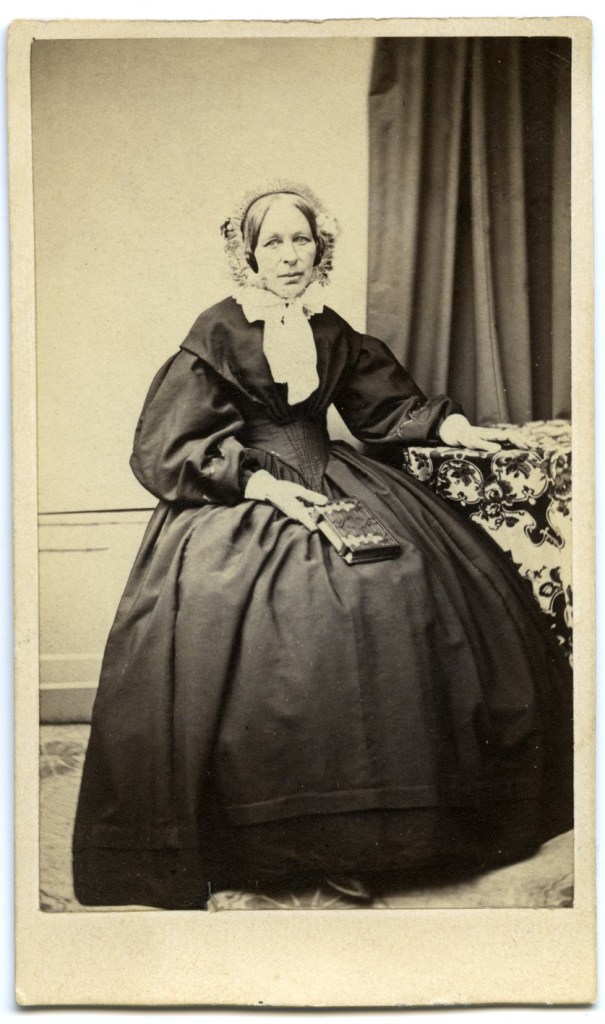
*Louise Augusta Hirsch Cormontan
Born October 1, 1802 in Christiania, Norway; died March 5, 1865 in Arendal, Norway
Mother of Theodora Cormontan
Louise Augusta Hirsch Cormontan was the daughter of Major Patroclus von Hirsch (1758-1828) and Bolette Kristine Müller (1765-1806). She had one brother, Christian Leuthauser Hirsch (1789-1868). According to Arendals geistlighed: dens genealogi og personalhistorie (Arendal’s clergy: its genealogy and personal history, written by Stian Herlofsen Finne-Grønn in 1897), Louise married clergyman Even Meldal Schelderup Cormontan on March 25, 1825 in South Valle, Norway.
During their forty years of marriage Louise and Even had nine children; five boys and four girls. One son was stillborn, one daughter only lived a year, and a second son died at the age of 23. The other six children who reached adulthood all immigrated to the United States in the 1870’s and 1880’s, and all eventually settled in Minnesota. Three of the sons received university degrees. It would appear that a desire to serve the masses of Norwegian emigrants who would need medical care, the opportunities in a new land, and a spirit of adventure called several of Louise’s children to the U.S. (one son was a doctor, one a pharmacist, and a daughter married another pharmacist). Louise Cormontan died in 1865, compelling Theodora to leave her musical studies in Denmark to return home to be with her father.
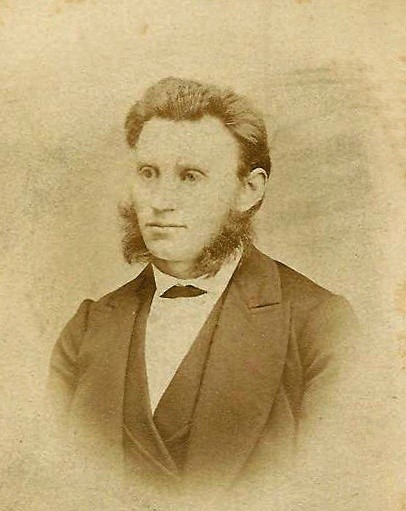
*Hans Nicolai Patroclus Cormontan
Born March 8, 1826 in Vigmostad, Norway; died April 17, 1913 in St. James, MN
Older brother of Theodora Cormontan
The Norwegian census confirms Hans’ birth in the Vigmostad parsonage. His father Even was a resident chaplain in Undal at the time, in Vest-Agder county in Norway. To quote the Finne-Grønn book (in an electronic and edited translation) “After having gone through Trondheim’s agricultural college, he [Hans] ran the Kjensmo farm in Urskog for many years and for several owners. For a time he worked for the magistrate Fabricius in Nedenaes, and then for August Stang. In 1869 he became sheriff in Froland, and a few years later went to America and worked as a carpenter in Franklin.”
While Hans would eventually end up in Franklin, Minnesota, it appears he left Norway in 1873 and settled in Illinois. 1873 was the same year his younger brother C.G.V. traveled with their youngest sister Marie to the U.S., so Hans may have accompanied them. He lived in Illinois in 1880, where the census reports him to be a boarder at the home of Jacob Larson in Big Grove, Kendall County. The census lists his occupation as carpenter, and this appears to be the way he made his living in the U.S. On October 16, 1882 he lived in Morris, Grundy County, Illinois, and on that day he became a naturalized citizen at the county courthouse.
By 1887 local newspapers place him in Sacred Heart, Minnesota, probably moving there to be near family members. This allowed him to see his father Even and his sisters Theodora and Eivinda when they arrived in Sacred Heart in the summer of 1887 from Arendal, Norway to live temporarily with his younger sister Marie and her husband, Edward Lyders. When Even, Eivinda, and Theodora left town in 1888 to live with C.G.V. in Franklin, Minnesota, Hans remained in Sacred Heart. In April of that year he lost his tools in a fire, but he recovered by September to take the contract to repair the Lutheran church in Sacred Heart that had been struck by lightning.
According to the 1895 Minnesota census, Hans appears to have moved to Franklin to live with his family in 1891. In the minutes for Dale Lutheran Church it reports that Hans was unanimously conferred membership in May of 1893. Over the next several years Hans served on various committees of the church, as well as being a godfather in at least one baptism. In 1898 he became one of the founding fathers of the Concordia Lutheran Church in Franklin, including serving as chairman of the planning committee for the church.
In 1899 he joined C.G.V., Theodora, and Eivinda in a move to Madelia, Minnesota, where C.G.V. opened the Madelia Drug Store. Their father Even passed away in 1893. Hans joined the other members of the family when they moved to nearby Hanska a few years later. While in Hanska he was one of the thirteen original members of the new Zion’s Scandinavian Lutheran Church. He is noted as returning to Madelia and enumerated next to his sister Theodora in the 1905 Minnesota census.
Evidence indicates that Hans was the first of the family to relocate to St. James, Minnesota. He became a member of the Norwegian Evangelical Lutheran Church in that town in 1908, a year before the rest of the family joined the church. It is possible that Hans helped C.G.V. find a pharmacist position in St. James. Hans is noted in the church minutes as a Sexton in 1910. The same church book writes that Hans died on April 17, 1913 (there is no record of his death at the county courthouse). At this time the family was so poor that the county buried Hans in an unmarked grave in Mt. Hope Cemetery in St. James.
*Kirsten Bolette Nicoline Magna Cormontan (older sister), born 1827; died 1828
*Stillborn brother, 1829
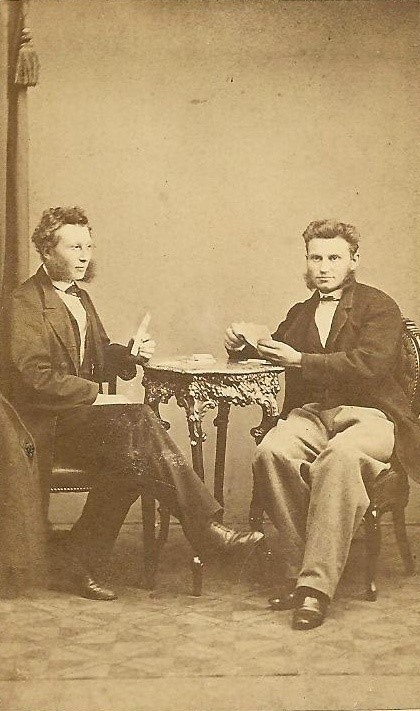
Magnus (on left) and Hans Cormontan
*Magnus August Franke Cormontan
Born July 6, 1831 in Standen, Norway; died July 21, 1892 in Fosston, MN
Older brother of Theodora Cormontan
and
*Evan Hans Cormontan
Born February 19, 1881 in Pelican Rapids, MN; died January 25, 1970 in Fosston, MN
Nephew of Theodora Cormontan; son of Magnus Cormontan
Finne-Grønn reports that Magnus was born on July 6, 1831 in Standen. He goes on to write that Magnus “went to college to become a pharmacist in 1850. [He served as an assistant druggist in several Norwegian towns, including Larvig, Arendal, Kongsvinger, and Porsgrund before passing his pharmacist exam in December of 1859.] He was a pharmacist in Skiens and later, in 1865, in Trondheim. He subsequently immigrated to the United States.”
By 1878 Magnus was serving as a physician in Pelican Rapids, Minnesota, according to the Minnesota, North and South Dakota and Montana Gazetteer and Business Directory of that year. His wife Karen Hansen Svenskerud (1857-1933) was born in Ringsaker, Norway, and they married on February 17, 1880 in Otter Tail County, Minnesota. They had one son, Even (he changed the spelling of his first name to Evan as an adult) who was born on February 19, 1881 in Pelican Rapids.
The Centennial Book for Fosston, MN (1883-1983), compiled by LaVerne Jesness and Josephine Mark, contains the following anecdote regarding an early settler named Augusta Lundhagen: “A story is told, that she was not allowed to wear her shoes out in the barn, so she was barefoot one cold day, when a man put his hand on her shoulder and asked her where her shoes were. After she told him she could not wear them, he said ‘young lady, you are to go back in the house and I never want to catch you without your shoes again.’ It turned out that that man was Dr. Cormontan, who later was a doctor in Fosston.”
Later in the Centennial Book, several paragraphs are devoted to Evan Cormontan, the son of Magnus. In this section it notes “As a young boy, Mr. [Evan] Cormontan recalled accompanying his father when he traveled by horse and buggy to treat patients. He remembered that many times these patients would be unable to pay as times were very hard and his father would accept farm produce instead. However, one time a patient didn’t even have that to offer. He had noticed that Dr. Cormontan’s son, Evan, had admired a figurine toothpick holder, so he offered that in payment. It must have been a satisfactory exchange because today Evan’s daughter, Florence, still has the holder that has been kept through all these years.” Cormontan’s practice varied from prescribing pills and medicine to complicated surgery.
In 1892 Magnus became seriously ill. The Morton, MN newspaper noted that his younger brother C.G.V., then a pharmacist in Franklin, MN, was summoned by telegram to travel north to Fosston in April of that year to the sick bed of his older brother. A week later C.G.V. returned to Franklin with Magnus, perhaps to seek additional medical assistance, more likely to say goodbye to his loved ones. After about a week Magnus returned to Fosston where he died on July 21, 1892.
By 1897, when he was 16 years old, Evan Cormontan lived in Franklin with Theodora and the rest of the Cormontan family and served as an apprentice pharmacist to C.G.V. Cormontan. Evan continued in this capacity when the family moved to Madelia in 1899. After the Madelia Drug Store went bankrupt and closed in 1900, Evan worked for a time at the Madelia Messenger newspaper before moving to Two Harbors, MN to work at their newspaper. He returned to Fosston and was employed at the P.M. Mark Drug Store by May, 1902. The Gully, MN Sunbeam reported in its March 4, 1904 edition that Evan was in town representing P.M. Mark as a traveling salesman. The 1906 Northfield Western Druggist noted that he had left P.M. Mark, done some “relief work” at the Reise store in McIntosh, and would move to Minneapolis in the fall.
In May of 1906 the Minnesota State Board of Pharmacy registered Evan as a pharmacist. With his partner George Hanson, he acquired the Owl Drug Store in Bemidji, Minnesota from F.A. Mayo in 1909. Cormontan had been employed by Mayo for several months before the partners leased the store. In January of 1910 the partnership was dissolved and Evan moved back to Fosston. Fosston’s Ruud Drug Store closed in 1911, and Evan opened the Cormontan Drug Store that same year.
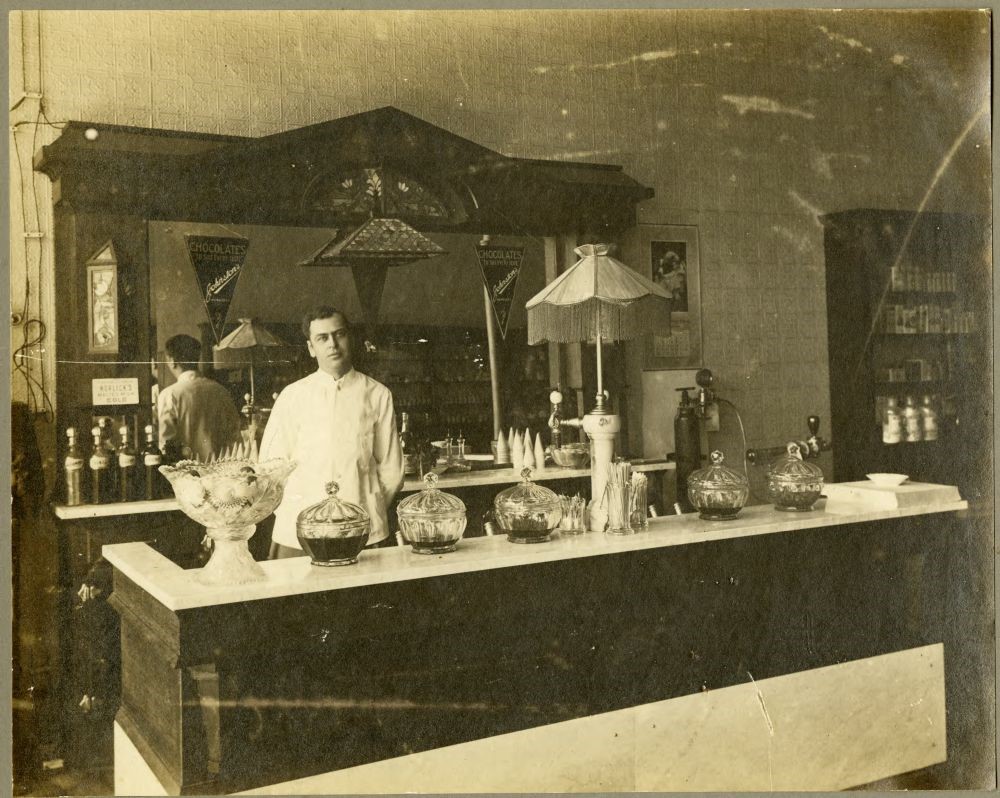
(above) Evan Cormontan behind the counter of the Cormontan Drug Store, circa 1915
The Centennial Book notes on page 70 “When Mr. Cormontan began his drug store all cosmetics and salves were prepared in the store by formula, measured and weighted by grams. The salves and ointments were prepared on sheets of paper from special paper tablets. [His daughter] Florence remembers being allowed to help mix these salves with different spatulas while her father would get the next ingredients that were to go in. Powered medicines were done by measures and folded into paper squares for each daily dosage and these would go into a cardboard box. Then, using a little typewriter which he operated with two fingers, Mr. Cormontan would type out the directions on the label.”
“Mr. Cormontan was married to Alma Froland in 1912 and they had one daughter, Florence (Mrs. Dave Lohn of Fosston). Alma Froland had finished high school in Fosston in the Class of 1905 and was a teacher before her marriage. During their marriage both Mr. and Mrs. Cormontan were very active in church and civic affairs. Mrs. Cormontan passed away in 1957. Mr. Cormontan retired in 1946 after serving the public for 35 years under the motto ‘Good Drugs Since 1911.’ He sold the store to Harris Sessions. It always pleased Evan to know that four of his helpers, or ‘boys’ as he called them, went on to become druggists.” On page 121 of the Cenntenial Book E.H. Cormonton [sic] is listed as one of the men who served a four-year term as mayor of Fosston before 1940.
“After enjoying several years of retirement during which Mr. Cormontan did some traveling, including a trip to Norway, Evan passed away in 1970 at the age of 89 years. (Editors note: Many in the Fosston area will remember how Mr. Cormontan unfailingly touched the brim of his hat whenever he greeted a lady on the street).”
Alma Cormontan (1886-1957) merited additional references in the Centennial Book. It noted that, as a member of the Athenian Club, she served on a four member committee that started the Fosston Library in 1938. The book also stated that she won a Beautification Contest conducted by the Athenian Club in which all the streets in town were renamed to facilitate home mail delivery. The avenues in town were renamed for pioneers of the Fosston community, including the “C” avenue being named after the town’s first doctor, (Magnus) Cormontan.
Evan and Alma’s daughter, Florence Catherine Cormontan Lohn was born on June 30, 1917 in Bemidji, Minnesota. She married David Lohn in 1937 and the couple had two daughters, Margo and Susan. Florence died at the age of 91 on November 10, 2008 in San Jose, California.
*Einar Fridthjof Cormontan
Born September 27, 1833 in Stranden, Norway; died November 23, 1856 in Arendal, Norway
Older brother of Theodora Cormontan
Einar appears to have enjoyed a brief career as a ship’s mate before contracting tuberculosis in 1853. He died when he was 23 and Theodora was 16.
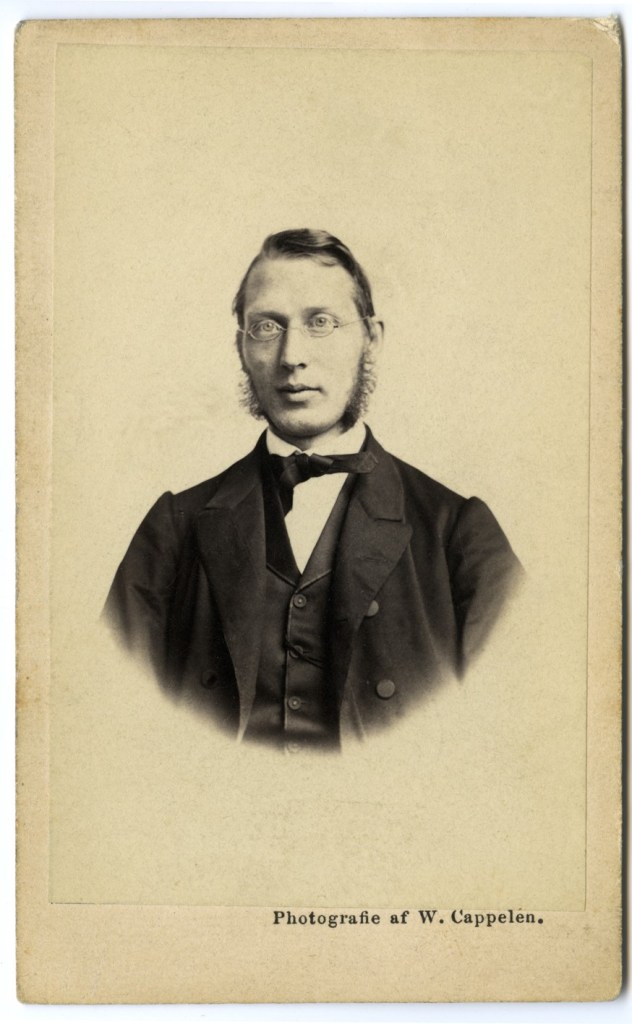
*Gottfred Christian Vogelsang (C.G.V.) Cormontan
Born February 1, 1836 in Beitstad, Norway; died June 13, 1917 in St. James, MN
Older brother of Theodora Cormontan
While in various publications he is called Gottfred, Gottfried, Christian, and C. V., he is most consistently referred to as C.G.V. Cormontan. C.G.V.’s biography is essentially covered in the section on Theodora Cormontan, so only a thumbnail sketch is included here.
In 1858 C.G.V. was one of the founding members of the Norwegian Pharmaceutical Association, as reported by the Norwegian Pharmaceutical Journal (NFT) on the 150th anniversary of the Association. He graduated from Christiania University in 1868 as a Pharmacist. On August 4, 1873 he sailed to the United States on the S/S Harald Haarfagre with his younger sister Marie and her two small children. He became a naturalized citizen on June 8, 1880 in Elkader, Clayton County, Iowa. The 1880 census placed him in Wagner of the same county, where he boarded in the home of Ole Peterson. His occupation was listed as school teacher, although he probably also worked as a pharmacist. The next year he relocated to Sacred Heart, Renville County, Minnesota, where the 1885 Minnesota census enumerated him in the home of his sister Marie and her husband, Edward Lyders. He moved to Franklin in Renville County in 1885 and became co-owner of the Franklin Drug Store with Edward, who was also a pharmacist. C.G.V. was elected to the first city council of Franklin in 1888, and was also on the council in 1897-1898. He served for many years as the treasurer for the Dale Lutheran Church east of Franklin in Camp Township, and in 1898 was one of the founding fathers of Concordia Evangelical Lutheran Church in Franklin.
C.G.V. and the rest of the Cormontan family moved to Madelia, Watonwan County, Minnesota in 1899 where he owned the Madelia Drug Store. The business did not succeed, and by 1901 he worked for Woods Drug Store in Hanska, Brown County, Minnesota. He moved again in 1904 to operate a drug store in Kennedy, Kittson County, Minnesota, and returned to Madelia a few years later. In late 1906 or 1907 he took a pharmacist position at Levens Drug Store in nearby St. James, Minnesota. He died in 1917 and was buried by the county in an unmarked grave in Mt. Hope Cemetery in St. James.
A coincidental side note: The 1865 Norwegian census recorded C.G.V. in Christiania (now Oslo) on Akergaden Street living in a residence with six apartments. He was a student at the time. The famous Norwegian writer Bjørnstjerne Bjørnson and his family lived in another apartment in the same building. Bjørnson was a theater director at the time. Did C.G.V. and Bjørnstjerne know each other? C.G.V.’s sister Theodora set at least two Bjørnson poems: “Dulgt Kjælighet” and “Holder du af mig.”
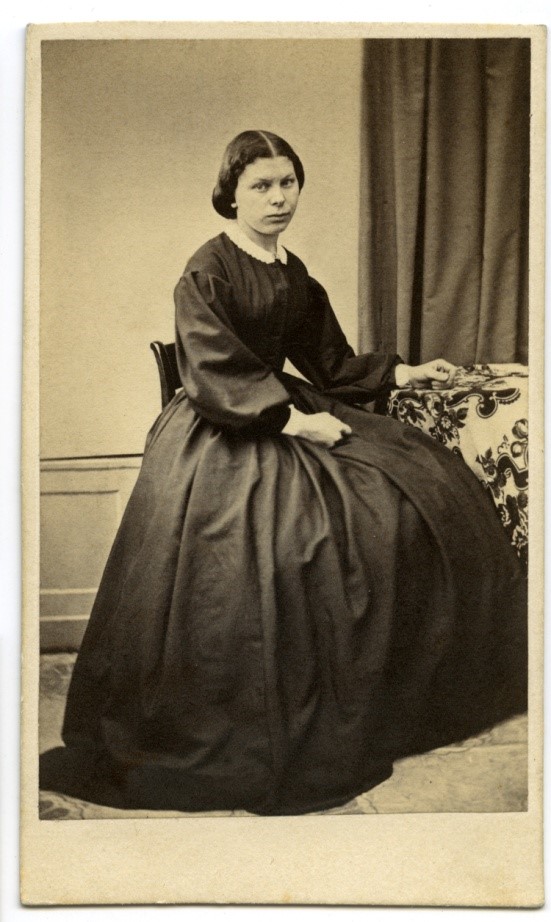
*Eivinda Louise Cormontan
Born April 26, 1838 in Beitstad, Norway; died November 8, 1924 in Decorah, Iowa
Older sister of Theodora Cormontan
Less information survives regarding Eivinda than any other sibling of Theodora’s who came to the United States. In Norway and in the U.S. she always lived at home and never married. Presumably, she kept the house running while others in the family worked outside the home. There is no newspaper report of her performing in concerts as there is for Theodora and her other sister, Marie. The Morton newspaper noted that Eivinda sometimes traveled with C.G.V. to Minneapolis on business or with Theodora to visit Sacred Heart. The paper reported one five-week trip she took by herself to Sacred Heart and Appleton, Wisconsin that it described as “recreative.” The Fort Ridgely and Dale Ministerial Book lists her as a godparent to at least three baptized children, including Gotthard Waldemar Xavier, born on May 12, 1889 to Pastor Xavier and his wife Amanda. The 1905 Minnesota census lists her occupation as “housekeeper” and has her living separately from Hans and Theodora, but this was only temporary. Typically, she stayed with the rest of the family and they all joined the same Norwegian Lutheran church in whatever town they lived.
Theodora and Eivinda seem linked at most stages of their lives. For over 15 years they were the two sisters who remained with their father in Norway after their mother died and the other siblings immigrated to the United States. There is a painting in their hometown of Arendal that depicts the two daughters in their permanent places in the church choir where their father was the parish priest. When Theodora sued the railroad company at her civil trial in 1889 in St. Paul, Eivinda was called to the stand for an entire day of testimony, the only person other than Theodora who was questioned at that length during the trial.
With their two brothers deceased, Eivinda and Theodora traveled together in 1917 to the “Aase Haugen Home for Old People” near Decorah, Iowa. As Theodora required a wheel chair, it is likely that Eivinda was there to help. The two sisters are buried side by side at the Aase Haugen Cemetery, located in a pasture near the Home, now a private residence.
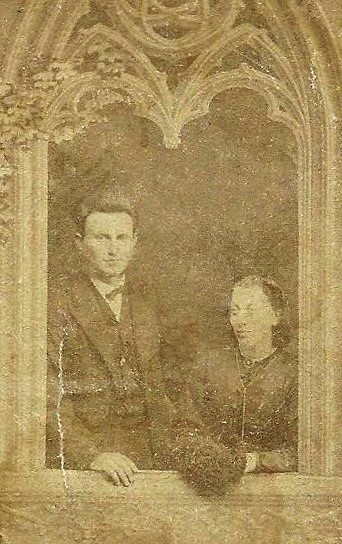
(above) Edward and Marie Cormontan
*Josephine Marie Cormontan
Born July 19, 1844 in Beitstad, Norway; died March 30, 1930 in Minneapolis, MN
Younger sister of Theodora Cormontan
(with gratitude to Nancy Clasen for providing information on her great-grandmother Marie)
Both Marie and her husband Edward Orla Lyders were 26 years old when they married on June 3, 1870. Edward was born on August 22, 1844 in Roskilde, Denmark, and had taken a position as a pharmacist in Arendal, Norway by 1865. He immigrated to the U. S. in 1872, probably going ahead of the rest of the family because Marie was pregnant with their second child.
In 1873 Marie departed from Bergen, Norway on the S/S Harald Haarfagre with her two-year-old daughter Louise and a one-month-old infant boy who would die before his first birthday. C.G.V. traveled with them. The family settled in Chicago for a few years before moving to Elgin, Iowa by 1876. In 1878 they relocated to St. Olaf, Iowa before coming to Sacred Heart, Minnesota in the spring of 1880, where Edward opened a drug store and became the first doctor of the village.
The 1885 Minnesota census notes C.G.V. temporarily living with the Lyders family. He would shortly be moving to Franklin to open his own drug store. By 1887 Theodora came to live with the family for several months along with her 89-year-old father Even and her sister Eivinda while C.G.V. prepared their permanent home in Franklin. The Sacred Heart residence was a full one, housing not only the three new guests and Marie and Edward, but also their six children.
The families in Sacred Heart and Franklin interacted frequently during the 1890’s. In 1893, for example, Franklin family visited Sacred Heart to see one of the Lyders daughters get married and members of the Lyders family came to Franklin for the funeral of Even Cormontan. Another Lyders daughter was a particularly frequent visitor to Franklin, and eventually married a young man from that town.
Edward died on May 15, 1898. Marie would outlive him by more than thirty years. For a few years she would continue to live in Sacred Heart as the widowed head of the household whose occupation was listed in the 1900 census as Boardinghouse Keeper. In 1902 she moved to Minneapolis to live with her daughter Josephine (nicknamed “Effie”), a dressmaker, and Marie’s son Edward Jr., a pharmacist like his father and uncle. She continued to live with Effie and Edward Jr. at the time of the 1920 census, and died in Minneapolis on March 30, 1930 at the age of 85.
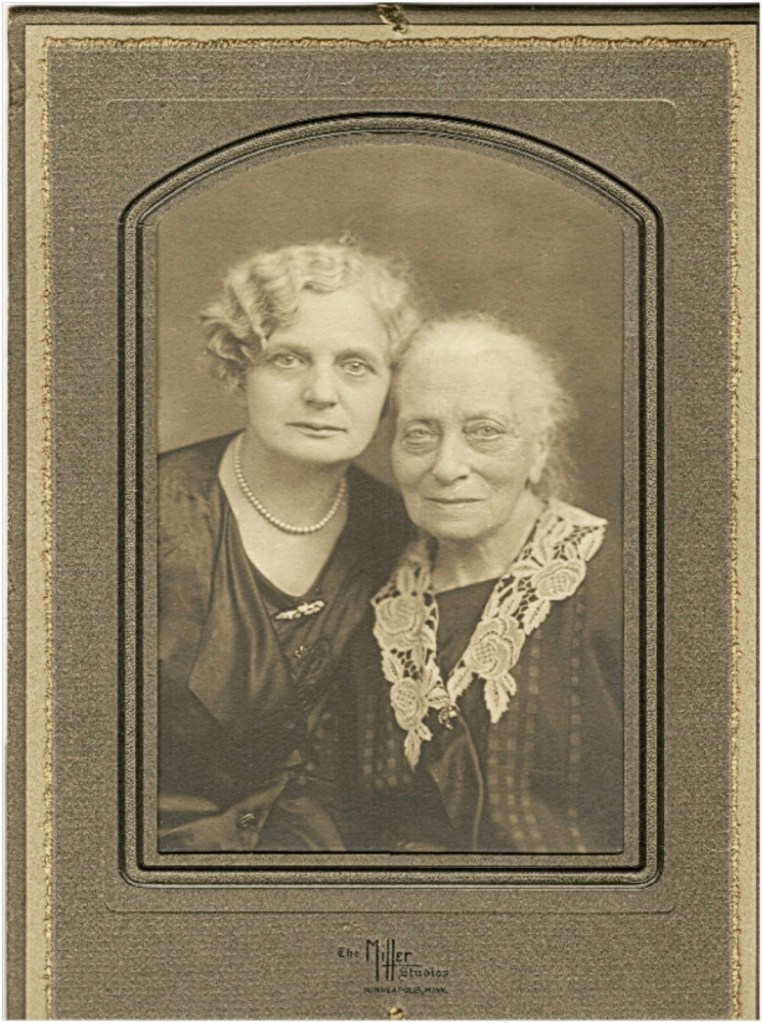
(above) Marie Cormontan Lyders (right) and her daughter “Effie” from the latter 1920’s
The following are excerpts from the obituary of Marie Cormontan Lyders that appeared in the Sacred Heart News on April 3, 1930:
“Funeral services were held in Sacred Heart Wednesday afternoon for Mrs. Marie Lyders, an old pioneer resident of the village, who died Sunday at her home in Minneapolis. Funeral services were held at Our Saviors Church, Rev. Nils Giere officiating. Burial was made at Sacred Heart by the side of her husband, E. O. Lyders, who died in 1898.
Mrs. Lyders was one of the sturdy pioneer women who exerted great influence for good as the wife of the first druggist and practicing doctor in the community. Many of the older residents recall acts of kindness and mercy performed by Mrs. Lyders in the early days of hardship as she went about assisting Doctor Lyders.”
Following some biographical information already noted above, the article continued: “She made her home for a time with a son but at the time of her death was making her home with a daughter, Miss Effie Lyders. Several years ago she suffered a stroke of paralysis but was in fairly good health until a year ago when she became unable to walk. She became ill about three weeks ago and died on Sunday at the age of 85.
Mrs. Lyders had a wonderful disposition and remained cheerful thru [sic] her last illness. It has been said of her that she was never known to complain during her life. Death came while she slept and she left her family with a smile. Her last visit to Sacred Heart two years ago is recalled by many of her friends.”
The item noted that four of her six children (listed below) were present at the funeral, with Evinda and Carl (living in Alaska and Washington respectively) not in attendance. It said she lost two children in infancy (only one is reported by Nancy Clasen) and that at the time of her death she had 10 grandchildren and three great grandchildren. An article in the April 10 edition of the same paper noted that her nephew, Evan Cormontan, also attended the funeral.
The children of Marie and Edward Lyders:
Louise Augusta Lyders Bromstad
Born June 21, 1871 in Arendal, Norway; died February 13, 1966 in Chippewa, MN
Male child, name unknown, born in 1873 and died before his first birthday.
Josephine Marie “Effie” Lyders
Born July 16, 1874 in Chicago, IL; died February 6, 1956 in Minneapolis, MN
Henrietta Ernestine Lyders Monson
Born May 7, 1876 in Oelwine or Elgin, Iowa; died May 18, 1965 in Minneapolis, MN
Evinda Lyders Tweet
Born May 16, 1879 in Elgin, Iowa; died May 1, 1972 in Teller, Alaska
Edward Orla Lyders (Jr.)
Born September 18, 1881 in Sacred Heart, MN; died January, 1967 in Minneapolis, MN
Carl Schelderup Lyders
Born May 13, 1884 in Sacred Heart, MN; died on September 7, 1956 in Tacoma, Washington
University Grades
The following is an electronic, edited translation of a portion of:
“Norske studenter: der har absolveret examen artium ved Christiania Universitet” by Paul Botten-Hansen, 1893.
[“Norwegian students who have graduated from Christiania University”–(the city of Christiana is now Oslo)]
Botten-Hansen’s book reports the grades assigned to the entrance examination to the University, the grades assigned to the final examination, and the professions graduates pursued after completing their degrees.
On page 3 the book reports that Even M.S. Cormontan (Theodora’s father) entered the university in 1817 and graduated in 1824. There were 24 students recorded in this class. Three graduated as early as 1821. Eleven students graduated before 1824, the rest graduated in 1824 or later (it appears three did not graduate), so seven years at the university appears to be in the normal range of length of attendance.
University grading utilized the Latin Scale, with the numbers 1-4 signifying the following:
1. Laudabilis prae ceteris: Excellent
2. Laudabilis: Very good
3. Haud illaudabilis: Good
4. Non contenendus: Not commendable but passing
Even scored a 3 in his entrance exam and a 3 in his final exam. It appears that a score between 1 and 4 was needed in the entrance exam to pass, and 1-3 in the final. 3’s and 2’s are the predominant scores, with two 1’s in the final and one 4 in the entrance. The graduates went on to various careers, including a few professors and a postmaster. The predominant degree was theology and the predominant profession was the clergy for the Church of Norway, with nine graduates noted in that profession. This included Even, whom the book notes was a clergyman in Arendal, Norway before going to America.
C.G.V. Cormontan (Theodora’s brother) entered the University in 1856 in a class of 109, as noted on page 87. He did not graduate until 1868. Only one other student graduated later, in 1869. Another student earned a second degree in 1872. Everyone else graduated earlier. One mitigating factor may have been that C.G.V. earned his masters degree–perhaps many of the others did not get a masters. On the other hand, while C.G.V. received a 3 in his entrance exam and a 3 in his final exam (just like his father), he does not appear to personally be a strong student in the opinion of the University. There is a category after the degree designation in the book denoted as “Charakterer.” This translates as “Character.” While most of C.G.V.’s classmates received a 2 or a 3 (just a few earned a 1), C.G.V. and just a few other graduates received a 4.
Still, he graduated with what appears to be a degree in Chemistry; at least, a degree that qualified him to be a pharmacist. The book notes that he lives in America with the profession of bookseller. While C.G.V.’s drug store in Franklin, Minnesota sold books and stationery (among many items), C.G.V. worked as a pharmacist, and likely as a doctor when the town doctor was unavailable. The book notes only one other graduate from C.G.V.’s class who subsequently immigrated to the U. S., and a second who ended up in London. The vast majority assumed professional positions in Norway. Did this unusual decision to go to the United States reflect a restlessness or an adventurous spirit in C.G.V.? Did it reflect a special concern for the (mostly) financially disadvantaged people from Norway who were immigrating to the United States and who would need medical professionals from their native Norway in the new land?
Most likely, C.G.V.’s decision to immigrate was born primarily of a desire to improve his opportunities. When he left Norway in the 1870’s, a pharmacist had to work for someone else for an average of 16 years before the government would allow him to own his own pharmacy. When a pharmacist worked for someone else, he typically lived in the building where the pharmacy was located because he was required by law to be available 24 hours a day, seven days a week. This profoundly impacted the quality of life for pharmacists who did not own their own business. For example, only about 20% ever married. C.G.V. probably came to the U.S. not only to serve others, but to make a better life for himself.
Norwegian Pharmacists
Norwegian Immigrant Pharmacists
The primary resource for the following information is:
Klevstrand, Rolf. “From Apothek to Drugstore: Norwegian Immigrant Pharmacists in The United States of America.” Oslo: Cygnus: en norsk farmasihistorisk skriftserie, May 2003.
Approximately 750,000 Norwegians immigrated to the United States between 1825-1915. Of this total, less than 100 were pharmacists who had been educated in Norway. Two of the first Norwegian pharmacists to immigrate were Theodora Cormontan’s brothers, Magnus and C.G.V. Her Danish brother-in-law, pharmacist Edward Lyders, was another early immigrant. All three practiced in Minnesota, with Magnus and Edward serving as physicians as well as pharmacists. Theodora lived with her brother C.G.V. for most of the years between 1888 and his death in 1917. The mixed fortunes he experienced in this country as a first-generation immigrant pharmacist had a profound impact on his sister and her aspiration to be a published composer.
A letter written by two Norwegian pharmacists living in Chicago, Ulrich Heyerdahl and Kristoffer Stange, may have inspired this emigration. Their letter was published in 1868 on the front page of the prominent Norwegian newspaper Morgenbladet. In this “America letter” Heyerdahl and Stange gave advice and information to pharmacists who were considering immigration to the USA. They wrote, “Every pharmacist considering emigration must be fully independent and equal to his job as pharmacist. He must have the courage to meet his fate alone and without any support or help, and he must have knowledge of English and German.” They noted that the U. S. was “crowded with American pharmacists,” but the German and Scandinavian pharmacists were well off because of their “more complete education.” They wrote that pharmacists usually earned $50-60 a month in the United States, but some earned $80-100, which was more than pharmacists earned in Norway. They asserted, “America is now, and will be still more in the years to come, able to give thousands of pharmacists a decent living. Here an economical pharmacist can save sufficiently to open his own business within 3-4 years. In Norway this is [rarely the case], as we can only hope for a ‘personal privilege’ to own a pharmacy (Apothek) when we are 40-50 years old.”
The law in Norway at the time required a pharmacist to possess a government-issued “personal privilege” in order to open his own pharmacy. In the 1870’s, when Theodora Cormontan’s brother C.G.V. immigrated to the U.S., a pharmacist needed to work at a drug store an average of 16 years before he would receive this “personal privilege.” A pharmacist without the privilege would typically receive room and board to live in the building that housed the pharmacy because Norwegian law required pharmacies to be open 24 hours a day, seven days a week. This system made it difficult for the non-privileged pharmacist to enjoy any kind of social life. For example, in 1890 only 30 of the 150 employed pharmacists in Norway were married, perhaps explaining C.G.V.’s bachelor status. The long wait for pharmacy ownership and the compromised quality of life during the years of waiting probably compelled C.G.V. and other Norwegian pharmacists to leave Norway for the United States during this time.
Pharmacists from Norway were often better trained than their American counterparts in the upper Midwest before the 1880’s. Essentially anyone could run a drug store until the state instituted a Pharmacy Law to regulate the profession. Iowa passed its Pharmacy Law in 1880, Illinois in 1881, Wisconsin in 1882, and Minnesota not until 1885, the year C.G.V. began operating the Franklin Drug Store in Franklin, Minnesota. Conversely, there was at least one issue that negatively impacted Norwegian-trained pharmacists of this period. While they claimed to have been educated at the University of Christiania, Norwegian pharmacists had been trained at the chemical laboratory of the university but were not technically enrolled there. Pharmacy was not established as a university education in Norway until 1923. In 1885 this technicality of enrollment prompted the president of the Illinois State Board of Pharmacy to not register Norwegian pharmacists. States like Iowa and Minnesota continued to register Norwegian pharmacists, which may explain why C.G.V. lived first in Iowa and then Minnesota.
Two Norwegian pharmacists immigrated to the USA in the 1850’s. Both of them practiced in Chicago. At least seven more pharmacists arrived from Norway between 1866-1869. Six of these settled in Chicago. The seventh, Peter Rønning, died in Willmar, MN in 1873. If he was a practicing pharmacist in Willmar, he was likely the first pharmacist from Norway to practice in Minnesota.
However, the Klevstrand source also mentions Theodora’s brother Magnus, noting that he may have immigrated during the 1866-1869 period. We know Magnus was in Trondheim in 1865 and was practicing in Pelican Rapids, MN at least by 1878. If Rønning did not serve Willmar as a pharmacist, Magnus was probably Minnesota’s first pharmacist from Norway.
Klevstrand reports seven Norwegian pharmacists coming to the USA between 1870-1879, five of the seven after 1876. Klevstrand does not include C.G.V. Cormontan in this list, even though he immigrated in 1873. He eventually located in Iowa, where he likely did at least some pharmacy work in addition to teaching. He moved to Sacred Heart, MN by 1881, where he likely assisted doctor/pharmacist Edward Lyders, husband of C.G.V.’s sister Marie. By 1885 C.G.V. ran his own drug store in Franklin, MN.
A larger wave of 39 Norwegian immigrant pharmacists came to the U. S. in the 1880’s, no doubt due to difficult economic times in Norway. Seven of this wave settled in Minnesota, but it is unlikely that any of them were practicing in Minnesota before 1886. This means that C.G.V. was one of the very first Norwegian-born pharmacists in Minnesota. It is very possible that Magnus and he were the first two Norwegian-born pharmacists in this state. If not, they probably were second and third.
Some Norwegian immigrant pharmacists were financially successful. Typically, they lived and worked in larger metropolitan areas with a greater number of Norwegians and immigrants from other Nordic countries. Some Norwegian pharmacists in small towns seem to have had financial problems. Rolf Klevstrand writes, “Both Paul Grønvold and Peter O. Bugge ran drugstores in small towns in North Dakota. When Grønvold died in 1932, Bugge wrote in an obituary in a Norwegian pharmaceutical journal: ‘Pharmacist Grønvold has been sick for the last years. The strenuous and dismal work in American drugstores has probably helped undermine his health.’ This remarkable statement is no testimony of fulfilled dreams!” We know C.G.V. declared bankruptcy in 1900 and was so poor when he died in 1917 that the county buried him in an unmarked grave.
To quote Klevstrand in closing, “Like the about 120 immigrant physicians, [Norwegian immigrant pharmacists] can be described as a special group of Norwegian immigrants that without doubt contributed to make life more smooth and secure for the large crowd of Norwegian immigrants. Probably they saw themselves as professional persons, responsible for providing Norwegian and other Scandinavian immigrants with medicines and other commodities, besides making a living for themselves.”
Dr. Christian Hirsch
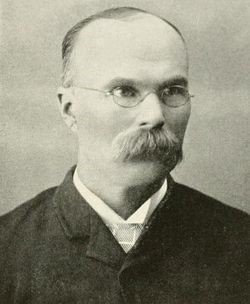
(above) Dr. Christian Hirsch
After her immediate family, the relative whom newspapers report visiting Theodora Cormontan and her siblings the most is first cousin Dr. Christian Johan Benedictus Hirsch (1842-1901). Both the Morton Enterprise and the New Ulm Review newspapers note several trips Dr. Hirsch made to Franklin, Minnesota in 1896-1897 where he visited with his relatives and also conducted business. One journey by C.G.V. Cormontan to New Ulm to visit Dr. Hirsch and family was noted by the Review in February of 1897; other possible meetings before or after 1896-97 are unreported. Dr. Hirsch’s father (Christian Leuthäuser Hirsch), and the mother of the Cormontan siblings (Louise Augusta Hirsch Cormontan), were brother and sister.
Looking at the lives of Dr. Hirsch and his family can potentially provide insights into the lives of the Cormontans. As a physician, reading about Dr. Hirsch’s professional activity in the 1890’s can help improve understanding the medical profession and medical practices at that time, giving insights into the professions of Theodora’s brothers C.G.V. and Magnus, as well as brother in law Edward. Dr. Hirsch’s oldest daughter Alpha was a music teacher like Theodora, so noting Alpha’s professional activity is of interest. It is also likely that the experiences of the Hirsch family, contemporaries of the Cormontan family who lived about 35 miles away, can assist in imagining the day-to-day experiences of Theodora and her siblings while they lived in Franklin.
Of additional historical interest, Dr. Hirsch’s wife, Camilla Thrane Hirsch (1846-1914), was a daughter of Marcus M. Thrane (1817-1890), the leader of the first Norwegian labor movement. Camilla’s sister Vasillia Thrane Struck was married to the Twin Cities architect Carl F. Struck (1842-1912). Struck designed many significant buildings in Minneapolis and St. Paul, as well as the Brown County Courthouse and the Hirsch residence in New Ulm.
The following is a biography of Dr. Christian Hirsch taken from:
Shutter, Marion Daniel. Progressive Men of Minnesota: Biographical Sketches and Portraits of the Leaders in Business, Politics and the Professions; Together with an Historical and Descriptive Sketch of the State. Minneapolis: Minneapolis Journal, 1897. Page 283.
“Dr. Christian J. B. Hirsch, of New Ulm, Minnesota, is a native of Norway, one of those who came to America as a young man and cast in his lot with his adopted country, fighting her battles and participating in the beneficial results of the war. Dr. Hirsch was born on August 29, 1842 [in Christiania]. His father was a physician in the employ of the government. Until he was sixteen years of age he was tutored by a lieutenant of the army. He then tried the life of a sailor for two years, but gave that up and returned to Christiania where he attended the university for three years. In 1863 he left for the United States in a sailing vessel. He stopped at Chicago, and during the following year enlisted in Company D, Eighty-ninth Illinois Volunteer Infantry, joining his regiment in East Tennessee, where it was then stationed. His corps started with General Sherman of the “march to the sea,” but after the battle of Atlanta was detached to pursue General Hood, who was threatening Nashville. After the battles of Nashville and Franklin they followed up the remnants of the Southern army until they scattered. They next went to East Tennessee to help in the final operations against Lee, and after the surrender of that famous fighter the regiment went to Texas, where Dr. Hirsch was finally mustered out of service in August, 1865. By this time the young Norwegian had seen enough of war and of the fighting qualities of the Americans to convince him of their energetic character. He had also had an opportunity of seeing a good deal of the country.
Upon being discharged from the service he went back to Chicago and entered Rush Medical College, from which he graduated with honor in 1868. A year previous he had been married to Miss Camilla M. Thrane, a daughter of Marcus Thrane, the leader of the Liberal movement in Norway in 1849. With his young wife Dr. Hirsch settled in Dane County, Wisconsin, where he practiced medicine for nine years. He then moved to Baldwin, Wisconsin, where he lived for one year. He was afterwards in Zumbrota, Minnesota, for a year; in Lake Mills, Iowa, for two years, and Blue Earth City, Minnesota, for three years. In the latter place he was part owner in a drug store and lost all his books and instruments in a fire which burned the store and his office. It so happened that his insurance was small and covered only the drug stock. The next two years were spent in travel in North Dakota. Dr. Hirsch next settled in Black River Falls, Wisconsin, where he remained for four years, after which he moved to New Ulm, in 1890.
Since establishing himself in New Ulm he has built up a large practice. Dr. and Mrs. Hirsch have had ten children, six girls and four boys, and have lost one child, a girl. The doctor belongs to the Brown County Medical Association and the Mississippi Valley Medical Association.”
The frequent movement of Dr. Hirsch and his family recalls that of C.G.V. and the Cormontans. Perhaps the vast promise of the opening frontier beckoned to many settlers with the potential of greater opportunity in the next location.
In April of 1897, Dr. Hirsch joined a group of doctors in New Ulm to experiment with the Röntgen ray. Though not the first to observe the effects of x-rays, German physicist Wilhelm Röntgen is usually credited as their discoverer in 1895 because he was the first to systematically study them. He also invented the term “x-ray,” referring to the radiation as “x” since it was an unknown type of radiation. The doctors in New Ulm gathered for their observations less than two years after Röntgen’s discovery.
Apparently greatly impressed with the medical potential of x-rays, Dr. Hirsch left New Ulm in 1899 and moved to Willmar, Minnesota, to join forces with the “Electro-Therapist” Prof. C.M. Stanton. They opened a clinic that specialized in the use of x-rays for diagnosis of “the most hopeless cases of chronic disease.” The doctors relocated to Worthington, Minnesota in 1900, where they advertised a facility with six offices and a treating room. By 1901 the Hirsch family had moved again to the town of Audibon near Detroit Lakes, Minnesota, where Dr. Christian Hirsch died on October 16, 1901 of a heart attack. His funeral and burial took place in New Ulm, with interment at the New Ulm City Cemetery.
The following is from the Vesterheim Museum record on Norwegians in the Civil War:
“HIRSCH, Christian J.B. IL 89th Inf Co D. Residence: Chicago, Cook County, Illinois. Born in Norway. Civil War: Sailor. Age 21. Hazel eyes, light hair, fair complexion, 5’11”. Enlisted for 3 years on 8 Jan 1864 at Chicago and mustered there the same day. Private. Promoted to Corporal on 31 Jul 1864. Transferred to the Illinois 59th Infantry, Company H. Mustered out 8 Aug 1865 at Green Lake, Texas.” Sources: (ILSA reel 6 p46, reel 8 p17).
The members of Dr. Hirsch’s family:
Camilla Hirsch: born in Christiania, Norway on January 15, 1846. Daughter of Marcus M. Thrane. Thrane was a political prisoner for eleven years for his publications and work on behalf of the common workers of Norway. His wife died before he was released from prison, and he immigrated with his five children (four daughters and a son) to the United States. They settled in Chicago in 1864, where Camilla married Christian Hirsch in 1867. After her husband’s death in 1901 she lived with her sons in Minneapolis, where she died on 2/22/1914 after being in poor health for a year following a stroke.
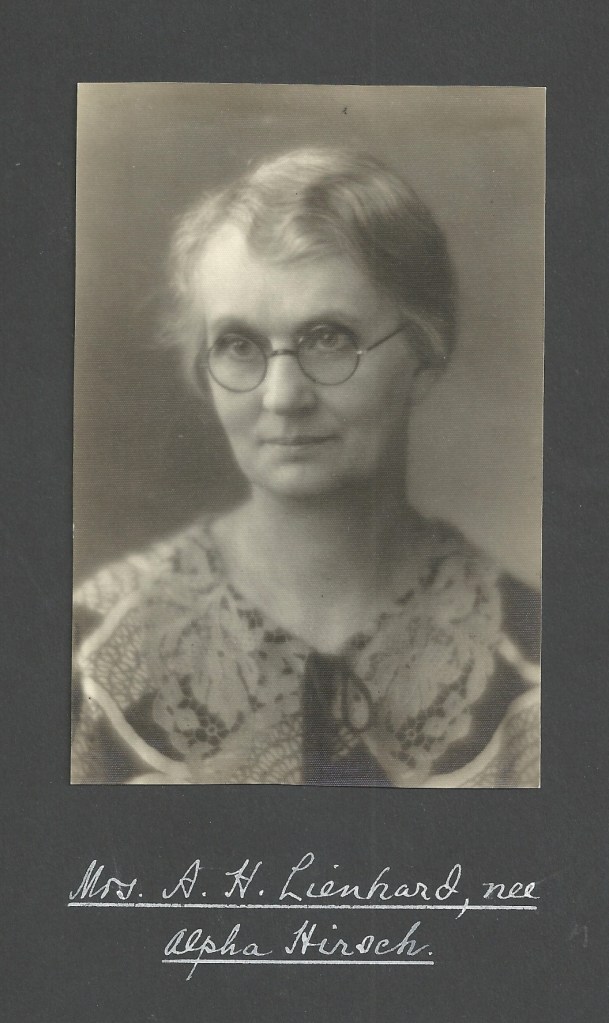
Alpha Hirsch was born in Chicago, Illinois on May 14, 1868 and moved to New Ulm in 1890 where she taught music lessons. Alpha married Adam Hugo Lienhard on August 3, 1896 in Minneapolis. For more than a decade they lived in New Ulm where they had two children: Lowell (John) and Vivian. By 1920 they resided in Minneapolis with their son John and his wife Kathryn. During this time Adam was a traveling salesman for the Iron Clad hosiery company; he eventually would become president of the Minnesota Commercial Men’s Insurance Company. Adam and Alpha continued to live in Minneapolis in 1930, but toward the end of her life Alpha lived with her daughter Vivian Lienhard Magnuson and her husband Elmer in Minneapolis. Adam died in Rochester, Minnesota on December 2, 1937 at the age of 75. Alpha died in Minneapolis on 9/21/1940 at the age of 72.
Axel Frederick (Fred) Hirsch: born in Chicago, Illinois on September 8, 1869. In poor health all his life, as an adult he lived with his parents in Minneapolis for a time before moving to Faribault, MN. He died on August 21, 1915 at the age of 44.
Vasilia Josephine (Wallie) Hirsch: Born 7/2/1871; died 11/16/1893 of tuberculosis.
Estella Hirsch: born in Wisconsin on August 24, 1872; married Willard G. Little in 1898; died 1/2/1903 in Phoenix, Arizona of tuberculosis. Willard moved to Tacoma, Washington in 1905 and died in Tacoma in 1955 at the age of 85.
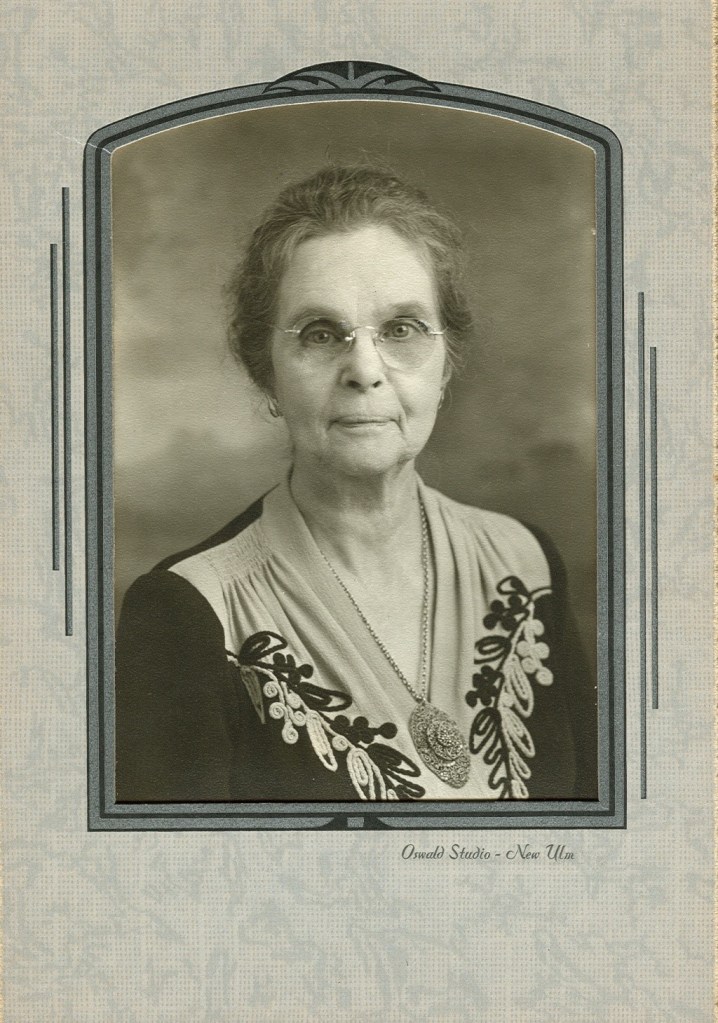
Caroline (Linsie) Hirsch, 1945
Caroline (Linsie) Hirsch was born in 1875 in Wisconsin and married Frans Hilding (Frank) Krook on 1/15/1895. F.H. Krook died in January of 1963 and Linsie died in 1965. They had five daughters: Beata Katharine Krook Nedry (1896-1979), Aimee E. Krook Held (1899-1986), Marjorie K. Krook McCarty (1906-1999), Helen Josephine Krook (1910-1984), and Florence Linsie Krook Van Valkenburgh (1912-2003). In 1955 the couple edited The Wisconsin Bible written by Linsie’s uncle, Marcus M. Thrane. The book was published in New Ulm by Linsie.
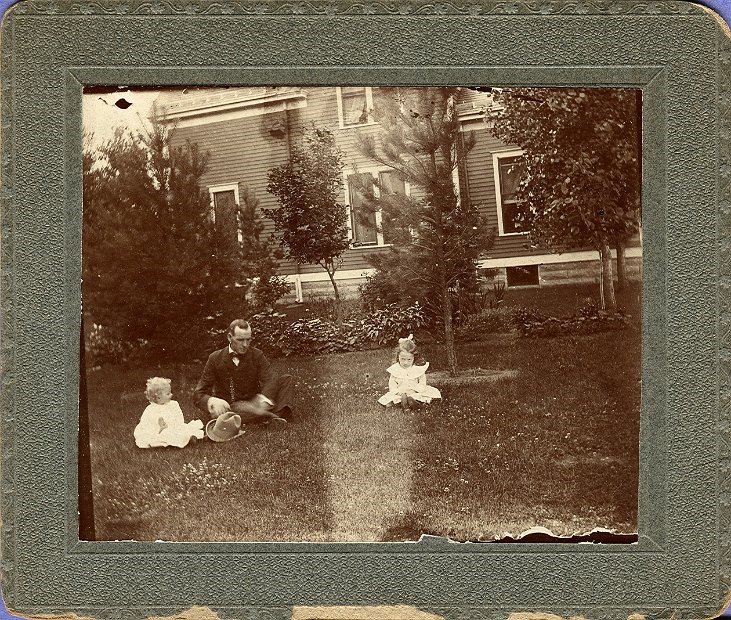
(above) Aimee, Hilding, and Beata Krook, around 1900 or 1901
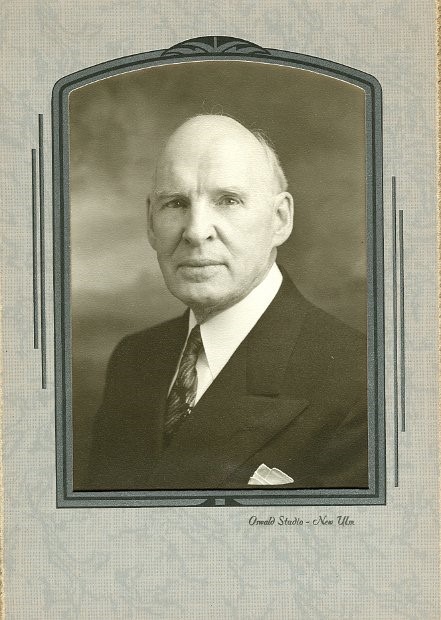
Frans Hilding Krook, 1945
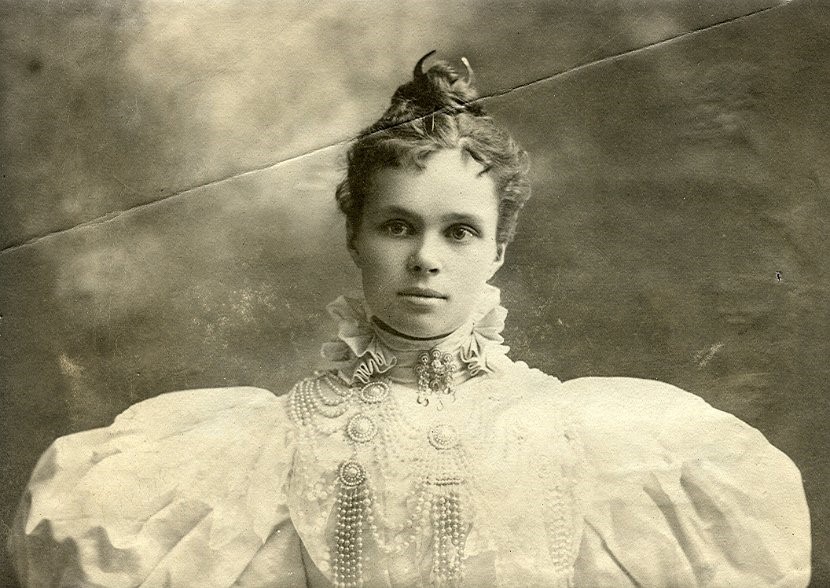
Linsie Hirsch in her wedding dress, 1895
Camilla Marie Hirsch (1877-1925): Born in Perry, Wisconsin on April, 30, 1877. On September 5, 1902 she married William L. Goodrich (1876-1915). They had three children; Camilla, Dorothy, and Standish. Camilla had been in failing health for ten years before passing on May 6, 1925. Her obituary notes: “Friends in New Ulm will remember Mrs. Goodrich as quiet and unassuming in nature with a disposition which endeared her to all. Her absence in the home will be keenly felt by her children where she was their devoted companion and guide. Thru [sic] her long illness she was patient and thot [sic] first of her family and others who were needy.” She is buried in Detroit, Michigan next to her husband.
Patroclus Jacob Frederick (Trudie/Trudy) Hirsch (1879-1942): In 1897 he moved west and developed a life-long interest in the fruit business. The July 9, 1942 New Ulm Review reported that he was an artistic wood carver and also a talented musician, especially on the violin. In 1906 he married Leonore Madge Newport (1887-1937) and they had four children. He died in Newcastle, California at the age of 70.
Robert Waldemar Hirsch (1881-1969): Born in Iowa in 1881. Married Lillian Janet Nelson in 1914. Died in Los Angeles, California. Lillian and Robert had one son, Robert Jr. (1915-2013).
Florence Beatrice and Darwin Paoli Hirsch: Twins born in May of 1883 in Minnesota. Florence married Ashley F. Smith in 1909. By 1930 they appear to live in California and have two sons, Donald and Ashley. Darwin married Hilda Marie Peterson (1885-1947) in 1913. In 1940 they lived in Minnesota and appear to have five children: Philip, Elizabeth, Eleanor, James, and Richard. Darwin died in 1949.
The following news items are from the New Ulm Review unless otherwise noted, organized by date. Editorial additions are bracketed. The articles give a fairly detailed depiction of Dr. Hirsch’s professional activity as well as information about the lives of the members of the Hirsch family, including their meetings with Carl F. Struck and family. With the marriages of Alpha and Linsie, the Lienhard and Krook families are also traced. This includes the musician Frances Bertha Juthilda Krook (1891-1978), daughter of F.H. Krook’s brother, Lewis Bernhard Krook (1864-1934) and Alma M. Vogel Krook (1871-1954).
5/28/1890: New Ulm is to have another physician and surgeon. Dr. C. [Christian] Hirsch, of Black River Falls [Wisconsin], has been here the past few days and has finally decided to locate. He will enter the offices of Dr. Berry in the Meridian Block, and calls attention to that fact in a card in another column. He is Norwegian, but speaks German, English and other languages fluently.
5/28/90: [An ad appears on page 5]: DR. C. HIRSCH, PHYSICIAN AND SURGEON. Office over Olsen’s Drugstore. When in town, can be found at office at all hours. New Ulm, Minn. [Ad appears to run every week until 9/24/90]
7/2/1890: Card of Thanks. To Dr. Hirsch who attended me in my recent illness, and who rendered valuable assistance. I wish to tender my hearty thanks. At the same time I can recommend him to all in need of a good physician. Julius Frank.
7/9/1890: Mrs. Maggie Norrell, wife of Peter Norrell, of Mulligan, was examined by Drs. Strickler and Hirsch before Judge of Probate Brandt on Wednesday and pronounced insane. She was taken to the hospital at St. Peter.
7/23/1890: Dr. Hirsch has rented Mrs. Hanft’s residence on German Street. Mrs. Hanft with her sons will remove to Minneapolis.
8/27/1890: A daughter of Dr. Hirsch arrived here last Saturday afternoon from Wisconsin. [Also]: See announcement of . . . Miss A. [Alpha] C. Hirsch, piano and organ teacher. [Alpha Hirsch also ran an ad on the same page that reads]: MISS A.C. HIRSCH. TEACHER OF PIANO AND ORGAN. Best of References: Terms 50 cts. per lesson. Call at office of Dr. C. Hirsch.
9/10/1890: [Dr. Hirsch tended to a man who dislocated his collar bone and received bruises in a farming accident.] [Also]: Miss Hirsch went to Mankato on Saturday to organize a class in instrumental music. [Also: a 17 year old woman fell from a wagon, had her clothes catch on the wagon and was dragged by the horses for some time until the team had cleared two wire fences.] When picked up she was terribly bruised. A gash extended on one side of her face from the nose to the back of the neck and the large arteries of the neck were exposed by an ugly cut an inch deep. The other side of the face was also badly disfigured by the wire. The left arm was marked by gashes and the left leg above the ankle broken and the flesh about the bone badly cut. For a time it seemed impossible that she could survive, but she was brought to the hospital, and under the care of Dr. Hirsch is now recovering nicely.
9/17/1890: Bernhard Fry, formerly a resident of New Ulm, now residing at Sprague, Wash., arrived here last week to visit friends and at the same time to have an amputation made of the first finger of his right hand. The latter was performed successfully by Dr. Hirsch.
9/24/1890: Mrs. [Camilla Thrane] Hirsch arrived here from Wisconsin on Monday evening for a short visit with her husband, Dr. C. Hirsch.
11/5/1890: Dr. Hirsch left for Black River Falls, Wis., Monday evening in order to cast a good Republican vote.
12/31/1890: Friday night, an accident occurred at the home of E.G. Pahl, which was all but a fatal one. The little children were playing in a room upstairs around a Christmas tree that they had lighted without the knowledge of their parents, and in some way one of them, Alice, fell against the tree so that her dress caught fire. A cry for help brought the mother into the room, and with good presence of mind she soon extinguished the flames. Luckily the child wore a heavy woolen dress and the flames were thus prevented from making very rapid progress, but even as it was, the accident was sad enough, her face and arms being severely burned. Dr. Hirsch is the attending physician.
1/7/1891: Fred Lange is sick with typhoid fever. Dr. Hirsch is in attendance. [Also]: On Friday, Dr. Strickler, assisted by Dr. Hirsch and Andrew J. Eckstein, amputated the left leg of Wm. Tesmer of Sleepy Eye. Fourteen years ago Mr. Tesmer cut his knee with an axe. His leg became permanently bent at the knee joint and lameness so increased with each succeeding year that amputation was necessary.
1/21/1891: Mrs. Dr. Hirsch of Black River Falls is here on a visit.
3/4/1891: [The newspaper asked a number of male citizens of New Ulm “Who is your candidate for New Ulm alderman, second ward?”] Hirsch: If [Dr. O.C.] Strickler can be induced to accept, I am in favor of his selection.
3/11/1891: Mrs. Dr. Hirsch is here on a visit from Black River Falls.
3/18/1891: While Dr. Hirsch was treating a patient at a farm house in Lafayette last Saturday, his team tore loose from the hitching post and ran to town. They went down two steep and icy hills and over poor roads without damaging anything, crossed the river bridge and entered town. There an attempt was made to catch them when the horses tore wildly up the street near the foundry, smashed the cutter and badly ruined the harness.
4/1/1891: [The New Ulm paper solicited public sentiment regarding the hanging of Clifton Holden.] Hirsch: Do not think it is right. Imprisonment for life, if made to really mean for life, would be a severer [sic] punishment. [Clifton Holden’s execution was commuted to life in prison by the governor of Minnesota.]
4/8/1891: Dr. Hirsch expects to go to Black River Falls, Wisconsin, the latter part of the week on business.
4/15/91: Dr. Hirsch left for Wisconsin on Monday.
4/22/1891: Dr. Hirsch returned from Wisconsin Friday morning. He has rented the Hummel residence on German Street and expects his family to arrive this week.
4/29/1891: The family of Dr. Hirsch arrived here on Saturday.
7/22/1891: Wednesday afternoon Alfred, a little son of Andrew Otterholm, fell from a scaffold or ladder in the new house of Chas. Stolz and received an ugly fracture of his skull. A slight concussion of the brain was the result, but fortunately the accident was not such as to prove fatal. Dr. Hirsch is treating him.
8/26/1891: On Thursday Nic Hillesheim was again examined before Judge Brandt by Drs. Strickler and Hirsch and committed to the asylum at St. Peter.
9/16/1891: [Dr. Hirsch was a Twin Cities visitor the previous week.] [Also]: The Minneapolis papers say that Dr. Hirsch of this city intends to remove to the former place, but there is no truth in the report unless the doctor fails to secure residence rooms. [Also]: A children’s concert will be given at Turner Hall under the direction of Miss A.C. Hirsch on September 23rd.
9/23/1891: The children’s concert under the direction of Miss Hirsch will be given at Turner Hall this evening. It promises to be interesting. [Also]: Dr. Hirsch has rented the Subilia residence on Minnesota Street. [Also: Dr. Hirsch advised the parents of a daughter who may have been bitten by a mad dog to send the girl to the Pasteur Institute in Chicago.]
9/30/1891: The family of Dr. Hirsch will remove to Mankato. [Also]: The Young People’s Concert at Turner Hall on Wednesday drew out a large audience and merited as large a one again. There was something so novel about the entertainment and something so cute that everyone who witnessed it was pleased. And then the little ones sang so sweetly, and looked so pretty and innocent and acted in such agreeable harmony, that one was inclined to wish that it might be that way always. Miss Hirsch certainly deserves praise for the manner in which she arranged and conducted the concert.
10/7/1891: The family of Dr. Hirsch have [sic] finally concluded to remain in New Ulm. They will occupy the Subilia residence. [Also an ad]: MUSIC LESSONS! Those who have applied to Miss Hirsch for lessons, and others who wish to take will do well to begin this week, as music will be furnished free to those commencing a term before Oct. 10.
10/28/1891: Mr. Schaeffer was brought to the hospital in this city from Windom last Wednesday. He had been kicked by a horse some weeks since and the result was two broken ribs near the heart. On Thursday Drs. Strickler, Fritsche and Hirsch operated on the man in his weakened state and removed the pieces of broken bone.
11/25/1891: Dr. Hirsch went to Chicago Monday on a visit.
12/2/1891: Dr. Hirsch returned from Chicago Saturday evening.
2/2/1892: The family of Dr. Hirsch will remove to Mankato. [Also: Drs. Hirsch and Schoch commit a woman to the asylum at St. Peter.]
2/24/1892: The report that Dr. Hirsch would remove to Sioux City is erroneous. The doctor visited the Iowa town but returned at once, thoroughly dissatisfied with the inducements offered and perfectly convinced that New Ulm affords a better field for his profession.
3/30/1892: [Citizens are asked by the paper who they considered the strongest Democratic candidates for president] Dr. C. Hirsch, Republican: Cleveland.
4/27/1892: [Republican leaders of New Ulm are asked by the paper whom they favor for governor and congress] Dr. C. Hirsch: I would prefer Lind, but think Knute Nelson can poll a larger vote for the party. Turrell is as good as anyone we could select for a congressional nominee.
5/18/1892: Mrs. Dr. Hirsch came up from Mankato Saturday evening to spend a few days with her husband.
6/1/1892: Dr. Hirsch will hereafter make professional visits to Madelia every Friday. [Also]: Bertha Peterson and Miss Olsen of Walnut Grove are in the city receiving medical treatment of Dr. Hirsch for lung troubles.
6/15/1892: Last Thursday Dr. Fritsche assisted by Drs. Strickler and Hirsch removed the right breast from Mrs. Anton Lang of Sleepy Eye in order to prevent the progress of a cancerous disease. [Also]: Three weeks ago Saturday Drs. Fritsche and Hirsch performed one of the most difficult operations known to surgery upon the person of Mrs. Yust. The operation consisted in sewing up a portion of the large intestine which had become destroyed through a gangrenous hernia and is one that has had only seven years standing in surgical history. Today the patient is improving nicely.
7/13/1892: A. Blanchard, Doc Hirsch, Doc Strickler, J. Newhart and one or two others have organized a Christian Endeavor society–that is they promise to make a christian endeavor to play cinch in this hot weather and maintain an evenness of temper even if someone bids fourteen without the low.
7/12/1892: Henry Siebert, an old settler of Linden, was brought to the hospital last Saturday in a serious state of illness. On Sunday Drs. Fritsche, Strickler and Hirsch performed an operation upon him with the view of relieving his suffering, but he was so far gone that he died during the operation. Mr. Siebert was a man of good traits and habits. He had many friends both in Linden and in New Ulm, all of whom were sorry to learn of his death.
7/27/1892: [Dr. Hirsch submitted the low bid in District 1 to furnish medical and surgical aid and also all medicines to county poor and county prisoners for one year. His bid was $150. He was also allowed a bill of $6.00 to the county for fees in post mortem examination.]
8/10/1892: Fred Borchert, an old man, had his right arm broken in a runaway last Friday afternoon. The accident occurred while driving up Centre Street and was occasioned by the breaking of part of the harness. The fracture is in the wrist of the right arm and is being cared for by Dr. Hirsch.
8/24/1892: Theo. Hovde of Lake Hanska had his collar bone broken last week in falling from a load of hay. The fracture was cared for by Dr. Hirsch.
8/31/1892: New Ulm is to have a new dry goods store or rather a new firm. Henry Crone having decided to go out of business, he has made arrangements to partially sell his stock to Lienhard Bros., of Winona, who will open up in the Doehne building on October 1st, with a first-class stock of fancy dry goods and notions. The new firm is made up of J.H. and A.H. Lienhard [Adam Hugo, the future husband of Alpha Hirsch], one of whom is a well-known traveling man. The latter and youngest brother will remain here and conduct the business. Both appear to be active business hustlers and New Ulm is to be congratulated on the acquisition.
9/7/1892: Dr. Hirsch, A.F. Reim, Mrs. Cady and children, Chas. Head, F. Boock and C. Bach were among the New Ulmites seen in Mankato on circus day.
11/9/1892: The family of Dr. Hirsch have [sic] returned from Mankato and are now located in one of Albert Held’s buildings.
1/4/1893: The Misses Hirsch entertained a large number of their friends Friday evening in a manner creditable to themselves and pleasurable to their guests.
4/19/1893: Miss Wallie Hirsch was a visitor in Mankato last Saturday.
4/19/1893: Miss A.C. Hirsch has rented the rooms over Dayton’s store and will use the same for the instruction of her pupils in piano music.
4/26/1893: [ad runs for a number of weeks] Miss A.C. Hirsch wishes to announce that she is now located in the rooms formerly occupied by Messrs. Hagberg & Lind (opposite Olson’s drug store) having fitted same up as music-rooms, and will be glad to receive pupils at any time for piano or organ. Call afternoons. [This location placed her in close proximity to her father’s office over Olson’s drug store].
5/31/1893: [under the headline] “The Musicale.” Turner Hall was well filled with people last Friday night who were anxious to hear what was heard. No program of the musicale had been circulated, and everybody was therefore curious to know what was in store for them. When it was over, many compliments were heard for the talent which made the affair possible.
The piano selections of Miss Hirsch were particularly fine . . .[later in the article it continued] . . . the K.P. quartette–well they seemed to win all the honors as well as all the cabbage heads of the evening. Time and again they were called out and we are almost sorry that we were compelled to treat them as we did. Our heart went out to them, along with the cabbage. [The item concluded] On the whole, and everything considered, the amatuers [sic] gave an excellent entertainment, well worth the patronage it received.
6/7/1893: [under the headline] “The Music Lesson.” “Your little daughter, as she went out awhile ago, seemed the very picture of misery.” “She was going to take a music lesson.” “And your oldest daughter, who is now going out, looks even more miserable.” “She is going to give a music lesson.”–New York Press.
8/23/1893: A friend of J.P. Bolstad, who came here recently from the Northern part of the state, Conrad Bang by name, met with a serious accident near town last Friday afternoon while running a traction engine for Ellef Asleson of Lake Hanska. He was in some way caught between the engine and separator and badly crushed. He was brought to town and given over to the care of Dr. Hirsch. Though his life was at first despaired of, he is still living, though in a precarious condition. [Mr. Bang recovered.]
8/30/1893: The Misses Alpha and Stella Hirsch have gone to Milwaukee on a visit.
11/1/1893: Dr. Hirsch, through the assistance of A. Blanchard, has been granted a pension of $12 per month.
11/15/1893: Miss Linsie Hirsch is teaching school in Linden. [Also]: Miss Wallie Hirsch, daughter of Dr. Hirsch, is so low with consumption of the stomach, that she is not expected to live over a day or two.
11/22/1893: Dr. Hirsch at present has nine or ten patients from outside towns (Madelia, St. Peter, Tracy and other places) for medical treatment. [Also]: Miss Wallie Hirsch, whose dangerous illness was reported last week, died Thursday morning after a siege of many month’s duration. During all this time her fortitude was remarkable for one so frail, and her kind and gentle disposition was manifest throughout. Miss Wallie was the daughter of Dr. and Mrs. Hirsch and was a young lady of twenty-two years, having been born in Wisconsin on the 2nd of July, 1871. Her nature and habits were such that she quickly acquired friends and always retained them. Her life was devoted to making herself acceptable in the eyes of her acquaintances and to spreading good will and friendship with an admirable example. To say this of a lady, young in years, is a tribute to be hoped for by all. [Also]: A Card of Thanks. We hereby desire to tender our most earnest and heartfelt thanks to the many who so kindly showed us sympathy or rendered assistance during our sad bereavement. Dr. and Mrs. Hirsch.
11/29/1893: Miss Hanson, the lady who was so dangerously ill at the home of A.J. Otterholm, has been improving lately under the care of Dr. Hirsch and will permanently recover.
12/27/1893: Mrs. Thorson, who has been receiving medical treatment from Dr. Hirsch of this city for some months past, has so far recovered that last week she was able to return to her home in Madelia.
1/24/1894: Christiana Anderson, daughter of A.M. Anderson of Lake Hanska, died last Sunday. She had suffered from a complication of scrofula and lung disease, and had been in New Ulm twice under the treatment of Dr. Hirsch. Each time she left for home in a favorable condition, but a relapse followed each time and on the latter occasion with fatal effects. She was a young lady of seventeen years.
2/14/1894: Mrs. M. Jenson of Brighton is in the city receiving medical treatment from Dr. Hirsch.
4/4/1894: Mr. Graufworth of Wisconsin has been spending a few days with Dr. Hirsch.
4/25/1894: The Misses Hirsch spent the week with friends in Mankato. [Also]: A chess club has been organized in this city with the following officers: Pres., Dr. Hirsch; vice-president, Prof. Bork; Secretary, J. Schaller; treasurer, H. Beussmann. Meetings are held every Monday and Thursday evening and all chess players are cordially invited to join.
5/9/1894: Miss Alpha Hirsch and Mrs. S.A. McElhinny will conduct a night school in one of the rooms of the Union School Building, the instruction to commence at once. [Also]: The pupils of Miss A.C. Hirsch will give a free piano recital at the Con. church on Sat. eve. May 12th 8 o’clock. All who are interested are invited to be present.
5/16/1894: The piano recital by the pupils of Miss Hirsch at the Congregational church on Thursday evening was quite largely attended and was well worthy of the patronage it received. The pupils showed marked advancement under Miss Hirsch’s instruction.
5/23/1894: The free night school at the Union Building is under the direction of the Misses Hirsch, Klossner and Tillie Schuetz.
8/29/1894: Pupils of Miss A.C. Hirsch’s class in music, wishing to resume lessons, are requested to make arrangements for hours this week if possible as the regular year’s work will begin Sept. 1st. New applications will also be received at this time, and more satisfactory hours given than later. The next public recital will occur in January, when it is hoped that a very good programme can be given, and that all possible progress be made before then.
11/14/1894: Miss Stella Walles, who has been the guest of the Misses Hirsch during the summer, will return to Minneapolis today.
11/28/1894: Dr. Hirsch went to St. Peter yesterday on professional business. Jos. A. Eckstein and C.A. Hagberg were also there attending court.
12/19/1894: Mrs. Dr. Hirsch is in Minneapolis this week, visiting friends.
12/26/1894: Dr. Hirsch spent a couple of days of last week at Winthrop on professional business.
1/2/1895: Measles have invaded the home of C.W.H. Heideman and Dr. Hirsch.
1/9/1895: The pupils of Miss Alpha Hirsch will give a public recital on the 18th of this month at the Congregational church. [Also]: The marriage of F[rans] H[ilding] Krook to Miss Linsie [Caroline] Hirsch is announced to occur at the home of Dr. and Mrs. Hirsch on the 15th. [Also: C.J.B. Hirsch’s personal property taxes are listed as $10.24.]
1/16/1895: Miss Hirsch’s musical recital will be given on the 25th instead of on the 18th as has been reported. It will be given at the Congregational church. [Also]: Last evening at the home of Dr. and Mrs. Hirsch a large number of friends witnessed the marriage of Miss Linsie Hirsch to Mr. F. Hilding Krook. The wedding was a brilliant affair, the residence being beautifully adorned with flowers and the ceremonies being performed in a manner that could not fail to please. Shortly after, a fine lunch was served and the guests passed the evening with the happy young couple in unalloyed joy and cheer. Of the contracting parties the Review wishes to say a few words and at the same time add its mite of congratulation to the great number already received. The young bride is the popular daughter of Mr. and Mrs. Hirsch and is an accomplished and estimable young lady in every respect. Many of our people know her and only speak well of her attainments and disposition. The groom is the well-known assistant in the Brown County bank, a position which he has held long and with credit. Strict in his habits, accommodating in his business duties and gentlemanly in his manners, all have learned to respect him. For such a couple, young in years and happy in their union, we can wish only for the best. [Also]: Miss Struck of Minneapolis attended the Hirsch-Krook wedding last evening.
1/23/1895: The program for Miss Hirsch’s recital at the Congregational church on the evening of the 25th appears in another column. [Also: the following is the program as it appears on page 8 of the 1/23 edition]:
The Hirsch Recital
The program for the recital by Miss Hirsch’s pupils next Friday evening is as follows:
1. Duet. The King’s Huzzar, March Heroique.
Paulina Schuetz and Ida Hellman
2. Solo Sonatine Kuhlan.
3. Vocal Trio Echo Engels,
Misses Peterson, Schuetz & Koch.
4. Solo Polonaise Lichner,
Miss Hilda Koch
5. Duet The Home Guards March.
Misses Peterson and Camilla Hirsch.
6. Solo Morning Prayer Streabbog.
7. Solo “Hussah” Bohm.
Miss Meta Koch.
8. Duet Little Melody Diabelli.
Misses Beussman and Schuetz.
9. Duet Polonaise Kaun.
10. Organ Solo, Birthday March, Ferber
Fred Campbell.
11. Chorus, The Frogs’ Singing School.
By the Class.
12. Solo, Musical Box Bohm.
Robert Hirsch.
13. Solo. Polonaise. Ferber.
Addie Olson.
14. Duet. Operatic Melody. Schubert.
Misses Scherer and Koch.
1/30/1895: Mrs. J.H. Hanson of Norseland is in the city receiving medical treatment from Dr. Hirsch. [Also]: The piano recital given by Miss Alpha Hirsch at the Congregational Church Friday evening was accorded a liberal attendance and in return gave those present an enjoyable treat. The various selections showed remarkable proficiency on the part of the pupils and reflected much credit upon the instructor.
2/13/1895: Miss Estella Hirsch is attending the Normal School at Mankato. [Also]: A little investigation has disclosed the fact that right here in our own city there are many cases of extreme want and need, caused in part by the hard times and in many instances by the inability to work as the result of sickness. There are some of these cases that would appeal to the sympathy of anyone, and yet our citizens, generally speaking, appear to be unaware of their existence. With one family, for instance, it has been found that the fare for weeks has been confined to salt and potatoes, while with another, the husband and father being weak-minded, the mother and children have absolutely no support whatever. Such distress needs looking after and as loyal citizens we should determine to do all that can be done in our own community before reaching out in other directions. There is one society at least that has been actuated by this motive and that is the Y.P.S. of C.E. [Young People’s Society of Christian Endeavor] working through the Reaching Out Committee of which Miss Alpha Hirsch is chairman. This committee is trying to raise a sum of money by subscription with which to relieve the most urgent need, and anyone wishing to contribute can do so by applying to Miss Hirsch. There are undoubtedly many, who, when aware of the distress, will be glad to lend a helping hand.
2/27/1895: Geo. Gieseke Jr. of Courtland had the forefinger of his left hand badly cut by a buzz saw last Thursday. Dr. Hirsch attended to the wound, and the young man will not lose his finger.
3/27/1895: Miss Alpha Hirsch is now arranging for another musical. Her pupils are rehearsing for the presentation of a cantata, entitled, “Laila.”
4/3/1895: A number of our young people, under the direction of Miss Alpha Hirsch, are preparing to give the pleasing cantata “Laila” in the near future. It is a pretty little story, told under the spell of enchanting music and fairy splendor. About forty will participate. [Also]: The date for the production of the cantata, “Laila,” has been fixed for April 11 at Turner Hall. [The news item continues with a detailed description of the plot].
4/17/1895: Laila was presented at Turner Hall Thursday evening to a very fair audience and listened to with a good deal of pleasure and interest. Mrs. Tupper appeared as Laila and at times sang with genuine sweetness. Mrs. Critchett was the Fairy Queen and gathered around her were eight or ten little girls in pretty green costumes as fairies. About twenty others participated, and the choruses, considering that the singers were all young and amatuers [sic], is to be commended. Miss Hirsch of course directed the affair and accompanied the singing with excellent piano music. [Also]: Estella Hirsch came home from Mankato Thursday to witness the cantata, “Laila.” [Also]: [An ad noted that Alpha Hirsch would play a piano solo that evening–Wednesday, April 17–for the Anniversary Concert of the New Ulm Maennerchor in Turner Hall].
5/8/1895: Dr. Fritsche, assisted by Drs. Strickler and Hirsch, performed an operation on Fr. Regelin’s little boy Monday afternoon. The operation consisted in putting a tube into the windpipe in order to cure a case of diphtheria. Today the boy is feeling quite well.
5/22/1895: Miss Alpha Hirsch will give a piano recital at Turner Hall on the evening of the 30th [of May, 1895].
6/12/1895: Miss Estella Hirsch has returned from Mankato.
6/19/1895: Dr. Hirsch went to St. Peter Monday to see his patients, six of whom he now has in that city. He was accompanied by his wife. [Also]: Andrew Harris from St. Peter is receiving medical treatment from Dr. Hirsch. [Also]: The following members of the Y.P.S. of C.E. represented the local society at the district convention in Lake Crystal last week: Rev. Campbell and A.H. Lienhard and the Misses Newton and Hirsch. Altogether about two hundred delegates were present. [Alpha and Mr. Lienhard would marry about a year later].
6/26/1895: The Y.P.S. of C.E. elected the following new officers Friday afternoon: President, Mrs. McElhinny; vice-president, Frank Webber; secretary, H. McLelland; treasurer, Miss Camilla Hirsch.
7/24/1895: Dr. Hirsch was made county physician for this district at a salary of $300, Dr. Wellcome for the Sleepy Eye District, and Dr. Sullivan for the Springfield district.
7/31/1895: Dr. Hirsch was in St. Paul Saturday. [Also]: Miss Alpha Hirsch will go to St. James tomorrow to assist in a musical entertainment. Her sister Stella will accompany her.
8/7/1895: At the county hospital last Wednesday an operation was performed on a lady from Redwood county, Mrs. Trost, for the removal of an ovarian tumor, that weighed over forty-six pounds. Drs. Strickler, Fritsche, Hirsch and Rothenburg performed the operation. [Also]: Dr. Hirsch enjoyed a visit the forepart of the week from his nephew, Mr. Thrane of New York, who at the present time is manager for the Ellen Beach Yaw Concert Co., of which Max Dick is a member. [Max Dick was a violin virtuoso from St. Peter, MN.]
8/14/1895: Dr. Hirsch was called to Gibbon Saturday to see Otto Pless, who was dangerously ill. He reports some improvement.
9/4/1895: [The paper gives the population of Franklin, MN, where the Cormontans live, as 333]. [Also, under “Among Teachers and Students.”]: Miss Estella Hirsch will have charge of the Goshen district.
10/16/1895: [The physicians of the county met to create a new organization, probably the Brown County Medical Society. Dr. Hirsch was elected secretary.]
10/30/1895: Miss Estella Hirsch is teaching school in Butternut Valley this year.
12/4/1895: Drs. Weiser, Fritsche, Strickler and Hirsch went to Mankato yesterday to attend the meeting of the Minnesota Valley Medical Association.
12/11/1895: Dr. Hirsch has been elected third vice-president of the Minnesota Valley Medical Association.
1/8/1896: Dr. Hirsch entertained a party of gentleman friends at whist last Tuesday evening. [Also: Alpha Hirsch was elected to the executive committee of the Congregational Church Society. Future husband A.H. Lienhard was elected clerk.]
1/29/1896: Mrs. Struck and daughter of Minneapolis are being entertained at the home of Dr. Hirsch this week.
2/5/1896: The Current News Club gives an entertainment at Turner Hall on the evening of the 8th, the proceeds to be appropriated for charitable purposes. [In the printed program that followed, Miss Hirsch was noted as playing a violin/piano duet by Beethoven with Wm. Pfaender, as well as a second duet with the same violinist by an unnamed composer. Hirsch also played a piano duet by Mendelssohn with Paulina Schuetz.]
2/26/1896: Chas. Heymann of Lafayette was taken suddenly ill with pleurisy while in this city last week. He is under the care of Dr. Hirsch at Hotel Wien. [Also]: A Children’s Aid Society, the purpose of which is to provide homes for orphan children, to supervise the care of adopted children, to report cases of destitution and to aid in supplying the wants of the needy little ones, was started here last week through the efforts of Mrs. Russell of Minneapolis. [Mrs. Hirsch served as one of the directors.]
4/8/1896: Architect [Carl F.] Struck of Minneapolis spent Sunday with the family of Dr. Hirsch.
4/15/1896: Ezra Bennett of Sibley county is sick at the Hospital in this city. He is under the care of Dr. Hirsch.
5/6/1896: Architect Struck of Minneapolis has prepared plans for a handsome new residence for Dr. Hirsch, to be built next fall. [Also]: Miss Dora Espenson, a young and estimable lady, [died the previous Monday] at St. Alexander’s Hospital, whither she had been removed a few days ago for the purposes of an operation. The latter was performed on Friday by Drs. Hirsch, Fritsche and Strickler, but it was all to no avail. The young lady had been a sufferer from tuberculosis and her case had long been considered a hopeless one. Her mother and sisters reside in this city and to them the sympathy of the community will be extended in their bereavement.
5/13/1896: At the meeting of the Minnesota Valley Medical Society in Mankato this week, Drs. Hirsch of this city and Wellcome of Sleepy Eye will read important papers. Dr. Strickler is president of the association and Dr. Hirsch one of the vice-presidents.
5/20/1896: “Leading New Ulm Republicans Say Whom They Want for Governor”—Hirsch: Van Sant would make a good governor and so would Eustis; but what I would like is a man whom I know to be entirely outside of the ring. [Also]: A postmortem examination on the remains of A.H. Schleuder was performed on Sunday by Drs. Rothenburg, Weiser, Strickler, Fritsche and Hirsch. [Also]: The Ellen Beach Yaw Concert Co. will be in Mankato on the 30th of May and will be attended by several New Ulm parties. The Company includes Max Dick, and the manager, Victor Thrane, is a near relative of the Krook family of this city.
6/3/1896: The Medical Society met at Dr. Hirsch’s office yesterday afternoon. [Also]: Mrs. Tina Thieling, a wandering woman, was found on the Hoffman place west of town Saturday morning and from the story which she told it was concluded to be best to turn her over to the authorities. She was kept, accordingly, at the jail until Monday, when she was taken before Judge Laudenschlager and examined as to her sanity by Drs. Weiser and Hirsch. It was a pitiable story that she told. Her home, she said, was in Chippewa County, near Montevideo. She had lived there since 1892 and had been sickly nearly all the while. Her husband abused her cruelly and misrepresented her before the public. In desperation, therefore, she had stolen away from him and made her way to Minneapolis. She imagined all the while that one of the commissioners of Chippewa county, Mr. Barber, was following her at the instance [sic] of her husband, and after going from Minneapolis to St. Paul she started out again, she knew not where, but landed at New Ulm Friday evening. She was sure Barber tracked her to this place, although no one is known to have seen him. Striking a team going into the country, she asked for a ride and went as far as Hoffmann’s. There she was found Saturday morning, sleeping in the barn. The physicians concluded from the examination that hers was a case of despondency as the result of long abuse and that her hallucinations relative to someone following her were the result of continued nervousness and fear. She was also ailing physically and they concluded that St. Peter would be the proper place for her inasmuch as she protested strongly against going back to her home. Jos. A. Eckstein appeared for the county attorney and protested against sending a woman to the insane asylum whose only need seemed to be medical treatment and rest. He therefore asked for a stay of proceedings in order to inquire into her history and relationship in Chippewa county. Nothing could be done, however, and she was committed and taken to St. Peter Monday afternoon.
6/24/1896: Henry Cordes Jr. was examined by Drs. Hirsch and Strickler before Judge Laudenschlager yesterday morning and committed to the asylum at St. Peter. Martin Dommer of West Newton was also committed last week.
7/15/1896: Dr. Hirsch has given the contract for building his new house to Geo. Brown of Minneapolis.
7/22/1896: Dr. Hirsch and wife went to Minnetonka Monday to spend about a week. [Also]: A branch of the Northwestern Legion of Honor, a society with social and insurance features combined, was partially organized last Friday evening. Dr. Hirsch was chosen as Past Commander, A.H. Lienhard [soon to be Dr. Hirsch’s son-in-law] as Commander, C.A. Zelle as Secretary and August Koehler as Collector. Another meeting will be held this evening to complete the organization. Deputy Grand Commander Van Dozen of Minneapolis will be present.
8/5/1896: News was received here yesterday that Mr. A. [Adam] H. [Hugo] Lienhard and Miss Alpha C. Hirsch had been happily united in marriage at Minneapolis Monday afternoon. The Review hastens to tender it congratulations and wishes the pair a life devoid of anything but happiness and cheer. The groom is one of our enterprising young men and the bride the accomplished daughter of Dr. and Mrs. Hirsch. They are both deserving young people and popular among their associates.
8/12/1896: Mrs. Alpha Hirsch Lienhard will resume her class in music next week. She would like to meet her pupils next Saturday afternoon, August 15th, for the purpose of arranging their respective hours for taking lessons.
8/26/1896: A daughter born to Mr. and Mrs. [Linsie Hirsch] Hilding Krook on Sunday. The Review offers to the happy parents its hearty congratulations.
9/16/1896: Miss Camilla Hirsch has gone to Milwaukee to attend a Ladies’ Seminary.
9/23/1896: Alwin & Sandau have secured the contract for plastering the new residence of Dr. Hirsch. They will use a new hard wall plaster, known as the Zenith.
9/30/1896: Mr. Carter of Detroit, Michigan, was here last week and supplied the residences of Drs. Strickler and Hirsch with apparatus for gasoline gas lighting.
10/28/1896: The Brown County Medical Society has elected the following new officers: President, Dr. Hirsch; vice-president, Dr. Sullivan; secretary, Dr. Wellcome Jr.; treasurer, Dr. Weiser.
12/23/1896: Drs. Weiser, Strickler, Schoch, Fischer and Hirsch performed an operation at the hospital last week on Mrs. Sauer, an aged lady who has been suffering from an ovarian tumor.
[The Medical Standard, Volume 19, 1897, reported on page 292 that “The Scandinavian physicians (of Minnesota) have formed an organization.” Dr. Charles [sic] Hirsch of New Ulm was named President.]
1/6/1897: [The paper reported that Dr. Hirsch had built a new residence at a cost of $3,800.]
1/20/1897: Miss Camille [Camilla] Hirsch is home from Milwaukee, having concluded her studies there.
2/3/1897: Dr. Hirsch made a business trip to Franklin Monday.
2/10/1897: Mrs. Dr. Hirsch is entertaining Mrs. C.F. Struck of Excelsior. [Mrs. C.F. Struck is Vasillia Thrane Struck, daughter of Norwegian union leader Marcus M. Thrane. Vasillia Struck and Camilla Hirsch were sisters.]
2/17/1897: A.H. Lienhard and wife [Alpha Hirsch] visited in Minneapolis during the week.
2/24/1897: Architect Struck of Minneapolis was the guest over Sunday of Dr. Hirsch. [Also]: Mrs. Dr. Hirsch entertained a large party of lady friends Saturday afternoon.
3/3/1897: Mrs. Struck of Minneapolis, who is the guest of Mrs. Hirsch, has been sick for several days. [Also: Mrs. Hirsch was reported as being on the “sick-list” with several other people].
3/17/1897: Dan O’Niel came down from Fairfax yesterday to undergo medical treatment at the hands of Dr. Hirsch. O’Niel is suffering from paralysis and has already lost the use of one arm. [Also]: Architect Struck of Minneapolis visited with his friend, Dr. Hirsch, yesterday.
3/31/1897: Mrs. Wm. Stark of Bashaw, who has been under the treatment of Dr. Hirsch in this city for the past three weeks, will return to her home today. [Also]: Drs. Hirsch and Fritsche performed an operation last week on Miss Lena Rasmussen of Fairfax. [Also]: Miss Stella Hirsch will attend the Pillsbury Academy at Owatonna.
4/7/1897: Dr. Hirsch visited Fairfax and Franklin on professional business yesterday.
4/14/1897: Aug. Hellman is dangerously ill. On Friday Drs. Hirsch, Weiser and Fritsche operated on him for strangulated hernia. [Also]: Drs. Fritshce, Strickler and Hirsch operated on Mrs. Sauer Monday for appendicitis.
4/21/1897: The Young People’s Society of Christian Endeavor will give a social at the home of Mrs. Dr. Hirsch next Friday evening.
4/28/1897: [Dr. Hirsch is one of a number of doctors from different parts of the state who were gathered in New Ulm for the purpose of conducting experiments with the Roentgen ray.] Dr. Danforth Cole, who has undoubtedly done more original work with the x-ray than any man in Minnesota, brought a transformer with him and superintended all of the experiments. They were all successful, as the photographs show, and not the least valuable was a shadow-graph of Dr. Fritsche’s heart obtained after an exposure of over twenty-three minutes. [Also: A.H. and Alpha Lienhard were elected to the committee on ways and means for the New Ulm branch of the Children’s Home Society of Minnesota.]
6/9/1897: Miss Stella Hirsch will return from her studies at Owatonna next week.
7/7/1897: It is estimated that nearly a thousand people visited Doty’s summer resort near Courtland Saturday. Among those who attended from here were Mesdames Lind, Hirsch, Lienhard and Olsen.
7/14/1897: [In an article regarding county taxes on personal property, it is estimated that there are pianos in over 100 homes in New Ulm].
7/21/1897: [A.H. Lienhard was a candidate for the school board of New Ulm, but was not elected].
8/25/1897: Dr. Hirsch was called to Franklin on professional business yesterday.
11/3/1897: A reception was tendered to Rev. and Mrs. H.W. Johnson at the home of Dr. and Mrs. Hirsch by the members of the Congregational church and their friends last evening. [Also: Among the students who attended a Christian Endeavor convention in St. Peter the previous Saturday were Trudie, Robbie, Camilla, and Florence Hirsch.]
11/24/1897: Mr. and Mrs. A.H. Lienhard rejoice over the arrival of a son at their home on Friday.
12/1/1897: Dr. Hirsch will go to St. Paul this week to assist in formulating new insurance regulations for the Northwestern Legion of Honor.
1/12/1898: [Stella Hirsch was named to the Music Committee for the First Presbyterian Church].
1/19/1898: Mrs. Conrad Schweppe of Sigel is quite low with pneumonia. Dr. Hirsch is the attending physician.
2/23/1898: A son of Dr. Hirsch will clerk in the new drugstore of Eugene Pfefferle.
3/16/1898: [As a member of the Commercial Union, A.H. Lienhard was named to a committee to address the issue of what to do with people whom the paper labeled “tramps.” The paper described the issue as “How to take the burden out of the hands of individuals and give food to those only who were willing to work, how to combine severity and economy with humanity . . .”]
4/13/1898: [The committee charged with finding solutions to the “tramp problem” presented a detailed plan to the Commercial Union, who approved it unanimously. The text of the plan started out “The city council shall provide suitable signs on all the principal roads leading into the city, notifying tramps that they cannot receive food or anything else in this city except for money or work.”]
5/4/1898: Dr. Hirsch has been spending the past few days with St. Paul friends.
5/18/1898: Mrs. Esther Glemmestad of North Star was examined by Drs. Strickler and Hirsch before Judge Laudenschlager last week and committed to the asylum at St. Peter. About twelve years ago Mrs. Glemmestad was an inmate of the Rochester institution.
5/25/1898: [Robert Hirsch is noted as one of the high school graduates from the “Latin course.”]
6/1/1898: [The programme [sic] for the high school commencement exercises scheduled for June 16 lists Robert Hirsch scheduled to speak on the topic “A Social Problem.” Writing on the commencement in the June 22 edition, the paper reported that Robert’s oration “showed considerable individual thought on the part of the young graduate and was well received.”]
6/15/1898: Mrs. Dr. Hirsch and daughter, Mrs. F.H. Krook, have been spending several days at Excelsior with the family of Architect Struck.
7/13/1898: The marriage of Miss Estella Hirsch and Willard G. Little is announced to occur at the home of Dr. and Mrs. Hirsch on next Tuesday, the 19th.
7/20/1898: The marriage of Willard Little to Miss Estella Hirsch occurred at the home of Dr. and Mrs. Hirsch last evening, Rev. Morrison of Marshall, a special friend of the groom, performing the pleasant ceremony. A large number of guests were present, the floral decorations were profuse and beautiful, and the ceremony itself of a simple, but charming character. Mrs. A.H. Lienhard [Alpha Hirsch Lienhard] played the wedding march. Of the contracting parties the Review need say but little. Both are well known, both are universally respected. The bride is the young and accomplished daughter of Dr. and Mrs. Hirsch. She has a host of friends and all will wish the utmost cheer that wedded life affords. The groom’s residence in New Ulm has been short, but it has been of that character which invariable [sic] wins esteem. We congratulate them upon their happy union and trust it may ever remain unclouded. [Also]: The following came down from Marshall yesterday to attend the marriage of W.G. Little and Miss Estella Hirsch: Mrs. Little, Walter Little, Rev. and Mrs. Morrison, Mr. and Mrs. Lawrence, Mrs. Arveson, Misses Sprague and Parker, Mr. McKennean and R.A. Chittenden. [Also]: Mr. and Mrs. Willard Little, the newly married couple, leave today for a month’s visit in the west. Omaha will be among the points visited.
7/20/1898: [The following was reported as business of the Brown County Commissioners]: Sealed bids for the county physicianships were then opened and found to be as follows: For the first district: L.A. Fritsche, $594; J.B. Hirsch, $598; O.C. Strickler, $472. Dr. Strickler’s bid being the lowest, it was accepted.
7/27/1898: Mr. and Mrs. Little are now on their way to the Pacific coast. They will spend at least a month in traveling before returning to New Ulm. [Also]: Among the guests at the Little-Hirsch wedding was Miss Dibble of Marshall. Miss Dibble is one of the two young ladies selected by a committee to represent the state at Omaha as types of Minnesota beauty.
8/17/1898: Willard Little and bride arrived in Marshall from their western wedding trip last Saturday. They are expected to reach New Ulm today.
9/7/1898: While the balloon was being prepared for the ascension at the Fair grounds on Saturday the large scantling, which held it to the ground, was suddenly snapped in two and hurled against the surrounding crowd. One little boy, a son of Dr. Hirsch, was struck on the back of his head by the heavy timber and badly cut.
9/21/1898: Rev. Johnson and wife and Miss Camille [Camilla] Hirsch will attend the annual conference of the Congregationalists of the state at Owatonna this week.
10/12/1898: The following from New Ulm have entered the Winona Normal: Robert Hirsch, Peter Kitzberger and Miss Johanna Weddendorf.
10/19/1898: Mesdames Little and Krook and Miss Camilla Hirsch visited the Mankato street fair the forepart of the week. [Also]: Dr. Hirsch has made arrangements to pay weekly professional visits to St. Peter. He will be there every Wednesday hereafter.
11/2/1898: [Lienhard Brothers announces that they are discontinuing their business in New Ulm and are selling out their entire stock].
11/23/1898: Dr. Hirsch has discontinued his weekly visits to St. Peter. [Also]: The Christian Endeavor Society will hold a “book social” at the home of Dr. Hirsch this evening at eight o’clock. It is the desire that those who attend should wear something indicating the title of a book. A collection will be taken.
11/30/1898: Miss Taylor, who has been the guest of Mrs. [Alpha] Lienhard for several weeks, left for St. Paul Friday to remain a few days before returning to her home in New York.
1/11/1899: [F.H. Krook leaves the Brown County Bank to become Assistant Cashier of the Citizens’ Bank].
1/18/1899: [A resolution was introduced by A.H. Lienhard to the Commercial Union at the request of the Mankato, MN board of trade asking that their congressman work to secure passage of a bill declaring the Minnesota River north of Le Sueur, MN unnavigable]. [Also]: A.H. Lienhard was in Winona the beginning of last week. [Also]: W.G. Little and wife [traveled] to the Twin Cities last Sunday.
1/25/1899: [The paper notes Probate Court Expenses owed to Dr. Hirsch for examination and commitments of the insane.] [Also]: F.H. Krook commenced his duties as assistant cashier in the Citizens bank last Friday. [Also]: A.H. Lienhard has just recovered from an attack of the grippe.
2/22/1899: Miss Lilly Struck of Minneapolis has been visiting with the family of Dr. Hirsch since Friday.
3/8/1899: Mr. and Mrs. Struck of Minneapolis will be the guests of Dr. and Mrs. Hirsch the latter part of the week.
3/22/1899: Miss Lalla [probably Camilla] Hirsch gives a party tomorrow evening in honor of Miss Struck.
3/29/1899: Lienhard Bros., having disposed of most of their stock of goods, will pack up the balance and store it for the present in the Kiesling Block before shipping it away. [Also]: A party given by Miss Lalla Hirsch last Thursday evening in honor of her guest, Miss Struck, was an enjoyable social affair and our young people are wishing that such pleasant occasions could come oftener.
4/12/1899: Geo. Siebert Jr. had the thumb of his right hand badly lacerated last Wednesday, while operating a circular saw. Dr. Hirsch attended to the injury. [Also] Two successful operations were performed by Drs. Weiser, Hirsch and Fritsche at the hospital last week. [Also]: Miss Lillie Struck of Excelsior, who was visiting with the family of Dr. Hirsch for several weeks leaves today for her home. [Also]: A.H. Lienhard has accepted a position as traveling agent with R.H. Woodward and Co., a publishing firm of Baltimore, MD., and will enter upon his duties next week. His family will take up their abode with Dr. Hirsch, Mr. Lienhard’s father-in-law, until definite arrangements will be made as to the future residence.
5/3/1899: Miss Flora Peterson was successfully operated on for appendicitis in the hospital Monday by Drs. Strickler, Hirsch, and Fritsche.
5/10/1899: A.H. Lienhard has left for Chicago on business last Monday. It is not decided how long he will remain abroad.
6/7/1899: [Mrs. W.G. Little was elected Vice-President of the Women’s Literary Club. She was also part of a group that attended the district meeting of the Federation of Women’s Clubs held in Sleepy Eye].
6/14/1899: Dr. Hirsch has left New Ulm on last Tuesday and took charge of a sanitarium at Willmar, Minn. His family remains here for the time being. [Also]: [Trudie F. Hirsch was one of the Latin Course high school graduates].
Willmar Tribune, 6/7/1899: There arrived in Willmar, last Saturday, a large number of scientific electrical batteries, including the wonderful X-Ray machine that has startled the world by its mysterious powers of penetration. By its aid the operator can see through you as though you were of glass. This apparatus is the property of Drs. Hirsch and Stanton, whose ad appears on another page. They are here to cure those suffering from chronic ailments. [Also]: Look for the advertisement of C.J.B. Hirsch, M.D., on another page. [Also: A large ad appears on page 5 of the Willmar Tribune, including a portrait of Dr. Hirsch] NOW IN OUR CITY. Two Gifted Specialists in the Treatment of Chronic Disease, who bring with them the most complete and costly Electrical Apparatus in the Northwest. THE MOST HOPELESS CASES OF CHRONIC DISEASE SOLICITED. No matter how long standing your trouble, consult these Physicians. They can tell all about your troubles without asking a question, and tell in advance whether they can cure you or not. Scores of Hopeless Cases Cured without Drugs or Medicines. X-Ray Examinations in Obscure Cases. C.J.B. HIRSCH, M.D., Assisted by DR. C.M. STANTON, Electric Specialist. [Several testimonials follow.]
Willmar Tribune, 6/21/1899: C.J.B. Hirsch, M.D., assisted by Dr. C.M. Stanton, electrical specialist, have made some wonderful cures. No matter how long standing your sickness is, you should not fail to see them. They can tell you whether they can cure you or not. To people who are suffering from chronic diseases we would like to call the attention to their advertisement. It might pay you to read it. [Also]: Have you read the ad of the two gifted specialists that are in our village at present? They bring with them complete and costly electrical apparatus for the treatment of chronic diseases of all kinds, using the X-ray in very obscure cases. People who have sought medical aid for years without relief should not fail to see them. It may mean a well body and a happy existence. They have offices at the Commercial House.
Willmar Tribune, 7/19/1899: [ad] If you are suffering from chronic disease consult with Drs. Hirsch and Stanton, the electrical specialists, who have offices at the Commercial Hotel, Willmar, Minnesota. Hours, 9 a.m. to 5 p.m. [Ad ran until 8/16/99.]
New Ulm Review, 6/20/1900: Mrs. Adam Linehardt [sic], of Minneapolis, who has been visiting in this city for the past two weeks, returned to her home yesterday. She was accompanied by Miss Florence Hirsch, who will visit in the cities for a few weeks. [It appears Alpha’s parents and siblings had moved back to New Ulm from Willmar by this time.]
New Ulm Review, 8/1/1900: Trude [sic] Hirsch of Minneapolis is spending a week or two with his parents in this city.
New Ulm Review, 8/15/1900: Mr. and Mrs. W.G. Little expect to leave tomorrow for a week’s visit with relatives and friends at Marshall.
New Ulm Review, 8/22/1900: Mr. and Mrs. Little, who have been spending the past week with relatives and friends at Marshall, are expected home today.
New Ulm Review, 8/22/1900: Dr. J.B.C. Hirsch will leave the latter part of this week for Worthington, this state, where he will locate for the practice of his profession.
New Ulm Review, 8/29/1900: A.H. Lienhardt [sic], who has for the past year been residing in Minneapolis, will return to this city to reside, his family reaching here Monday evening.
The Worthington, MN Advance, 8/24/1900: [An article of several columns appears on page 8 of the paper. The large type introduction reads]: NOW IN WORTHINGTON! C.J.B. Hirsch, M.D., Assisted by Prof. C.M. Stanton, Electro-Therapist, Locate in Worthington for a Short Time. They Bring with Them the Most Costly and Complete Array of Electro-Medical Apparatus in the Northwest. They Solicit the Most Hopeless cases of Chronic Disease—No Matter of How Long Standing or How Many Have Failed, Try Them. EIGHTY PER CENT OF CURES MADE WITHOUT MEDICINE OR OPERATION OF ANY DESCRIPTION. [After copy similar to that run in Willmar and a number of testimonials, they included the following]: To the medical fraternity of Worthington, Hirsch & Stanton would say that they intend building up their business through successful treatment of chronic cases and ADVERTISING. Any of the underhanded tactics employed by the average country physician against new competition and advanced and progressive methods of healing will be promptly and thoroughly answered through the columns of the Worthington newspapers. We shall deal entirely with FACTS and shall not fear to print them. The only way to destroy our competition is to prove one of our testimonials false, then we shall be compelled by law to quit business and serve a jail sentence. [Also]: Worthington now has an elegant X-ray apparatus, the property of Drs. Hirsch and Stanton. With this apparatus it is not only possible to see through the human body, but through metals of all kinds and 20 inches of solid oak. Since the discovery that the Crookes tube can be illuminated by static electricity instead of the galvanic current, it is as safe as sunlight.
Worthington Advance, 8/31/1900: Beginning Monday, September 3 Drs. Hirsch & Stanton will exhibit, free the wonderful penetrating power of their giant x-ray apparatus to interested callers, everyday for one week between 3 and 4 o’clock p.m. Ladies specially invited. Offices Singer Bldg. opp. Hotel Worthington. [Also]: [Large ad on page 8. It notes the doctors have six offices and a treating room in the Singer Building opposite Hotel Worthington and that their hours are 9-5 every day except Sunday. The ad also includes testimonials.]
Worthington Advance, 9/14/1900 and 9/21/1900: [large ad.] [Also on 9/21]: All persons suffering from chronic disease should consult with Drs. Hirsch and Stanton, the electro-medical specialists in chronic diseases. They are located in Worthington, with several offices and treating rooms in the Sanger block, opposite Hotel Worthington. They cure epilepsy, palsy, paralysis, rheumatism, St. Vitus’ dance and all nervous disorders; diseases of the stomach, lungs, heart, kidneys, bowels, brain, eyes, ear, throat and nose; all female diseases. If you are in trouble see them at once. X-ray examinations. Eighty per cent of cures made without drugs or medicine. Hours, 9 a.m. to 5 p.m. P.O. box 655.
Worthington Advance, 10/5/1900: Mrs. P. Thompson went to the cities to have an operation performed on one of her thumbs. Some time ago she injured it and it has never recovered. The member was examined by Drs. Stanton & Hirsch with the X-ray machine and ascertained that the bone was afflicted.
Worthington Advance, 10/12/1900: Mrs. Howard, who has been very bad with consumption, is improving under the treatment of Drs. Hirsch & Stanton. [Also: an ad with the headline] These Specialists Are Successful. [text]: Since Drs. Hirsch & Stanton opened their electro-medical institute in Worthington, six weeks ago, they have been kept busy with the chronic sick of this vicinity. All those patients who have been treating with them a sufficient length of time, speak in the most flattering terms of the results of their treatment. The following testimonial, from the pen of one of our own citizens, is a fair sample of what they are doing for their patients:
Worthington, Minn., Oct. 8, 1900. For three years I have been sick with consumption. Have had much medical treatment and have taken great quantities of medicines said to be cures for consumption. None of them availed me, however, and I was given up by friends and physicians and advised to change climate. However, I began treatment with Drs. Hirsch & Stanton, and, under their electro-medical-ozone treatment, the night sweats have stopped, cough almost gone, temperature and pulse normal, my voice is restored, heart troubles abated and am steadily gaining in flesh and weight, and I can now climb stairs. I am more than glad that I went to Drs. Hirsch & Stanton, and would advise all chronic sufferers to consult them. I have lived in Bigelow township 13 years. This testimonial was not solicited by the doctors. Mrs. W.C. Howard.
Drs. Hirsch & Stanton solicit the worst cases of chronic disease. They have one of the most perfect X-ray outfits manufactured, and the most complete and costly array of electro-therapeutic apparatus in the northwest. Eighty per cent of their cures made without medicine. They will not treat cases they cannot cure. Offices in the Singer building, opposite Hotel Worthington, Worthington, Minn. Hours from 9 a.m., to 4 p.m. Post office box 655. Correspondence promptly answered. Reasonable accommodations for patients from a distance.
Worthington Advance, 10/19/1900: Wanted:–and wanted at once, a team of driving horses. They must be sound, safe for a lady to drive and reasonable in price. See Drs. Hirsch and Stanton, Worthington. [Also]: Anyone in need of a good heating stove, that will burn hard or soft coal or wood, can get a brand new “Acme Oak” Parlor heater of Drs. Hirsch & Stanton, at a bargain.
Worthington Advance, 11/23/1900: Drs. Hirsch & Stanton, the electro physicians left Monday for New Ulm. Whilst here they made many friends and had a good business. They expect to return here another year.
New Ulm Review, 10/10/1900: At the last meeting of the Y.P.S.C.E., Edwin Juni and Miss Camilla Hirsch [were] elected as delegates to the annual convention of the Christian Endeavor to be held at Albert Lea October 18th to 21st. [Also]: [Darwin Hirsch presented a composition as part of the Friday, Oct. 12 Literary Society program.]
New Ulm Review, 10/17/1900: Mr. and Mrs. W.G. Little are the happy parents of a baby daughter who arrived Friday morning.
New Ulm Review, 11/14/1900: A.H. Lienhard made a business trip to the towns west on the C. & N.W. last week. [Also]: The Women’s Literary Club met with Mrs. Mowery yesterday. The topic of the day was Michael Angelo [sic] and the discussion was led by Mrs. Webber and Mrs. Hirsch.
New Ulm Review, 12/5/1900: The Woman’s Literary Club will meet Tuesday evening of next week at the home of Mrs. W.G. Little, on Broadway. The program comprises the following topics: Monastic Institutions at the beginning of the 16th Century, by Mrs. Little; Erasmus and the Humanists of the North, by Mrs. Boesch; Current History, by Mrs. Barager.
New Ulm Review, 12/26/1900: A few friends were very pleasantly entertained Friday evening at the studio of Miss Grace Newsalt by a private recital given by the members of her class in voice culture. [Her students included F.H. Krook, who performed “Awake.”]
New Ulm Review, 1/23/1901: [C.J.B. Hirsch’s personal property taxes for the year 1900 were $8.76.] [Also]: [At the semi-monthly meeting of the Women’s Literary Club Mrs. Hirsch presented on Sir Thomas Moore and the Oxford Reformers.]
New Ulm Review, 1/30/1901: [The paper announced that Florence Hirsch would be singing a duet the following Sunday with Eva Klossner for the Christian Endeavor meeting at the Congregational Church.]
New Ulm Review, 2/13/1901: Mrs. A.H. Leonhardt [sic] (Alpha Hirsch Lienhard) returned to Minneapolis Wednesday after several months spent with relatives in this city. [Also: Mrs. Little read a paper on the Influence of Women in Great Enterprises for the Woman’s Literary Club.]
New Ulm Review, 4/3/1901: Miss Camilla Hirsch went to Minneapolis Saturday where she will make her home in the future.
New Ulm Review, 4/10/1901: The concert to be given by Miss Newsalt and her class at the opera house Friday evening promises to be one of the very best of its class ever given in this city. [Both F.H. and Linsie Krook sang in the “Bridal Chorus.” F.H. sang several other times, including the solo “Forget-me-not” by Owen.]
New Ulm Review: 8/28/1901: W.G. Little entertained his brother from Marshall the past week.
New Ulm Review, 9/25/1901: New Ulm furnished her quota of excursionists for the Saturday Northwestern trip to the cities. Among those who went were Mr. and Mrs. Little and Hugh Reid. The train was made up of two sections with nine coaches each and they were all well filled.
Minneapolis, MN Journal, 10/16/1901: [headline]: DR. HIRSCH IS DEAD. Late Resident of New Ulm Expires at Audibon. [text]: Dr. Hirsch, late of New Ulm, died here suddenly of heart failure this morning [Wednesday, October 16, 1901].
New Ulm Review, 10/23/1901: The funeral of the late Dr. Hirsch took place on Saturday afternoon, the cortege going from the train to the cemetery direct. The pall bearers were Drs. F.W. and L.A. Fritsche, Strickler, Schoch, Beachler and Reineke, all of this city. At the cemetery the coffin was opened and the friends were allowed to view the remains. The ceremony at the grave was conducted by the Rev. S.G. Updyke who preached a very touching and eloquent sermon. Previous to his removal from this place Dr. Hirsch was a resident of New Ulm for twelve years and has many friends who hold his acquaintance in gracious memory. Besides his wife nine children are left to mourn him. They are: Mrs. A.H. [Alpha] Lienhard, Minneapolis; Mrs. W.G. [Estella] Little and Mrs. F.H. [Linsie] Krook, New Ulm; the Misses Camilla and Florence and Messrs. Fred, Robert, Darwin and Trudie, Audibon.
If you wish to find out more about the remaining Hirsch family, go to “More Dr. Hirsch.”
Friedrich Wilhelm Thoschlag
The following is an electronic translation of the original Norwegian from the following source: Kari Michelsen: Musikkhandel i Norge (Music Publishers in Norway), Chapter 10, pp 214-215. University of Oslo: 2010. In this book Michelsen writes that Theodora probably studied with Thoschlag while growing up in Arendal.
“Friedrich Wilhelm Thoschlag was born in Elmshorn Holstein in 1812 and died in Arendal on November 3, 1885. In 1834 he was appointed City Musician in Arendal, and Organist in 1863. In addition to leading the city’s musical company in many concerts (generating additional income for himself!) he composed several smaller pieces and gave private lessons on various instruments. Around 1848 he opened a music lending library [perhaps inspiring Theodora to do the same]. After Thoschlag’s death the library, now holding over 8000 items, was advertised for sale in 1886. Thoschlag’s library is held in the National Library in Oslo.
Thoschlag married Birgitte Hackenerg and had four children. The 1865 census noted he owned a large farm in Arendal. Residents there included the organist, who was then a widower, one son (William later became a doctor in Arendal) and three daughters in addition to two maids. His daughter Felicita (1841 [2]-1921) was a music teacher in Arendal for many years. [Theodora knew and was likely a good friend of Felicita’s. They performed together on several recitals in Arendal].
When Thoschlag celebrated the fiftieth anniversary of his ministry in 1884, the Nordic Music-Journal in Christiania wrote: ‘For many years he has likely been the outstanding supporter of musical life in his native city [Arendal].’”
(above) This photograph was downloaded from the Agderposten newspaper website, and is from the Aust-Agder museum and archive (KUBEN). It is an 1852 daguerreotype taken by Karl Ragnar Gjertsen of the Thoschlag family: Friedrich Wilhelm, his wife Birgitte Rosina Hachenberg, and their three daughters (from left to right) Felicita (b. 1842), Birgitte Wilhelmine Camilla (b. 1846), and Betty Cecilie Jenny (b. 1849). The Agderposten asserts in the accompanying article that this is probably the oldest preserved photograph related to music culture in Norway.
In the summer of 1857 Thoschlag arranged for a concert in Arendal featuring an old acquaintance, the Norwegian pianist and composer Thomas D.A. Tellefsen. Tellefsen studied with Chopin and had acquired a number of Chopin’s students after his death. Considering that Theodora Cormontan traveled to Paris to study music probably around 1857 or 1858, it seems quite plausible that both Felicita and she auditioned for Tellefsen during this visit and subsequently traveled together to Paris to study with him, as did a number of other Norwegians during this period.
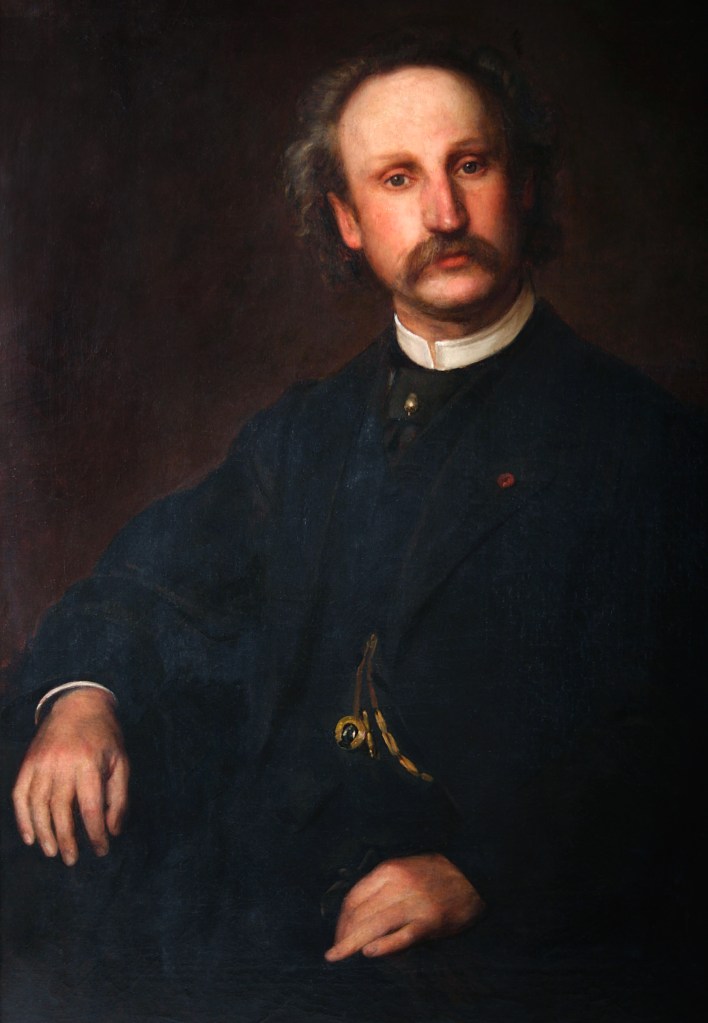
(above) Thomas Tellefsen (1823-1874)
I have other theories that may be possible. When Theodora was ill in 1870 and 1871, it seems quite plausible that she studied music theory and music composition while she recovered in Arendal, since it appears that she did not perform one of her own works before 1872. There is also no record that she taught music theory before 1872. I think her childhood music teacher/town musician may well have devoted time to tutoring her in these areas.
Additionally, while it appears that Cormontan opened her music store in competition with her former teacher Thoschlag, it seems likely that he probably supported and advised her as Theodora began her own music lending library/music business. I believe the evidence indicates that Friedrich Wilhelm Thoschlag played a major role in the musical development of Theodora Cormontan.
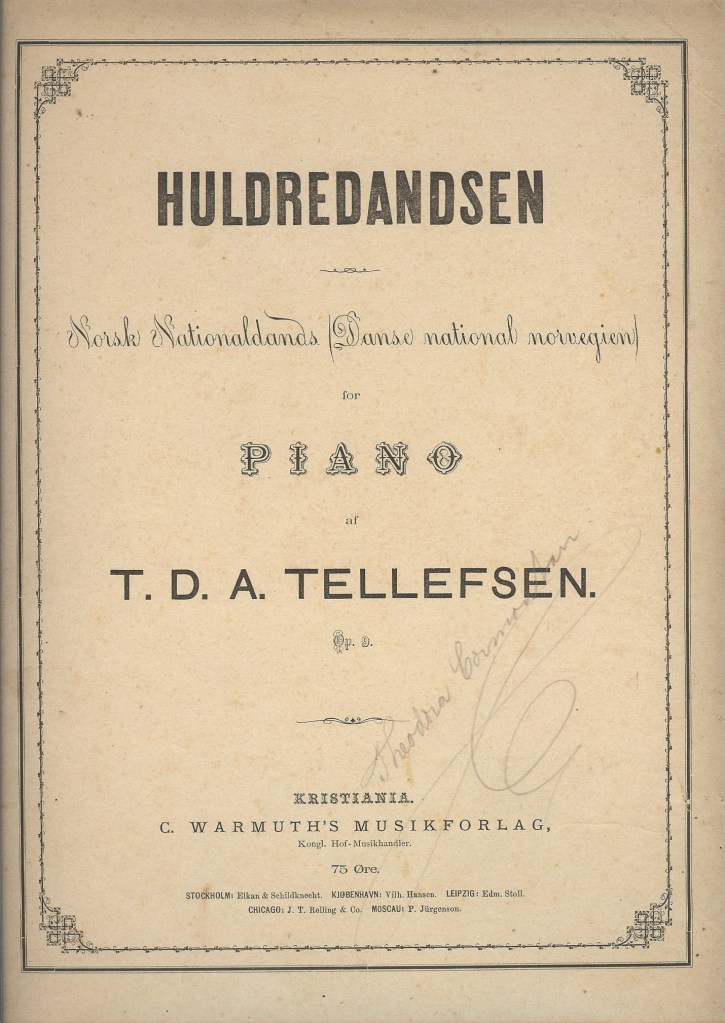
(above) The front cover of Theodora’s copy of Tellefsen ‘s Huldredansen, found among the manuscripts uncovered in 2011. Notice her enthusiastic, probably youthful signature on the score. Could this reflect her enthusiasm for her teacher?
.
Packard Organ
The January 1, 1892 edition of the Morton, Minnesota Enterprise, a weekly newspaper, noted that “Mr. Cormontan has a new organ in his store [the Franklin Drug Store] which is to go to the Lutheran church.” The Packard Organ was subsequently delivered to the Ft. Ridgely and Dale Lutheran Church in Camp Township, where it remains in working order into the 21st century. The following is taken from the website packardorgan.com.
Organs: 1888-1897 (Fort Wayne Organ Co./Packard Organ Co.) This decade of organ production highlights the influence of Victorian era excesses in case design. The Fort Wayne Organ Company produced some remarkable examples of detailed craftsmanship. By 1897, the design excesses had been greatly curtailed, and many of the designs associated with post-1900 production were actually initially produced beginning circa 1897. The initial group of organs through Case 540 were first produced circa 1888 and continued into production into the early 1890s.
Chapel Organ Case 450 (this is the model at Fort Ridgely-Dale church):
When it was first introduced, circa 1888, this chapel organ was the top of the line for single manual chapel instruments. It had a very elaborate case, front and back.
Organs: 1898-1914. This time period marks the beginning of the end of organ production by the Packard Company. In 1899, the company name had changed from The Fort Wayne Organ Company to The Packard Company. Also, the emphasis began to be placed on piano production. Within a very few years, almost the entire advertising emphasis by the company was focused on the piano part of the business.
While they continued to sell a number of quality organs, apparently greater profits were to be made in the sale of pianos. The piano catalogs of this period are quite extensive in their descriptions of their product and varied with each edition. This is unlike the organ catalog production, which varied very little for a period of over 20 years except in the cuts of models available. The descriptive pages were almost virtually unchanged.
Organ production ceased by the end of 1914, and the company name was changed from The Packard Company to The Packard Piano Company, ushering in a new year and a new era in 1915.
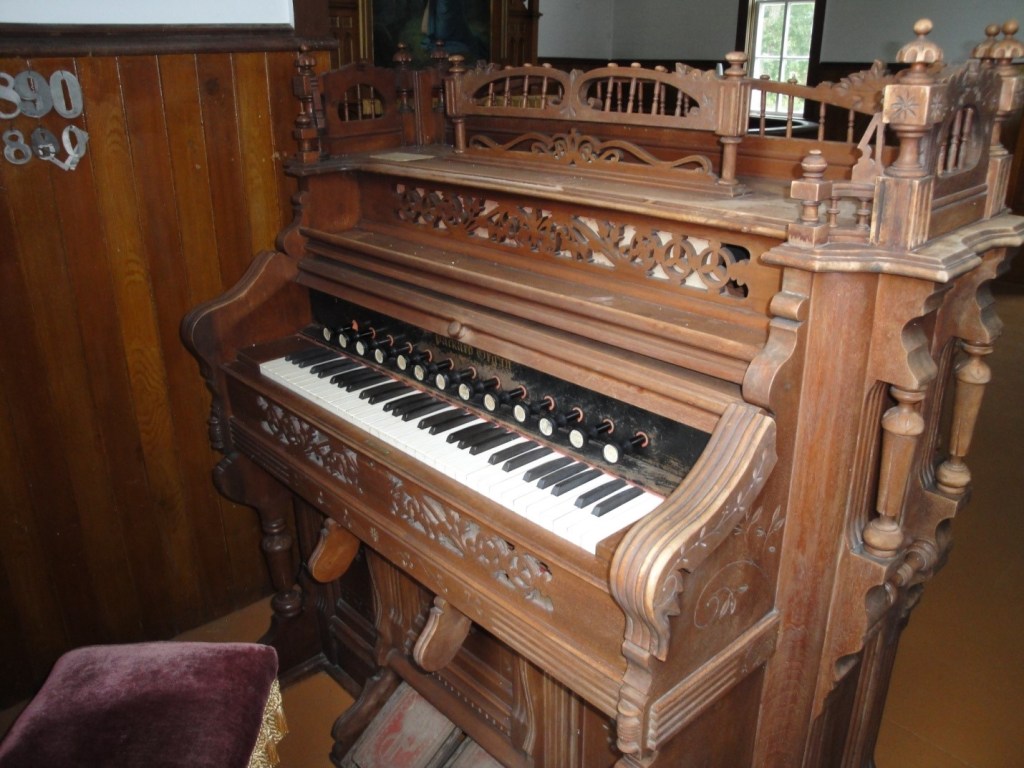
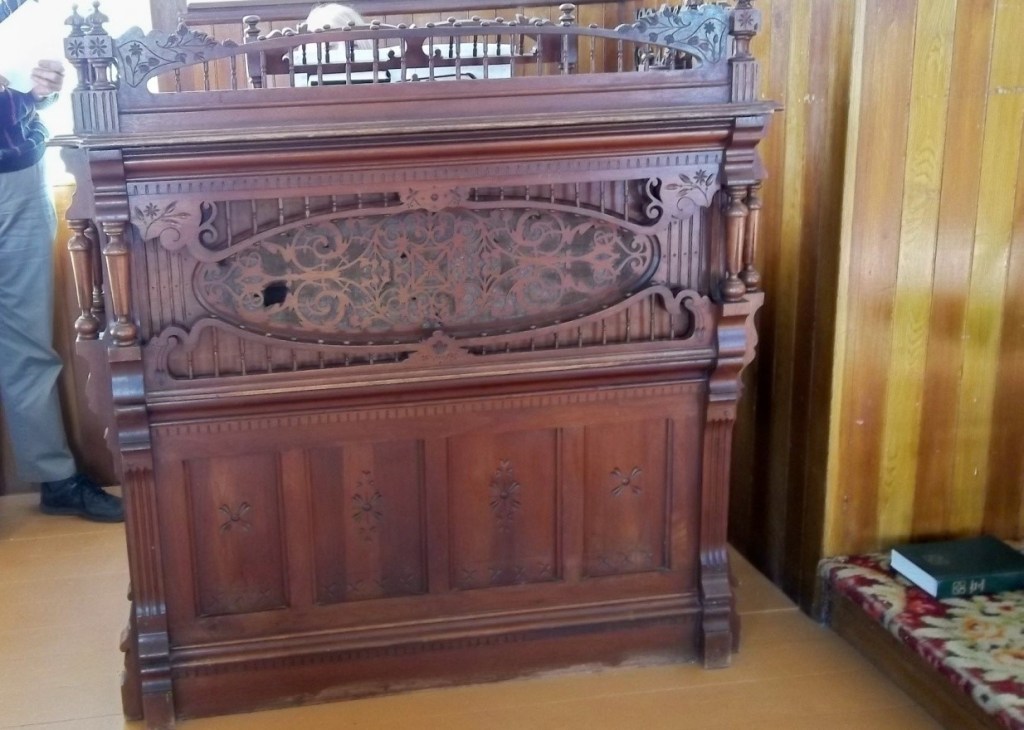
Fort Ridgely Dale Church
Two sources are cited below regarding Fort Ridgely and Dale Church, the church Theodora Cormontan joined in October of 1887 and where she worshiped and served as a church musician until 1899. The first is a short, general overview of the church’s history; the second discusses the church’s early history in detail.
From:
Lathrop, Alan K. Churches of Minnesota: An Illustrated Guide. Minneapolis: U. of Minnesota, 2003.
Page 47
Fort Ridgely and Dale Evangelical Lutheran Church
From Fairfax, west 4 miles on Minnesota Highway 19; 1 ¼ miles south on 430th Street
Architect and builder unknown
1886
“The history of the congregation of this church is indeed an interesting one. It was organized in 1868 as the first Lutheran congregation in the county. Soon afterward, the congregation’s district divided on the issue of where to build a new church: the northern half became Dale and the southern half became Fort Ridgley.
Before the church could be built, however, the congregations split once more, this time over doctrinal issues. Each lost half its members, and what remained of Fort Ridgely and Dale agreed to build a church together but not to unite (that step was not to occur for sixty years). The church was erected in 1886 and dedicated on May 28, 1893, after the installation of the altar, pulpit, pews, and bell. A parsonage had been built much earlier, in 1878, for the first resident pastor.
The church is said to have a log core, but this has not been confirmed. It is a simple rural church, covered with clapboard and having the usual projecting tower entrance centered at the front of the church. It is still heated by wood stove and is maintained in very good condition. The sacristy was added in 1900.
The Fort Ridgely and Dale congregations finally united in 1946 and today are part of Central Lutheran Church of Fairfax.” [The Central Lutheran Church building housed the Hauges Church during the time Theodora attended Ft. Ridgely and Dale. The two churches are a short distance from each other on opposite sides of the road.]
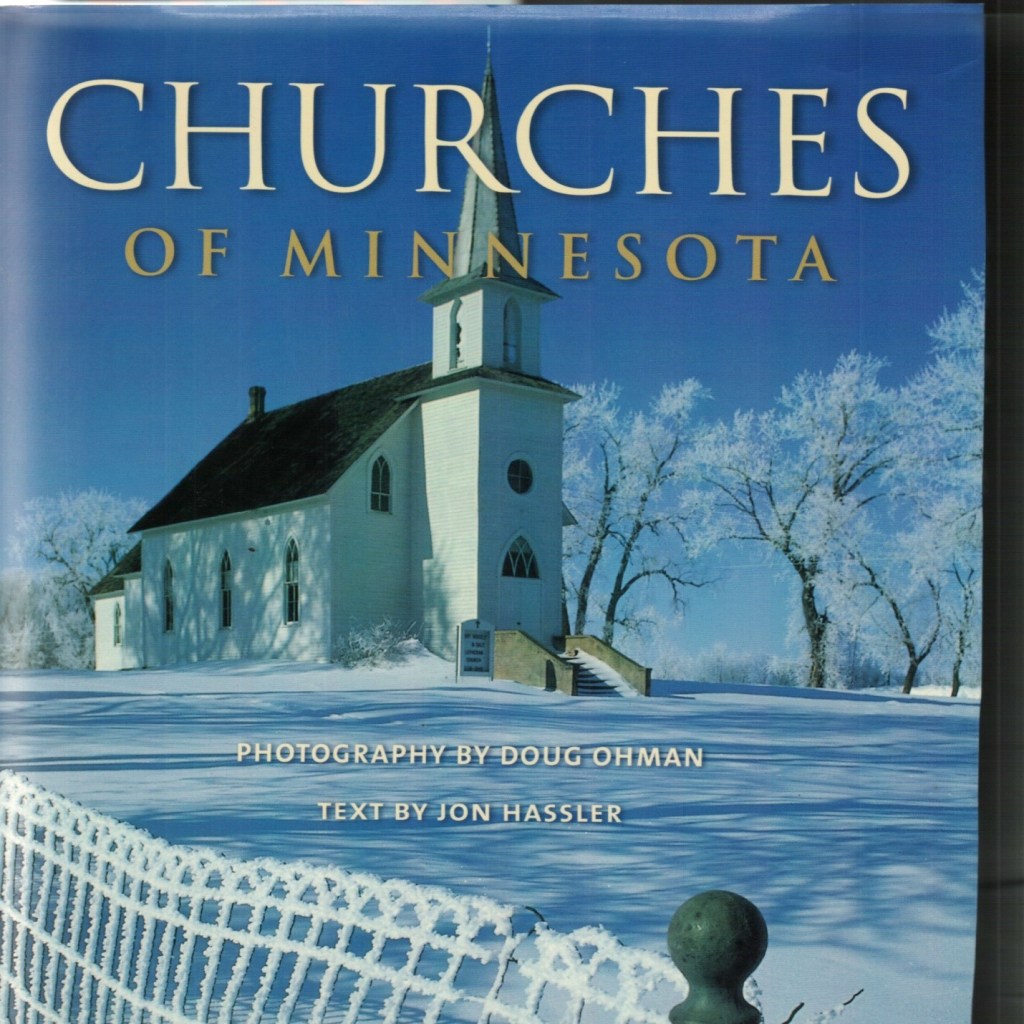
(above) The front cover of “Churches of Minnesota” features the Fort Ridgely and Dale church.
From:
Curtiss-Wedge, Franklyn. The History of Renville County, Minnesota, Vol. 2. Chicago: H.C. Cooper, 1916.
Pages 1259-1261; 1262. Edited.
[Note that this entry is written by Reverend Parelius H. Rognlie, the pastor of the Fort Ridgely and Dale Church during the time Theodora was a member. The two frequently collaborated in various religious services during the 1890’s, not just at Ft. Ridgely/Dale but also at nearby Camp Church and Palmyra Church where Rognlie also served as pastor and Cormontan as church musician.]
“Fort Ridgely Congregation. (By Rev. P. H. Rognlie.) The first people of the Norwegian Evangelical Lutheran Church came to the southeastern part of Renville County in 1861 and 1862. After the outbreak [of 1862] it took some years before the Scandinavians again began to immigrate to this part of the state. However, in 1868 a good many Scandinavians settled in the southeastern part of Renville County. As the Scandinavian people always have been known for their deep, earnest religiousness, they had longed for years for an established church of their own faith.
On the fifth of May, 1868, Rev. Thomas Johnson, of St. Peter, Nicollet County, Minn., conducted his first service at the house of Johannes Andersen [spelled “Anderson” in the next paragraph], in the Township of Camp.
On the twentieth of May, 1868, Rev. Johnson returned from the west and on that day a meeting was held at the house of Johannes Anderson, Camp Township, for the purpose of organizing an Evangelical Lutheran congregation. Consequently the Fort Ridgely Norwegian Evangelical Lutheran congregation was organized, and on that day its constitution adopted. It is no doubt the first organized Norwegian Evangelical Lutheran congregation in Renville County.
The founders of the congregation were Jorgen Gilbertsen Ellestad, Hans Jorgen Halvorsen, Magnus Johnson, Mathias Bogema, Johannes Anderson and Tov Rudy.
In 1878 this congregation was incorporated under the laws of the state of Minnesota.
The members of this congregation as well as the rest of the pioneers in this part of the state suffered greatly from the grasshopper plague from 1872 to 1876. And there also came other trials for this congregation, which shall not be mentioned here [Rognlie is no doubt referring to doctrinal issues that impacted the church].
In 1874 this congregation joined the Norwegian Evangelical Lutheran Synod of North America. On June 2, 1874, this congregation was divided into two congregations, viz. Fort Ridgely and Dale—an action which ever since has been more or less lamented. In 1871 a committee of five was appointed to find a suitable place for a church and cemetery, without any result. In the spring of 1878 the Fort Ridgely and Dale congregations bought the improvements from Rev. Johannes Halvorsen, made on the north one-half of the northeast quarter of section 16, in the town of Camp. This parsonage, land and buildings, are now owned in connection by Fort Ridgely, two-sixths, Dale, two-sixths, Concordia, two-sixths, Palmyra, one-fourth, Clear Lake congregation, Sibley County, one-fourth.
On June 19, 1878, a committee meeting of members from Fort Ridgely, Dale and Palmyra congregations was held to discuss the erection of a parsonage on the northeast one-half of this land. A building committee was appointed, viz., Mathiaz O. Lee, Jacob P. Kopperud and Gabriel A. Nilsen Bjurselmo. It was decided that a frame building, 26×26, 14 feet high, should be erected. The work on this building was commenced October, 1878, and the building was partly finished the same fall, and on Christmas Eve, 1878, Rev. Nils P. Xavier with his family, moved into the new building.
From the earliest time it had been the greatest wish of these congregations to get a house of worship of their own. On the fifteenth of May, 1884, a joint meeting of Fort Ridgely and Dale congregations was held to discuss the possibility of building a church. It was decided with a great majority to go to work as soon as possible. In the meantime the controversies concerning the [issue of] predestination had sprung up in the Synod and spread to most of its congregations. Also these congregations suffered greatly on account of those controversies. On Tuesday, December 15, 1885, a new meeting was held in the parsonage to discuss the question about building the church on the parsonage land, the north one-half of the northeast quarter of section 16, Town of Camp. The next meeting was held in 1886. A building committee was appointed, and the site of the church was decided on to be 40×28, and 16 feet high, with tower and chancel. In the summer of 1886 the church was built by Mr. Harrison. On October 29, 1886, the cornerstone was laid in the name of the Triune God, and the church was dedicated on May 28, 1893, by Rt. Rev. Knut Bjorgo. On the following day an old settlers’ reunion was held at the parsonage. The congregations have a graveyard adjoining the church in common.
Among the pioneers of Fort Ridgely congregation may be mentioned, besides the six founders, above named, the following: Mathias O. Lee, John Enger, Sr. and Jr., Lars Enger, Sylfest Olson, Leif Torgrimson, Ole E. Berge, Odd B. Jacobson, Einar Nilsen Hunsaker, Olaf Dale, Hans Grasmoen.
The Dale congregation was organized 1874. What already has been related about Fort Ridgely congregation does also for a great deal concern the Dale congregation, as they always have been served by the same pastors and have owned all church property in community.
Among the pioneers of Dale congregation may be mentioned Peder and Ole Hoimyr, Rasmus O. Ness, Gabriel A. Nilsen Bjurselmo, Ole Johnson, Gustav Anderson, Jacob Volen, Halvor Johnson. Hans Carlson, Ole Pedersen Ronne. Ole Veikle, Mathias O. Hagestad, Tarald Semmingsen, Peder Nestande.”
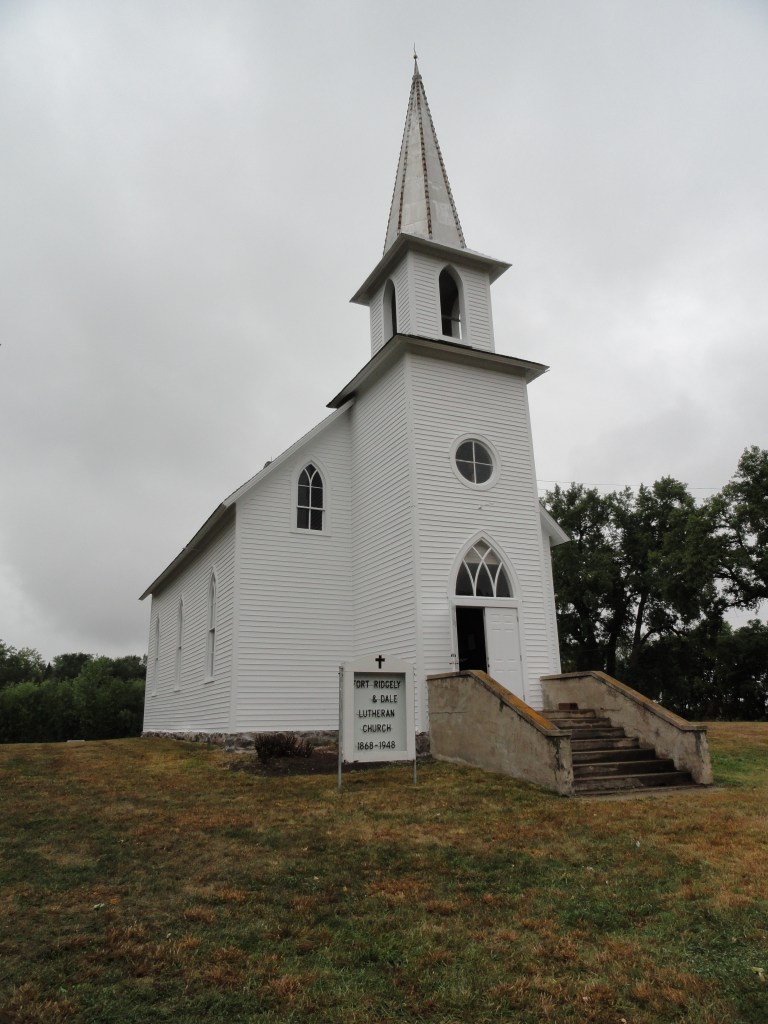
(above) Ft. Ridgely and Dale Church, taken around 2012.
The following, from the same source, notes the establishment of a “branch” church of the Dale Church. Note that C.G.V. and Hans Cormontan are both listed as founding fathers. Both men served as chairs of the planning committee for the founding of the church. The Cormontan family moved away from Franklin in 1899, less than a year after the church was established. According to a booklet published by St. Luke’s Lutheran Church in Franklin, MN, on their 75th anniversary in 1996, the process for forming the Concordia Lutheran Church began in 1893. The Concordia Church merged with Trinity Lutheran in Franklin in 1921 to form the present St. Luke’s Lutheran Church.
“Concordia Congregation of Franklin. (By Rev. P. H. Rognlie.) Our brethren in Franklin first belonged to the Dale congregation, but on account of the long distance to the church and the difficulty of making the trip, they asked for the privilege to be considered as an annex to the Dale congregation.
In the spring of 1898 they commenced the building of their own church. The first service in the new church was held May 22, 1898. The cornerstone was laid by Prof. Johannes Ylvisaker, July 22, 1898. The size of the church is 40×24, and 14 feet high, and supplied with a tower and chancel.
On November 9, 1900, it was decided to organize a separate congregation, and that the name of that congregation should be Concordia Evangelical Lutheran congregation.
The congregation owns one-sixth of the Fort Ridgely and Dale parsonage and cemetery.
Among the founders of this congregation may be mentioned Johannes A. Bergley, Halvor Johnson, Iver Mahlum, Ole Pedersen Ronne, Hans Jensen, John Foss, George O. Steen, Oscar Johnson, Gustav Johnson, Gottfried and Hans Cormontan, Martin C. Skau, Martin Larson, Johan Bernhard Tweet, Gabriel A. Nilsen Bjurselmo, Carl Nilsen, Sven and Gilbert Gilbertsen, Even Anderson.”
The Fairfax, Minnesota Centennial Book (1882-1982, authors unlisted) notes on page 85 that the Concordia Congregation merged with Trinity Lutheran in Franklin to form St. Luke’s Lutheran Church. The book also reports that people in Camp withdrew from Ft. Ridgely Congregation in 1885 to form the Camp Congregation. In the same year members of the Dale Congregation who lived in Bandon Township withdrew their membership to form the Zion Evangelical Lutheran Congregation. On page 87 the Fairfax Centennial Book gives some additional insights into these churches (the following is edited):
“Ft. Ridgely and Dale stayed with the Little Synode [a Synod that did not join in the merger of the Hauges, Norwegian, and United Synods in 1917. It is now known as the Evangelical Lutheran Synod with its headquarters in Mankato, MN] using liturgy and chanting. The ministers wore a long black robe with a high stiff white collar. Zion people showed more revival, conversion, and repentant spirit. A lay man was the leader in scripture and song.
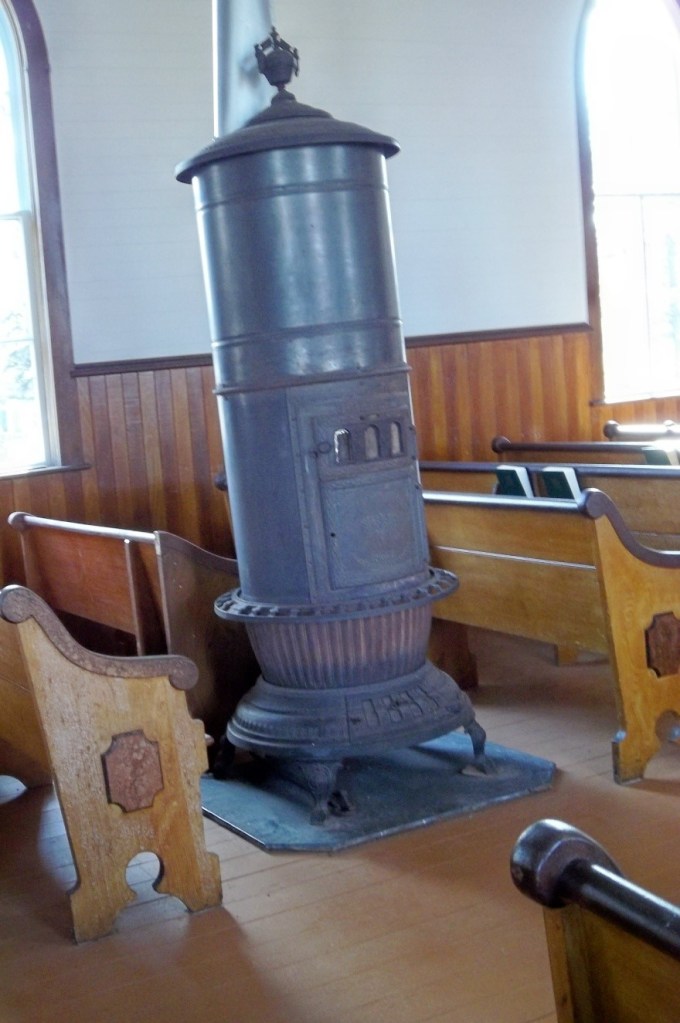
(above) The wood stove inside the Ft. Ridgely and Dale church.
Camp kept its pioneer atmosphere; homemade pews and altar and railing and other furniture. Camp had two wood stoves, one on each side. All churches each had high pulpits until a tall minister decided he got too hot. Each church had wood stoves with long stove pipes across the ceiling leading to the chimney in front. Ft. Ridgely and Dale, and Camp churches had a reed organ in each church. Zion used a piano. The churches had kerosene lamps either hanging from the ceilings or attached on the walls until electric lights were used. As was the custom, the women and children sat on one side near the back and the men sat on the other side.
On the side of the church yard there were stables for the horses to protect them while the worshippers were in the rather lengthy church services. There also was an outdoor privy hidden to the side.”
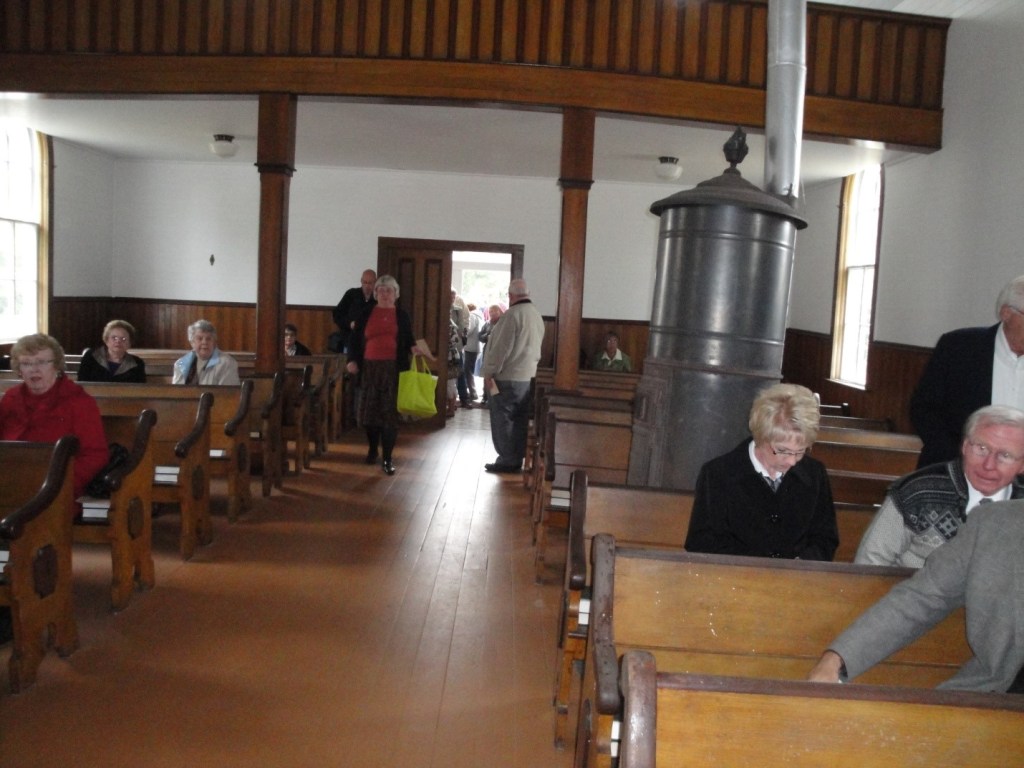
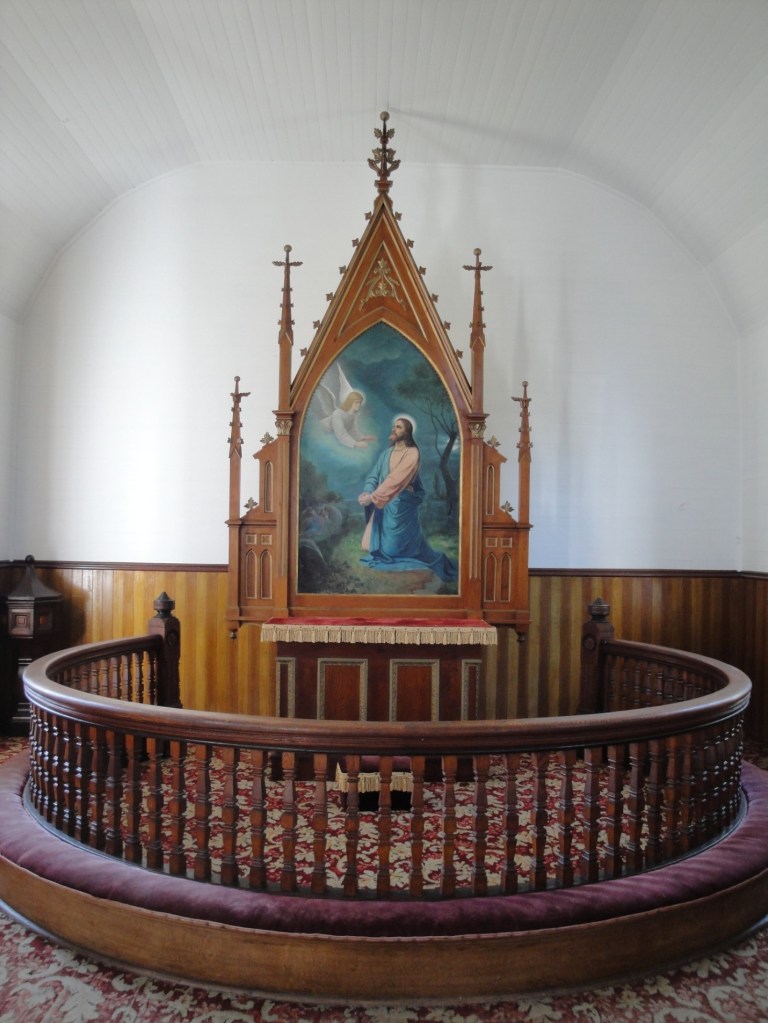
(above) A view from the front to the back of the church; picture taken in September, 2011. Also a picture of the front of the church, taken at the same time. The altar painting is by the noted Norwegian artist, Herbjørn Gausta.
Rev. Nils Paul Xavier
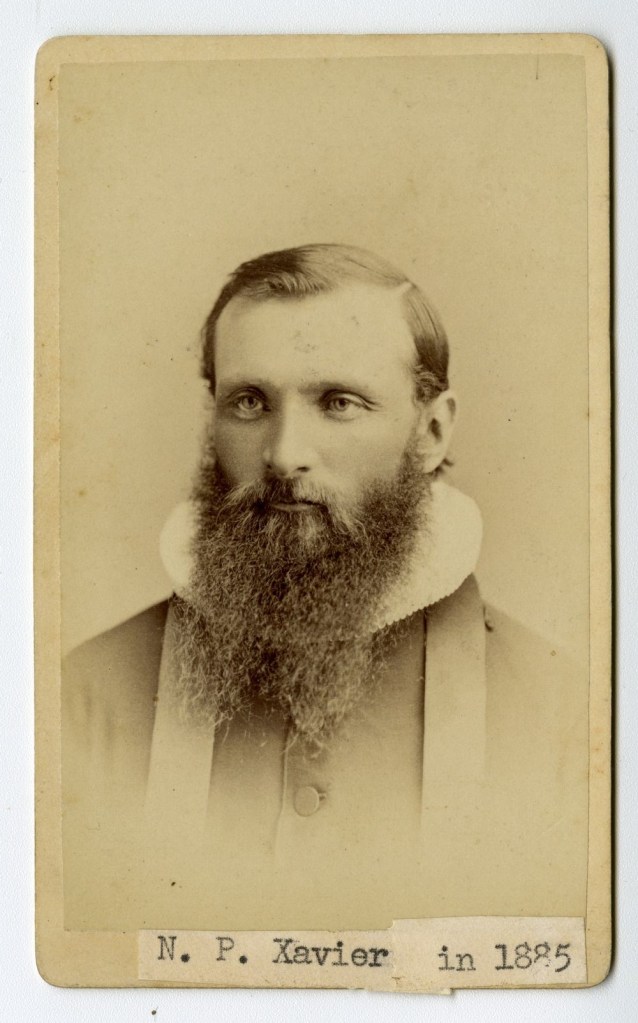
Nils Paul Xavier (1839-1918) served the Fort Ridgely and Dale Church during the first years of Theodora Cormontan’s membership. Rev. Xavier kept a log of his activity at the church, and several visits to Theodora are noted there. These entries may be found on the Ft. Ridgely/Dale Book page on this website. Notably, Xavier apparently became the first Saami trained for church ministry here in the U.S. rather than in the Norwegian (Lutheran) State Church. The Saami, as an indigenous Arctic people of about 100,000 in number, live in a multi-border (or transnational) society, and make their home at the top of the Nordic and Russian territories. I have included several entries below detailing the life of Rev. Xavier.
From: Curtiss-Wedge, Franklyn. The History of Renville County, Minnesota, Vol. 2. Chicago: H.C. Cooper, 1916.
“Nils Paul Xavier served the Fort Ridgely and Dale church from July 31, 1876-May 12, 1891. Rev. Xavier was born in Kautokeino, Norway September 26, 1839, graduated from Springfield, Illinois. On Sunday, 4/8/1888 he preached the first Norwegian Lutheran sermon for the Morton congregation in the schoolhouse in Morton, MN. He preached his first sermon in Palmyra, MN on July 31, 1876 in the town hall. Rev. Xavier and his family moved into the Ft. Ridgely and Dale parsonage on Christmas Eve, 1878. The cornerstone for the church was laid on October 29, 1886, and the church was dedicated on May 28, 1893.”

From: Norsk lutherske prester i Amerika, 1843-1913 … By Olaf Morgan Norlie, Knut Seehuus, Mons Olson Wee, Arnliot Mattias Arntzen, Amund Larson Wiek, Lars Lillehei:
“Rev. Nils P. Xavier served Ft. Ridgely and Dale church and other area Norwegian Synod churches until 1891. From there he traveled to Ridgeway, Iowa, where he pastored from 1891 to 1904. He subsequently worked as a ‘home missionary’ in Parkland, Washington.”
From: A Saami-American Experience: the Extended Xavier Family
A Saami-American Web Blog by John E. Xavier, begun on 12/2/2010
“Nils Paul Xavier (1839-1918), godson of Paul Gaimard and Xavier Marmier, was born in Sapmi under the name of Nils Paul Xavier Tornensis in Guovdageaino (Kautekeino). He was born of the second marriage of father Johan O. Tornensis (1780-18??), his mother being Marit Qvanegan (18??-18??). Nils Paul Xavier carried out his own name change before attending the Tromso school in the 1850s for teacher training. Nils Paul (N.P.) had multiple links by bloodline and marriage to several extended families, including Tornensis, Balto, Gaup, Haetta, Keskitalo and others. These links carried over to North America, during N.P.’s life span and up to contemporary times.
Prior to the main Scandinavian rush for emigration, known as Amerika Fever, the family of N.P. and Amanda Magdalena (Norum) Xavier (1849-1933) first appeared in North America in 1873. N.P. had excelled in school at the Tromso Seminar and at teaching and by his late twenties met his future wife, Amanda. Married in 1868, N.P. and Amanda soon had three children, Karl, b. 1869; Johan, b. 1870; and Anna, b. 1872. The family emigrated, crossing by steamboat on the Sverre in 1873.
In Chicago, N.P.’s sister, Ellen Tornensis Severtsen, lived with her tailor husband, having arrived in the U.S. more than a year earlier. After a brief stay in Chicago, N.P. and Amanda moved to Spring Prairie, Wisconsin, and became associated with the family of Rev. H.A. Preus, an historic figure in the Lutheran church, old Norsk (Norwegian) Synod, generally referred to as The Synod. H.A. Preus was instrumental in evaluating, encouraging, and later including, N.P. in various roles in The Synod.
In The Synod and beyond that church group, N.P. would ultimately become an historic figure of some note, as the first Saami to come to the United States and to be trained here as a Lutheran Pastor in The Synod. The Synod was a dominant organization in Norwegian-American religious and ethnic matters for decades, from the 1850s until its merger with other Norwegian church groups in 1917. Saami-Americans, including many of the families and friends of N.P. and Amanda Xavier, were active across all the Nordic ethnic and religious communities.
N.P and Amanda were not alone in The Synod in their Sapmi background. In The Synod, and other Norwegian church groups, there were other Saami active in the mid- and later 1800s, notably Rev. Bernt Julius Muus. Rev. Muus, an upper-crust product of the high-powered State Church of Norway, was a colorful, controversial, and prominent Synod organizer.
In contrast to Muus and most rather elite Synod leaders, N.P. Xavier’s niche-claim to a certain renown (as referred to above) comes not from high status in Norway, but from his early days in the U.S. It was in 1874 that he was recruited to The Synod through the influence of Synod co-founder Rev. H.A. Preus, who always was ever on the lookout for worthy candidates for the rank of Synod pastor.
Thus it was that Nils Paul Xavier apparently became the first Saami trained for church ministry here in the US rather than in the old-school and largely elitist Norwegian (Lutheran) State Church. His wife, Amanda, was herself the daughter of Karl Norum, an Arctic-based Lutheran State Church pastor in Alta. She had held employment in the Sapmi areas of Norway with a post office and churches. In Wisconsin in 1874-1876, Amanda energetically engaged in farm work, housekeeping, and child care. She gave birth in 1874 to Marit Xavier, the first Xavier born in North America. Amanda also helped arrange for some of her own siblings to come to the U.S. during N.P.’s two years of theological training in St. Louis [Concordia Seminary, 1874-1875] and Springfield, Illinois [Concordia Seminary, 1875-1876].
Following N.P.’s theological studies in 1876, he and Amanda found themselves bound for southern Minnesota, along with N.P.’s sister, Anna Johanessen, and Amanda’s brother, Arne Norum. Locating upriver near New Ulm, on the north ridge of the lush valley of the Minnesota River, N.P. and Amanda spent better than a year in a hillside dugout, in what became known locally as “Finntown,” due to the large number of immigrants from Finland.
N.P. would assume his pastoral role at the historic Fort Ridgely and Dale parish in Renville County, near Franklin. As the first Lutheran parish in that county, Fort Ridgely and Dale was a rarity for the times: a truly multiethnic church and thus a good place for the multilingual N.P. Xavier. N.P. would perform pastoral duties in Norwegian, Finnish, German, Saami (he conducted a funeral for the newborn son of his sister, Anna), Swedish, Danish and English. The Synod parish had substantial members at Fort Ridgely and Dale, but lacked both church building and parsonage when N.P and Amanda arrived in 1876.
The Xaviers awaited the construction of a parsonage, but nonetheless carried on their work in the Minnesota River valley, primarily Franklin and Fairfax. And it is there we leave them on this blog post, in 1876, at this stopping point for the story of the Xavier Family in the Saami-American experience.”
In the June 15, 1944 edition of the Sacred Heart News the third and last installment of the memoirs of Bolette Marie (Stub) Bergh were published. She was the wife of Reverend Johannes E. Bergh, a long time pastor in Sacred Heart who also for a time served Ft. Ridgely Church. Her recollections include the following:
“Our first neighbor-minister was Rev. N.P. Xavier of Fort Ridgely. I longed so to meet a ‘prestefamilie,’ but even when Xaviers came, we could not visit them very often, as it meant a drive of 40 miles on poor roads. But [Rev.] Bergh was relieved of these long drives as part of his missionary work, when Xavier came.”
From: “Norwegian-American Studies, Volume 34” published by the Norwegian-American Historical Association (NAHA) in 1995. This entry discusses Xavier’s activity after he moved to Parkland, Washington in 1904:
“Johan Ulrik [Nils Paul’s son] and Nils Paul Xavier built a large house in Parkland. Here Nils Paul and Amanda Magdalena lived for the rest of their lives. Father and son worked together in an editorial capacity. For many years they were editors of The Pacific Lutheran University Herald, published in Tacoma. It was a sort of home mission paper for the pastors of the Norwegian Synod living on the West Coast. The inlets and bays musthave reminded them of northern Norway. Small settlements of their countrymen were to be found along the coast, emigration from the coastal districts of northern and western Norway having begun in earnest. But one could not yet talk of established communities. For one thing the religious needs of the settlers were not being met. Nils Paul Xavier could not stand idly by. Thus the third phase of his life as a minister began. It was reminiscentof the first, on the Minnesota frontier. He became a ‘visiting pastor,’ akind of ‘home missionary,’ with missions scattered over a wide area, a couple lying more than 200 miles from his home. He visited themregularly, preaching the Word of God and administering the sacraments. He used all means of transport — railway, steamship, fishing boats, and hisown two feet. He carried on this activity for fourteen years, down to hisdeath in 1918. Even in his seventy-eighth year he spent the whole of Easter week in visiting the ‘mission,’ traveling long distances on foot.He delivered his last sermon only two weeks before his death, in spite of the fact that now he showed the effects of failing health. Nils Paul Xavier was buried in the cemetery at Portland, by the side of his daughter who had died before him. The cemetery was already in existence when he first visited Portland in 1904. He said then that here was the place he wished to be buried. On visiting it at that time, he wrote in his diary, according to Karl Xavier: ‘the cemetery liessurrounded by beautiful pinewoods, truly a peaceful resting place for those who have passed on. God’s peace lies over it!’ Anna Magdalenaoutlived her husband for many years, dying in Parkland in 1935.”
Rev. Parelius Rognlie
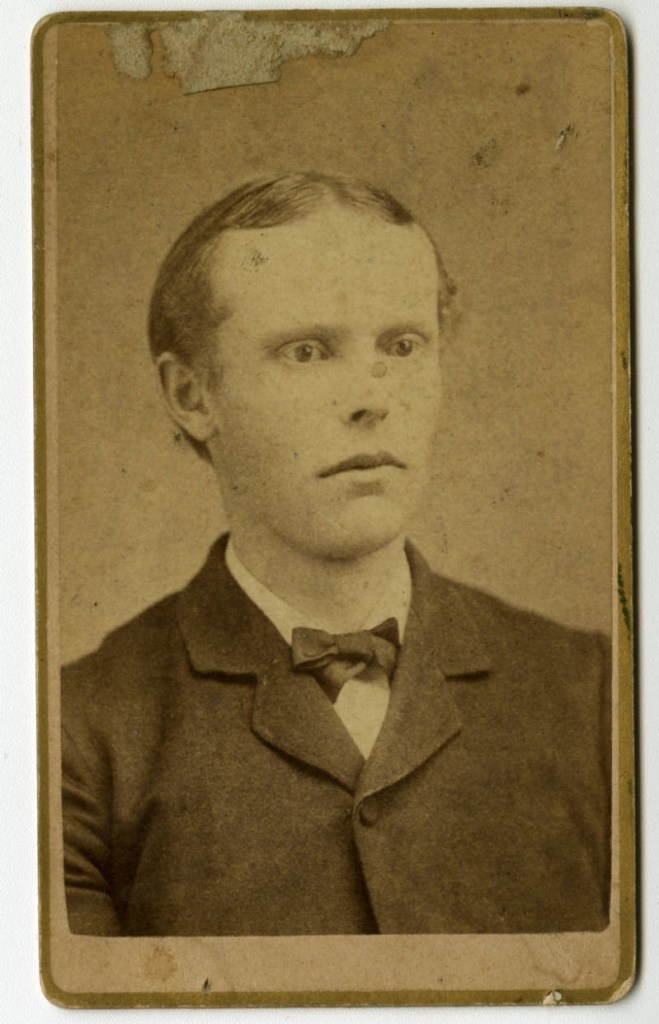
(above) Parelius Rognlie around 1891
Rev. Parelius H. Rognile served as pastor of the Fort Ridgely and Dale Church during most of the time that Theodora Cormontan was a member and served the congregation as a professional church musician. Numerous collaborations between Rognlie and Cormontan may be noted in the “Franklin, MN” entries under “Theodora’s Story” in this website.
The following is from: Curtiss-Wedge, Franklyn. The History of Renville County, Minnesota, Vol. 2. Chicago: H.C. Cooper, 1916. Page 1262.
“Rev. Parelius H. Rognlie was born near Trondheim, Norway, December 21, 1858. He attended the public schools in his native land for about four years. In the spring of 1870 he immigrated with his parents to the United States and lived in Houston County, Minnesota, one year. In the spring of 1871 he moved to Lyon County, Minnesota, at that time a wilderness, and with his parents went through all the hardships of the pioneer days. The next year most of the homestead land in the town of Lucas was taken up and a year or two later a school was organized which he attended. August 8, 1875, he, with thirteen others, was confirmed by Rev. Thorstensen in the Grove of Hellek Glaim on the Yellow Medicine River, there being no church in that part of the country.
His pastor and others urged him to go to college and take up the study of the ministry, but on account of lack of means and also on account of his father’s poor health, he decided to stay at home for a time and help his parents. In 1881 he entered the preparatory school at St. Olaf College, Northfield, Minnesota, and later attended Luther College, Decorah, Iowa, earning his way by teaching school and doing farm work.
In the fall of 1885 he went to Europe in order to receive treatment for his eyes and was operated on at the State Hospital in Norway. When he returned to the United States, he resumed teaching and continued his studies by himself. In 1888 he was admitted to the Luther Theological Seminary, Minneapolis, and graduated June 26, 1891.
In February, 1891, he was called as pastor for the Fort Ridgely, Dale, Palmyra and Clear Lake congregations, Renville and Sibley counties. Minnesota. On July 22, 1891, he was ordained at Fort Ridgely and Dale Church by Rt. Rev. K. Bjorge, assisted by Rev. S.J. Bergh, Rev. N.P. Xavier, Rev. Thomas Johnsen and Rev. B. Askevold. He has remained at this place ever since [as of 1916] and now serves Fort Ridgely, Dale, Concordia, Clear Lake and Morton Scandinavian Evangelical Lutheran congregations and every other month he serves Camp and Fairfax Norwegian Lutheran congregations, alternating with Rev. Thomas Hanson. He preached the first Norwegian Lutheran sermon in Bird Island, September 16, 1891, and organized the church there. He preached the first Norwegian Lutheran sermon in Fairfax December 10, 1893.
On June 13, 1895, he was married to Ronnaug Marie M. Gullerud and they have had the following children: Ingolf Herman Marentius, born March 26, 1896: Katharina Josephine, born December 26. 1897; Parelius Monrad, born January 28, 1900, died July 2, 1901; Palma Margrethe, born April 8, 1902; Clarence Parelius Monrad, born May 6, 1904; Julia Christine, born October 4, 1908.”
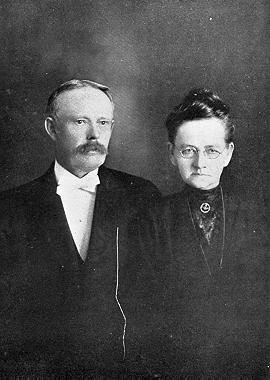
The following is taken from a booklet published in 1996 by St. Luke’s Lutheran Church in Franklin, Minnesota to celebrate their 75th anniversary as a congregation (1921-1996). Trinity Lutheran and Concordia Lutheran of Franklin merged in 1921 to form St. Luke’s:
“In these early years when Rev. Ronglie served three or four churches at one time, he often drove up to 25 miles with horse and buggy in one day on dirt roads. He never complained of this being a hardship though, as he was accustomed to it. In the winter, he wore a fur overcoat, cap and mittens and several fur robes, and maybe some hot bricks along to help keep his feet warm.
His annual salary was low, but in those years the parishioners often gave him meat, potatoes, other foods and fuel. Many people did not have money to give but gave food instead. Pastor Ronglie also served Palmyra, Clear Lake, Morton, and Ft. Ridgely and Dale congregations besides Concordia, so services were only every three weeks, sometimes in the forenoon and often in the afternoon. Often the pastor was invited for Sunday dinner after services in the members home.
Concordia had a Sunday School and in the summer they conducted parochial school for one month or six weeks, taught by a teacher from some Bible school. She usually stayed a week at the homes of her pupils. When the school was over, a barnefest (children’s day) was held at the parsonage where the pupils presented a program of what they had learned. This all-day affair was truly a day of Christian fellowship. A church choir was also organized by Steffen Steffenson in the early 1900’s.
Confirmation classes always met down at the parsonage, and started at 9:00 or 9:30 a.m. Classes were held in the pastor’s office. At noon Mrs. Ronglie would give them all dinner. She set a long table with white table cloth and served a sumptuous meal. After dinner, another session was held to study the Bible and memorize hymns.”
Parelius Rognlie served Fort Ridgely and Dale Church until the fall of 1928. He read scripture when the cornerstone was laid for the current St. Luke’s Lutheran Church on September 4, 1938. He died on January 23, 1942 in Franklin, MN.
Other Pastors & Churches
After leaving Franklin and the Fort Ridgely and Dale Church in 1899, the Cormontan family moved to several different towns over the next decade. In each new town they joined a Norwegian Evangelical Lutheran Church. However, while they belonged to a Norwegian Synod church at Fort Ridgely and Dale, the subsequent churches where they became members were all part of the United Church (Den Forenede Kirke). This Church formed in 1890 after disagreement over doctrinal issues compelled a portion of the Norwegian Synod congregations to leave and join with the Augustana Norwegian Synod and the Norwegian-Danish Conference. It is my sense that the Norwegian Synod favored a more strict and narrow interpretation of issues like conversion and predestination, while the United Church (more formally, the United Norwegian Lutheran Church of America) adopted a broader, more flexible viewpoint on doctrine in general. These two bodies, along with the Hauge Synod, merged in 1917 to form the Norwegian Lutheran Church of America. The information below provides a brief history of the churches the Cormontans attended after leaving Fort Ridgely and Dale, as well as information on the men who served as pastors while the Cormontan family were members. It appears the Cormontan family was less active in these churches than at Fort Ridgely and Dale, perhaps because of advancing age. It may also be that the churches records are less detailed and reported less of the Cormontan involvement. Still, it is documented that Theodora Cormontan served as a choir director at the Madelia church, as an organist at the St. James church, and almost certainly as a church musician in Hanska as well.
Sources:
Norsk lutherske prester i Amerika, 1843-1913 … By Olaf Morgan Norlie, Knut Seehuus, Mons Olson Wee, Arnliot Mattias Arntzen, Amund Larson Wiek, Lars Lillehei.
Norsk Lutherske Menigheter I America, 1843-1916 by Pastor O.M. Norlie and others.
Trinity Evangelical Lutheran Church (informally known as Madelia West early in the 20th century) was organized on October 28, 1870. It belonged to the Norwegian Synod from 1870-1887, was Anti Missouri from 1887-90, and belonged to the United Church from 1890-1917. Reverend Lars Engebtetsen Green was born in Christiania (now Oslo) on April 20, 1841, the son of Engebret Olsen Grinkelsrud and Barbra (Nilson Svangerud). He attended the Augustana Seminary from 1866-69 and was ordained in 1869. He subsequently attended Concordia Seminary, St. Louis, in 1873. He pastored at Forest City, Iowa, from 1869-1873, and Madelia, MN from 1875-1909. He also served at Lake Hanska from 1873-1900 and again in 1910-11. He married Jennie Jensen in 1869. Members of the Cormontan family worshiped at the Madelia church for a few years beginning in 1899 and again from 1905-1908. He died on June 9, 1930, and is buried in Trinity Lutheran Cemetery in Madelia.
The Lake Hanska Norwegian Evangelical Lutheran Church (now the Lake Hanska Lutheran Church) organized on November 9, 1869. It belonged to the Norwegian Synod from 1869-1887; Anti Missouri from 1887-1890; and United Church from 1890-1917. Rev. Lars Green, pastor at Trinity Lutheran during the time the Cormontans were members, also served this church from 1873-1900 and again in 1910-1911. The church was remodeled in 1901 and rededicated in 1904. The Cormontan family joined this church in 1903. Reverend G.O. Skaret pastored the church from 1900-1907.
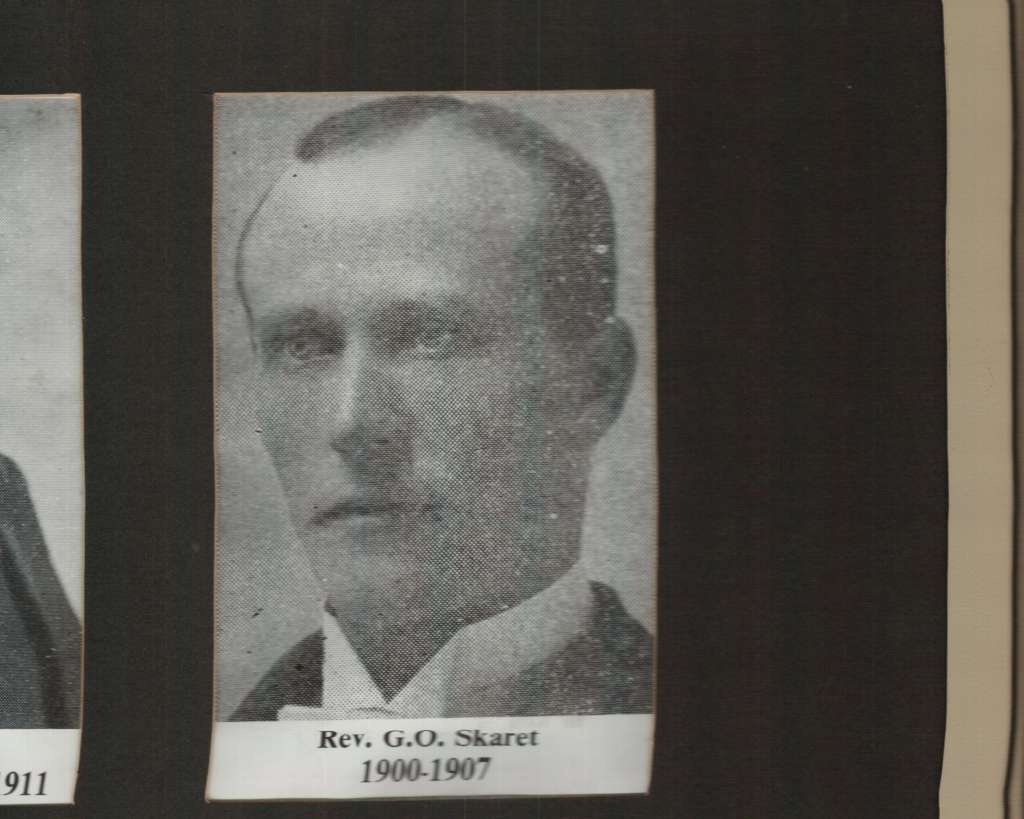
The United Norwegian Lutheran Church in St. James (now the First Lutheran Church) organized on June 19, 1893 after two United St. James churches unified. The church belonged to the United Church from 1893-1917. The church building was built in 1900, and the parsonage was erected in 1905.
Reverend Lars Paulsen Thorkveen (1857-1923) served the church as pastor between 1909-1910, the year Theodora, Eivinda, and C.G.V. joined. The Cormontan family may have been attracted to Thorkveen’s interest in music. He acted at various times as secretary, president, and director of the Norwegian Lutheran Singer Association (sangerforbunds) for over twenty years beginning in 1895. He also served as editor in the publication of several sacred songbooks in the first decade of the 20thcentury, including one for mixed choir. A 1930 NAHA article by Sigurd Hakstad reports that Thorkveen also composed music. He attended Luther College and Luther Seminary in the 1880’s and, beginning in 1888, he served as pastor at a number of United Norwegian Lutheran churches, including Butterfield, MN (near St. James) beginning in 1896.
Reverend Marcus Kristian Hartmann was born in Benson, MN on April 3, 1878 and died in California on October 7, 1964. He attended St. Olaf College and graduated from U.C. Seminary in 1903. He pastored in Portland, Maine from 1903-04 and Cresco, IA from 1904-10 before coming to St. James in 1910. He married Thusnelda Bøckman in 1905. The Cormontan family worshiped in St. James from 1908-1917.
It is probable that Rev. Hartmann was responsible for directing Theodora and Eivinda Cormontan to the Aase Haugen Home near Decorah, Iowa in 1917 after their older brother C.G.V. passed away. During the time he ministered at the United Lutheran Church in Cresco, Iowa, it appears that Hartmann got to know Rev. Otto Schmidt of Decorah Lutheran Church. Schmidt became the first administrator of the Aase Haugen Home in 1915. The May 28, 1920 edition of the Cresco Plain Dealer reported that Rev. Hartmann was visiting Rev. Schmidt and family at the Aase Haugen Home. Though not reported, one would trust he also visited Theodora and Eivinda.
The Schmidt Family
Otto and Mollie Schmidt provided support for Theodora Cormontan (and her sister Eivinda) in the last years of the sisters’ lives. Mollie and her daughter Carola (as well as Mollie’s granddaughter Barb Schmidt Nelson) preserved Theodora’s musical compositions for almost 100 years. The following includes several documents that provide more information on this extraordinary family.
The first document below is a portion of an article I wrote for the Vesterheim magazine, a publication of the National Norwegian-American Museum & Heritage Center, Vol. 12, No 1 2014. The information is based on interviews from 2011-2013 with Barb Schmidt Nelson and documents supplied by her.
“THE SCHMIDT WOMEN
With no children and almost no relatives, Theodora Cormontan’s few possessions would have been distributed among the workers at the Aase Haugen Home or thrown away when she died in 1922. However, Theodora had formed a strong friendship with fellow musician Mollie Helgerson Schmidt, the wife of the first administrator of the Home, and gave her compositions to Mollie. This started the journey of Theodora Cormontan’s music through three generations of Schmidt women, who kept it safe for nearly a century.
Mollie Helgerson was born in 1875 in Larchwood, Iowa, the daughter of Ole T. Helgerson and Bertha Marie Sogn Helgerson. Mollie attended Augustana College in Canton, South Dakota, studied music in Sioux Falls, South Dakota, and taught piano for several years. Otto Schmidt was introduced to Mollie by his best friend, and Mollie and Otto married in 1897. Having completed seminary school, Otto accepted calls in Chicago, Illinois and Muskego, Wisconsin before serving Decorah [Iowa] Lutheran Church and then the Aase Haugen Home. During this time the couple had four children: Waldemar, Carola, Orval, and Otto. Theodora doubtlessly enjoyed hearing Mollie play the piano for the residents of the home, and it is understood that she comforted Mollie when Waldemar died in 1918 while attending St. Olaf College, a victim of the influenza pandemic.
Carola Schmidt graduated from St. Olaf College in 1925 and subsequently received nurses’ training in Rochester, Minnesota. She hoped to find a nursing position in Chicago, but her mother’s poor health forced Carola to return home to care for Mollie until she died in 1933. Subsequently, her father expected Carola to run the house for him and to work at the Home, so she gave up her nursing career and never married. Carola, like Mollie, loved music and kept Theodora’s compositions stored safely in the attic of the family home. Carola taught herself the art of Norwegian Hardanger embroidery and was well known in the Decorah area for her intricate needlework. One of the proudest moments of her life took place when Crown Prince Harald of Norway visited Vesterheim Museum in 1960 and stopped by the table where she was giving sewing demonstrations to compliment her work.
Carola passed away in 1975 and her brother Orval, with the help of his daughter Barb, began clearing out decades of collected contents from the Schmidt attic. Early in the process they discovered a box of family letters from the 1880’s and decided to save nearly everything for a later, more careful examination. The items they set aside included several boxes of music with Theodora’s manuscripts dispersed throughout them.
Like her aunt, Barb Schmidt attended St. Olaf College (where she met her future husband, Roger Nelson) and became a registered nurse. The couple moved to St. Peter, Minnesota in 1959 where Roger taught junior high science for several decades. After a few years of working in hospitals, Barb focused on being a wife and mother before returning to work in an insurance office in 1976. Theodora’s music traveled to St. Peter and the Nelson attic where it stayed until 2011, when Barb gave several boxes of family music to Bonnie Jorgensen, a professionalpianist and her husband Michael, a professor of music at Gustavus Adolphus College.
ROGER NELSON
Birth: November 6, 1933, Rose Creek, MN
Died: January 12, 2022, Litchfield, MN
Education: St. Olaf College, Northfield, MN, 1951-1955
Occupation: Taught junior high math, science, phy ed, and high school sciences, Okabena, MN, 1955-1957. Also coached football, basketball, and track.
US Army: 1957-1959
Taught junior high school sciences, St. Peter, MN, 1959-1993. Also did some coaching of football, track, and wrestling.
BARBARA SCHMIDT NELSON
Birth: November 6, 1936, Plentywood, MN. Moved with family to Portland Oregon in 1941 and to Minneapolis in 1949.
Education: St. Olaf College, Northfield MN, 1954-1958, nursing program
Occupation: Registered nurse, Fairview Hospital, Minneapolis, MN, 1958-1959
Married Roger Nelson in 1959 and moved to St. Peter, MN
Registered nurse, St. Peter Community Hospital, St. Peter, MN, 1959-1962
Secretary for insurance office, St. Peter, MN, 1976-1988
Barb and Roger moved to Litchfield, MN in 2016
They had three children: two daughters and a son
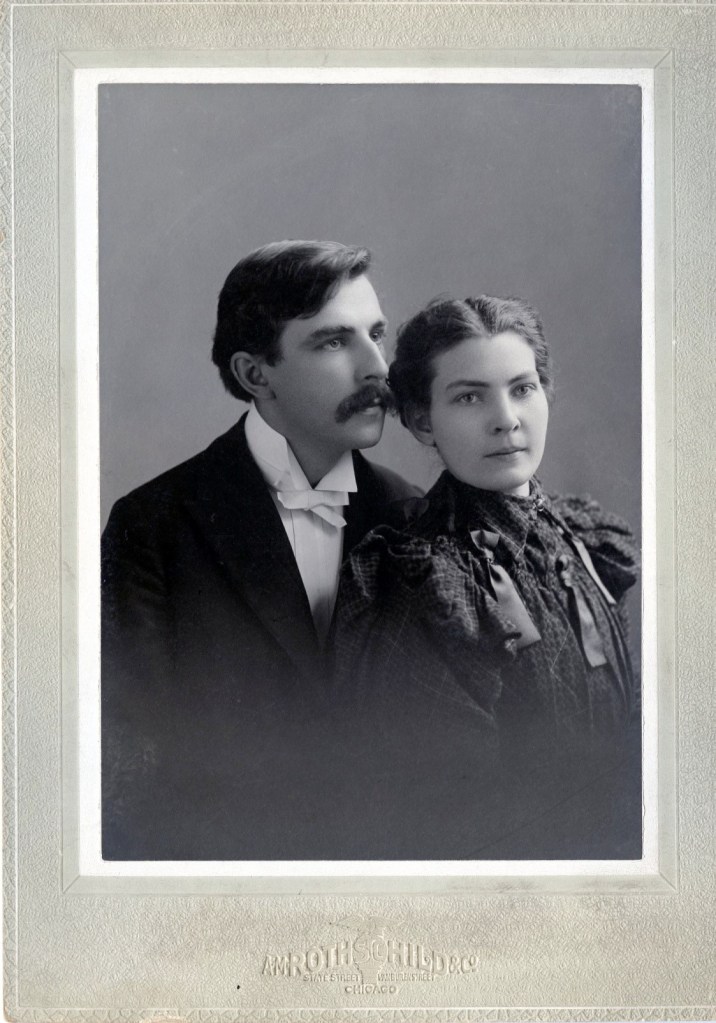
(above) Otto and Mollie from around 1900.
OTTO AND MOLLIE SCHMIDT
The following is adapted from a document written by Barb Schmidt Nelson, drawing on information gleaned from family letters.
“In 1885, when Otto was twelve, his parents sent him off to live with his brother Herman and wife Lou and their two-year-old son in Columbus, Ohio so that Otto could attend Capitol University. He stayed with them for three years and then was sent to Canton, South Dakota, to live with his sister Bertha and her husband, Olav Lee, and their three-year-old son Alfred. Olav had recently taken a teaching position at Augustana College, so it was logical for Otto to attend school there.
We have an undated letter that F.A. [Otto’s father] wrote to Olav and Bertha, apparently in December of 1893, in which he wondered why Otto was so insistent on leaving Augustana immediately and living at home with his parents. It made no sense because Otto had only six months left at Augustana to finish his degree. Somehow Otto changed his mind and he did stay at Canton, maybe because he had met Mollie Helgerson through her cousin Almer Helgerson, who was Otto’s best friend and hunting buddy. Mollie was teaching piano at a girls’ school in Sioux Falls.
For some reason, Otto was back in Canton the following September when he abruptly decided he wanted to leave Canton and attend the seminary in Minneapolis. He left Canton and settled into his parents’ home in Minneapolis. During the next three school years, Otto wrote often and at length to Mollie, – sometimes almost every day. For the most part, he did not like living in the city. It was much too noisy for him, – and ‘all sin and corruption.’ He found the city streets interesting, however, and described the fine ladies and the Irish kitchen girls, all with their little dogs. He enjoyed hiking and ‘wheeling’ to the Mississippi River, to Minnehaha Falls, and to the various lakes.
He wrote about the weather–winter storms, the frozen Mississippi River, spring floods on the river flats, heavy rains that clogged sewers and left two feet of water standing on Riverside Avenue. In one letter he described the problems men faced in crossing boot-deep muddy streets, and the even more difficult problems women faced with their dainty skirts! And in spite of his distaste for the city atmosphere, he liked to describe the sunshine or the newly-fallen snow in flowery poetic style,–in fact he said he would have liked to have been a poet.
Otto enjoyed music – he played a band instrument and he was a good singer. The city provided opportunities for Otto and his brother Paul to take in an occasional concert. He described the thrill of hearing for the first time, a concert by a seventy-man orchestra. He shared another thrill when he heard the John Philip Sousa band in concert in 1896. And a few months later, he had the audacity to attend a performance of “The Merchant of Venice.” This was not a pleasure that his seminary professors would have approved, and as a pastor, he believed he would never be able to do so again. And even though he warned Mollie not to tell anyone, he admitted that he had enjoyed the play!
Otto’s letters reflect his commitment to his calling as a future minister. He often wrote in long wordy sentences about matters of faith and proper conduct. In fact, he liked to expound on various issues. In one letter, he spent more than eight pages discussing the value of education for women, and what sorts of studies they need to pursue in order to provide a happy home. In another long discourse, he put forth his position on the evils and dangers of ‘secret societies.’ He often wrote lengthy instructions to Mollie on how she should write her letters to him, – mainly often!
Seminary life was hard. Otto’s studies were demanding, and the fact that he was the son of one of the professors certainly put pressure on him. Otto spent the summer of 1895 in Mason City, IA as an intern, serving a floundering congregation with no pastor. Among other things, he was not getting paid and would have liked to leave, but “…father says I must stay and that settles it for sure…” The summer was very difficult for him and he was extremely lonesome for Mollie. To add to his distress, he was trying unsuccessfully to give up tobacco – “…a man without a chew is like a dog with a tin can attached to the end of his tail – it irritates him very much….”
The following summer was no happier. In April 1896, with several weeks of classes left of the term, Otto was abruptly sent off to Gardner, IL where he was assigned to teach school six days a week for five months – “Norsk skole” – to the local children, and to preach on Sundays. (It seems that he had been pressured to go, and eventually agreed, reluctantly.) He described the muddy town, muddy roads, poor families, rough accommodations, terrible weather and long days, including Saturdays when he taught in another town. Otto hated being there and was again terribly lonesome. He stayed in various homes and had no privacy, and the food didn’t agree with him. And to top it off, he had fleas! In spite of that, he learned to enjoy the children he taught and found that they liked him, and he and his supervising pastor became very good friends.
Tired and lonesome, Otto was finally able to return to Minnesota in September. He decided to skip two weeks of classes at the seminary in order to spend some valuable time with Molly in Northfield, but when he returned to school, things did not go well. For one thing, the classes were mostly taught in Norwegian and Otto clearly did not feel himself competent to preach or write well enough in Norwegian to satisfy his professors. [Otto’s father felt led to serve in the Norwegian-American Lutheran church and Otto followed in his footsteps, though they were not Norwegian]. In addition, the church dispute was intensifying, and there were rumors that his father would be forced to quit teaching.
In early October, Otto was told by ‘headquarters’ to “get ready to go to Chicago where a mission [congregation] is sorely in need of a pastor.” He flatly refused to go, as had several other seminary students. Then in January Otto was summoned by the Chicago congregation which he had earlier refused, and he went. It was cold on the train going down, and even much colder in Chicago, which he found to be a dirty, unappealing city. He preached twice to the congregation, but wrote that he did not “exert” himself at all and really would not mind if he made a poor impression. “…
Otto received a call in early May from the very mission congregation he had earlier visited in Chicago. The work there would be almost entirely in Norwegian. He also had heard that he might be offered a call at Vermillion SD. He wrote to Mollie to ask her preference. The pay at the Chicago church would be $600 if he were married, otherwise $500. “…If I turn out to be a Mormon, don’t blame me…” By May 19th, the decision was made and he agreed to begin his work in Chicago as soon as possible. “…I will take that place in Chicago for reasons that I will later explain to you and which I know will be satisfactory to you also. It is my duty. And therefore I will go now though no one else will…”
June was a busy month – Otto finished his exams, was ordained on June 20th, and married Mollie at her parents’ home in Canton on June 30th. He went to Chicago, and she stayed in Canton with her parents, to pack up her things and wait until Otto could find them a place to live, preferably one with plumbing! (He did.)
By the time Mollie arrived on August 9th, Otto had been informed that the treasury of the Mission Board was empty and there was no money to pay him probably for several months. Apparently they were able to get by on some money Mollie had saved. But a year later, both F.A. and Olav wrote to Otto to give him advice about his financial situation in expectations of a cut in his salary.
Otto and Mollie stayed in Chicago for three years, and during that time Otto often received advice from his father on questions that arose in his ministry. Otto apparently was unsettled in his position and several other ‘calls’ were offered to him. Usually, F.A. would counsel him about his decision. In one such letter, F.A. told Otto “…If you preach a probation sermon, that would not, I think, act much in your favor, for you do not seem to have the gift of winning hearts at first sight…”
Otto did accept a call in 1901, to Muskego, Wisconsin, a rural area where they were very happy. They had two children while living there – Waldemar and Carola. Orval and Otto Eugene were born in Decorah, Iowa where Otto was pastor of Decorah Lutheran Church from 1907 to 1915, at which time he became the superintendent of the Aase Haugen Home. There he worked until his retirement in 1944. For much of that time, he also managed the farm on which the Home was built, finding the joy in farming that he had described to Mollie many years earlier in a letter. Like the other Schmidt men, he not only loved gardening and growing things, but he also thoroughly enjoyed hunting and fishing. He made good wine too!
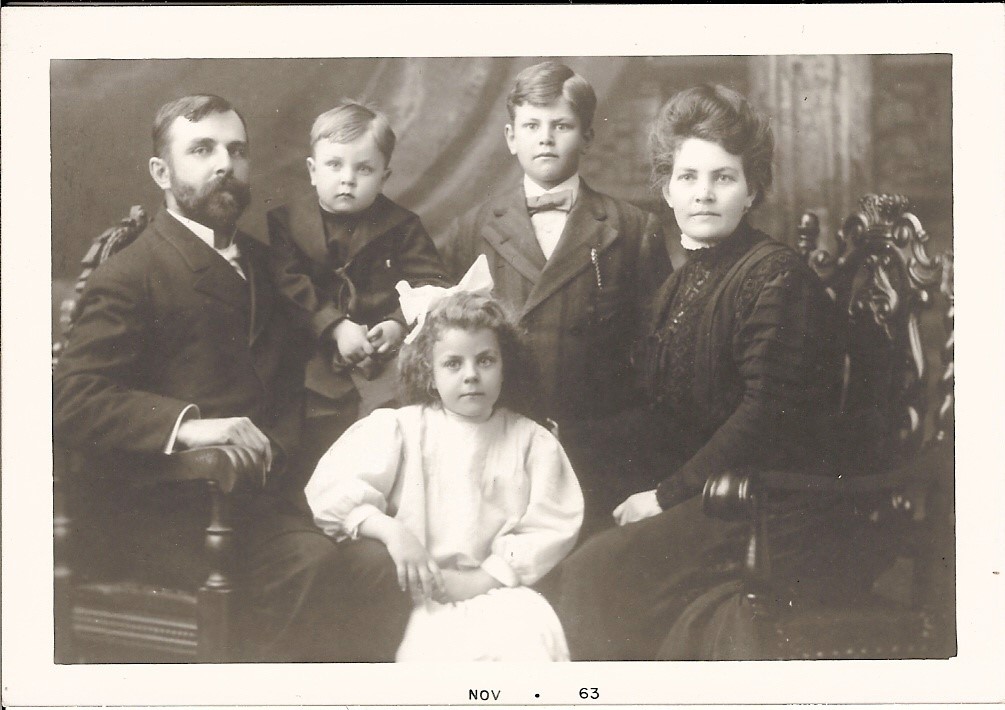
(above) The Schmidt family in 1911. The two boys from left to right are Orval and Waldemar
The family enjoyed camping together, often with the Lee family at lakes in southern Minnesota where they would fish. For many years Otto went fishing and hunting in Canada with a good friend and some Indian guides. In 1926, the family drove all the way out to Yellowstone National Park, camping all the way.
Mollie died in 1933 after a long illness, and Otto died in 1946. Carola studied nursing, but spent much of her adult life working at ‘the Home’ and caring for her parents. She died in 1975. Both Orval and Otto became Lutheran pastors. Otto died in 1978 and Orval in 1997.”
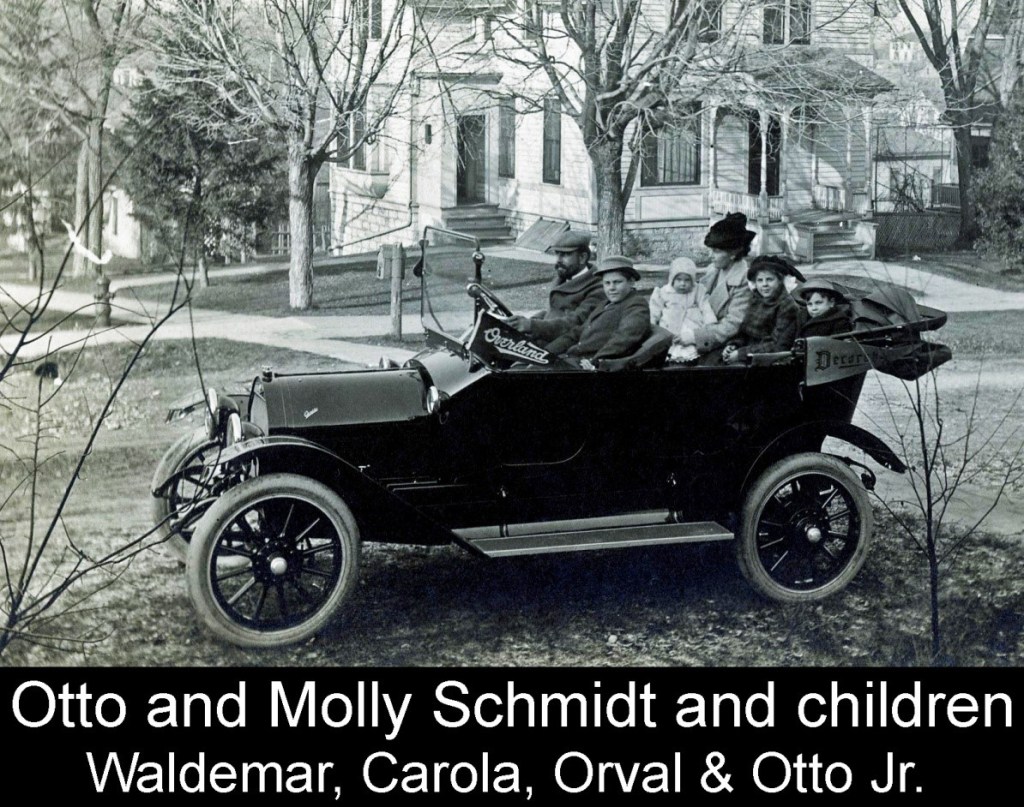
(above) Photo taken in 1913 in Decorah, Iowa. Otto is driving (with the steering wheel on the right!) and Waldemar is in the other front seat. Mollie is in the back seat with Otto Jr. on her lap, Carola sitting next to her mother, and Orville sitting next to Carola.
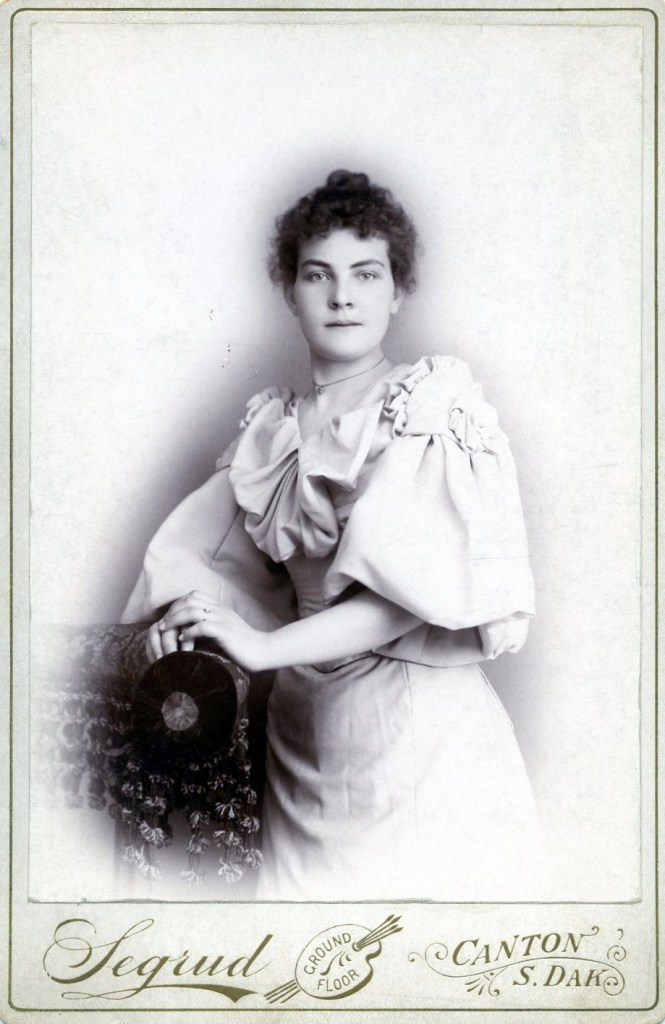
(above) Mollie in 1896.
MOLLIE HELGERSON SCHMIDT
by Barb Schmidt Nelson, from a letter written to her granddaughter for a school assignment. Most of the information was told to Barb by Carola.
“Mollie Helgerson was born in Larchwood, Iowa on June 30, 1875, but grew up in Canton, South Dakota. She learned to play the piano when she was quite young, and she was only nine years old when she played the organ at the church. As a teen-ager, she lived with a family in Sioux Falls, so that she could study piano with a very good piano teacher named Anna Strom.
It was while Mollie was studying with Ms. Strom that there was an opportunity for someone to teach music at All Saints’ Normal School, an Episcopal girls’ school. Ms. Strom recommended Mollie for the job, so after that Mollie lived at the school. She was the faculty person living in one section of the girls’ dormitory there and she also took her turn as the faculty person at a table. There were six at the table, five girls and the faculty person. Mollie said it was very, very interesting. She had to take her turn acting as the host to serve the meals and they were assigned certain topics that had to be discussed. Each person at the table – each one of the students – had to contribute at least one thought on the subject that was assigned for the day. On certain days, they had to speak a certain language at the table. That was the way they learned French and German, and learned correct English usage as well. They were taught the English Episcopalian religion and also the English speech, not the American. Mollie found it very, very interesting. She enjoyed that work very much. Miss Peabody was preceptress (headmistress) and Mollie thought a great deal of her. Ms. Strom had a sister who sang very well and Mollie quite often would accompany her in recitals. Mollie also did quite a bit of traveling around in South Dakota and in parts of Iowa on recital tours of her own.
During the time that Mollie was teaching at All Saints’ Normal, one of her students was a young girl named Katherine Hustvedt. Kate was only a few years younger than Mollie. Several years later, on the strength of some of her original pieces that she herself had composed, Kate Hustvedt won a very lovely Victrola. And another time she got a whole year’s study in France at the Sorbonne. Eventually she taught music at Luther College in Decorah Iowa, where Mollie and her husband lived for many years. When Mollie was very ill before her death and was confined to her bed upstairs – Kate would come to the house. She would not go upstairs to see Mollie, but she would sit at the piano and for a half an hour or longer she would play some of the old classics – a gift of music for her former teacher.
During the time that Mollie was living in Sioux Falls, her cousin Abner Helgerson introduced her to Otto Schmidt. Otto was attending Augustana College in Canton. Abner and Otto liked to go hunting together for jackrabbits. Mollie and Otto were married in Canton on June 30, 1897 (Mollie’s birthday) at the Lutheran church. For their reception they had a tent outdoors and a nice wedding dinner.
Otto was a minister and their first church was in a part of Chicago called West Pullman. The services were conducted in the upstairs hall over a store building. There was a deaf girl in that area who wanted to be confirmed and nobody had taken the time to teach her. So Mollie and Otto learned the hand language, and that girl was confirmed. Many years later Otto visited the church in West Pullman and the deaf girl gave him a plate, salt and pepper shakers and a toothpick holder that she had hand-painted to take home as a gift to Mollie.”
The following items are taken from the Dakota Farmers’ Leader newspaper, published in Canton, South Dakota:
12/16/1892: “Miss Marie Averill and Miss Mollie Helgerson went to Sioux Falls last Tuesday morning to take part in the musicale given there that evening by Miss Strom of the Sioux Falls Conservatory of music. They returned Wednesday.”
9/22/1893: “O.T. Helgerson, wife, and daughters Mollie and Nettie, and son, Oscar, left for Chicago Tuesday.”
1/26/1894: “Miss Mollie Helgerson came down from Sioux Falls Wednesday where she is studying music. She will remain at home until after the Greig [sic] Sangforening concert on Tuesday evening next. She will assist in the musical program.”
Also from 1/26/1894: “Prof Indseth, Miss Mollie Helgerson, Halvor Gregurson, Miss Gunda Jacobson, Miss Palma Anderson, G.S. Hanson, Miss Hofstad and Mr. Westby are among the celebrated members of Canton’s musical talent who will take leading parts in the Greig [sic] Sangforening concert next Tuesday evening in Bedford Hall. Extra seats have been secured.”
2/2/1894: [Excerpt from an article titled “The Concert”] “The concert given by the Grieg Sangforening last Tuesday evening in Bedford Hall, was a gratifying surprise to everyone present . . . An Instrumental by Miss Mollie Helgerson on the piano, gave that young lady a fine opportunity to display her splendid training and faultless execution. Every note was as clear as a bell and her timing was perfect. She received a well merited encore . . . A violin overture by Prof. Indseth and an accompaniment by Miss Helgerson on the piano was charming. The numbers by the society was [sic] well received and again Miss Helgerson gained fresh laurels by a piano accompaniment.”
8/3/1894: An article titled “Demorest Medal Contest” featured “six young ladies dressed in white” who competed in an elocution contest. They marched into the church for the competition accompanied to music by Miss Mollie Helgerson. [The Demorest prize was created by philanthropist W. Jennings Demorest (1822-1895) in 1886 to encourage young people to recite speeches of temperance movement leaders. Its medals—silver, gold, and even diamond—were presented in contests throughout the country through the early years of the 20th century.]
12/14/1894: “The young ladies of All Saints school gave a tea party last evening. Tea and vanilla cakes were served and some very pretty cups and saucers were sold. Instrumental music was furnished by Misses Mollie Helgerson and Mabel Alley, and Miss Harriet Charlton recited several selections. A large number of young people from the city were present and enjoyed the evening’s entertainment.”
12/21/1894: “Miss Mollie Helgerson, assistant teacher of music in All Saints School at Sioux Falls, came home Tuesday to enjoy a holiday vacation with her parents in this city. Miss Helgerson is already classed among the most accomplished musicians in Sioux Falls, and is making rapid progress towards greater eminence in this line.”
5/15/1896: “Miss Mollie Helgerson, who is at present engaged in teaching music at Sioux Falls, will give up her Sioux Falls classes about June 15, and devote her entire time to teaching music in Canton. Miss Helgerson is an accomplished musician and has been very successful in Sioux Fall [sic], having had charge of Miss Strom’s class for the past year, but it keeps her away from home and this is not agreeable to her as she loves home and all its charms. She will, however, continue to receive instructions from Mrs. Smith, nee Miss Strom.”
6/5/1896: “The Grieg Sangforening delighted a Canton audience last Friday night with a delightful concert. The program was a good one and each part was rendered with artistic effect. Prof. Indseth, as leader, deserves credit for his excellent management. Miss Mollie Helgerson with the piano proved to be all for which her most ardent admirers hoped. She is graceful and artistic in her work and proved, as Prof. Petzel said, to be one of the few young ladies in the northwest who are competent to play Grieg’s masterpieces.”
2/26/1897: [An article titled “The Grieg Concert” included the following in what was described as an “excellent program.”] “Misses Helgerson, Sogn and Ramberg rendered a pleasing trio . . . The trio composed of violin, cello and piano, [was] heartily appreciated. Miss Mollie Helgerson presided at the piano in a most graceful manner.”
6/25/1897: “Rev. Otto Schmidt and Miss Mollie Helgerson are to be married at the home of the bride’s parents in this city on June 30.”
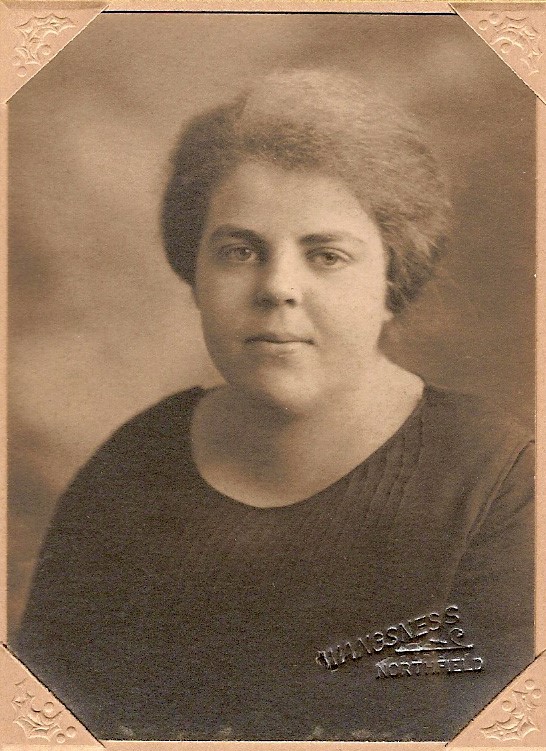
(above) Carola from around 1921
CAROLA M. SCHMIDT
by Barb Schmidt Nelson
“When Carola was born on March 19, 1903, Otto and Mollie lived in Waterford, Wisconsin, where Otto served his second parish. They lived in a very rural area; Otto had a garden and apparently raised a few animals. Carola remembered that she and her older brother Waldemar had a pet sheep that they dearly loved. She liked to tell about the time she had a broken arm, which had to be set by a doctor in nearby Milwaukee. Naturally, it was a painful experience and Carola had a very hard time holding still for the procedure. Her parents finally promised her that if she would calm down and let the doctor finish, they would buy her a doll. She did, and they did. But first they went to a photographer to have studio pictures taken of Waldemar and Carola! One photo shows a very tired-looking little girl resting her head on her brother’s shoulder, but no sign of the broken arm. Along with the new doll, Carola brought home her X-ray too!
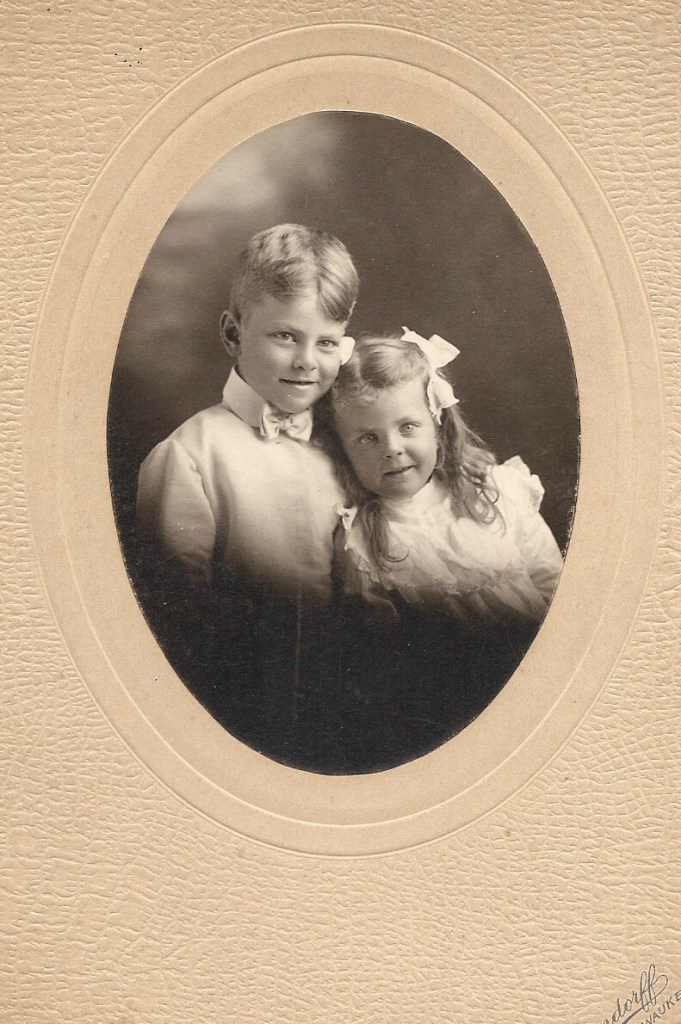
(above) Yes, this is the picture referenced in the previous paragraph!
Carola graduated from Decorah High School in 1921 and from St. Olaf College in 1925. She taught high school for one year in Claremont, South Dakota, but her mother was very lonesome for her. Mollie begged Carola to come back and live at home, which she did for the next two years. In the fall of 1928, she enrolled in nurses’ training in Rochester, Minnesota. She enjoyed the training, and would reminisce about her experiences, especially while on a rotation at Gillette Hospital in Minneapolis. One of her cherished mementos was a stiffly starched white bib from her student uniform, with autographed notes from other student nurses. When she graduated she hoped to find a nursing job in Chicago, where her cousin Dorothy was nursing. But that wasn’t to be. Her mother was in poor health and Carola was expected to come home and take care of her.
(below) Carola and Otto in Decorah, c. 1940
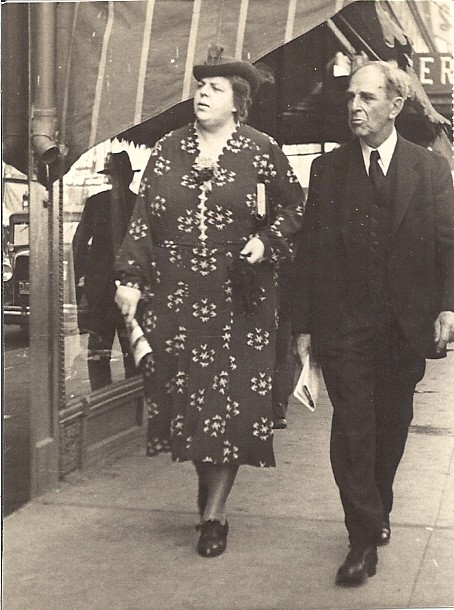
Mollie died in 1933, and Otto felt that he still needed Carola’s help, both at home and at “The Home.” For the next eight years, Carola worked at the Aase Haugen Home in addition to keeping house for her father. She never received a single paycheck. Otto retired in 1944, and Carola continued to care for him until his death in 1946. When he died, she was left with no means of supporting herself, and no property except for the family home, which she inherited from her mother. In order to have some income, she divided the house into two apartments, living in one, and renting out the other. Beyond that, she earned money by baby-sitting and by working occasionally in the office of a local veterinarian, and from the sale of her handwork.
As a young woman Carola learned to knit, crochet, tat and embroider, and in the 1930’s, she taught herself the art of Norwegian Hardanger embroidery. It was the latter that brought her a bit of fame. She gave lessons and demonstrations, was interviewed for an article about her in the “Wisconsin Agriculturist,” and took orders for her handiwork. She was especially proud of the pictures taken of her, sewing at her demonstration table, when Crown Prince Harald of Norway visited Vesterheim Museum in 1960. He stopped at her table to admire her work, and he complimented her!
Everything she made – crocheted doilies, knitted lace, tatted edgings, intricate Norwegian sweaters and mittens, as well as her Hardanger creations, – all were impeccably finished and flawless! And so were her Norwegian cookies – perfect krum kaker, Berliner kransers, and rosettes! She loved to cook and to try new recipes, and she loved to garden.
And she loved to laugh! She was a wonderful story-teller – jokes, yes, – but also family stories. She lived surrounded by her family’s history, of which she was proud, – but she also enjoyed the present. She had a love of books, and she enjoyed corresponding with people she heard on the radio.
In 1941 Otto bought a new Chevrolet, and Carola continued to drive it until her death. She used it mostly for grocery shopping and errands, and it was rarely driven in the wintertime. In 1974, Carola claimed she only used about 25 gallons of gas a year. She did however drive it out to Oregon and back in the summer of 1948 to visit her brother Orval and his family.
(below) Carola around 1970
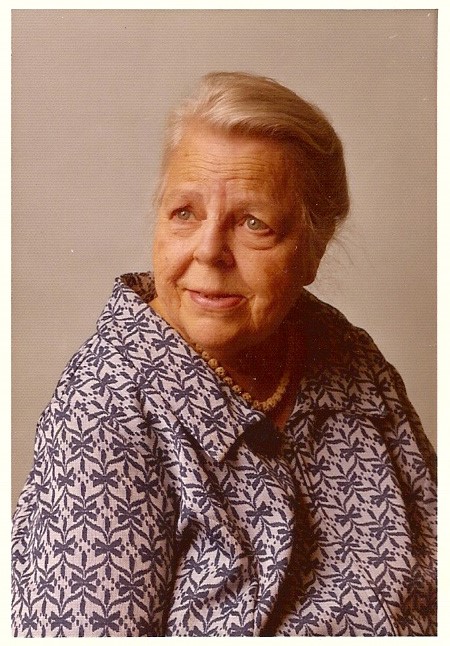
Carola died on February 9th, 1975. The following poem was found in her Bible, and was included in her funeral folder –
Let me die working,
Still tackling plans unfinished, tasks undone,
Clear to its end, swift may my race be run,
No lagging steps, no faltering, no shirking,
Let me die working.
Let me die thinking,
Let me fare forth still with open mind
Fresh secrets to unfold, new truths to find,
My soul alert, undimmed, no question blinking,
Let me die thinking.
Let me die laughing,
No sighing o’er past sins; they are forgiven,
Spilled on this earth are all the joys of heaven,
The wine of life, the cup of mirth still quafing,
Let me die laughing.
S. Hall Young–M.S.”
The final three articles come from newspapers. The first describes the wedding of Otto Schmidt to Mollie Helgerson and the other two are the death notices of Otto and Mollie Schmidt.
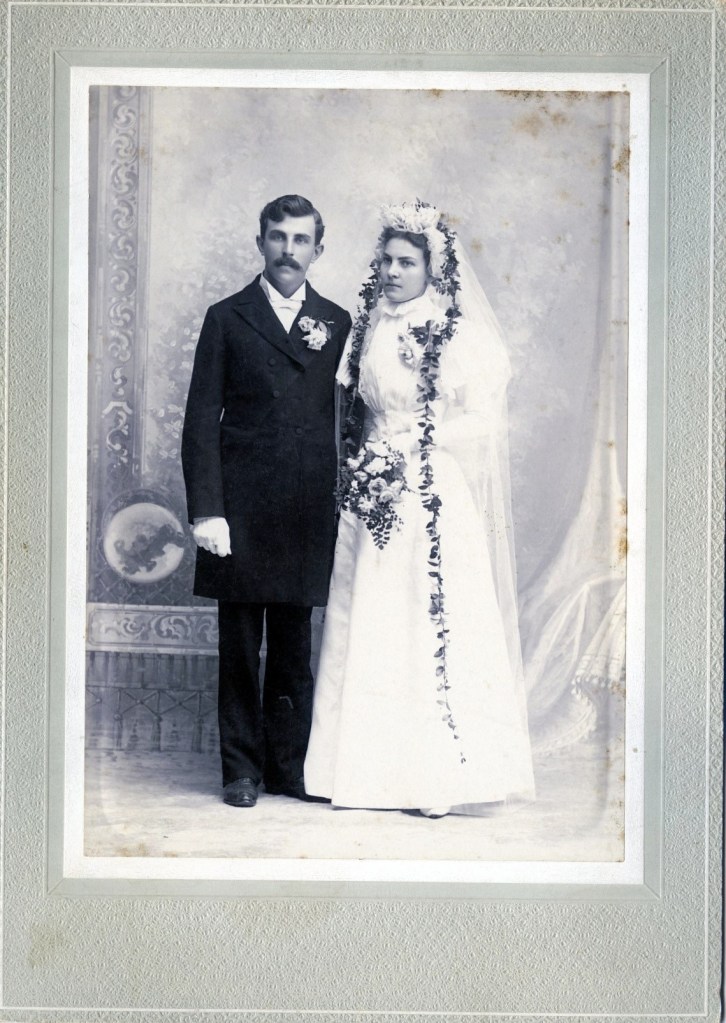
(above) Otto and Mollie’s wedding picture, 1897.
From the Dakota Farmers Leader newspaper in Canton, SD, July 2, 1897 edition. The headline reads: “WEDDINGS STILL ON TAP. Three Couples Have Participated in the Greatest of All Social Acts During the Past Week.“ The first of the three weddings described is the Schmidt-Helgerson marriage.
“Married—Otto E. Schmidt to Miss Mollie E. Helgerson, Wednesday, June 30, at 8 o’clock p.m., Rev. Tetly officiating.
The Evangelical Lutheran church was tastily decorated in honor of the event, which occurred Wednesday night before a large congregation of admirers and friends. At the above mentioned hour the wedding party arrived at the church where the wedding ceremony was performed by Rev. P.H. Tetly of the Lutheran church. The sermon was preached by Rev. F.A. Schmidt, D.D., of Minneapolis, father of the groom. Miss Palma Anderson rendered Mendelssohn’s wedding march [sic] as the party filed down the aisle. Otto E. Schmidt was born in St. Louis, MO., and prior to his matrimonial adventure has made his home in Minneapolis with his parents, having been in attendance at the United Church Seminary at that place from which he graduated last month. He was ordained last Sunday in St. Paul. During his attendance at Augustana College [in Canton] three years ago, the LEADER had the pleasure of forming his acquaintance and we have found him a young man of sterling qualities and one who will make the life of the fair lady he has chosen as his wife one of happiness and bliss. Miss Mollie E. Helgerson was born in Lyon county, Iowa, on June 30, and uniquely celebrated the anniversary of her birth, and with her parents removed to Canton when a young girl. She has grown to womanhood among the large circle of friends who were pleased to congratulate her Wednesday night. She is a beautiful young lady, possessing a kind heart and an admirable disposition, both of which are important factors in constituting a pleasant home, and in our judgment Mr. Schmidt could never find a better specimen of true womanhood and love than Miss Helgerson. After the sermon Mr. and Mrs. Schmidt, accompanied by their relatives and a large circle of admirers and friends, repaired to the residence of the bride’s parents where congratulations and best wishes were showered upon the newly made husband and wife. Mr. Schmidt will make his home in Pullman, Ill., to which place he goes week after next, having been tendered two missionary churches at that place. Mrs. Schmidt will follow later on. The LEADER tenders its most hearty congratulations and wishes Otto Schmidt and his charming bride a life of unalloyed bliss.”
From the Decorah Public Opinion, Wednesday, August 7, 1946:
“SCHMIDT FUNERAL YESTERDAY
Well Known Charity Worker Died Aug. 2
Funeral services were held here yesterday for the Rev. Otto E. Schmidt, 73, retired pastor and charity worker, who died at his home at 409 East Broadway at 6:10 a.m. Friday, August 2, following a lingering illness.
The funeral sermon was delivered yesterday at 2 p.m. at the Decorah Lutheran church by the Rev. M.A. Egge, pastor of the church. The Rev. Egge was assisted by the Revs. T.A. Hoff and N. Astrup Larsen.
The Fjelstul funeral home was in charge of arrangements. C.L. Nasby, R.O. Evans, P J. Ness, W.B. Ingvoldstad, A.F. Fritchen, O.W. Bauder, Melvin Satire, and B.B. Anundsen served as pallbearers. Burial was in the Lutheran cemetery here.
The Rev. Schmidt was born in St. Louis, Mo., July 12, 1873, son of Professor and Mrs. F.A. Schmidt, D.D.
In 1876 he moved with his parents to Madison, Wis., and from there in 1886 to Northfield, Minn., where he attended the academy department of St. Olaf college for two years. In 1888 he was confirmed.
The same year he entered Capital university, Columbus, O., which he attended three years. In 1891 he entered Augustana college, Canton, S.D., from which he was graduated with the Bachelor of Arts degree in 1894.
In the fall of 1894 he entered the theological seminary of the United Lutheran church, St. Paul, and he was graduated from this institution in 1897. That year he accepted a call to Nazareth and Messiah congregations in Chicago.
Ordained in 1897.
He was ordained June 20, 1897, and was married to Miss Mollie Helgerson, Canton, S.D., June 30, 1897. In 1901 he accepted a call from Muskego congregation near Waterford, Wis., and participated in having the old Muskego church moved to the campus of the theological seminary of the United Lutheran church in St. Paul.
In 1907 he accepted a call from the Decorah Lutheran church. During his pastorate in Decorah, he became the guiding spirit in the erection of the Aase Haugen home, and in 1915 resigned as pastor of the Decorah Lutheran church to devote his whole attention to the management of the home.
The Rev. Schmidt continued this management until July 23, 1944, when the Rev. Torger Thompson of Beloit, Ia., was installed as superintendent of the home.
Because of His Zeal.
It is in large measure because of the Rev. Schmidt’s zeal and unselfish devotion to service that the Aase Haugen home is the splendid home it is, in excellent financial condition, and furnishing a merciful haven for many old people who without its facilities would not fare so well. The home is now in its 31st year.
The Rev. Schmidt is survived by two sons and one daughter: the Revs. Orval A. Schmidt, of Portland, Ore.; Otto E. Schmidt, of St. Paul; and Miss Carola M. Schmidt, at home.
The pastor was preceded in death by his wife, who died in 1933, and by two children, one of whom, Waldemar F., died in 1918, and another died in infancy.
Survivors also include five grandchildren and five brothers and sisters: Mrs. Bretha M. Lee, Professor E.W. Schmidt, and Dr. Pau; G. Schmidt, all of Northfield; Dr. Karl H. Schmidt, Minneapolis; and Mrs. Clara S. Johnson, St. Paul.”
From the Decorah Public Opinion, probably the October 12, 1933 edition [the news article clipping source is undated]:
“Funeral of Mrs. Otto E. Schmidt Largely Attended
Last Thursday, October 5, the funeral of Mrs. Otto E. Schmidt took place in the Decorah Lutheran cemetery, attended by a large number of people.
Brief memorial services were held at 11 o’clock in the family home on East Broadway where members of the family—many of them from out of town—and close friends gathered. Dr. O.M. Norlie, who had known the deceased since childhood and school days, spoke words of comfort based on Genesis 23:2. Then the remains were brought to the church of the Decorah Lutheran congregation to lie in state from 12 o’clock until 2. During this time Adolph Lee, Lars Nesheim, Oscar Amundsen and Ed. Ostenson formed a guard of honor about the casket, while the mourners passed by.
In the meantime the ladies of the Volunteer Society had arranged a dinner in the church parlors for members of the Schmidt family, relatives from afar, and friends.
At 2 o’clock the public funeral services began at the church where Rev. O. Glesne, of whose congregation the deceased was a member, spoke, taking Revelations 14:13 as his text. He dwelt on the genuine piety and devoutness of Mrs. Schmidt, bringing out many instances as a tribute to her character.
A quartette consisting of Mrs. Geo. W. Johnson, W.B. Ingvoldstead, Mrs. McCall and Ashley Ellickson sang and then Rev. T.A. Hoff, a member of the board of directors of the Aase Haugen Old People’s Home, offered a few remarks. Dr. O.J.H. Preus brought a greeting of farewell from the Luther College faculty and student body, and a similar message from the St. Olaf College faculty and students, Northfield, Minn., was conveyed by Dean J. Jorgen Thompson of that institution. In behalf of the family Professor Paul Schmidt of Northfield expressed thanks and appreciation to all who had shown sympathy during the hours of sorrow.
Interment took place at the beautiful Lutheran cemetery. Rev. Otto E. Schmidt himself read the commitment ritual.
Nearly all of the ministers of the Decorah Lutheran circuit were present, and among them the following were pall bearers: Revs. Gunsten, Heltne, Tolo, Jordahl, Norlie and Kvammen. Transportation had been provided for the residents of the Aase Haugen Home, and many of them made use of this opportunity to be present, and by their presence testify to the affection which they bore the deceased.
A large number of telegrams and other messages of condolence arrived during the day, and a number of “memorial wreaths” in the form of donations to the Aase Haugen Home and other institutions of the Norwegian Lutheran church were received, representing a total of about $400. Numerous flowers and wreaths covered the casket.
The fact that Mrs. Schmidt was exceedingly beloved in the community was testified to by the large number of her friends who wound their way around the casket in the church, and also by the very large audience filling the auditorium of the church. She will be missed for a long, long time to come by her friends and neighbors. Blessed be her memory!
[Written by] T.A.H. [Rev. T.A. Hoff]”
More Dr. Hirsch
The Following is a continuation of the information on Dr. Christian Hirsch and family, tracing the remaining family for about another two decades.
12/4/1901: [headline] CHURCH FAIR PROGRAM. The friends of the Congregational church will find useful household articles, dolls in evening or street costumes, and the well-beloved reversible ones, home-made cakes and confections, for sale in the parlors this week Saturday afternoon and evening. Light refreshments will be served. [Mr. Little sang in a quartette that performed in a program associated with the event. They performed “The Night has a Thousand Eyes” by Nevin.]
1/8/1902: [W.G. Little is one of two men “put in charge of the music” at the annual meeting of the First Congregational Church in New Ulm]
2/5/1902: [Headline] “Woman’s Literary Club.” [The subject for the club meeting was Spain and Mrs. Little spoke on “its weak kings from 1558 to 1700 and its national decline.”]
2/19/1902: Mr. and Mrs. W.G. Little left on Friday for Marshall where they will spend a week or so with relatives.
4/30/1902: Mrs. F.H. Krook [Linsie] and children returned on Saturday from a three-week’s visit at Minneapolis. [Also]: Walter Little of Marshall drove to this city Friday last and spent a few days with his brother Willard. He leaves his horse and buggy here to be cared for while he takes a trip throughout the coast states. [Also]: [Mrs. Little was elected Vice President of the Woman’s Literary Club].
5/7/1902: A.H. Lienhard of St. Paul was in the city over Sunday.
5/14/1902: [Headline]: “For the Parsonage.” The Christian Endeavor Society of the Congregational church has arranged a special program for an entertainment to be given Friday evening May 16, the proceeds from which are to go into the parsonage fund. A collection will be taken and the lowest amount expected to be put in will be twenty-five cents. [W.G. Little began the program with an organ prelude].
6/11/1902: Mr. and Mrs. A.H. Lienhard who have spent the past week with relatives in this city left for their home in Minneapolis Sunday.
6/18/1902: An eclesiastical [sic] conference of Congregational churches from the Anoka, Mankato and Western conferences is called to meet in Mankato Friday. This church will be represented by the pastor and W.G. Little.
9/10/1902: On Friday, Sept. 5, at the home of Mrs. C.J.B. Hirsch in Minneapolis her daughter Camilla was married to W.L. Goodrich of Audubon, Minn. Mr. Goodrich is a druggist in that city and a young man of high standing. Mrs. Goodrich at one time was a resident of this city during the time of her father’s life and many people will remember her through the memory of her father. She is also a sister of Mrs. W.G. Little of this city.
10/15/1902: Mrs. C.J. Hirsch, mother of Mrs. Willard Little of this city arrived in the city last week to visit her daughter.
10/22/1902: The recent ill health of Mrs. W.G. Little has necessitated a change of climate and last week she left for Minneapolis with her husband and on Saturday they both will leave for Phoenix and Tucson, Arizona where they will spend the winter. Mr. Little’s place in Bingham Bros. office will be filled by his brother from Marshall who will arrive this week.
11/12/1902: [W.G. Little was named to Petit Jury duty].
12/31/1902: Walter Little came home [to Marshall, MN] from New Ulm for Christmas with his parents. He is filling his brother Willard’s position, the latter being in Phoenix, Arizona, with his wife, where they went in October, leaving their eldest child with it grandparents, Mr. and Mrs. George Little, in Marshall. Mrs. Willard Little was menaced with serious lung trouble, and a month ago but slight hope of her recovery was felt. Many Marshall friends will be very glad to know that during the past month there have been brighter indications of improvement.–Marshall Messenger.
1/7/1903: [Headline] Death of Mrs. [Estella Hirsch] Little. [Article]: Among the many sad things that have happened in this place there has not been one that was more so than the death of Mrs. W.G. Little which occurred at Phoenix, Arizona. Five months ago a child was born to Mr. and Mrs. Little in this city and the mother took cold soon after and it settled on her lungs, rapidly taking the form of tuberculosis and it was thought that a change of climate would benefit her, but there was no material improvement in her condition and on the 2nd day of January her spirit returned to its maker and her husband and two children were left desolate. [The child referenced in this paragraph, George Little, was born on August 5, 1902 and died on January 15, 1903, less than two weeks after his mother.]
Word was received here Friday morning that she had died and that the body would be brought here for burial and the funeral will be held from the Congregational church tomorrow, Rev. S.G. Updyke officiating. [Both mother and child are buried in the family plot in the City Cemetery of New Ulm.]
Mrs. Little was the daughter of Dr. and Mrs. C.J.B. Hirsch who for the past twelve years until recently have been residents of this city. She was married to Mr. Little on the 29th day of July five years ago and was thirty years old at the time of her death. [She was] A woman of a rare and sweet disposition, devout and conscientious in the discharge of all obligations and loved by all who knew her. She made her home the center of happiness and the place of inspiration for her husband and was just in that time of life when hope and the desire to live for her family was the strongest and brightest, and the mystery of her untimely death is hidden in the wisdom of that providence in which she placed such implicit trust.
Her death has cast a shadow over the large circle of friends who were her companions in this city and especially those of the Congregational church, with which she affiliated, all of whom have for the bereaved husband the sincerest sympathy in this hour of his most poignant grief. [also]: [W.G. Little was named a Deacon at the Congregational Church.]
1/14/1903: The funeral of Mrs. W.G. Little was held from the Congregational church Thursday afternoon at 2 o’clock conducted by Rev. S.G. Updyke. The church was filled full of people from all parts of the city. About the coffin were many floral tributes from friends of the deceased, covering two large tables. The ceremony was very beautiful and touching and the remarks of the minister simple and very appropriate, complimenting the life of the dead woman for its consistent christian [sic] virtues. The ceremony at the grave was short but impressive, only a few braving the wintry weather to be there.
1/21/1903: Misfortune has again visited Willard Little in the death of the infant son left by the mother who was buried only a few days ago. The child was not strong from birth, and the prospects of its living were few. It was less than six months of age. In this double affliction the sympathy of the friends of Mr. Little in this city is again made manifest and all share with him in the distress, that has come over his life this early in his years. The infant was buried Saturday from the home of Mr. and Mrs. Hilding Krook and was laid to rest in the city cemetery beside its mother.
1/28/1903: For Sale. Modern dwelling house, at a bargain. Apply to F.H. Krook, city. [It is quite possible that the house being sold belonged to the Little family.]
2/4/1903: Willard G. Little has returned to the city and once more resumed his duties in the office of Bingham Bros.’ grain house. His brother who has filled his place while he was away will return to his home at Marshall, this week.
4/8/1903: W.G. Little invoked the aid of painters and paper hangers last week to brighten up his room in the offices of Bingham Bros. They succeeded admirably and Mr. Little now has one of the prettiest apartments in New Ulm.
4/15/1903: W.G. Little went to Marshall Saturday evening to spend Sunday with his small daughter and other relatives.
4/29/1903: In a letter to New Ulm relatives Mrs. Camilla Hirsch, formerly of this city, gives an interesting description of her experiences last Thursday at the time of the explosion of the plant of the Northwestern Star Oil company, when ten persons lost their lives. The Hirsch dwelling is within three blocks of the oil works and when the castastrophe occurred their house shook and trembled from the force of the concussion. Rushing out of doors, they beheld the thick smoke arising and were among the first to reach the scene of the horror, subsequently witnessing the awful fire and the removal of the bodies. [Also]: Mrs. F.H. Krook and daughters, Beata and Aimee, are visiting with relatives in Minneapolis.
5/6/1903: A.H. Lienhard, formerly of this city but now of Minneapolis, has decided to return and will soon move his family here. [Also]: A.H. Lienhard came down from Minneapolis Sunday for a visit with relatives in the city.
5/20/1903: [Both F.H. Krook and W.G. Little contributed to the fund to keep the library open.]
6/3/1903: A.H. Lienhard of Minneapolis, was in the city Saturday. He will soon move his family to New Ulm.
6/10/1903: W. G. Little went west Monday to inspect elevators for Bingham Bros. His destination was Volga, S.D.
7/8/1903: W.G. Little visited from Friday until Monday with friends at Rochester and Eyota.
7/22/1903: W.G. Little spent the Sabbath in Marshall. [Also] Mrs. F.H. Krook [Linsie] and Mrs. F.W. Johnson were among those who went to Minneapolis on the excursion Sunday.
7/29/1903: Mrs. A.H. Lienhard [Alpha] and baby, Miss Daisy Schwartz and P.J. [Patroclus Jacob] Hirsch, all of Minneapolis, Sundayed at the residence of Mr. and Mrs. F.H. Krook.
8/12/1903: Thursday afternoon Mrs. F.H. Krook entertained a number of her lady friends at 5 o’clock tea. [Also]: W.G. Little journeyed to Lake Minnetonka Sunday, spending the day at the Leonhardt [probably Lienhard] cottage.
8/26/1903: A.H. Lienhard and family arrived Saturday from St. Paul to make their future home in this city. On Monday they moved into the Hornburg dwelling on Second South street.
12/23/1903: [Front page headline]: DEATH OF “FORTY-NINER” J.H. Lienhard Passes Away at Nauvoo, Ill. Was Present at First Discovery of Gold in Californina. Staked Out Claim and in Three Years Amassed a Fortune. [Article]: A.H. Lienhard of this city, received a telegram Saturday morning apprising him of the death of his father, J.H. Lienhard, which occurred at the latter’s home in Nauvoo, Ill. Deceased was 83 years of age and had been in feeble health for the past five years. Mr. Lienhard had lived a long and active life and his career was one of more than usual interest. [The article then went into detail about J.H. Lienhard going to California in 1846 and discovering gold in 1849.] Mr. Lienhard resided in California until 1852, when he took the fortune he had amassed and returned to Switzerland, intending to settle down in the country of his birth. He married there but later returned to America and settled in Madison, Wis.
Forty-seven years ago he moved to Nauvoo, Ill., the town which is famous as the home of Brigham Young and the birthplace of the Mormon creed, and resided there until his death.
Six children survive. They are A.H. Lienhard of this city; J.H. Lienhard of Nauvoo, formerly a member of the firm of Lienhard Bros., of New Ulm; J.J. Lienhard, Slater, Mo.; J.P. Lienhard, Arcola, Wash.; Miss Bessie Lienhard, Chicago, and Miss Mary Lienhard, Nauvoo.
A. H. Lienhard left for Nauvoo Sunday to attend the funeral.
12/23/1903: Lowell, the six-year-old son of Mr. and Mrs. A.H. Lienhard, was operated upon at St. Alexander hospital Sunday morning by Drs. O.C. Strickler, G.B. Weiser and J.H. Vogel for abscess. The child’s trouble was caused by an attack of measles and he underwent a similar operation in Minneapolis about eights [sic] ago. Friends of the family will be pleased to learn that he is doing nicely.
12/30/1903: A.H. Lienhard returned Thursday from Nauvoo, Ill., having attended the funeral of his father, J.H. Lienhard, whose death was mentioned in the Review last week.
1/6/1904: W.G. Little was in Minneapolis Wednesday evening and went to the exposition building to hear Adaline Patti. He says that in spite of her sixty-one years the famous diva’s voice is still sweet and pure.
1/13/1904: [Headline]: Church Officers Elected. [At the annual meeting of the Congregational Church W.G. Little was elected as an officer and named to the prudential committee. Mrs. A.H. Lienhard [Alpha] was elected to the music committee.]
1/20/1904: W.G. Little was a passenger for Marshall Saturday. He spent Sunday with relatives in that city.
2/24/1904: W.G. Little departed Saturday for Marshall, where he has since been visiting relatives.
3/2/1904: Miss Florence Hirsch arrived Thursday evening from Minneapolis and is visiting with her sisters, Mesdames F.H. Krook and A.H. Lienhard.
3/9/1904: Miss Lillian Elmore of La Crosse, Wis., came Saturday for a visit of a week with Mrs. F.H. Krook. [Also]: Mrs. C.M. Hirsch arrived here Friday evening from Minneapolis for a visit with her daughters, Mesdames F.H. Krook and A.H. Lienhard.
3/16/1904: [On page 1, the newspaper reports that the doctors of Brown and Redwood Counties requested of the newspapers that they “omit any mention of their names when publishing accounts of surgical operations and similar cases.”] [Also]: Miss Lillian Elmore returned to her studies at Mankato Sunday after a visit of a week at the home of Mrs. F.H. Krook.
3/23/1904: W.G. Little and Mrs. Camilla Hirsch were passengers for Marshall Saturday, to visit relatives.
5/4/1904: The Congregational church was crowded last night by people of this city to listen to the Olde Folkes Concerte. [Mrs. F.H. Krook portrayed Tribulation Doolittle.]
6/1/1904: W.G. Little was a Minneapolis visitor Saturday and Sunday. [Also]: Mrs. F.H. Krook returned home Sunday from a visit with friends in Mankato.
6/29/1904: An ice cream social was given last evening on F.H. Krook’s lawn by the members of the Christian Endeavor society. [Also]: Mrs. A.H. Lienhard and children left Thursday for Minneapolis and New Paynesville, where they will spend several weeks.
7/13/04: W.G. Little spent Sunday with friends in Minneapolis.
7/20/1904: W.G. Little will leave about the first part of next month for the west and will visit points on the Pacific coast. He expects by taking this trip to escape his usual siege of hay fever.
7/27/1904: W.G. Little intends taking a vacation from his duties in Bingham Bros. office about August 15th and will visit several of the Puget Sound cities.
8/3/1904: Miss Florence Hirsch is here from Minneapolis, visiting at the home of Mrs. G.B. Weiser.
8/10/1904: W.G. Little goes to Marshall Saturday and will leave next week for Spokane, Wash., and other Pacific Coast points. On his return he may go through the Yellowstone national park.
8/17/1904: W.G. Little went to Marshall Saturday and is now on his way to the Pacific Coast, where he will spend the coming fortnight.
8/24/1904: Mrs. F.H. Krook and family are visiting the Hirsch home in Minneapolis. [Also]: A.H. Lienhard and family returned home Thursday from their summer vacation.
8/31/1904: F.H. Krook went to Minneapolis Saturday and spent Sunday with the Hirsch family.
9/21/1904: Mrs. A.H. Lienhard is visiting in Minneapolis with Mrs. C. Hersch [sic–Hirsch].
9/28/1904: [Headline]: INJURED IN COLLISION. W.G. Little Slightly Hurt on Canadian Pacific.
After passing through a railroad wreck in which he was slightly injured, on his way home, Willard G. Little arrived in New Ulm Monday from his six week’s vacation spent in the northwestern part of the country and in Canada.
The accident occurred on the Canadian Pacific at Medicine Hat, Canada, early Monday morning of last week. The east bound train on which he was riding was just pulling into the station and because of the steam and smoke from a switch engine in the yards the engineer failed to see a west bound train lying directly in front of him. In the collision that followed the front part of the engines were badly damaged and the passengers received a shaking up.
Mr. Little was standing leaning over his berth at the time and when the shock came was thrown against the door, injuring his side. The claim agent of the company offered to settle with him for $5, but he didn’t know what might come of the hurt and declined to accept it. His side is still very sore.
12/7/1904: [Mrs. A.H. Lienhard (misspelled “Loenhardt”) was named secretary of the Ladies’ Missionary society of the Congregational Church.]
12/14/1904: Mr. W.G. Little made a business trip to Essig Thursday in the interests of Bingham Bros.
12/21/1904: W.G. Little was called to Minneapolis on business Saturday, remaining over Sunday. [Also]: Mrs. F.H. Krook returned Saturday from a three weeks’ visit with her mother in Minneapolis.
12/28/1904: A.H. Lienhard came in from the road Thursday to spend the holidays with his family in New Ulm.
3/8/1905: Miss Florence Hirsch of Minneapolis, is in the city the guest of her sisters Mrs. Krook and Mrs. Lienhard.
3/22/1905: Lowell Lienhard, son of A.H. Lienhard was operated upon Friday for mastoid abscess at St. Alexander’s hospital.
4/5/1905: Miss Addie Olsen entertained at whist in honor of Miss Florence Hirsch Thursday evening at her home on south Broadway. Miss Antoinette Crone and Richard Higgs won the head prizes and Miss Lulu Doehne and Fred A. Alexander were awarded the booby prizes.
4/12/1905: Willard G. Little, who for the past six years has been in the office of Bingham Bros. in this city has resigned and will leave in a short time for Tacoma, Wash., where he will enter a large book store in that city as partner. The firm will deal largely in photos and photo supplies. This decision on the part of Mr. Little is quite sudden as the opportunity came to him only recently. He is a victim of hay fever, which each year compels him to seek a change of climate and one reason of his desire to get to this western country is to avoid this annual trouble. He will leave a large circle of friends in this city.
6/21/1905: (Headline) PLAN PLEASANT PARTY FOR PARENT. Reception For Mrs. Hirsch Friday Afternoon Very Enjoyable. One of the most enjoyable afternoon entertainments that have been given this season was when Mesdames F.H. Krook and A.H. Lienhard as hostesses entertained a large number of their friends, Friday afternoon in honor of Mrs. C. Hirsch of Minneapolis, at the home of Mrs. F.H. Krook on South German street.
Preparations had been made to accommodate seventy guests on their lawn but owing to the disagreeable weather many were prevented from going and the hostesses were compelled to hastily arrange the large house for the occasion. The rooms were prettily decorated with roses, and after the guests had assembled and participated in numerous games, such as guessing contests and cards, they were supplied with individual lunch baskets decorated in colors corresponding with the colors in which their table was decorated.
This afforded any amount of amusements as the colors in many instances bore great similarity which confused the guests in seeking for their respective tables and at times unexpected partners.
8/2/1905: A.H. Lienhardt [sic] returned Thursday evening from the northern part of the state, where he has been for several weeks on business.
8/30/1905: Mrs. A.H. Lienhard entertained in honor of Mrs. G.W. Nicholson, at her home on Second South street yesterday afternoon.
9/13/1905: Mrs. F.H. Krook and children who have been visiting with her mother at Minneapolis the past week returned home Saturday. [also]: A.H. Leinhard [sic] returned from a trip to St. Joseph, Mich., where he was the guest of the people who manufacture the “Iron Clad” hose, one of the leading brands of hostiery [sic] on the market and for which he has the agency. The factory is one of the largest in the world and has the reputation of being most satisfactory of this most unsatisfactory piece of wearing apparel. It is probably harder to get good hosiery than it is to get any other piece of necessary furnishings and it is claimed for the Iron Clad that it has no equal. Mr. Leinhard had a very pleasant trip and enjoyed the vacation. [also]: A.H. Lienhard has decided to built [sic] a residence for himself and let the contract for a cottage yesterday, to be erected on South State street near the Wenzel Eckstein residence.
5/9/1906: [headline]: YEAR’S BUSINESS GRATIFIES. Large Number of Stockholders Attend Meeting. Six Hundred and Fifty-One Telephones Being Used. [article]: Philip Liesch was elected to succeed himself as president of the New Ulm Rural Telephone Company at the meeting held last Thursday and Alex Russell was made vice president. F.H. Krook secretary [sic] and Otto Schell is treasurer, which is practically the same official body as the company has for the year passed. Mr. Krook, after being elected found that to attend the business would require too much of its [sic] time and resigned. L.G. Vogel was elected to fill the vacancy and is now the acting secretary of the company.
5/23/1906: Mrs. Hirsch, mother of Mrs. F.H. Krook is in the city, the guest of her daughter. [Also] W.G. Little of Tacoma, Wash., at one time book keeper for Bingham Bros. in this city, was here over night last week visiting friends. From here he went to Marshall where his relatives are and where his daughter has been staying. He has a very good business on the coast and likes the country and people.
7/11/1906: [headline]: CALL ISSUED FOR CONVENTION. Sunday Schools of District Will Meet Sunday. [The article notes that A.H. Lienhard, representing the Congregational Church, will speak from 8:15-8:30 p.m. on “Pressing Needs of our Sunday Schools.”]
7/18/1906: [headline]: FIRST MEETING SUCCESSFUL. Large Number of Sunday School Workers Meet. Three Churches Unite in Advancing Work of School. President Ruenitz Sees Success in Enthusiastic Meeting. [The ensuing article discusses the meeting, including the following]: A.H. Lienhard spoke on the “Pressing Needs of the Sunday School.” Chief of these needs he emphasized the necessity of getting the young men into the school and retaining the interest of the parents in the work. He argued that there was little incentive for the youths to attend the Sunday service when the parents were careless as to whether they attended or not and seldom, if ever came to the school themselves. He gave some excellent thoughts as to how this was to be accomplished and urged the workers to make it a part of their duty to see that the interest of the parents was awakened. First of all he said it was necessary that teachers and officers be consecrated to their work and thoroughly in earnest. [Lienhard was subsequently elected as “teachers’ training secretary” for the following year.]
7/25/1906: [In an article about an upcoming Sunday School Convention for the Congregational and Methodist Churches, it notes that Mrs. A.H. [Alpha] Lienhard will speak at 11 on Friday morning about “Decision day;” how it should be conducted and it’s possibilities.]
8/1/1906: Mr. and Mrs. A.H. Lienhard have been entertaining relatives from Chicago the past week and they expect to remain in the city during this week. They are two sisters and a brother of Mr. Lienhard, and this is their first visit to New Ulm.
8/15/1906: [The following is the first two paragraphs of an obituary that ran on page 1] Funeral services were held in the Congregational church Monday afternoon for the late Alexander F. Ottomeyer and the church was crowded with the friends of the deceased, and it seems that almost if not quite all the people of the city were his friends.
The coffin was borne into the church by six members of the faith to which he had subscribed and which he lived to the time of his death, Messrs. Beecher, Geo. Schmidt, Lienhard, Mihleis, F.H. Krook and Held, while a slow march was played by Mrs. Lienhard. The choir sang “Come Unto Me,” and Rev. C.H. Sauter offered prayer in the German tongue and the choir sang at the conclusion, “Asleep in Jesus.”
9/5/1906: F.J. Errett, secretary of the Minnesota Mutual Fire Insurance Company . . . was in the city one day last week for the purpose of arranging for a resident representative to take the place of John Bobleter who has recently resigned. He was successful in getting F.H. Krook to look after the work and appointed him as agent for the company. [Also]: A.H. Lienhard visited over Saturday and Sunday with friends in Fairfax.
10/3/1906: A.H. Lienhard, F.H. Krook and G.A. Ottomeyer left this morning to attend the Minnesota Conference of the Congregational churches.
10/10/1906: (Headline) MINISTERS CHOOSE NEW ULM. It required very little urging on the part of the representatives from the Congregational church in this city to get the members of the association that met in Minneapolis last week, to decide to come to this city for the meeting in 1907 . . .The New Ulm church was represented by its pastor, the Rev. E.F. Wheeler and by G.A. Ottomeyer, A.H. Lienhard and F.H. Krook, and on behalf of the church at this city the matter of having the association come here was presented in a formal manner in the convention and was the immediate unanimous choice. [Also]: Sunday evening at the Congregational church there was held what was called an echo meeting of the conference that was held in Minneapolis last week. Besides the pastor G.A. Ottomeyer and A.H. Lienhard gave interesting talks of the conference, which is to be held in this city next year.
11/21/1906: A.H. Lienhard left yesterday for a four weeks’ trip in the northern part of the state. Mr. Lienhard represents the Cooper Wells Co., of St. Joseph, Michigan, manufacturers of fine hose.
12/5/1906: A New Ulm Young Men’s Christian Association was organized on Monday evening. County Secretary Pierce was here to assist in the organization and after an interesting meeting, at which unusual enthusiasm prevailed, the following officers were elected: [F. Hilding Krook was elected President].
12/12/1906: [Mrs. A.H. Lienhard was elected vice-president of the Ladies Missionary Society of the Congregational church].
12/26/1906: A.H. Lienhard, the traveling salesman, is enjoying a brief vacation with his family in this city.
1/16/1907: After an interesting banquet Thursday evening the Congregational Society elected the following officers: Deacon, C.W.A. Krook [father of F.H. Krook]; clerk, Herman Held; trustee, G.A. Ottomeyer; treasurer, F.H. Krook; superintendent of Sunday school, A.H. Lienhard, assistant, Dr. Mihleis; music committee, F.H. Krook, Mrs. Zelle and Mrs. Mather; prudential committee, Mrs. G. Schmidt, Mrs. Krook and Mrs. Baxter.
6/12/1907: Mrs. Hirsch of Minneapolis is visiting here with her daughters, Mrs. F.H. Krook and Mrs. A.H. Lienhard. [Also]: Rev. Wheeler, C.W.A. Krook and Mr. and Mrs. A.H. Lienhard represented the New Ulm Congregation at the western conference of the Congregational churches in Winthrop yesterday.
7/17/1907: Word received recently from Seattle tells of a disastrous fire which completely destroyed the book and stationery stock of W.D. [sic–should be W.G.] Little, a former resident of New Ulm. [Also]: The families of A.H. Lienhard and F.H. Krook are enjoying an outing with Mrs. Hirsch at Lake Harriet near Minneapolis.
8/7/1907: [The paper announced that F. Hilding Krook would be performing several pieces in a Ladies Missionary Society musical entertainment at the Congregational Church on the evening of August 13. The pending concert would feature him in a “quartette” scheduled to present three selections: “Spring” by McFarren, “Moonlight and Music” by Pinsuti, and “Laughing Gas” by Giebel. He also would present the vocal solo “I’ll Sing Thee Songs of Araby” by Clay.] [Also]: C.W.A. Krook and son, Hilding, returned Saturday from attending the funeral of a relative in Chicago.
8/28/1907: A.H. Lienhard is paying a visit to his employees in St. Joseph, Michigan. [Also]: Mrs. A.H. Lienhard and Mrs. E. W. Mihleis represented the Congregational Sunday school at the Brown County Sunday School convention in Springfield yesterday.
9/11/1907: The state convention of the Congregational churches of Minnesota will be held in this city the first week in October. The committee on general arrangements consists of Prof. Critchett, G.A. Ottomeyer and Rev. Wheeler, and the committee on entertainment of H.L. Beecher, A.H. Lienhard, Herman Held, Dr. Mihleis, F.H. Krook and the Mesdames Critchett, Beecher, Zelle, Seiter, Starr, Siegel and Mather.
9/18/1907: The Ladies Aid Society of the Congregational church held its annual meeting Friday afternoon and elected the following officers: President, Mrs. C.A. Zelle; vice president, Mrs. Fred Meier; secretary and treasurer, Mrs. F.H. Krook.
10/9/1907: Miss Hirsch of Minneapolis is a guest at the home of her sister, Mrs. Leinhard [sic].
10/16/1907: A.H. Linehard is a member of the new executive committee of the Brown-Redwood Young Men’s Christian Association.
12/11/1907: The Ladies Missionary Society of the Congregational church held a meeting Saturday and elected the following new officers: President, Mrs. Lienhard; vice president, Mrs. Mihleis; secretary, Mrs. Hubbard; treasurer, Mrs. Beecher.
1/15/1908: [The Congregational Church Society elected A.H. Lienhard superintendent, Mrs. A.H. Lienhard as “member of music committee,” and Mrs. F.H. Krook as a member of the prudential committee.]
2/5/1908: The Social Science Club will hold its next meeting at Schell’s hall on the evening of February 12th. The program will include a vocal solo by Mrs. Critchett and papers as follows: “History of Money,” Miss Rockwood; “Principles of Money and Banking,” F.H. Krook; “What Determines the Value of Money,” Prof. Jedlika.
2/19/1908: [The discontinuation of private banks in the state of Minnesota compelled the Citizens Bank of New Ulm to reincorporate as The Citizens State Bank of New Ulm. F.H. Krook was listed as one of nine men who acted as the “incorporators.”]
4/8/1908: [The new board of directors for the Citizens Bank of New Ulm elected F.H. Krook as assistant cashier.]
4/29/1908: [Mr. and Mrs. Lienhard joined a group that attended a Sunday School convention in St. Paul.]
5/20/1908: Mrs. Hirsch of Excelsior is visiting this week with her daughters, Mrs. A.H. Lienhard and Mrs. F.H. Krook.
6/17/1908: Mrs. Hirsch returned to Minneapolis Monday after a month’s sojourn with her daughters, Mrs. Lienhard and Mrs. F.H. Krook.
7/1/1908: Mrs. A.H. Lienhard and Mrs. F.H. Krook are entertaining their sister, Mrs. Goodrich [Camilla] of Glenwood.
8/19/1908: A.H. Lienhard started east Monday afternoon to visit the factory of his employers at St. Joseph, Mich. Mr. Lienhard travels for one of the most successful hosiery manufactories in the country, a concern that employs over 600 men and turns out 1,500 dozen pairs of stockings daily. [Also]: Mr. and Mrs. A.H. Lienhard pleasantly entertained the members of the local Christian Endeavor society at the State street home Wednesday evening.
8/26/1908: The sixth annual convention of the Brown County Sunday School association will be held in Sleepy Eye on Aug. 27th and 28th. Among those from New Ulm who are slated to play an important part in the proceedings are Rev. Sauter, Dr. Reinecke, Mrs. A.H. Lienhard, Mrs. Blume and Miss Yahnke.
9/30/1908: Rev. Wheeler, G.A. Ottomeyer and Mrs. J.H. Sigel have been elected to represent the local Congregational society at the annual Minnesota conference to be held in Faribault next week. A.H. Lienhard and Miss Lillian Klossner are the alternates and Mrs. Lienhard the delegate of the Ladies’ Missionary society.
10/7/1908: The following departed for Faribault yesterday to attend the Congregational conference; Rev. Wheeler, Mr. and Mrs. A.H. Lienhard, Mrs. Siegel and Mrs. F.H. Krook.
12/23/1908: [F.H. Krook is named vice-president of the Congregational Men’s Club.]
1/20/1909: [The directors of the Citizens’ State Bank met and elected F.H. Krook assistant cashier.]
2/24/1909: Prof. Amundson and his pupils will give a recital at the Turner Theatre next Monday evening. [F.H. Krook is noted as one of the participants.]
3/17/1909: The Brown County Sunday School association will hold a meeting at the Congregational church in this city next Sunday. [Mrs. F.H. Krook was scheduled to read a paper for the meeting entitled “The Child in the Home.”]
5/5/1909: [The New Ulm Review ran an article about the Norwegian Marcus M. Thrane, noting that one of his children (his daughter Camilla) became the wife of Dr. Hirsch and that two of his granddaughters, Mrs. A.H. Lienhard and Mrs. F.H. Krook, lived in New Ulm.]
5/19/1909: It is reported that A.H. Lienhard will dispose of his residence property in this city and take his family to some city in South Dakota, nearer to his center of the territory covered in his travels as a commercial salesman. His dwelling on State street [sic] is one of the coziest in the city.
8/4/1909: Mrs. A.H. Lienhard and children will leave for Glenwood, Minn. next week to visit with Mrs. Goodrich, sister of Mrs. Lienhard. (Also) A.H. Lienhard, the well known traveling man, leaves next week for St. Joseph, Mich., the home of the famous Iron Clad hosiery, where he will select the new spring styles, preparatory to an extended business trip through the country.
8/25/1909: Mrs. A.H. Lienhardt [sic] who has been seriously ill while visiting her mother [and sister?] at Glenwood is reported as being out of danger and improving in health.
9/8/1909: Mr. and Mrs. A.H. Lienhardt [sic] returned last Saturday from Glenwood where Mrs. Lienhardt had been visiting with her mother for the past four weeks. While there she took seriously ill but is now reported as being greatly improved in health.
10/6/1909: On Wednesday evening the Citizens Lecture committee elected the following officers: Rev. E.F. Wheeler President, Ben. Stockman Vice President, F.H. Krook Secretary and Dr. Reineke Treasurer.
10/13/1909: [F.H. Krook donated $1.00 to the John A. Johnson Monument Fund in honor of the governor of Minnesota from nearby St. Peter who died on September 21, 1909.] [Also] [Three organizations from the Presbyterian denomination were meeting in Minneapolis.] Each local church is entitled to be represented by its pastor and two delegates, with an additional delegate for each 50 members above 100. Mr. and Mrs. F.H. Krook are the delegates from the Congregational church in New Ulm and with the pastor, Rev. E.F. Wheeler, left for Minneapolis Monday morning. [Also] G.A. Ottomeyer and A.H. Lienhard will leave Saturday morning for Minneapolis to attend the Congregational Brotherhood banquet in that city Saturday evening.
12/1/1909: A.H. Lienhard, traveling salesman for Cooper Wells & Co. spent Thanksgiving with his family. He started out Monday on his last trip before the holidays.
12/8/1909: The Ladies Missionary Society of the Congregational church at the last official election, elected the following officers: Pres., Mrs. A.N. [H] Lienhardt [Lienhard]; vice president, Mrs. O.C. Seiter; sec., Mrs. J.N. Siegel; treas., Mrs. N.L. Beecher.
1/12/1910: At the annual meeting of the Congregational church it was evidenced that this organization enjoys a healthy and prosperous growth. The meeting which was held in the church parlors Thursday evening was well attended and the following gentlemen and ladies will act as church officers during the ensuing year: Treas., F.H. Krook; deacon for three years. C.W.A. Krook; trustee for three years, Chas. Vogtel; Sunday school supt., A.H. Lienhard; asst. supt., F.H. Krook; chairman music committee, Mrs. A.H. Lienhard; prudential committee; Mesdames Gottl, Schmidt, H.L. Beecher and G.A. Ottomeyer. Over $3,000 were expended during the past year for the improvement and the welfare of the church. It is the intention to install many improvements during the present year.
1/19/1910: [The stockholders of the Citizens State Bank elected directors, including F.H. Krook as an assistant cashier.]
2/16/1910: H.A. [A.H.] Lienhard, who has been battling with the grippe for over a week, has sufficiently recovered to start out on his regular trips. He left Tuesday morning for the cities and from there will make his territory in the northern part of the state.
2/23/1910: The prizes in the State Bank of New Ulm Essay Contest on “Raising the first American Flag” and other patriotic subjects which were given out by the management of the bank were awarded. The contest was a lively one and drew out a keen interest amongst the young folks in the city as well as in the country. [Lowell Lienhard, son of A.H. and Alpha Hirsch Lienhard, placed fourth in the “Scholars 12 of age and under” category. Lowell won $1.00. There were 82 contestants.]
3/16/1910: Mrs. Hirsch has been seriously ill at the home of her daughter Mrs. Lienhart [sic].
4/13/1910: Miss Beata Krook [daughter of F.H. and Linsie] last Saturday underwent an operation at the local hospital and is reported as having improved considerably.
4/20/1910: Owing to prolonged illness Mrs. C. Hirsch, widow of the late Dr. Hirsch, Monday was taken to the Shakopee Sanitarium. [According to the 1910 census, she had been living with her daughter, Florence Hirsch Smith, and Florence’s husband Ashley in Minneapolis.]
6/1/1910: Mrs. A.H. Lienhard entertains the teachers and a number of Friends at a musicale this evening at her home.
7/13/1910: Vivian Lienhard, Beata and Aimee Krook are in Minneapolis visiting with their grandmother, Mrs. Hirsch. [Also] Mr. and Mrs. A.H. Lienhard and children returned Thursday from a several weeks visit with Mrs. Lienhard’s sister, Mrs. Goodrich, at Glenwood, Minn.
8/3/1910: A daughter was born to Mr. and Mrs. F.H. Krook, Sunday morning.
8/10/1910: The Ladies Missionary society of the Congregational church were royally entertained by Mrs. A.H. Lienhard last Friday afternoon.
8/17/1910: Mr. A.H. Lienhard left for St. Joseph, Michigan on Monday, the home of the famous “Iron Clad” Hosiery, where he will spend a week in the factory before returning with the new spring sample line.
8/31/1910: [Mr. and Mrs. A.H. Lienhard and their son Lowell represented the Congregational Sunday school at the 8th annual Brown County Sunday school convention at Springfield, MN.]
9/7/1910: [Mrs. A.H. Lienhard served as a member of the nominating committee for the Brown County Sunday school convention and Mr. A.H. Lienhard was elected to temporarily serve as Secretary for someone who was out of the country.]
9/14/1910: Mr. Robt. Hirsch [son of Dr. and Mrs. Hirsch], of Minneapolis, visited relatives here Sunday. [Also]: Mr. and Mrs. A.H. Lienhard accompanied their son, Lowell, to Owatonna [MN] on Monday, where he will attend Pillsbury Academy.
10/19/1910: The Ladies Aid society of the congregational [sic] church will meet with Mrs. F.H. Krook Friday afternoon.
1/11/1911: [Among the people elected to office at the annual Congregational Church meeting on January 5 were Treasurer for one year F.H. Krook; Superintendent of Sunday School for one year A.H. Lienhard; Assistant Sunday School Superintendent F.H. Krook; and Music Committee for one year Mrs. A.H. Lienhard.]
2/8/1911: The editor acknowledges the receipt of a sonvinier [sic] postal card from “The Boys” dated Lake View Hotel, Los Angeles, Cal. G.A. Ottomeyer, Chas. Arbes, Fred Krone, and H. [F.H.] Krook are “enjoying June weather and are all well.”
3/1/1911: F.H. Krook, G.A. Ottomeyer, Ferd [Fred?] Krone and Chas Arbes returned from their trip “out west” last Friday evening. The gentlemen had a splendid journey and have many a tale to tell.
3/15/1911: [under “School Notes,” news from the New Ulm high school] The literary societies held another program last Friday afternoon. Some of the numbers were very well rendered. The judges, Mrs. W.A. Bingham, Mrs. Beussmann and Mr. F.H. Krook decided in favor of the Athena society 4-3.
4/5/1911: [under “School Notes”] The literary societies held another one of their programs last Friday afternoon. The Thalians again carried off the honors. The judges at the last program were Mrs. Beecher, Mrs. Zelle and Mrs. Lienhart [sic].
4/19/1911: Mrs. Hirsch of Minneapolis is enjoying a weeks’ visit with her daughters, Mrs. A.H. Lienhard and Mrs. F.H. Krook.
7/5/1911: Lowell Lienhard who attended the Pillsbury academy during the past term is spending his vacation at the home of his parents is [in] this city. [Also]: Norman Harris, a classmate of Lowell Lienhardt [sic] at Pillsbury Academy, Owalonna [Owatonna], visited last week at the home of Mr. and Mrs. Lienhardt. He left Monday for the state Y.M.C.A. camp in Wis. His father is a missionary for the Baptist church at Schweyeing [Schweyen?], India. Young Harris is a native of India and is at present studying in America.
7/26/1911: A.H. Lienhardt [sic] made a business trip to Minneapolis last week.
8/2/1911: The Brown County Sunday School Association will hold its convention at Sleepy Eye Aug. 15 and 16th. The following New Ulm workers are on the program: A.H. Lienhard, Mrs. Geo. F. Reinke, Miss Elizabeth Schmidt, Miss Elenora Dirks, Alex Russel and Henry Durbahn.
8/9/1911: Mr. and Mrs. H.A. Lienhart [A.H. Lienhard] and daughter left for Chicago and St. Joseph, Mich. At the latter place he will visit at the home of the “Iron Clad” Stockings Factory for which he travels.
11/29/1911: [The New Ulm Congregational Church was gifted with a vocalion organ. A guest organist played for the Sunday morning service.] In the evening Mrs. A.H. Lienhard, the regular organist played and her friends were pleased at the highly satisfactory manner in which she handled the new instrument.
12/13/1911: [The Citizens State Bank of New Ulm reports its assets and liabilities in the paper. The report is sworn to by F. H. Krook, Notary Public.]
12/20/1911: The Ladies Aid Society of the Congregational Church met Friday afternoon at the home of Mrs. G.A. Ottomeyer [and elected officers.] Besides the election of officers a fine paper on “Christmas and Christmas Shopping” was read by Mrs. F.H. Krook and dainty refreshments were served by the hostess. [Also]: Mr. and Mrs. F.H. Krook will entertain the L.B. Krook family and the A.H. Lienhard family at the Christmas dinner table.
12/27/1911: Closing exercises at the High School took the usual form of the monthly contest between the two literary societies, the Athena and the Thalian . . . Debate—Resolved, that woman’s Suffrage Should be Adopted in the United States. The affirmative side, upheld by Irwin Haenze and Beatta [sic] Krook showed much careful preparation but was weak on convincing delivery and the decision was awarded to the negatives, Leo Seifert and Vera Mueller who made their points clearly and distinctly and drove them home by their confident manner of presenting them. [Interestingly, New Ulm’s future children’s author Wanda Gag presented an original story called “Extracts from Peggy Pennington’s Diary” at the program.]
1/17/1912: [At the meeting of the Board of Directors of the Citizens State Bank of New Ulm F.H. Krook was elected as an assistant cashier.] [Also]: The Congregational Church made its annual meeting something of a social affair and as a result a most pleasant evening was spent in getting thru the more or less routine work of election and committee reports. [F. H. Krook was elected Treasurer and A.H. Lienhard was elected Sunday School Superintendent as well as Deacon for a three year term.]
2/7/1912: Mr. and Mrs. A.H. Lienhard and F.H. Krook represented New Ulm at the season of Grand Opera in St. Paul last week. They attended the performance of “The Jewels of the Madonna” Tuesday night and “The Walkeure” [sic] Wednesday afternoon. They heard Caroline White in “The Jewels of the Madonna” and Olive Fremstad sang in “The Walkuere.” [“The Jewels . . .” was composed by Wolf-Ferrari and had its first performance the previous December in Germany. Olive Fremstad was born in Stockholm. When she was six her family came to America and settled in St. Peter, MN, a town about 30 miles from New Ulm.]
2/14/1912: Next Sunday evening, Feb, 18th, the following program will be given at the German M.E. Church by the District of New Ulm Sunday School Convention. [A.H. Lienhard presented a paper on “The Men in the Sunday School.”] [Also]: The Dicken’s Social given at the Congregational Church in honor of the Centenary of the great English writer was another of the big successes of the week. [As part of the program, Aimee Krook portrayed Little Red Riding Hood, Beata Krook played Medusa, and F.H. Krook was the Deceased Mr. Jarley. Additionally, “Mrs. A.H. Lienhard gave one of Beethoven’s ‘Sonatas’.”]
3/13/1912: G.A. Ottomeyer has recently purchased the Lienhard residence on South State Street. Possession will be given during the summer. Mr. and Mrs. Lienhard have practically decided to remove to the City [Minneapolis] as Mr. Lienhard’s business interests there seem to make that advisable. New Ulm will be more than sorry to lose Mr. and Mrs. Lienhard but offers the best of good wishes to go with them.
3/20/1912: C.T [F.]. Struck, known here as the architect who made the plans for the Courthouse, the Boesch Block, and also for the residence built by Dr. Hirsch on South State Street where the Edwards family have lived for some years, died in Spokane, Wash. March 3rd. Mr. Struck was an architect of Minneapolis for thirty years before going to Washington some five years ago. He was 70 years of age at the time of his death. Mrs. A.H. Lienhard and Mrs. F.H. Krook are nieces by marriage of the deceased.
3/27/1912: The twenty members of the Junior Endeavorers gathered at the home of Vivian Lienhard Monday afternoon for a social. A committee of the children with the assistance of their Superintendant, Mrs. H.L. Beecher, had planned the details of the “Animal Social” as they called it. The games consisted of guessing contests and puzzle pictures of animals and prizes were awarded to those who guessed the greatest number of animals in the cages correctly. The tables were decorated with Easter bunnies and baskets and each little guest received a fluffy Easter chicken as a souvenir of the happy occasion. Rev. and Mrs. Wheeler and Mrs. Beecher were specially invited guests.
4/3/1912: A.J. Lienhard, the well-known traveling salesman, paid his brother a brief visit the early part of the week.
5/ 15/1912: (under “Social Events”) Forty of the Ladies of the Aid Society of the Congregational Church met with Mrs. C.A. Zelle at her home on South Broadway last Friday afternoon. The affair combined the usual business meeting of the Society with a farewell gathering for Mrs. A.H. Lienhard who will be leaving for their new home in Minneapolis shortly. Mrs. Lienhard recently attended a Womans Missionary Convention in the Cities and it was intended to hear her report on it at the regular meeting May 10th but the rainy weather kept so many members at home that the report was held over to last Friday’s meeting and together with a paper on “Woman in Business” by Mrs. Held made a very interesting program. This was followed by the social part of the afternoon in honor of Mrs. Lienhard. The rooms were beautifully decorated in lavender, white and green, palms, ferns and lilacs being used in profusion. Dainty refreshments were served and Mrs. Lienhard was presented with a handsome candelabra as a token of the good wishes of her many friends.
6/12/1912: A.H. Lienhard and family leave to-day for Minneapolis, their future home, accompanied by the best wishes of their large circle of friends.
7/10/1912: A.H. Lienhard was in town Wednesday calling on his customers and greeting friends. Mr. Lienhard reports that they have found their new home most pleasant and congenial and are very well content there.
7/17/1912: The Haengartner farm was recently sold by Executor J.M. Haubrich to F.H. Krook for the sum of $10,400 which is the equivalent to $65 per acre. [Also]: The quarterly meeting of the Congregational Church was scheduled for last Thursday evening but the lack of a quorum prevented the transaction of any business matters and the meeting adjourned to Monday evening when a large attendance was present. Among business matters taken up were those of the election of a Superintendent of the Sunday School and Deacon of the church to succeed A.H. Lienhard who recently removed from the city and the appointment of a member of the music committee to succeed Mrs. Lienhard. Dr. C.W. Miller was elected Superintendent and Gottlieb Schmidt Deacon. The music committee will consist of Mrs. W.B. Mather, Mrs. C.W. Miller and Mr. F.H. Krook.
8/28/1912: A.H. Lienhard and wife were seen smilingly greeting their many friends here during the week. [The Lienhards were among some 15,000 visitors during a weeklong commemoration of the 50th anniversary of the battle at New Ulm during the Uprising of 1862].
10/16/1912: The Men’s Club of the Congregational Church had a most interesting discussion last Thursday evening at their first meeting of the winter’s series. A debate had been arranged and the question was, “Resolved, that Euthanasia is justifiable under proper auspices and in hopeless cases.” [Most in attendance sided with the anti-euthanasia position. G.A. Ottomeyer and F.H. Krook were appointed to prepare the program for the next meeting the second Thursday in November.]
10/23/1912: A.H. Lienhard of Minneapolis transacted business in the city the forepart of the week and took occasion to call upon his former neighbors and friends. [Also]: A daughter [Florence] arrived last Wednesday to brighten the home of Mr. and Mrs. F.H. Krook.
11/6/1912: [The first Literary Program of the high school year included an adjudicated debate “on the question of the Open versus the Closed Shop.”] Elizabeth Dougher led the Affirmative argument for the Closed Shop and Beatta Krook led the Negative . . . Some very good points were made on both sides. The Affirmatives were awarded the decision . . .The program of the afternoon which had been illiatrated [illustrated?] by Miss Wanda Gag was awarded to Elizabeth Dougher as leader of the winning side in the debate.
1/15/1913: [At the Congregational Church annual banquet and business meeting F.H. Krook was elected treasurer and a member of the music committee.]
2/5/1913: A. H. Lienhard visited in New Ulm Friday and Saturday and looked after business matters in his line.
3/5/1913: The Congregational, Bethel and German M.E. Churches will hold their District Sunday School Association meeting next Sunday evening March 9th at the Congregational Church. The following program has been arranged: [F.H. Krook is listed to begin the program by leading the song and praise service.]
4/30/1913: List of Contributors. New Ulm has not responded so generously as might have been expected to the appeals for aid for the stricken people of Omaha [an F4 tornado cut a swath through the city on March 23—Easter Sunday—killing over 100 people] . . . The following list shows what has been collected at the various banks in response to the Mayor’s appeal. The full amount is $260.00 in amounts as follows: [F.H. Krook is on the list for contributing $2.00].
5/7/1913: [The Norwegian explorer Roald Amundsen gave a lecture in the auditorium of Gustavus Adolphus College in St. Peter, MN. F.H. Krook and his father, L.B. Krook, attended.]
6/18/1913: Mrs. A.H. Lienhard of Minneapolis who recently underwent a very serious operation some time ago has left the hospital and is doing very nicely.
7/16/1913: Miss Vivian Lienhard who has been visiting her cousins for three weeks will go home Thursday. Aimee Krook will go with her for a short stay in Minneapolis.
9/10/1913: The members of the Christian Endeavor Society of the Methodist [Presbyterian?] church held their monthly meeting Friday evening, at which time the Misses Elizabeth Schmidt and Beata Krook gave detailed and very interesting reports on the County Sunday School convention at Springfield and the State Christian Endeavor meeting at Glenwood, respectively. It was voted to invite the officers of the Christian Endeavor Society to hold the next annual convention in New Ulm, in June, 1914.
10/22/1913: A.H. Lehnart [sic] visited New Ulm friends last week.
11/5/1913: [Beata Krook participated in a high school public debate on the topic “Resolved, that New Ulm should adopt the commission form of City Government.” Beata argued for the negative; that the city should retain its mayor and city council form of government, and she won the adjudicated debate.] Miss Krook shows evidence of ability to make the school’s debating team which will this year contest with other high schools of the state. Her work has improved vastly over that of last year. [Not only was the debate reported upon on the last page of the paper, but the text of Beata’s argument (and that of her opponent) was printed on the editorial page.]
12/17/1913: [Headline: “Nine Candidates Up For Debate.”] Work on the Interscholastic Debate is going steadily on in the New Ulm high school and, from the fact that nine of the High School boys and girls are making a spirited effort to land a coveted place on the team, it is evident that the school will have a team entered in the State High School League that will do it simple justice. [Beata Krook is one of the nine students competing for a position on the team.]
12/24/1913: Monday evening the Seniors of the New Ulm High School gave their annual banquet to the Faculty and a most delightful affair it proved. [A number of students gave “witty and pleasing” addresses, with Beata Krook speaking on “Why I like to argue.”]
1/14/1914: [At the annual business meeting of the First Congregational Church F.H. Krook was elected as treasurer and named to the committee on music.]
1/21/1914: [At a meeting of the Board of Directors for the Citizens’ State Bank F.H. Krook is elected Cashier. This appears to be a promotion from his previous position as assistant cashier.] [Also]: Miss Beatta [sic] Krook who has been suffering from an attack of blood poisoning in her right arm is recovering and hopes to be able to take part in the Interscholastic Debate which is scheduled for a week from today at Redwood Falls. [Also]: A.H. Lienhard of St. Paul was greeting his New Ulm friends one day last week.
2/4/1914: [Headline] Redwood Team Scores Victory. New Ulm High School Trio Loses The Decision in Their First Debate. Direct Argument Fine But Opponents Excelled In Rebuttal. [Main text]: Last Friday night the New Ulm High School Debating team, composed of Beata Krook, John Woenke, and Elizabeth Dougher was defeated in a very close debate with Redwood Falls High School at Redwood Falls. [The judges came from Mankato Normal and the U. of Minnesota.] . . .The debate was extremely close, much closer than the unanimous decision would seem to indicate . . .This defeat eliminates New Ulm from the State League for the year but already coach and debaters are looking forward to revenge next year. Beata Krook, leader of this years’ team will be lost by graduation. Her place will be hard to fill as she has developed into a very forceful speaker with the ability to think clearly in the pinches.
2/18/1914: Mrs. F.H. Krook has had her sister, Mrs. [Florence] Smith of Minneapolis, with her for the past week. Mrs. Smith returned home yesterday.
2/25/1914: [headline]: SENIOR CLASS PLAY. [text]: “Christopher Junior,” is the name of the play finally settled upon by the senior class of the New Ulm High school to be given by them at commencement time. [Beata Krook was cast in the role of Mrs. Glibb.]
3/4/1914: Class honors have been awarded at the High School this week. Harry Mecklenburg ranks highest with an average of 86.9 and will be valedictorian. The salutatory honors will be divided between Beatta [sic] Krook and Martha Kunze, each of whom attained a standing of 86.3. A fourth contestant also came very near the above marks. There will be a class of about 25 members this year.
4/8/1914: [F.H. Krook became a member of the New Ulm Commercial Club.] [Also]: A.H. Lienhard of Minneapolis hobnobbed with friends and acquaintances for several days last week. He left again Monday evening. [Also]: The program given by the Glee Club of the High School last Friday evening proved entirely successful in every way. The assembly hall was packed by the school children and their parents who all voted the evening an unqualified success. The girls deserve great commendation for the way they carried the program thru [sic]. . .Then came a clever farce, “Miss Parkington.” . . . The part of the younger Miss Parkington was admirably filled by Stella Gag and Beata Krook was equally good as the anxious, elder Miss Parkington.
5/6/1914: [Headlines]: Bank Building Now Complete. NEW HOME OF CITIZENS BANK IS A BEAUTIFUL STRUCTURE. SOME FACTS IN THE HISTORY OF NEW ULM’S LARGEST BANK. [After describing the new bank, the article outlines its history]: The history of this banking institution is closely interwoven with the history of the community. It was organized in 1875 as the Citizens National Bank of New Ulm. M. Mullen was president and John C. Rudolph, Cashier. . . In 1908 the bank was re-organized as a State Bank. When John C. Rudolph retired as cashier his place was taken by Wm. E. Koch. . .Wm. E. Koch after 25 years work, because of ill health could no longer attend to the cashier’s duties and the place was filled by the election of the assistant cashier F.H. Krook. [Also]: [Headline]: CLASS PLAY ENJOYED. Lines well learned and an appreciation of their roles marked the efforts of the High School Seniors at the annual class play [“Christopher, Jr.”] given at Turner Hall last Friday evening. . .The Glibbs, Frank Niemann and Beatta [sic] Krook, added the final touch to the comedy. The latter played her part to perfection, seeming entirely at home as the vivacious society woman whose husband was a perfect foil for her beauty and loquacity.
5/20/1914: Friday evening, May 29th, has been chosen as their graduating day by the seniors of the High School this year and a class of twenty-three young people will at that time take leave of their schoolmates and go out to try their luck at the bigger problems of life. [Beata Katharine Krook was named as one of two salutatorians.]
5/27/1914 and 6/3/1914: [Is it possible that Beata Krook was involved in an issue regarding cheating in school?] Serious conditions in the High School have been brought to the public notice the past week by the threatened revolt of the Senior class because the members felt that class honors had not been rightfully apportioned. It was said that one of the class members had not been honest in her work and had secured her marks by unfair methods. The teachers and superintendent found it difficult to believe the charges since the girl had always been a sincere and earnest student, interested and hardworking. The girl firmly denies that she is guilty of wrongdoing and there the matter stands as this writing. [The June 3 article on the commencement notes that Beata Katharine Krook graduated by finishing the Latin course, but does not note that she was one of two salutatorians. The valedictorian and the other salutatorian both read essays as part of the ceremony, according to the article, but Beata did not.]
7/8/1914: Robert W. Hirsch and Miss Lillian Nelson of Minneapolis were guests Fourth of July at the F.H. Krook home.
7/22/1914: [“Hilding Krook and family and Miss Frances Krook” attended the Ringling Bros. circus at Mankato, MN. Frances Bertha Juthilda Krook (1891-1978) was the daughter of Hilding’s brother Lewis Bernhard Krook (1864-1934) and Alma M. Vogel Krook (1871-1954). They also lived in New Ulm. Frances studied music at the University of Michigan and frequently shared her singing talent with the residents of New Ulm.]
8/12/1914: [Newspaper editors from the second district of Minnesota gathered in New Ulm for an Editors Association Meeting. F.H. Krook was one of the men who provided a car so that the editors could be “taken for a drive to various points of interest in and about the city.”]
9/16/1914: Mrs. F.H. Krook returned last week from Northfield where she had gone with her daughter, Miss Beata, who entered Carlton College for the academic course. [Right below this entry ran the following]: Miss Frances Krook will remain at home this winter and expects to give lessons in piano and voice. Those who have heard Miss Krook sing find her work delightful and she will no doubt be able to secure a large class. [And the following was entered just a few items later]: Mrs. Viola Frederick of Los Angeles is visiting New Ulm and Springfield friends. Mrs. Frederick will remain for several weeks and September 25th she and Miss Frances Krook will give a recital at the Congregational Church. Mrs. Fredrick has been [a] teacher of dramatic art in a Los Angeles school since she removed to the West.
9/23/1914: [A recital featuring Viola Frederick and Frances Krook is announced for October 1 at 8 pm in the Congregational Church. Admission was 50 cents. The works Frances sang include “Solvejg’s Lied” by Grieg and “Im Treibhaus, study for ‘Tristan and Isolde’” by Wagner.]
10/7/1914: F.H. Krook who was present [at the regular monthly meeting of the Commercial Club the previous Monday evening] called attention to the University Extension Course, the first number of which a lecture by Dr. Eaton, will take place Thursday evening. He urged the members to give this lyceum course not only moral but also financial support. [Also]: Mr. and Mrs. F.H. Krook returned last week from an automobile trip to the Twin Cities and Northfield. They were accompanied by Mr. Krook’s parents, Grandpa and Grandma Krook who greatly enjoyed the trip. They visited with Miss Beata at Northfield where she is attending Carleton College. [Also]: The recital given at the Congregational Church by Mrs. Viola Frederick and Miss Frances Krook was most delightful. The ladies both have rare abilities as entertainers and their selections were most happily chosen and rendered with a thoro [sic] understanding of the requirements. There was a good attendance and a nice sum was realized by the Aid Society which was promoting the affair.
10/14/1914: The committees have been working diligently in the matter of collections for the Red Cross Fund and a total of $3897.80 has been signed so far as it was possible to complete the list to date. [This fundraising was designed to help the Red Cross in Europe provide civilian relief as a result of WWI. F.H. Krook donated $5.00. With many New Ulm citizens of German descent, there was much interest in the war and significant sympathy for Germany/Austria. Both F.H. and Linsie had Nordic roots.]
10/21/1914: For the first time in the history of the city, fully 150 business and professional men will sit down at the festive board to talk earnestly about the future development of New Ulm. [The event would be sponsored by the Commercial Club and] the well-known soloists, Miss Frances Krook and Ed. Stoll will furnish the vocal numbers on the program.
10/28/1914: [The Commercial Club banquet was a success.] Miss Frances Krook, Mr. Ed. Stoll and the Masonic Quartet furnished the vocal numbers and each one was enthusiastically applauded and none could escape without answering to an encore.
11/25/1914: Dr. and Mrs. J.H. Vogel will have as their guests Thanksgiving Day the families of L.B. and H.F. [sic] Krook. [Also]: Mrs. Ida Bobleter, Mrs. L.G. Vogel, Mrs. L.B. Krook and Miss Frances Krook were hostesses yesterday afternoon to a large group of friends at the Vogel home on South Minnesota Street. A part of the guests were bidden for cards and the others spent the time in visiting and with needlework. Supper was served at five after a most pleasant afternoon. [Also]: The first of the Intersociety competitive literary programs of the year will be given by the High School students in the high school assembly room Wednesday at 2:00 o’clock. [Aimee Krook gave a recitation of “The Hazing of Valiant.”]
12/23/1914: Miss Beatta [sic] Krook came home from Carleton last Friday to spend her holiday vacation. She was accompanied by her room mate, Miss Orpha Webb of Tracy, who spent the week end here before going on to her home.
1/6/1915: [Mrs. F.H. Krook was named secretary of the Ladies’ Aid Society of the Congregational Church.]
1/13/1915: [F.H. Krook was elected Treasurer of the Congregational Church.]
1/20/1915: [F.H. Krook was again elected as Cashier on the Board of the Citizens State Bank.]
2/17/1915: Miss Beatta [sic] Krook who was at home last week to visit with her grandmother who has been quite ill, and her uncle, C.G. Krook, returned the early part of the week to her studies at Carlton. Mrs. Krook, Sr. was not very well Sunday but had improved a little at this writing.
3/10/1915: [Headline]: Concert to be Given under the Auspices of the Ladies’ Aid Society, at the Congregational Church, Thursday Evening, March 11. [Frances Krook was scheduled to sing O komm in Traum by F. Lizst and Sognai (I Dreamt) by S. Schira.]
3/17/1915: The concert given at the Congregational Church last Thursday evening under the auspices of the Ladies Aid Society was a most enjoyable affair. [After discussing the guest artists on the program]: The home favorites, Miss Frances Krook and Mr. Ed Stoll were also heard and enjoyed.
3/31/1915: A.H. Lienhard of Minneapolis was in the city Thursday hobnobbing with friends and incidently [sic] doing a little business. He took occasion to attend the “Good Roads” talk by Charles G. Krook [F.H. Krook’s brother] at the Commercial Club rooms Thursday evening. [F.H. Krook’s other brother, Louis B. Krook, was noted as a candidate for alderman of the 3rd ward in New Ulm.]
4/7/1915: [Louis B. Krook won the election by 16 votes, 253-237.] [Also]: Mrs. L.B. Krook, her daughter, Miss Frances, and Mrs. F.H. Krook accompanied Miss Beatta [sic] Krook as far as Mankato on her return to school at Carleton and spent the day in the Blue earth County metropolis.
4/14/1915: That New Ulm business and professional men see the good sense of getting together to work for the common good was once more demonstrated, and even more forcibly than ever before, by the gathering of the clans to the number of nearly 225 at the Good Fellowship banquet given at Turner Hall last Thursday evening on the second occasion of the kind that has been arranged by the Commercial Club . . . [The toastmaster Henry N.] Somsen called first upon Miss Frances Krook for a musical number. Miss Krook had chosen “The Nightingale Has A [sic] Lyre of Gold” and never did she sing more pleasingly. Her audience could not let her off without an encore and her choice for this was “With A Delicate Air.”
6/9/1915: [A new musical organization called the “Music Lovers Club” began meeting weekly at the L.B. Krook home.] [Also]: Saturday the Krook families enjoyed an auto trip to Franklin where they spent the day at the Andrew Olin home. On the way home they also visited at the “Way Side Inn” as the hospitable Russell home in West Newton is called. [Also]: Rev. E.F. Wheeler will attend the Western Association of Congregational Churches to be held at Marshall this week Wednesday and Thursday. There are fifteen churches in this district. The other delegates to the Association are the Misses Frances and Beatta [sic] Krook. Alexander Russell is trying to make arrangements so that he can also attend. [Also]: Miss Beatta Krook arrived home from Carleton College Saturday evening.
6/16/1915: Rev. E.F. Wheeler, Miss Beatta [sic] Krook and Mr. G.A. Ottomeyer attended the District Association of Congregational Churches held in Marshall, Minn., Thursday and Friday of last week. The gathering was very well attended. Miss Krook acted as scribe of the meeting.
6/23/1915: A.H. Lienhardt [sic] of Minneapolis visited at the Hilding Krook home last week. His daughter, Vivian, is spending a fortnight here with her cousins. [Also]: A clever variation from the regular grown-up program at the Congregational Ladies’ Aid Social meeting took the form of a “Baby Show. . . .” [P]rizes were awarded the two youngsters who measured up the tallest and the heaviest for their ages and the consolation prizes went to the smallest and lightest little ones. This settled the award of the prizes in short order and with no chance for argument, leaving everybody happy. The “in-betweens” of the fifty odd children who were present received each a little gift so no one felt slighted . . . The hostesses on the occasion of the baby party were Mrs. C.A. Zelle, Mrs. I.M. Olsen and Mrs. F.H. Krook, tho [sic] the two former united in declaring the credit for the success of the occasion belonged to Mrs. Krook who arranged the program.
7/7/1915: F.H. Krook and family, Mrs. L.B. Krook and daughter, Frances, and Mrs. Wm. Smith of Minneapolis motored to St. Peter Monday for the day. Mrs. F.H. Krook and children then accompanied Mrs. Smith to Minneapolis where they will visit for a few weeks. [Also]: Friday of last week Mr. and Mrs. F.H. Krook and family motored to Faribault for a visit with Mrs. Krook’s brother, Fred Hirsch. Miss Amie [Aimee] Krook and her cousin, Vivian Lienhardt [sic] then went on to Lake Marion to spend the summer vacation.
7/21/1915: Hilding Krook and daughter Beatta [Beata], accompanied by Rev. and Mrs. Wheeler, Mrs. L.B. Krook and Miss Frances Krook drove to Winthrop to visit Rev. Barns last Thursday. Rev. Barns is emulating Luther Burbank and is getting some wonderful results in his scientific farming experiments. [Also]: Hilding Krook and daughter, Beatta, together with Mrs. L.B. Krook and Miss Frances Krook autoed to Minneapolis in Mr. Krook’s car Monday. They will return the latter part of the week and will bring Mrs. Hilding Krook with them. Mrs. Krook has been visiting in the cities for some time.
8/25/1915: Mr. and Mrs. Hilding Krook and Mr. and Mrs. L.B. Krook enjoyed an auto trip to Hector last Sunday, returning via Lake Marion which is a popular summer resort in McLeod County. [Also, under “Obituary”]: Axel Frederick Hirsch. Word was received in New Ulm Monday that Axel Frederick Hirsch, brother of Mrs. F.H. Krook of this city had died Saturday at Faribault after an illness of several months during which time he had gradually grown weaker. He had never been well from the time of his birth and for many years was under the constant care of physicians. The deceased was born in Chicago as the son of Christian Hirsch, September 8th, 1869, making him very nearly 45 years of age at the time of his demise. For a time he lived with his parents in Minneapolis but for years he had been at Faribault. The funeral will be held this (Wednesday) morning from the Congregational church in this city.
9/1/1915: The H.F. [F.H.] and L.B. Krook families drove to Mankato Saturday morning, combining business and pleasure on the trip.
9/8/1915: Attorney F.E. Allen and family of Hector, Minn., were guests of the Krook families Sunday and all enjoyed a drive to Lake Emily. Miss Mary Chrisman of Minneapolis was also a member of the party. [Also]: Dr. L.A. Fritsche, Capt. Albert Steinhauser, and J.M. Garrow attended a directors meeting of the Minnesota Commercial Men’s Health Association in Minneapolis Saturday. Geo. W. Barnes, well-known as the President of the Association resigned and Mr. Steinhauser was elected to fill the vacancy. Geo. S. Koffend, one of the directors also resigned and A.H. Lienhard was chosen in his place.
9/15/1915: [Miss Frances Krook sang “Elizabeth’s Prayer” as part of a presentation on Wagner’s opera Tannhauser for the Ladies Aid social meeting at the Congregational Church.]
9/29/1915: [Headline]: A NEW BIT OF NEW ULM HISTORY. [Article]: A postal card was received here the other day addressed to the Central Bank of this city and was turned over to the Citizens’ State Bank. The postal card was postmarked Portland, Oregon, altho [sic] the writer, one E.M. Church, gave Grants’s Pass as his place of residence. The writer informs the Bank that he has two $1.00 bills in his possession issued by the Central Bank of New Ulm in 1859 and 1861 and wants to know if the bank would care to have them. F.H. Krook, Cashier of the Citizens State Bank has about decided to write Mr. Church to send on his two bank bills for inspection with a statement of the amount that he wants for them. Mr. Krook had never heard of the Central Bank and every one that he spoke to seemed to know as little about it as he does. Even some of the old pioneers to whom the matter was mentioned could not recall a banking institution by that name.
10/13/1915: [The Review published an article on the first page saying that a reader looked back in an early New Ulm paper and discovered that the Central Bank existed from 1859-1862.] [Also]: [Frances Krook sang a vocal solo at a meeting of the Junior Pioneers.] [Also]: Miss Frances Krook entertained a number of the teachers of the public schools at a delightful card party last Saturday evening.
10/20/1915: Mrs. F.H. Krook went to Minneapolis Saturday to visit with her sister, Mrs. A.H. Lienhard, and others of her relatives. She returned Tuesday.
10/27/1915: [Frances Krook sang two solos at the annual Fire Department banquet.] [Also]: The Music Lovers Club is considering the matter of preparing to give an operetta sometime during the coming months. Nothing definite has yet been decided upon but it is hoped that the club will do something of the sort. Any one [sic] interested in singing work and desirous of joining the organization can secure details of the work by calling upon the director, Miss Frances Krook. A small amount is charged in dues for the purpose of securing the necessary music for the use of the club. The meetings are held at Miss Krook’s home.
11/3/1915: [Mrs. L.B. Krook and her daughter Frances sang a duet at the Ladies Birthday party at Turner Hall.] [Also]: [In an article regarding Halloween events in town] Friday evening Miss Amy [Aimee] Krook gave a party at her home for twenty-four of her school-mates. The young folks were ushered to the house thru the back gate by goblins and met at the door by ghosts. On their entrance they were offered the witch-like viands of human eyes and worms, which when known as grapes and spaghetti are quite palatable but when offered as ghosts’ food can produce shivers galore. Games filled the evening with fun until it was time for the guests with their friends, jack-o-lanterns, to depart . . . Monday evening an impromptu Hallowe’en party for young and old was given at the parlors of the Congregational Church . . . Miss Frances Krook was in charge of the ceremonies. All the children were seated in a circle in the center of the room and their elders in another circle about the walls. Miss Krook sang some of the old favorite songs and then invited the guests to join her in singing “Auld Land [sic] Syne,” meanwhile arranging that all should change seats and generally move about to wear all stiffness off. Fortunes prepared in advance by the witches were furnished to the guests who were blindfolded in making their choice. These fortunes furnished merriment when each one was required to read his or her fate.
11/17/1915: Miss Frances Krook entertained Sunday afternoon and Monday afternoon for two different groups of the teachers of the city schools.
12/8/1915: [F.H. Krook was a member of a committee associated with the New Ulm Commercial Club that visited a packing house in Faribault, MN and proposed to the Club that a packing house would be a “good thing for New Ulm.”]
1/12/1916: [Frances Krook was elected to the Music Committee at the annual meeting of the Congregational Church.]
1/19/1916: Following the meeting of the board of Directors of the Citizens State Bank last Tuesday evening, the board re-elected their bank officials: O.M. Olsen, president; Chas. Vogtel, vice president; F.H. Krook, cashier; P.J. Soukup and Wm. E. Engelbert, assistant cashiers. [Also]: The Christian Endeavor Society of the Congregation church will give a play, “The District School” about Jan. 28th. The play will be under the direction of Miss Frances Krook and rehearsals are now being held.
2/23/1916: [Mrs. Carl W.A. (Johnson) Krook, mother of F.H. Krook, passed away in New Ulm on February 19, 1916 at the age of 84.]
3/1/1916: [On February 23 Adam and Alpha Lienhard traveled from Minneapolis to attend the funeral of Mrs. Carl W.A. Krook.]
4/26/1916: Miss Beata Krook, student at Carlton College, spent a ten-day Easter vacation at the home of her parents, Mr. and Mrs. F.H. Krook. She returned to her studies Monday morning.
5/17/1916: [Frances Krook sang a song at the dedication of the new armory in New Ulm on Tuesday, May 16. Her performance immediately followed the principal address given by Minnesota Governor L.A.A. Burnquist.]
5/24/1916: [Headline] PUPILS ENTERTAIN PARENTS AT MUSICALE [Article] Miss Frances Krook and some of her pupils entertained their parents and their friends at an evening musicale Saturday evening at the Krook home. Only the younger pupils took part and they provided an hour and a half of real musical enjoyment for their audience. The progress that the children have made under Miss Krook’s direction is noteworthy, both in their vocal and their instrumental work. Their teacher is to be congratulated on the success she has had with the children. All the selections were charming, the expression attained by the little musicians being most pleasing and their stage appearance delightfully free and natural. [The article included the program of works performed. This included Marjorie Krook (daughter of Linsie and F.H. Krook) playing “Pastorella (Little Shepherdess)” by Reincke and performing “Song of the Church Bells” with Thelma Rinke.]
6/14/1916: A.H. Lienhard of Minneapolis was looking after business matters here and extending his cheerful greeting to his many friends here last week. [Also]: Mrs. H.F. [F.H.] Krook and daughter Amy [Aimee] left for Minneapolis yesterday to spent [sic] some time visiting with relatives. [Also]: Miss Ella Lundgren of Warren, Minn., has been a guest at the L.B. Krook home the past week. Miss Frances Krook entertained for her last Thursday evening.
6/21/1916: [Beata Krook returned home for the summer from Carleton College].
6/28/1916: L.B. and F.H Krook went down [up] to the city last Thursday to attend a meeting of bank officers. L.B. returned the next evening but his brother remained until Saturday, visiting with Mrs. Krook and Amy [sic] who are spending some time with relatives in Minneapolis.
7/26/1916: Several of New Ulm’s business and professional men put aside all cares and left Wednesday for a fishing trip to Leech Lake. Among the party were F.H. and L.B. Krook . . .They returned early this week and a number of their friends enjoyed the treat of some splendid fish.
8/2/1916: [A list of New Ulm residents who contributed funds to the city’s National Guard unit that was deployed to the Mexican border included F.H. Krook.]
8/16/1916: The F.H. Krook family motored to Fairmont Sunday to spend the day at the Lake. Several other cars were over from here and a party of forty-five cars were there from Minnesota Lake.
8/23/1916: Mr. and Mrs. Mayo Bingham and Mrs. F.H. Krook enjoyed an auto trip to Mankato Monday. [Also]: Miss Amy [Aimee] Krook entertained Friday evening at a little dancing party in honor of her cousin, Miss Vivian Lienhard, who is visiting her. The young folks enjoyed their dancing at the Bingham home and refreshments were served at the hostesses’ home.
8/30/1916: Miss Frances Krook will spend this week at Lake Chisago, a summer resort near Taylor Falls, Wisconsin. [Also]: Miss Vivian Lienhard returned to her home in Minneapolis Friday after spending several weeks in New Ulm visiting with the F.H. Krook family. [Also]: Mrs. F.H. Krook is spending the week at Blue Earth which is celebrating a Home Coming. Mrs. Krook’s parents lived at Blue Earth before coming to New Ulm. [The Hirsch family lived in Blue Earth for three years in the mid-1880’s, when Linsie Hirsch Krook was around 10 years old.]
9/13/1916: The following students left Sunday afternoon for Northfield where they will enroll at Carleton College: Elizabeth Dougher, Beata Krook, Walter Miller, Arthur Miller, Harold Reineke, of New Ulm and Howard Rieke of Fairfax.
9/27/1916: Mr. and Mrs. F.H. Krook arranged an auto party to go to Mankato last Saturday. Six of the teachers, the Misses Kuester, Johnson, Hernlund, Drownlee, Pederson and Mauerer, were the guests. After lunch at Mankato the party came home and spent the evening at the Krook home and had a thoroughly enjoyable time. A number of informal pleasures have been arranged for the teachers this year and it is said that they are a very agreeable lot of young people to meet and this report argues well for a pleasant year for the teachers both in their work and their play hours.
10/4/1916: F.H. Krook was chosen by the Congregational church as delegate to the State Conference of Churches to be held next week at Northfield. The conference will last nearly a week and will include the celebration of the fiftieth anniversary of the founding of Carlton College when the new chapel of the college and a new organ will be dedicated. [Also] The regular monthly meeting of the Missionary Society will be held at the F.H. Krook home this week. [Also] Mrs. F.H. Krook entertained the teachers of the public schools at a party Friday evening. All were present except Miss Johnson whose sister is very ill and the men teachers who were not bidden because they are not “melodiously” inclined. The party was a musical one and each guest was expected to furnish some more or less musical contribution to the evening’s amusement. Each was asked to bring her favorite song and perform it [in] some fashion. It was somewhat astonishing to note how very fond the teachers are of the Charley [sic] Chaplin style of music but each funny selection added considerably to the amusement. Not a single funeral song was offered as a favorite. Following the program were musical contests in which the prizes were awarded to those who came out best and consolation offerings to those who failed to keep up with their fellow teachers. Delicious refreshments and the “Home Sweet Home” song concluded the evening’s fun. [Also]: Miss Frances Krook returned last week from her visit with friends at Lake Chisago. Miss Krook has recently decided to go to Ann Arbor to continue her musical studies and she will also take special subjects at the University. She will leave this week and her friends here are entertaining at several parties in her honor before she leaves. Miss Vera Strickler was hostess Saturday evening and Miss Minnie Wendt Sunday at dinner and Miss Krook entertained her pupils at her home yesterday.
10/18/1916: Miss Beata Krook and three college friends, the Misses Harriet Kamrar, Ruth Goudy and Ruby Larson spent the week end at the Krook home. They came down in the car with Mr. and Mrs. Krook who had spent last week at Northfield attending the Congregational church conference. [Also]: A.H. Lienhard, a former resident of this city, was in town Monday, as a guest of his brother-in-law, F.H. Krook. Mr. Lienhard sells hosiery and he tells the Review that supplying orders is getting to be a fierce proposition. He is under strict orders from his house not to solicit any new business and he is trying only to supply his old customers with the renowned Iron Clad, and turns down everything else from other sources. At this time it looks dubious if the orders received from the old customers can be filled. While in the city Mr. Lienhard received a telegram from his brother, telling him that prices on suit cases, and for that matter, on all leather goods are soaring skyward and that all current prices have been withdrawn. [WWI was the primary cause for the shortages.]
11/22/1916: [At a meeting of the Commercial Club] President [G.A.] Ottomeyer announced that the matter of “community singing” had been brought to his attention with a request that it be brought before the club. A motion that the matter be referred to a special committee of three, was carried. President Ottomeyer appointed the following committee, who will act with a committee of the Current News Club, to plan a Community Singing program: W.G. Alwin, F.H. Krook, and Dr. Rieke.
12/6/1916: [The committee responsible for developing a Community Singing program (including F.H. Krook) decided Christmas was too soon to start one, but “the members will take up the work immediately following the holiday season and organize a community chorus.”]
12/13/1916: F.H. Krook was a St. Paul business visitor last week.
12/27/1916: Miss Frances Krook who is attending Ann Arbor will not be home during the holidays this year.
1/3/1917: [from the editorial page] Miss Frances Krook writes that the housewives of Ann Arbor where she is attending school this year are quite determined that they will not submit to being held up by the dealers and have declared a boycott on various articles of food consumption so that the dealers will be forced to lower the price. [WWI continued to cause shortages and higher prices.]
1/10/1917: [F.H. Krook was named a member of the Membership standing committee for the New Ulm Commercial Club. The New Ulm Review also noted that Krook would likely be elected to continue as cashier for the Citizens Bank, though the vote had not been taken before the paper went to press.] [Also: the annual election of the Women’s Missionary Society of the Congregational Church took place and Mrs. F.H. Krook was named vice president.] [Also]: Miss Vivian Lienhard and Miss Annabel Rogers of Minneapolis were the guests of Miss Amie [sic] Krook during the past week.
2/14/1917: Rev. E.F. Wheeler, H.L. Beecher and F.H. Krook will go to Mankato Friday, where they will meet Dr. William Scudder of New York, who will address the Congregational ministers and laymen of the Mankato district on the Tri-Centenary program, which is being celebrated this year.
2/21/1917: Mrs. F.H. Krook of German street [sic], entertained at a valentine party on February 14. Miss Dora Eggar of St. Paul was the guest of honor. A dinner of four courses was served to fourteen guests at 5:30 o’clock. The valentine idea was carried out in all the appointments. The rooms were decorated profusely with hearts, and the invitations assured the guests of a very hearty welcome. The pastime of the evening consisted of various games, the high favors going to Miss Dora Eggar and Miss Kathleen Eggar, while the low prizes went to Miss Turner and Miss Pederson.
3/7/1917: The Christian Endeavor Society of the Congregational church held their semi-annual election last week and chose the following officers: Aimee Krook, pres.; A. Koehler, vice pres.; Elizabeth Russell, treas.; Louise Fritsche, Secy.
3/21/1917: In spite of the blizzard which raged all of Friday the meeting of the Ladies’ Aid Society of the Congregational church, at the church parlors, on the afternoon of that day, was attended by thirty-eight ladies. The meeting was a genuine St. Patrick’s Day affair, and the program given under the direction of Mrs. F.H. Krook, was exceptionally enjoyed. The High School Octet, composed of high school girls sang several numbers. Those who took part in the program, were dressed in Irish costume.
3/28/1917: At the opening of the evening services [for the Minnesota’s Sunday School Association] a short business session of the New Ulm District Sunday School Association was held at which the following officers were elected: President, Dr. H.W. Rieke; vice president Dr. C.W. Miller; secretary, F.H. Krook; treasurer, Adolph Sandmann.
4/4/1917: Miss Beata Krook, who is attending school at Carlton College, is home for a visit during the Easter vacation. [Also]: A.H. Lienhard of Minneapolis was smilingly greeting many New Ulm friends last week. [Also]: Jack Lienhard, son of Mr. and Mrs. A.H. Lienhard of Minneapolis, has been winning laurels in the basketball world. He is given a considerable share of the credit for the success of the team of St. John’s Military academy. They played in the Chicago university inter-academic basketball tourney and Lienhard held the position at right guard. More than that he holds the rank of lieutenant on the staff of the president, an office of reward for excellence in military work and scholastic standing.
4/11/1917: Mr. and Mrs. H.L. Beecher and Mr. and Mrs. F.H. Krook will represent the Congregational Sunday School at the Fifty-Ninth State Sunday School Convention to be held in Minneapolis April 18 to 22.
4/18/1917: Mrs. F.H. Krook left Sunday afternoon to attend the Sunday School convention as a delegate. She also intended to hear one of the operas which are given at the St. Paul Auditorium this week.
4/25/1917: The entire public school population, besides lots of other people in the city, are looking forward with much interest to the Senior Class play, which will be staged at the Turner theater next Wednesday evening, May 2. The play selected by the class this year is “A Rose o’ Plymouth Town,” and from present indications there will be an exceptionally large audience. [Aimee Krook is cast as the character referenced in the title, Rose de la Noye. Rose is described in the article as “a sweet Puritan maiden, staying at the home of Captain Standish and his wife, Barbara Standish.”]
5/9/1917: One of those pretty, wholesome pleasing plays with not a single doubtful line in it was the “Rose o’ Plymouth Town” given by the Senior Class of the New Ulm High School at Turner Hall last Wednesday evening . . . The play was eminently suited for the purpose and the young people were well fitted by nature and personality for the roles they played. Certainly there could have been no lovelier Rose than Aimee Krook . . .
5/16/1917: [The list of civil cases to be heard in district court included Annie Faas, described by the paper as “an insane person” and represented by her guardian F.H. Krook, vs. A.N. Faas et al.] [Also]: [Aimee Krook was listed as one of four valedictorians for the New Ulm High School graduating class of 1917. A total of 43 graduated. In the commencement exercises Aimee presented an essay entitled “Woman and the War.” She was one of only four students who graduated from the Latin Course. The rest of her class either tracked in the Scientific Course or the English Course.]
6/6/1917: [The paper ran a front page article on the New Ulm High School graduation of 1917. It included the following]: “Women and War” was the subject of an essay delivered by Miss Aimee Krook, who was also entitled to valedictory honors. The ideas expressed were most appropriate, and were spoken in a way to convince all, that women are needed and have a place to fill at this time.
7/4/1917: C.W.A. Krook and sons, L.B. and F.H. Krook and their families will spend the Fourth by motoring to Redwood Falls, for a picnic. [Leaving town to celebrate Independence Day may have been due to the challenging times that New Ulm was experiencing. While none of the Krooks were German, the city as a whole retained a very strong German heritage in 1917, and the declaration of War against Germany in April and the announcement of a national draft in June caused considerable conflict of emotions. The questioning of the town’s patriotism from some quarters added to the difficulty. There would be more trying times ahead after the WWI draft rally in New Ulm on July 25.]
7/11/1917: An active Red Cross campaign, both for membership to the local chapter and for contributions will begin at once. A strong volunteer committee, together with a number who have been appointed to assist, will soon make a house to house canvass. [F.H. Krook was assigned to canvass Center Street with F.P. Zschunke.]
7/25/1917: At the Congregational Ladies Aid Society, which met on Friday afternoon an excellent program of music and readings was given to the enjoyment of the large number of local women and their out-of-town guests who were present . . . The hostesses for the afternoon were Mesdames F.H. Krook, G.A. Ottomeyer and T. Snilsberg. [Also]: [The paper announced “a monster mass meeting” at Turner Park that evening (July 25) “under the auspices of the People’s Council of America . . .The People’s Council of America is opposed to the declaration of any war whatever, except for the defense of the country and then only by a referendum vote of the people . . .The Council does not believe in sending any troops out of the country by compulsion.”]
8/1/1917: [The paper reported nearly 8,000 people attended the war meeting. “The audience at Turner Park was probably the largest that had ever gathered in Brown County, and one of the largest in southern Minnesota.” The men who spoke that evening included Dr. Louis Fritsche, three-term mayor and a leading doctor of the city; city attorney Albert Pfaender, a member of one of New Ulm’s founding families; Adolph Ackerman, professor and president of Martin Luther College in New Ulm; and Albert Steinhauser, a lawyer and publisher of the New Ulm Review as well as the German-language New Ulm Post newspaper.] [Also]: Mrs. F.H. Krook and children plan to leave soon for Lake Marion where they will camp for several weeks.
8/29/1917: [The front page reports that Mayor L.A. Fritsche, County Auditor L.G. Vogel and City Attorney Albert Pfaender have been “suspended” from office by Governor J.A.A. Burnquist related to the July 25 meeting.] [Also]: The Turner Ladies held their regular birthday celebration Thursday of last week at the hall. The celebrants were Mrs. John Hauenstein, Jr., Mrs. Hy. Fuerst, Mrs. Carl Haugenstein and Mrs. R.R. Kemski. Miss Frances Krook sang a group of three songs, Mrs. Brandt read the congratulations, Mrs. Schapekahm gave a reading and Miss Adela Fuerst danced for the company, adding a delightful touch to the short but pleasing program.
9/5/1917: The annual convention of the Brown County Sunday School association was held at Sleepy Eye last Sunday, September 2, and was one of the most successful meetings in the history of the organization. [Frans Hilding and Linsie Krook were part of the contingency that represented the Congregational Church at the convention. Linsie read a paper at one of the sessions].
9/12/1917: [Probably at least in part a reaction to the gathering in July, thousands attended a patriotic meeting in New Ulm. There were several speakers including Governor Burnquist, who stated that “he was convinced that New Ulm is 100 per cent loyal to the United States.” The event was also conducted to recognize the drafted men from the area who were about to leave for the war.] Miss Frances Krook sang “The Star Spangled Banner,” accompanied by the Hofmeister band.
10/17/1917: [F.H. Krook, Mrs. F.H. Krook, and Aimee Krook are among the hundreds of names listed as members of the New Ulm chapter of the Red Cross.]
10/24/1917: The Liberty Bond sale started in New Ulm and in all Brown county Monday morning, and bids fair to be oversubscribed so far as this city is concerned. The total subscriptions reported up to Monday evening footed up nearly $200,000, and at that time was but a little short of the $250,000 apportioned to New Ulm. The amount expected from the county is $1,000,000, one-fourth of which is to come from the city of New Ulm. [F.H. Krook was appointed as one of the team captains to solicit subscriptions for the bonds.]
10/31/1917: [F.H. Krook is again mentioned for his work on the Liberty Bond sale, being mentioned as one of the team captains who, “with their assistants did the hustling for the money.”] [Also]: Miss Frances Krook left last week for Ann Arbor, Mich., where she will resume her musical studies at the University of Michigan.
11/21/1917: Mr. and Mrs. F.H. Krook and family and Mr. and Mrs. H.L. Beecher and family motored to Northfield Sunday, where they attended a lecture by the Rev. Mr. Aked, pastor of Rockefeller’s church in New York. They learned while at Northfield that the students of Carlton college raised about $3,000 for the Y.M.C.A. fund, the students of St. Olaf college about $1,000 and the citizens of Northfield $2,000, making a total of around $6,000 coming out of that little city for the fund.
11/28/1917: A.H. Lienhard, Vice Pres. of the Minnesota Commercial Men’s Association of Minneapolis, visited with friends Tuesday.
12/5/1917: [F.H. Krook was appointed to the Membership Committee of the Commercial Club.] [Also]: By an order issued by Governor Burnquist, Saturday, Dr. L.A. Fritsche is removed from the office of Mayor and Major Albert Pfaender is removed from the office of City Attorney of the city of New Ulm for malfeasance in office on account of their connection with and participation in the meeting held in the city of New Ulm July 25.
12/12/1917: The Adult Bible Class of the Congregational Sunday School held their annual social and business meeting at the F.H. Krook home last evening. [Also]: At the Congregational church next Sunday morning, in place of the regular services, the choir and several other members of the church will sing “The Christ Child,” a Christmas Cantata. [F.H. Krook was one of the soloists.]
12/19/1917: [Regarding the cantata “The Christ Child, the paper noted that “the tenor and baritone solos were sung by H.F. [sic] Krook and Mr. Geo. Bromley.] [Also]: Miss Frances Krook will not be at home this year for Christmas but plans to go from Ann Arbor to Detroit for the holidays. [Also]: The Misses Beata and Aimee Krook will be at home from Carlton, and expect some of their college friends may come with them for a short stay during the holidays.
12/26/1917: The police had an easy job Christmas day as all the Krooks, big and little, very obligingly gathered under one roof, at the H.F. [sic] Krook home that day and stayed there as long as their hosts would keep them. And there’s quite a lot of Krooks in New Ulm when they all get together, and a merrier party could not have been found than they.
1/9/1918: The Misses Beata and Annie [sic] Krook left Monday to return to their studies at Carleton College.
1/23/1918: [The paper listed the residents of the city who owned personal property and the property taxes they owed. F.H. Krook owed $20.82 for 1917.] [Also]: [The Board of the Citizens State Bank re-elected F.H. Krook as Cashier.]
1/30/1918: Mrs. H.F. [sic] Krook spent a part of last week visiting at the A.H. Lienhard home in Minneapolis. Miss Vivian Lienhard graduated last week from the West Side High School and Mrs. Krook attended the exercise.
2/6/1918: Mrs. F.H. Krook will entertain the Banner class of the Congregational church Friday night. This is Mrs. Ottomeyer’s class. [Also]: [The director of Martin Luther College, Professor Ackermann, is forced by the Safety Commission to resign his position for speaking at the July 25, 1917 meeting.]
2/20/1918: [In an article about the Red Cross that mentions the Junior Red Cross]: The members meet to work every Saturday. They are finishing a large Afghan now and are planning to make hoods after the Afghan is completed . . . The class was organized January 1st. The members, all of whom are between the ages of twelve and fifteen are: [The list includes Vice President Marjorie Krook, daughter of F.H and Linsie Krook.] [Also]: The Adult Bible Class of the Congregational Church entertained at the church parlors Monday evening. The husbands of the class members, all the officers and the teachers were the guests. There were about forty-five present, all of whom reported the “bestest” time they ever had. Mrs. F.H. Krook had planned the dinner as well as the evening entertainment and both proved an entire success. [The paper found the printed description of the menu so clever that it reprinted it in its entirety. Accompanying the rolIs was a poem by Babcock that went “Back of the loaf is the snowy flour, And back of the flour the mill, And back of the mill is the wheat and the shower, and the sun, and the Father’s will.” At the end of the menu it included “We may live without friends, We may live without books, But civilized folks cannot Live without cooks. (Meredith)” After singing “Blest Be the Tie that Binds” a series of toasts were offered, one by Linsie Krook regarding “Our Class—By studying the past, we catch visions of the future.”]
3/6/1918: The Orthos Bible Class of the Congregational Church met at the H. Krook home Thursday evening and elected officers for the ensuing year. Mrs. H. Krook was re-elected president, Miss Minna Gleason, vice pres., and Mrs. H. Schramnel, Sec. After the business meeting, refreshments were served.
3/13/1918: The Junior Red Cross Society is conducted by Mrs. H. Krook now. The accomplishments of the junior class are praiseworthy. They are working on a second afghan.
3/27/1918: Misses Beata and Aimee Krook, both of whom attend Carleton College are spending their Easter vacation with their parents. They will return to Northfield Monday.
5/1/1918: The annual convention of the New Ulm District Sunday School Association will be held at the Norwegian Lutheran Church at Hanska next Sunday, May 5th. The following program will be carried out. [Mrs. F.H. Krook presented on “The Most Vital Part of the S.S.—The Elementalry [sic] Division.” F.H. Krook was the Secretary of the Association.]
5/8/1918: [The paper reported on the New Ulm District Sunday School Association convention. Regarding the paper presented by Linsie Krook, the paper noted “One of the delegates informed us that this was the best paper he had ever heard on the topic.” The paper reported that F.H. Krook was elected secretary.]
6/5/1918: Miss Beatta [sic] Krook will complete her Senior year at Carleton College this week and will be a member of the graduating class which holds its commencement exercises beginning next Monday morning and continuing for three days. Mr. and Mrs. Hilding Krook expect to drive to Northfield to be present at the commencement Monday. [Also] There will be a State Sunday School Convention at Worthington, the 11th to the 13th of June. Mrs. Adolph Frederickson will represent the local Congregational church and Mrs. F.H. Krook will attend as a county officer.
6/19/1918: [Linsie Krook, as Superintendant of the Elementary Department of Brown County, attended the Sunday School Convention at Worthington, MN. Over a thousand delegates were in attendance.] [Also]: The Mothers Club which was organized about a month ago held their first meeting last Friday at the Congregational church. The following program was carried out: Solo, Mrs. Higgs; Paper: Are Our Children Truthful? Mrs. C.I. Stone[;] Reading, selected, Mrs. F.H. Krook.
7/3/1918: Miss Frances Krook returned to her home in this city last week. She attended the University of Michigan at Ann Arbor during the year, doing post graduate work. She intends to spend the entire summer vacation here.
7/17/1918: The Mothers’ Club met Friday in the Congregational church at 2 P.M. An interesting program was given beginning with the song “America” by the club members. Mrs. F.H. Krook and Mrs. Foster Fisher read papers on “The Child’s Physical Health,” and Mrs. C.W. Miller gave a talk on “Feeding the Family.” Roll call was answered with anecdotes concerning children. A light luncheon was served. Mrs. C.I. Stone was the hostess. It is urged that any mothers who are interested make application for membership to Mrs. C.W. Miller, the president of the club. [Also]: A group of friends of Herbert Schulke were entertained in his honor at a farewell party at the F.H. Krook home Friday evening. The evening was spent at games and dancing. [The 7/24 issue of the Review reported that Herbert Schulke went to Missouri for training in the Signal Corps.]
7/24/1918: Mrs. F.H. Krook leaves today for a visit of several weeks with her sister, Mrs. A.S. Smith of Minneapolis. [Linsie went to visit her younger sister Florence Beatrice, who married Ashley F. Smith in 1909.]
7/31/1918: New Ulm’s first tag day proved to be a complete success . . .There were six teams of young ladies who spent the entire day at the work. Small cardboard tags bearing a red cross and the words “Tag Day” and “Help our boys” were used. The girls wore the Red Cross costume and some appeared on the street as early as 7:00 A.M. A house to house canvas was made between 8th South and 8th North Street and all day the white gowned girls could be seen flitting gaily about in every part of the town. [Aimee Krook was on one of the teams that collected about $700.00 in change for the Red Cross.] [Also]: Mrs. F.H. Krook and daughter, Marjorie, are at present in Minneapolis where they will spend several weeks visiting with relatives and friends.
8/7/1918: An auto party including Mrs. L.G. Bell, Mrs. Herman Hein and Mrs. L.B. Krook and daughter, Frances, motored to Arlington Saturday. The A.J. Alwin family from Mound, Minn., joined them there. A very enjoyable visit was the result.
8/28/1918: Thirty representatives from the various Sunday Schools of the county attended the annual Sunday School Convention held in New Ulm Monday, Tuesday and Wednesday of last week. [Mrs. F.H. Krook was elected to the position of Supplementary Supt.]
12/11/1918: [The issues of the New Ulm Review between 9/11/1918 and 12/11/1918 are missing from the collection. This is likely due to the advent of the 1918 pandemic]: The Ladies Aid Society of the Congregational Church will hold their annual election of officers Friday afternoon at the home of Mrs. F. H. Krook. All are urged to be present.
12/18/1918: The newly elected officers of the Missionary society of the Congregational church are: Mrs. H.L. Beecher, pres.; Mrs. F.H. Krook, vice pres.; Mrs. C. W. Miller, sec.; and Mrs. Herman Held, treas. [Also]: [The 1918-1919 pandemic was sweeping through the area. Three deaths (from what was described as influenza or the “flu”) were reported in the paper, all in their 20’s. A page was also devoted to men who had served in WWI. It noted those who had been wounded, those who died on the battlefield, and those who died of influenza.]
12/25/1918: [The public school closed only briefly for Christmas break since it was suspended for seven weeks earlier in the semester because of the pandemic.]
1/1/1919: [The paper continues to report the deaths of soldiers overseas, the news just arriving though the war ended in November of 1918. It also continues to report many deaths from influenza. In all cases the victims are young.] [Also]: Last Friday a class of enthusiastic music students under the direction of Miss Frances Krook gave a musical at the latter’s home on South Washington Street. The program . . . was successfully rendered and the audience enjoyed every number. [Marjorie Krook, the third of the five daughters of Linsie and F.H. Krook, was one of the performers.]
1/8/1919: [The Personal Property Tax list for the citizens of New Ulm was published by the paper. The value of everyone’s personal property (excluding money and credits) and the amount of tax owed on that property is listed. F.H. Krook’s property value was higher than a significant majority of the others, at $607. He was noted as owing $31.69 in taxes. By contrast, one of the first citizens listed, a John Affolder, had $2 in personal property and owed 10 cents in taxes.]
1/29/1919: [Mr. and Mrs. F.H .Krook and Beata Krook (as well as L.B. and Mrs. L.B. Krook and Frances Krook) were listed as members of the New Ulm Red Cross Society.]
2/5/1919: [F.H. Krook is a member of the Membership Committee of the Commercial Club.] [Also]: Miss Louise Pedersen who was supervisor of music in the local city schools last year was a visitor in New Ulm from Friday to Sunday. Miss Pedersen is teaching at Stillwater this year and says she finds her work delightful. She was a guest at the F.H. Krook home while here and Sunday Mrs. Krook entertained a number of Miss Pedersen’s friends at dinner in order to give them a chance to have a pleasant visit with her before her return on the afternoon train. [Also]: The Ladies Missionary Society of the Congregational Church will meet Friday of this week with Mrs. F.H. Krook. It will be Visitors’ Day and a very pleasant time is anticipated.
2/12/1919: The Mother’s Club will meet at the home of Mrs. Wm. Backer Friday afternoon at 2:30. All mothers who are interested and wish to join the club should make application to Mrs. C.W. Miller or Mrs. H. Krook.
3/19/1919: Miss Amy [Aimee] Krook from Oberlin, Ohio is spending her spring vacation at the home of her parents, Mr. and Mrs. F.H. Krook.
4/9/1919: [F.H. Krook is listed as the secretary of the New Ulm District Sunday School Association. His re-election as secretary was announced in the 4/16/1919 edition.]
5/28/1919: [F.H. Krook was on a three member committee to name of slate of candidates for the Board of Directors to plan a Chautauqua Meet in New Ulm.]
6/25/1919: [The following appeared on the front page of the paper with the headline “NEW ULM GIRL MAKES GOOD IN HER OLD HOME TOWN” accompanied by a picture]: One of New Ulm’s popular young ladies who has made a place for herself in her home town in spite of the handicaps which always attend that endeavor is Frances Bertha Krook, Soprano, who has established [an] enviable reputation for herself as an exceptional fine instructor of voice in this city. In her teaching, she is thorough and conscientious, and her work bespeaks all the elements of success. Miss Krook is endowed with a voice that is strangely and impressively beautiful. She has had the best training, which is very apparent in her artistic singing. Her career will be watched with interest. Miss Krook entertained her pupils last Saturday at a private recital. A Festival had been planned by the pupils for June 29 and 30 but this has been postponed to a later date not yet decided upon. Miss Krook will not teach during the summer.
7/9/1919: Miss Beatrice Oliver from Minneapolis is a guest at the F.H. Krook home in South German street. Miss Beata Krook returned from Minneapolis the fore part of the week where she had visited with relatives for several weeks! She will spend the remainder of the summer vacation at home. She taught last year at Aitkin, Minn. [I don’t know why the exclamation point was used at the end of the second sentence, but that is the punctuation mark used in the article.]
7/16/1919: A.H. Lienhard of Minneapolis was greeting his many New Ulm acquaintances during the past week. He and Mrs. Lienhard have just recently returned from a stay of several weeks in California. Mrs. Lienhard is feeling very well as a result of her long rest. [Also]: The Misses Katherine Randall and Adeline Borgenson are guests at the F.H. Krook home this week. The former is a daughter of Frank Randall and a granddaughter of Mrs. Ross, both of whom were well known by the earlier people of the city. Miss Randall will go to her home near Boston after leaving here and Miss Borgerson will return to her home at Minneapolis. Before they go some of the young folks of New Ulm will treat them to the joys of a wineer [sic] roast on the Camel’s Back.
7/30/1919: [under the headline “ENJOY MUSICALE.”] The ladies of the Turner society enjoyed a very interesting musicale last Thursday when the monthly birthday party was given. Miss Frances Krook was in charge of the entertainment and all present were impressed with the work of Miss Krook’s pupils. Their freedom and interpretation reflected thorough training. [The paper went on to list the program, which featured singing, piano, and readings.] [Also]: Mrs. F.H. Krook and daughter Aimee will leave this week for Rochester where they will spend several weeks.
9/3/1919: Miss Beata Krrok [sic] left Friday for Aitkin, Minn., where she will resume her duties as instructor in the High school.
9/10/1919: Mr. and Mrs. L.B. Krook and daughter Frances and Mrs. L.G. Vogel and son, Willard, left this morning by auto for Bismark [sic], N.D., where they will visit with Mrs. Vogel’s nephew, Dr. Schoregge.
9/17/1919: Delegations from various points in the Minnesota river valley met at Mankato last Saturday to discuss plans for obtaining protection for southern Minnesota farmers from flood waters of the Minnesota river. This movement was started August 4th when about two hundred farmers from the affected area met in the New Ulm Court House and organized what is known as the Minnesota Valley Drainage Association. [F.H. Krook was listed as treasurer of the Association.] [Also]: Miss Winnefred [Winifred?] Christens from Chicago, Ill., arrived in New Ulm Monday and is a guest at the home of Mr. and Mrs. F.H. Krook. Miss Christens is a cousin to Mr. Krook.
10/8/1919: Miss Frances Krook left yesterday for Bismark [sic], North Dakota where she will spend some time visiting with relatives.
11/5/1919: Florence and Helen Krook, daughters of Mr. and Mrs. Hilding Krook entertained Friday evening at a Hallowe’en party to sixteen of their girl friends. Amusements of all kinds were indulged in and a good time enjoyed by all.
11/12/1919: A.H. Lienhard of Minneapolis, well-known former New Ulmite, arrived here Monday evening for a few days’ visit with local relatives and friends.
11/19/1919: [The Commercial Club had met on Tuesday, November 11. A major topic was recurring floods in the Minnesota Valley. The Minnesota Valley Drainage Association had been established to address the problem. As treasurer of the Association, F.H. Krook spoke about the challenges regarding raising contributions to pay for the needed action. The matter was eventually referred to a special committee, of which F.H. Krook was named a member. Another topic of the meeting was the beautification of New Ulm’s parks and “driveways” (roads that would connect the parks). Mr. Krook was among a number of members who spoke in favor of a project to improve the local park system.]
12/3/1919: A new bank was opened at Cambria on Monday, December 1. This financial institution is located in an entirely new and up-to-date building, the name chosen is Cambria State Bank. [F.H. Krook is noted as vice president.] [Also]: The flood control committee recently appointed by the chair submitted a report by Mr. Liesch saying that they decided on a levy of about $280 in support of the movement carried on by the Minnesota Valley Drainage Association. [F.H. Krook is listed as a member of the committee.]
12/24/1919: [Headline: SPLENDID CANTATA] The cantata: “The State of the East,” which was rendered by a special choir under the direction of Mrs. Henry Schrammel at the Congregational church Sunday evening, proved a most decided success and was well received by the large audience which crowded the spacious edifice. The choir consisted of about 25 persons and there were about a dozen numbers in the cantata. [F.H. Krook was one of the soloists.] [Also]: Miss Frances Krook has returned home from Bismarck, N.D., where she was a guest at the home of Dr. and Mrs. C.W. Schoregge for some time. Miss Krook has again opened her musical studio in this city. [Also]: Miss Beata Krook, who is teaching at Aitkin, arrived home Saturday evening for a two weeks’ vacation at the home of her parents, Mr. and Mrs. F.H. Krook.
1/7/1920: Miss Beata Krook, who spent the holiday vacation at the home of her parents, Mr. and Mrs. F.H. Krook, in this city, returned to Aitkin, Saturday, to resume her duties as teacher in the public schools at that place.
1/14/1920: [The paper listed assets and taxes owed by citizens of New Ulm and reported that F.H. Krook’s personal property excluding money and credits totaled $481. The amount he owed for taxes totaled $30.30. Even someone whose personal property was no more than $3 owed 19 cents.] [Also]: [F.H. Krook is named treasurer at the annual meeting of the Congregational Church.]
1/21/1920: [F.H. Krook was again elected as cashier at the annual meeting of the stockholders of the Citizens State Bank of New Ulm.] [Also]: At the annual meeting of the Klossner State Bank [of Klossner, MN], held last week, the following directors were elected: Herman Albrecht, Robt. Reinhart, Ben I. Vetter, John Ulrich, F.H. Krook, H.N. Somsen and Alf. J. Vogel. At a directors meeting immediately following the annual meeting the following officers were elected: Pres., Her. Albrecht; vice president, F.H. Krook, and cashier, Geo. H. Vetter. [F.H. Krook’s brother, L.B. Krook (father of Frances Krook), was elected cashier for the Brown County Bank. I wonder if the brothers were ever teased about Krooks overseeing other people’s money?]
1/28/1920: Miss Aimee Krook, who was compelled to give up her studies at Oberlin College, Oberlin, Ohio, some time ago owing to failing health, was able to return to that place, Thursday, to resume her college work. [Also]: Mrs. F.H. Krook and daughters, Helen and Florence, departed for Kingman, Ariz., Thursday, where they will spend several weeks at the home of the former’s brother-in-law, C.G. Krook, and family. From there the New Ulmites will journey to California and enjoy the balmy sunshine at Los Angeles and San Francisco for some time, and returning will stop over at Denver, Colo. [Also]: Miss Marjorie Krook is enjoying an extended stay at the Andrew J. Olin home in Franklin. She expects to remain there and attend the public school while Mrs. Krook is sojourning in the West.
3/3/1920: Six members of the Turner Ladies’ Aid were guests of honor at the monthly birthday party held at Turner Hall, Thursday afternoon, their natal day occurring during February. [Frances Krook presented two readings during the program that included “songs, music addresses, recitations, and readings.”]
3/24/1920: [Mrs. F.H. Krook was noted as being on a committee that raised money for the New Ulm Relief Society for German and Austrian Children.]
4/21/1920: [F.H. Krook is noted as the secretary for the district Sunday School Convention committee that arranged for the program presented to those in attendance.]
5/5/1920: [F. H. Krook is re-elected to the position of secretary for the Sunday School Convention.]
6/23/1920: Mrs. J.H. [A.H.] Lienhard and daughter, Vivian, of Minneapolis, arrived here Saturday and are spending the week at the home of Mr. and Mrs. F.H. Krook. [Also]: Miss Aimee Krook, who has been attending Oberlin College at Oberlin, Ohio, has arrived to spend the summer vacation at the home of her parents, Mr. and Mrs. F.H. Krook. Her sister, Miss Beata, who taught in the public schools at Aitkin, Minn., during the past school year, is also home for the summer. [Also]: Miss Mildred Barnes of Little Falls is visiting her friend, Miss Beata Krook, here this week. She arrived in New Ulm yesterday. [Also]: Mrs. F.H. Krook and two daughters, Helen and Florence, returned to New Ulm some weeks ago from an extended sojourn in Sunny California. They also visited with the family of the former’s brother-in-law, Carl G. Krook, at Kinman, Ariz., for several months. Her stay in the balmy climate of the distant West has greatly benefitted Mrs. Krook’s health, which is, indeed, good news for her many friends.
7/7/1920: [F.H. Krook was elected treasurer to the Brown County advisory board for the Salvation Army’s initiative to take its work into rural areas after 40 years of addressing social problems in cities.]
8/4/1920: [New Ulm business men appointed a nine man committee to investigate the lack of railroad cars to transport “enormous crops being harvested” to market. F.H. Krook was one of the committee members. The situation was reported to be much improved in the next week’s newspaper.]
8/18/1920: The Brown County Bankers’ Association held a meeting at the Commercial Club rooms in Sleepy Eye, last Tuesday afternoon with a very good attendance. [F.H. Krook and his brother, L.B. Krook, were two of the four New Ulm bankers who attended the meeting.] [Also]: [Frances Krook was elected to a three person committee to draft a constitution and bylaws for a group of grandchildren whose grandparents lived in New Ulm during the 1862 Dakota Uprising. These grandchildren were the children of the Junior Pioneers, a group already formed to honor the 1862 residents. The proposed name for the new group was “Junior Pioneer Juniors.”]
9/22/1920: [The Junior Pioneer Card Club entertained about 50 friends at the Pioneer Lodge. Frances Krook and Adele Fuerst served supper.] [Also]: The Salvation Army, that big, generous-hearted harbinger of hope for the outcasts of our present-day social system, is to be the beneficiary of a big drive for funds which will be made in Brown County . . . At a meeting of interested New Ulmites, held Monday evening, various committees for this campaign were appointed . . . [F.H. Krook was named chairman of the Organization and Quota Committee.] [Also]: Miss Aimee Krook of this city and Miss Marvel Espernson of Winthrop departed for Oberlin, Ohio, Sunday afternoon, where they will attend Oberlin College.
10/13/1920: [Frances Krook accompanied baritone H. Halling in a portion of the entertainment for the annual Pioneer Banquet. Almost 250 people attended the event designed to honor the pioneers of New Ulm.]
11/3/1920: A delightful musical program was rendered at Turner Hall Thursday afternoon, in connection with the monthly birthday party given by the Turner Ladies’ Aid . . . The program was in charge of Miss Frances Krook and was rendered by her pupils, as follows: Vocal solos, Howard Haling and Miss Mildred Eibner; vocal duet, Mr. Haling and Miss Eibner, and piano solo, Miss Marjorie Krook.
11/17/1920: Thursday evening members of the New Ulm Turnverein and the Turner Frauenverein met at Turner Hall for the purpose of celebrating the anniversaries of these two societies. The former celebrated its 64th Stiftungsfest and the latter its 31st year . . . George Wicherski made quite a hit with his humorous recitation “Auf dem Standesamt” and Mrs. L.B. Krook with her novel humorous recitation with musical accompaniment furnished by her daughter, Miss Frances Krook.
12/15/1920: An entertainment extraordinary, and one that will delight all those who attend, will be staged at Turner Hall on the evening of Christmas Day, Saturday, December 25, at 7:30 o’clock. It will be in the nature of a Christmas operetta and all the participants in the play will appear in costumes impersonating the different characters which they represent, including the sun, the moon, stars, flowers and Santa Claus, whose official title in the operetta is Kris. The costuming scheme will even be carried to the ushers, who will appear as sweet peas. Frances Bertha Krook is in charge of the operetta and is now busily engaged rehearsing the various parts with the cast of characters. [Aimee Ellen Krook played the violin for the production.] [Also, the following ad appeared on another page]: The “Christmas Garden Festival” given under the direction of Frances Bertha Krook by the Turner Sunday School will be presented at the Turner Theatre, Saturday, December 25, 1920. 7:30 p.m. Dance after play. Fifty cents admission which includes both play and dance.
12/22/1920: A.H. Lienhard of Minneapolis renewed old acquaintances here last week.
1/5/1921: [Headline] DELIGHTFUL OPERETTA. We failed to mention last week of the delightful Christmas operetta staged at Turner Hall, Saturday evening, December 25, by the pupils of the Turner Sunday school, assisted by a few grown-ups, under the able direction of Miss Frances Bertha Krook. The affair was most pleasing and demonstrated the remarkable talent, especially of the juvenile performers. From an educational standpoint also it was a decided success, as it proved the pliability and adaptability of the youthful mind. A packed house greeted the play.
1/12/1921: [The New Ulm Review published the personal property tax list in Brown County for 1920 with F.H. Krook listed as owing $27.96.] [Also]: [F.H. Krook was reelected treasurer at the annual Congregational Church meeting.]
1/19/1921: Miss Aimee Krook daughter of Mr. and Mrs. F.H. Krook, South German St., had a narrow escape from serious and probably fatal injuries, recently when the sash of her dress was ignited by coming into too close proximity to the gas stove at her home. The young lady exhibited great presence of mind by running out into the yard and throwing herself into a bank of loose snow, thus extinguishing her burning clothes. Nevertheless, she received painful burns on her back and arms and was placed in a physician’s care. She is able to be up and around again, although still confined to her home. [Also]: [F. H. Krook was again elected as cashier of the Citizens State Bank in New Ulm. At the Klossner State Bank he was chosen as one of the directors and elected vice president.]
2/9/1921: A destructive blaze, which, it is believed, originated from the over-heating of a defective chimney, threatened the old bottling works building on Center street, late Tuesday evening . . . F.H. Krook, cashier of the Citizens State Bank, observed a light in the front room in the second story of the building while walking along German street on his way to the M. & St. L. depot. He noticed it from the crossing at German and First South street, and from the peculiar red glare became convinced that it was not an electric light. Upon closer investigation he found the building aflame and turned in an alarm . . .
3/9/1921: [Howard Haling and Miss Frances Krook presented a “delightful musical program” at a luncheon offered by Mrs. Eleanora Mullen in honor of guests from Madison, Wis.]
3/30/1921: [The New Ulm Review noted that the Commercial Club had grown by 50 members over the past year. F.H. Krook was listed as one of the members of the Membership Committee of the Commercial Club.]
5/25/1921: Mr. and Mrs. F.H. Krook, accompanied by Rev. and Mrs. E.F. Wheeler and daughter, Mrs. Martin Sjelstad, and Miss Bertha Schmidt, attended the annual state conference of Congregational Churches, which was held at Winona, Tuesday, Wednesday and Thursday of last week. Rev. Wheeler was elected to deliver the conference sermon at Duluth next year. The party drove to Winona in the Krook car, returning home Saturday evening, and the trip was greatly enjoyed. [Also]: [F.H. Krook’s brother, Carl G. Krook, was married in Kingman, Arizona to Libby Mary Mathieson.]
6/15/1921: Children’s Day Program. A delightful Children’s Day program was rendered at the Congregational church here, Sunday morning. One of the features of the affair was the presentation of diplomas to the graduating class of the cradle roll department, which is in charge of Mrs. F.H. Krook. Nine little tots received their “sheepskins” upon this occasion. [Also]: The Misses Jennie and Ida Olin, daughters of Mr. and Mrs. Andrew J. Olin of Franklin, arrived here, Monday, and are spending the week as guests at the home of Mr. and Mrs. F.H. Krook of South German street. [Also]: Miss Beata Krook, who taught in the public schools at Wadena during the past school year, arrived home Thursday evening and is spending the summer vacation with her parents, Mr. and Mrs. F.H. Krook, and other local relatives and friends.
6/29/1921: In order to accommodate those patrons of the high school library, who want to keep up their reading during the summer months, arrangements have been made, whereby they will be able to secure books two afternoons each week, namely, Tuesdays and Fridays. The library will be open on these two afternoons from 2 to 5 o’clock. Miss Frances Krook will be in charge, as the regular librarian, Mrs. Emmy Steinhauser, is attending the special summer course for librarians at the University of Minnesota.
7/6/1921: We were misinformed by Supt. Arnold Gloor as to the time when the local high school library will be open during the summer months. Miss Frances Krook, acting librarian, tells us that the library will be open only on Friday afternoon, from 2 to 5 o’clock, instead of also on Tuesdays. [Also]: Miss Frances Krook rendered at delightful vocal solo during the recent district convention of the Women’s Foreign Missionary Society of the Methodist church at Echo, which was attended by a large delegation from the New Ulm society. [Also]: Mrs. L.B. Krook was most agreeably surprised by a party of friends, Thursday, who escorted her to Winthrop and arranged for a birthday dinner at the Seiter House there, in honor of Mrs. Krook’s natal day. [Daughter Frances Krook was one of the women in attendance.]
7/27/1921: COUNTY BANKERS HOLD MEET AT SLEEPY EYE. At the annual meeting of the Brown County Bankers’ Association, which was held at the Commercial Club rooms in Sleepy Eye, Wednesday afternoon, F.H. Krook, cashier of the Citizens State Bank of this city was elected vice president, succeeding H.D. Reed of Comfrey, who was elevated to the presidency of the Association . . . The local bankers attending the annual meeting were O.M. Olsen, F.H. Krook, L.B. Krook and Albert A. Manderfeld. [also]: Miss Vivian Lienhard of Minneapolis arrived here Thursday, and is enjoying a few weeks visit at the home of her uncle and aunt, Mr. and Mrs. F.H. Krook, South German street.
8/3/1921: YOU PAID FOR IT. WHY NOT USE IT? Miss Frances Krook, acting librarian at the High School says that New Ulm people really do not appreciate the advantages to be found in making use of the High School Library. Miss Krook tells us that there are many excellent reference work, many magazines, which are not called into service at all during the summer because none of the adults visit the library. Miss Krook is at the library every Friday from 2 to 5 but she says the readers are practically all children of the grades. Why not make use of the books you have paid for? [Also]: Mrs. W.G. Alwin, Mrs. Herman Hein, Mrs. L.B. Krook and daughter, Miss Frances, will entertain a party of forty friends at the Log Cabin in Turner Park Thursday afternoon. Cards will form the pastime of the afternoon. [Also]: F.H. Krook family accompanied by their guests Miss Kathleen Mitchell of Cleveland, Ohio and Miss Camilla Goodridge of MInneapolis motored to Lake Madison Sunday. [This last guest is likely Camilla Goodrich, a widow and daughter of Alpha and A.H. Lienhard.]
8/10/1921: [The newspaper reported that former New Ulm resident Frank L. Randall, a retired lawyer and prison administrator, had passed away. Mrs. F.H. Krook was noted as one of the “New Ulmites” who “attended the obsequies.”] [Also]: Mrs. L.B. Krook and daughter Frances, Mrs. W.G. Alwin and Mrs. Herman Hein were hostesses at a very pleasant afternoon party at the log cabin in Turner Park last Thursday afternoon. Some forty guests were present and the afternoon was spent in playing “500.” Prizes were captured by Mrs. Henry Somsen [and] Mrs. John Nansen. A delicious supper was served.
9/7/1921: Miss Marjorie Krook returned Monday from Redwood Falls, where she had been visiting with her friends, Miss Gladys Crimmins, who was a guest at the F.H. Krook home during County Fair week. Miss Jennie Olin of Franklin was also a guest at the Krook home. Both Miss Crimmins and Miss Olin left for their homes on Wednesday. [Also]: F.H. Krook, H.L. Beecher, F.D. Minium and H.N. Somsen returned Sunday from a week’s fishing trip, spent at Walker in the northern part of the state. Henry Somsen, Jr. and James Beecher were also members of the Party. The trip was made in the Somsen car. [Also]: Miss Beata Krook, who has been visiting with friends at Aikin, Brainerd, and other points in Northern Minnesota, the past several weeks, left for Hutchinson, where she will teach Latin and English for the high school.
10/12/1921: [Over 225 guests celebrated the 67th edition of Pioneer Days with a banquet in Turner Hall. As the Review explained “ . . .the only requirement for admission is that ones’ family took some part in the very early history of the community.”] Musical numbers were rendered by Hofmeister’s Orchestra during the service of the banquet and interspersed with the toasts were vocal solos by Miss Frances Krook and Mr. Alois Marti, a violin solo by Miss Dorothy Hein, and two piano duets by Miss Gladys Grussendorf and Miss Frances Krook. All of them were very pleasing and were received with generous applause.
10/19/1921: The F.H. and L.B. Krook families, accompanied by C.W.A. Krook, motored to Hector Sunday, to spend the day at the A. Allen home.
10/26/1921: Miss Frances Krook will leave for Chicago, Saturday, to continue her vocal studies.
11/2/1921: The Turner Ladies Society celebrated their regular monthly birthday party at the hall last Thursday. The program was in charge of Miss Frances Krook who had provided a number of musical treats for the company. Mrs. Stanton and Miss McFarlin of the public schools, were two new entertainers in musical numbers that gave a great deal of pleasure. Miss Krook and Miss McFarlin sang two duets, while Howard Vogel rendered three piano selections and Orval Fenske also played for the ladies.
11/23/1921: On Wednesday afternoon, Mesdames Louis G. Vogel and Ida Bobleter entertained a number of ladies at “500” at the Vogel home on South Minnesota street. Honors were awarded to Mesdames H.L. Beecher, Joseph Epple, Alfred Schroeck and P. Liesch. Mesdames F.H. Krook and W.T. Eckstein were winners in the sewing contest. At the close of the afternoon, the hostesses served a dainty two-course luncheon. [This is one of six gatherings reported on page 5 of the paper where people gathered to play “500.” Inevitably a “luncheon” (sometimes “two courses”) was served, though one event described it as “a midnight feed.”]
11/30/1921: The men’s club of the Congregational church which has not been active since 1917 reorganized Monday of this week at a social session held at the Congregational church parlors. Any oyster supper and a general visit with a discussion of plans for the winters work occupied the entire evening. A.F. Angelmeyer was elected president, H.F. [F.H.] Krook, secretary and treasurer. The plan is to meet every second Monday of the month during the winter. As in earlier years the will have lectures, debates and so forth. The program for December meeting will consist of a stereoptican [usually spelled “stereopticon”] lecture by Rev. Hjetland of Winthrop. Rev. Hjetland has made a trip around the world and recently made a trip to Norway. This meeting will be open to the public and all are cordially invited.
12/7/1921: [At the regular monthly meeting of the New Ulm Commercial Club, F.H. Krook was appointed to the Entertainment committee.]
12/21/1921: At the annual meeting of the Missionary Society of the Congregational church, held recently, the following officers were elected for the ensuing year: President, Mrs. H.L. Beecher; vice-president, Mrs. C.W. Miller, secretary, Mrs. E.F. Wheeler; treasurer[,] Mrs. F.H. Krook.
12/28/1921: Miss Beata Krook, instructor at Hutchinson high school, arrived here Thursday evening to spend the Holiday vacation with her parents, Mr. and Mrs. F.H. Krook. Miss Aimee, who is teaching at the Rushmore high school, is also spending vacation at home.
1/11/1922: The annual meeting of the Congregational church was held in the church parlors, Thursday evening. A supper was served in the basement by the Ladies’ Aid to some 125 members and friends. [F.H. Krook was elected treasurer.] [Also]: [F.H. Krook is listed as a member of the New Ulm Salvation Army Annual Appeal committee. He was one of 25 leaders of the community listed.]
1/18 1922: [The New Ulm Review published the personal property tax list for 1921 for the city of New Ulm. The citizens were taxed on personal property, money and credits. It appears the tax rate was 6 cents taxed for every dollar of personal property, money and credits. F.H. Krook owed $5.84 in taxes. His brother L.B. Krook owed $10.73. His father C.W.A. Krook owed $1.37. Two names above F.H., Mr. Chas. Kretsch was credited with $2.00 of personal property, no money or credits, and owed 12 cents in taxes.]
1/25/1922: [Headline]: LOCAL BOARD FOR SALVATION ARMY. OFFICERS AND COMMITTEES SELECTED AT MEETING SUNDAY P.M. [Article]: If present plans materialize—and there is no reason why they should not—New Ulm will be permanently aligned with the Salvation Army and will do its share and more at every future annual appeal. [F.H. Krook was named treasurer of the New Ulm Salvation Army Advisory Board. He was also treasurer of the Finance Committee and chosen as county treasurer.]
2/15/1922: Dr. and Mrs. C.W. Miller entertained a group of friends at a delightful St. Valentine’s party at their home on South State street, Thursday evening. The rooms were very prettily decorated with hearts and cupids, the color scheme of red and white being carried out. A six o’clock dinner was served and covers were laid out for twenty-five guests. After the dinner, the evening was spent with various amusements. An advertising contest was held. Ads were pinned to the wall and all had to guess what the object was by its description. Mrs. F.H. Krook and Adolph Sandmann were awarded prizes for having the most correct answers. In the valentine making contest, the ladies of the party made the valentines, and the men wrote rhymes for them. Mr. F.H. Krook secured the prize for the best rhyme, while Mrs. Adolph Sandmann received it for the best valentine made.
3/22/1922: Mrs. F.H. Krook left Saturday for the Cities where she was joined by her daughter, Beata, who has been teaching at Hutchinson. They had planned to attend Grand Opera and visit together over the week-end. Mrs. Krook returned home yesterday [Tuesday].
3/29/1922: [F.H. Krook served as a member of the Entertainment and Program committee for a four-day homecoming celebration of the 60th anniversary of the Dakota Conflict, labeled by the paper as the “Indian Massacre.”]
4/5/1922: [While this thread has not covered the news items related to Mrs. L. B. Krook (the wife of F.H. Krook’s brother and mother to Frances Krook), her role in a confrontation of New Ulm citizens with the Superintendent of the School Board over the dismissal of the school librarian is worth noting.] A delegation of taxpayers appeared before the [School] Board at their Monday meeting with the petition and its signatures [that the librarian be given a hearing] but were treated rather rudely . . . Mrs. L.B. Krook who acted as spokesman insisted on the right to a hearing . . . Mrs. Krook informed the meeting that it was her intention to see that things were cleaned up, that there is a general feeling that the School Board is dominated by one man [the Superintendent] and that that man does not even send his own children to the public schools. She declared that [the librarian] had been dropped from the list [of employees to rehire] for personal reasons . . . She told the Board that they had never consulted with [the librarian], had never visited her department and knew nothing about the matter except what their Superintendent told them. She also told them that they had re-elected as teacher, a relative of one of the members of the School Board, about whom there had been many complaints during the year, a teacher whose work had been condemned by State High School inspectors. Mrs. Krook told [the Superintendent] that he needed the support of the Board member who was a relative of this teacher and that was why she was re-elected. Mr. Henle [a member of the Board?] at this point expressed his opinion that Mrs. Krook was taking too much liberty but Mrs. Krook informed them that she was a taxpayer and she had a right to express her opinions of the Star Chamber Sessions of the School Board . . . Mrs. Krook informed [the Superintendent] that she intended to make it her business to see that there is a cleaning up. [Also]: The Women’s Missionary Society of the Congregational church will meet with Mrs. F.H. Krook on South German street Friday afternoon at 3 o’clock.
5/10/1922: [The Spring Court Calendar included]: In the Matter of the Guardianship of Fred Wilfahrt, a minor, Maggie Rickers, vs. F.H. Krook as Guardian. [Also]: The members of the Congregational Aid Society surprised Mrs. F.H. Krook at her home on South German Street on Thursday afternoon in honor of her birthday anniversary. A social hour was spent with fancy work and visiting. At five o’clock a delicious luncheon was served.
5/17/1922: Mrs. F.H. Krook visited Thursday and Friday with her daughter, Miss Amie[e] who is a teacher at Rushmore. Mrs. Krook had gone there to be present for the school closing exercises. Mr. Krook and Mrs. L.B. Krook motored to Mankato Sunday to accompany Mrs. Krook and Miss Aimee home. [Also]: Miss Frances Krook, daughter of Mr. and Mrs. L.B. Krook of this city, who has been taking dramatic art the past winter in Chicago has recently been appearing with the company known as “The Lincoln Players” at the Lincoln Center in Chicago. Miss Krook took the leading role in “The Florist’s Shop” and in “The Traveling Man.” The latter was considered so excellent that the company has been asked to repeat it at the University of Chicago the 26th of this month. Miss Krook’s part in this play is that of a travelling poet who in the last act is revealed as “The Christ.” The part is usually played by a man but Miss Krook’s work was so good that she was chosen for the role. She has also been singing with the Central Church Choir under the direction of Daniel Prothero [also spelled Protheroe], one of Chicago’s leading musical directors. Frances’ friends, locally, will be pleased to know her work has won favorable comment by the Chicago Tribune.
5/31/1922: Mrs. F.H. Krook left on Friday afternoon for Minneapolis where she will make a visit with her sister, Mrs. A.H. Lienhard for several weeks.
6/7/1922: [While nothing was reported by the paper regarding the confrontation in April of Mrs. L.B. Krook with the school board, this issue of the New Ulm Review reported that the librarian who had been the subject of the clash would be in charge of the library for the summer. Also, the season of court cases concluded without any report on the custody case involving F.H. Krook.] [Also]: Miss Mildred Green of Minneapolis is the guest of her friend Miss Aimee Krook this week. The Krook family motored to Mankato to meet her on Friday evening. [Also]: Nedry-Krook. Mrs. F.H. Krook was in Minneapolis last week to be present at the marriage of her daughter, Miss Beata, to Mr. Robert L. Nedry of Lorain, Ohio. The ceremony was performed at the home of the bride’s aunt, Mrs. A.H. Lienhard, on Friday morning at 8 o’clock by Rev. Scott of the Knox Presbyterian church. The young couple was attended by the bride’s sister, Miss Aimee Krook. The newly-weds are enjoying their honeymoon trip at a lake near Minneapolis and will visit in New Ulm after a short time. They will make their home in Minneapolis where the groom holds a position with a large book firm. The bride is well known in this city. She was a graduate from the local high school with the class of 1914, and completed a course at Carleton College at Northfield. For the past year she has been instructor in the public schools at Hutchinson, Minn., and prior to that taught in other high schools of the state.
6/21/1922: Miss Marjorie Krook who enjoyed a two weeks’ visit at Redwood Falls, returned to her home in this city, Wednesday.
6/28/1922: In a letter received by friends in New Ulm from Miss Frances Krook, she writes that she is now touring the state of Illinois and part of Indiana with the Mutual Morgan Chautauqua. She is out with the Welsh Lady Glee Singers, soloists and ensemble singers. They expect to be out some ten weeks visiting seventy-five towns. There are eight in her company and they are touring in a Studebaker car. Miss Krook is the daughter of Mr. and Mrs. L.B. Krook of this city.
7/12/1922: Robert Nedry, who is visiting with his wife at the home of her parents, Mr. and Mrs. F.H. Krook on South German street, luckily escaped what might have been a disastrous accident, when he stepped into quick-sand last Tuesday. The Krook family and their guests had gone for an outing near the Cottonwood River, some three miles from here on the Sleepy Eye road. Mr. Nedry had become very much impressed with the surroundings and set forth upon a solitary expedition to explore the river bank. When he was quite out of hearing of the rest of the party, he felt himself suddenly sinking. He was already buried two or three feet in the quick-sand, when he succeeded in grasping a projecting root, by which he managed to pull himself up. He was covered with mud when he joined the rest of the party to narrate his experience. [Also]: [The paper ran its periodic statement of the condition of the Citizens State Bank, with the accuracy of the statement sworn to by the president of the bank and by F.H. Krook as cashier.]
7/26/1922: Brown County Bank Meet. Last Wednesday the Brown County Bank Association held its annual meeting at Sleepy Eye. The principal business of the meet was the election of officers. F.H. Krook of New Ulm, who had served as vice president of the association for the preceding year, was chosen president, and E.L. Nippolt of Springfield was elected to Mr. Krook’s former position. J.Z. Herzog of Sleepy Eye was re-elected to serve as secretary and treasurer of the organization for the ensuing year. Last year’s president was F.D. Reed of Comfrey. Three local banks were represented at the meet: F.H. Krook and O.M. Olson of the Citizens’ State Bank; L.B. Krook of the Brown County bank; and A.L. Boock of the Farmers’ and Merchants’ State Bank. No representative was set [sent?] by the State Bank of New Ulm. Delegates from Sleepy Eye, Springfield, Comfrey, Evan, were present besides those from New Ulm. [Also]: Mr. and Mrs. F.H. Krook and son-in-law and daughter, Mr. and Mrs. R. Nedry spent Sunday at Ramsey State park at Redwood Falls and at [a] state park at Sleepy Eye. [Also]: Mr. and Mrs. R.L. Nedry, who spent the past three weeks at the home of the latter’s parents, Mr. and Mrs. F.H. Krook, returned to their home in Minneapolis, Monday afternoon.
8/2/1922: F.H. Krook and family and Mr. and Mrs. L.B. Krook visited over Sunday with Mr. and Mrs. Andrew Olin at Green Lake. Mr. Olin is recovering from a rather serious automobile accident which happened about three weeks ago near Morton in trying to escape running into a car which was on the wrong side of the road. He urged the driver to steer more and more to the right and as a result they went over an embankment and rolled down a distance of about twenty-five feet, the car turning turtle several times. Mr. Olin received some internal injuries and the driver had several of his fingers broken. The car was abandoned and when it was to be taken back to Franklin the next day it was found that it was entirely stripped, the wheels were gone and everything that could be removed without chopping up the car had been stolen. Mr. Olin is almost well again.
8/9/1922: Miss Helen Krook entertained ten little guests at the home of her parents, Mr. and Mrs. F.H. Krook on South German street Tuesday afternoon. Various games were enjoyed during the afternoon, and at six o’clock dinner was served. [Also]: Miss Aimee Krook spent the past week-end at Minneapolis. She was a guest of friends and relatives.
8/9/1922 (special edition): [This 8 page edition was mostly devoted to promoting the activities surrounding the 60th anniversary of the Dakota Uprising]. This week’s issue of the Review is gotten out solely and wholly for the purpose of boosting the home-coming and 60th anniversary of the Indian Massacre and if our readers find that it contains little else, this must be overlooked because, in our opinion, the one and only thing to think about these days is how to make a success if the greatest event of the town since the days which it is intended to commemorate. [Also]: Miss Vivian Lienhard of Minneapolis was a guest at the F.H. Krook home last week. She returned to her home Monday. The Lienhard family removed to Minneapolis from New Ulm a number of years ago. [The Lienhards left New Ulm a decade earlier, in the summer of 1912.]
8/16/1922: Mrs. N.E. Nelson entertained forty ladies at her home on South German street Wednesday afternoon. The hours were spent playing five hundred to which Mrs. Ida Vogtel, Mrs C.E. Poynter, Mrs. F.H. Krook, Miss Ilda Hauenstein, and Mrs. J.L. Schoch won honors. At five o’clock the hostess served a delicious luncheon.
9/6/1922: [The newspaper reported that a new school librarian was hired for the fall of 1922.]
9/13/1922: Miss Frances Krook is home to visit with her parents, Mr. and Mrs. L.B. Krook after an extended absence from New Ulm. Miss Krook toured Illinois and part of Indiana during the summer months as a member of the Mutual Morgan Chautauqua Bureau. Miss Krook says she had a very pleasant and enjoyable trip but is very happy to be back in New Ulm.
9/20/1922: Miss Aimee Krook who left two weeks ago for Shell, Wyoming, where she accepted a position as teacher in a graded school, writes to her parents, Mr. and Mrs. F.H. Krook that she enjoyed her trip to that state very much and is much pleased with the country. Miss Krook says she likes the western people as they are such a happy lot. She is located about one hundred miles from Yellowstone National park [sic], and lies near the mountains.
10/4/1922: A delightful program was presented at the Turner auditorium Thursday afternoon by the ladies of the Turner Society at their monthly birthday party . . . Miss Frances Krook rendered two vocal selections, “The Break of Day” and “Ye, Birds Without Number” [“Stridono lassu”] from Pagliacci [by Leoncavallo]. The latter was sung in accompaniment with a Victor record. Miss Krook returned recently from Chicago where she had been studying, and she surprised and delighted her hearers with her selections. The work that she has done has improved her voice wonderfully.
10/11/1922: The banquet of the Junior Pioneers held Saturday evening at Turner Hall was, as usual, a most enjoyable affair. [The Junior Pioneers was an organization of the children of the early New Ulm settlers.] . . . The toastmaster next called upon Miss Frances Krook for a musical number and she responded with “Break of Day,” playing her own piano accompaniment. [This was followed by several speakers and musical performances.] The program was concluded with another musical number by Miss Frances Krook, who sang “Ye Birds Without Number” in Italian with Victor accompaniment.
10/18/1922: BANKS OPPOSE BIG CITY PLAN. Bankers of New Ulm and Brown county have gone on record against the establishment of branch banks by large city institutions as a menace to the independent banking system of the nation. The bankers at a meeting in New Ulm, presided over by F.H. Krook of the Citizens’ State Bank [and] president of the Brown County Bankers’ association, declared that branch banking would be particularly detrimental to rural banks for the system is monopolistic and not for the best interests of local communities. [The bankers drafted and adopted resolutions supporting their position that were sent to politicians and top banking officials in the state.]
10/25/1922: BELIEVE AMATEURS BROKE INTO BANK. [While not able to crack the Klossner State Bank safe, the robbers made off with $128.13 that had not been deposited in the vault. The bank had been organized three years earlier, and F.H. Krook was vice president.]
11/1/1922: The entertainment provided for the guests at the regular monthly birthday party of the Turner Ladies’ Society was unusual and very pleasing last Thursday afternoon. For the program, the Misses Frances Krook, Marguerite Vogel and Aleen Seiter had prepared a comic little one act play rendered [in] a delightfully funny fashion which kept their audience smiling from start to finish . . . The three young ladies filled their parts to perfection and everybody enjoyed the skit very much. [Also]: Mr. and Mrs. A.J. Olin of Franklin spent Sunday at the home of Mr. and Mrs. F.H. Krook on South German street.
11/8/1922: ANOTHER HOME TALENT PLAY. The Ladies of the Turner Society will present “The Secret of Wealth” and “Spreading the News” at Turner Hall on Friday November 24th. The plays are being staged under the direction of Miss Frances Krook, who has had considerable experience in this line. A list of cast members will be published next week.
11/15/1922: [At the Turners annual banquet] Miss Frances Krook, accompanied by Mr. Gould on the violin, sang “Happy Days” and responded to an encore. [Also]: DON’T MISS THIS FUN. Those who enjoy home talent productions (and who doesn’t?) will find something unusually attractive and pleasing in the two offerings which are to be given at Turner Hall Friday, November 24th, under the auspices of the Turner Ladies Society. The two plays will be given for the price of one and either is said to be worth the price of two. The work is being done under the direction of Miss Frances Krook. [Helen Krook and Florence Krook were listed as members of the cast for “The Secret of Wealth.” An ad elsewhere in the paper listed the price of admission as 35 cents for children and fifty cents for adults. The program was advertised to start at 8:15 P.M.]
11/29/1922: TURNER LADIES 2 PRODUCTIONS ARE BIG SUCCESS. “The Secret Of Wealth” and “Spreading The News” Well Received. CLEAR MORE THAN $100 FROM THE TWO PLAYS. Miss Krook [the director] Announces Program Will Be Repeated Soon. [Frances Krook said the production would be repeated “soon after Christmas.” There was a cast of 50 in the “The Secret of Wealth,” in which Frances played one of the leading roles; a Peddler.] Miss Krook as the pedlar [sic] wore knickers, tam and cape of scarlet, with blouse and stockings of champagne color.
12/6/1922: [The F.H. Krook civil case is one of 62 scheduled for the December calendar of the Brown County District Court]: In the matter of guardianship of Fred Wilfahrt, a minor, Maggie Rikkers vs. F.H. Krook as guardian.]
12/27/1922: The Klossner State Bank has received their check from the Insurance company to cover the loss they sustained at the time the bank was burglarized October 18 last. [F.H. Krook was vice president of the bank.]
Theodora Cormontan, the Norwegian-American composer who was the inspiration for this research, passed away on October 26, 1922 near Decorah, Iowa. The internet access to the New Ulm Review also ends with its editions from 1922. So, the thread of newspaper articles related to Dr. Christian Hirsch and family ends here, except for some additional information on architect Carl F. Struck, particularly noting his musical activity:
St. Paul Daily Globe 3/23/1885: [Struck sang a tenor solo at the Harmonia Society concert. He also sang “Waiting” by Millard for the same society in January. Struck built the venue for this concert, Harmonia Hall, in 1884.]
Wikipedia: [Dania Hall, designed by architect Carl Struck, was a cultural center and performing arts space in the Cedar-Riverside neighborhood of Minneapolis for over one hundred years. Completed in 1886, the building was destroyed by an accidental fire in 2000 at the outset of an extensive renovation project.]
St. Paul Daily Globe 3/23/1889: [Mrs. Struck and daughter (probably Alpha) visited Dr. and Mrs. Thrane for several days—it appears in Eau Claire.]
St. Paul Daily Globe 9/9/1889: [Struck was the architect of the Luther Seminary building.]
St Paul Daily Globe 6/25/1890: [Struck was the architect for the Century piano factory in Minneapolis.]
New Ulm Review 4/3/1895: Architect Struck of Minneapolis appeared before the Board of County Commissioners last Friday and with them discussed the plans and specifications for the completion of the court-house. [Also]: The impromptu musicale given by Miss Alpha Hirsch, Mrs. Wm. Pfaender Jr., and Mr. C. F. Struck of Minneapolis was a brilliant affair. The participants are all artists, and on this occasion seemed to display their full powers to excellent advantage.
New Ulm Review 6/19/1895: Architect Struck of Minneapolis met with the Building Committee on Saturday and inspected the work already performed in the upper story of the new court house.
New Ulm Review 9/18/1895: Architect Struck of Minneapolis was in the city Friday, inspecting the work in the second story of the new court house.
[The first page of the 1/8/1896 edition of the New Ulm Review reports the opening of the new court house].
Warren Sheaf, 4/23/1896: [Struck was a member of the committee that selected a young woman who would unveil a statue of Ole Bull by sculptor Jacob Fjelde. J.W. Arctander was also a member of the committee. Arctander successfully represented Theodora Cormontan in her 1889 civil lawsuit against the Chicago, Milwaukee & St. Paul Railway Co.]
Minneapolis Journal 5/24/1901: [Struck sang “Lenore” at the commencement exercises for Excelsior High School. This is probably a setting of the Edgar Allan Poe poem—the article does not note the composer.]
Minneapolis Journal 2/28/1901: [Struck sang “The Holy City” for the Magazine Club in Minnetonka.]
Minneapolis Journal 10/7/1906: [Struck was a member of the Apollo Chorus. This all-male chorus was founded in 1895 and continues to perform in the 21st century.]
 Theodora Cormontan