Norway 2015
The following essay was written by Katha Chamberlain in 2015 and is reproduced here with her permission. Our trip to Norway to donate the manuscripts of Theodora Cormontan to the Nasjonalbiblioteket in Oslo and to perform her music in her home country would not have been possible without the support of Katha and her husband John.
“Last summer (in 2014) John and I were invited by our good friends, Bonnie and Michael Jorgensen of St. Peter, MN who work in the music departments of Gustavus Adolphus College, St. Peter and MN State University, Mankato, to accompany them on a tour of Norway May 25-June 6, 2015. The purpose of the trip was to give concerts for Michael and Bonnie to present the lost works of Norwegian-American composer, Theodora Cormontan (1840-1922), a pianist, church organist, soprano soloist, composer, and the first woman in Norway to own her own publishing company. Baritone soloist Michael and professional piano accompanist Bonnie had received the original manuscripts from their St. Peter friend Barb Schmidt Nelson whose family had stored the box of music in three generations of Schmidt family attics. Barb’s grandmother, Mollie Helgerson Schmidt, had been Theodora’s friend late in TC’s life in Decorah, IA where she died at the Aase Haugen Home, a facility opened in 1915 to provide a home for indigent elderly Lutherans.
When Michael and Bonnie asked us to present TC’s music with them, we were enchanted! A trip to Norway with good friends AND singing, too!! What a fabulous way to celebrate our 45 years of marriage in 2015! Accompanying us on this journey to return TC’s original handwritten music and a few published by her own company, about 125 documents in all, was a choir of musical relatives and friends. Adrian Lo, violinist, Hardanger fiddle specialist (a Norwegian tradition), composer, arranger, and teacher at Norwegian-American Bethany Lutheran College in Mankato, MN, was one of the first to make arrangements to appear with us at the concerts. He also wrote some violin accompaniments to several of TC’s pieces so that he could play with Bonnie and accompany Michael as soloist and the TC Chor when we sang a few of her choral pieces and Lutheran Church hymns. Barb Schmidt Nelson and her husband Roger, friends of ours from The St. Peter Choral Society, also joined us, as did Barb’s cousin from Ottawa, Canada, Martha Helgerson. Joel Botten, current president of the national Romerikslaget, and a yearly visitor to the country of his ancestors since his retirement from principalship in Mankato, was our translator and the one who could call for taxis in Norwegian! The last two to join us were Nancy and her sister-in-law Carla Clasen. Nancy and her brother Mark are the great-great-niece and nephew of TC and the great-great-great grandchildren of TC’s father, Even Cormontan, Norwegian Lutheran pastor and Provst of Trinity Lutheran Church in Arendal, Norway in the second half of the 1800’s. Mark was undergoing therapy for a serious illness and thus unable to join us, but he wanted his wife and sister to accompany us and kept in touch with our journey by phone calls and emails.
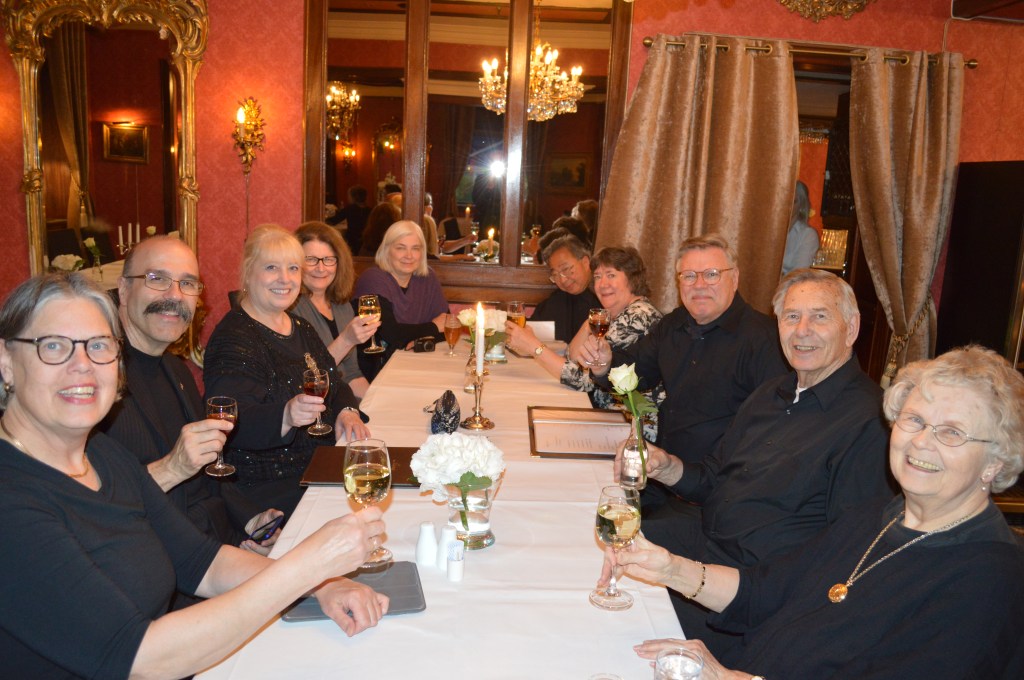
(above) Most of the group that traveled to Norway in 2015 having a meal in Skien. From left around the table: Katha Chamberlain, Michael Jorgensen, Bonnie Jorgensen, Nancy Clasen, Martha Helgerson, Adrian Lo, Carla Clasen, John Chamberlain, Roger Nelson, Barb Nelson.
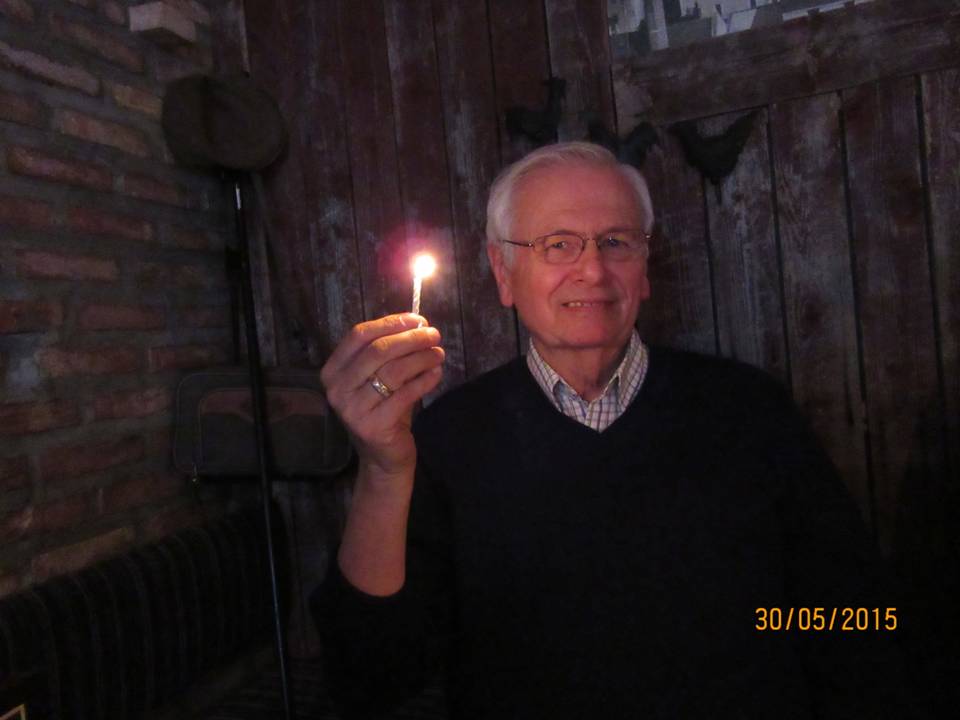
(above) Here’s the other member of our group, Joel Botten, as we celebrate his birthday while in Arendal.
Michael made the arrangements for our concerts in Norway, and he and Bonnie and John made the travel plans, when and how to travel to each of four cities in southern Norway with the help of Molly Smith of Mankato’s Travel and Cruise Center. Lots of phone calls, emails, and visits to the Travel Center ensued over the course of the year. Michael had lots of problems with communicating and receiving responses from the churches, libraries, museums, schools, and information centers he contacted about setting up the concerts, but he persevered and was able to choose The National Library in Oslo (where we donated the manuscripts), the KUBEN Museum in Arendal (Cormontan’s hometown), a cabaret setting in Porsgrunn (the home of Porsgrund porcelain…one of my favorite designers of dishes), and finally at the Vest Norsk Utvandering Museet in Sletta. Each setting and each concert was unique and memorable.
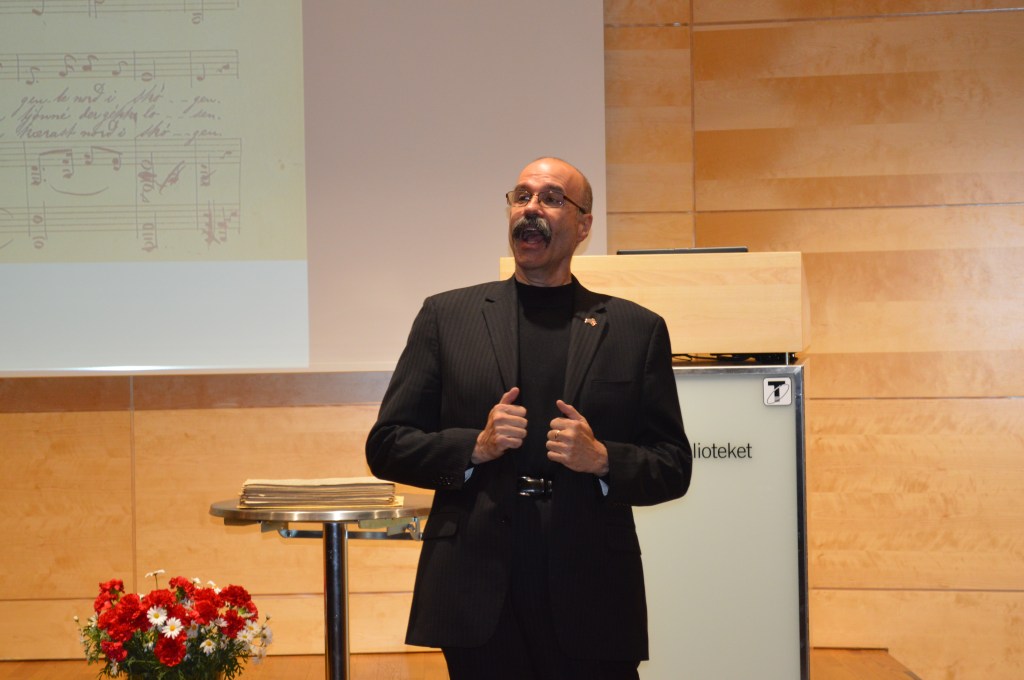
(above) Michael singing at the National Library of Norway (Nasjonalbiblioteket). The soon-to-be donated Cormontan scores are on a table next to him. Michael is performing “Eg veit ei lité gente (I know a little maiden)”–a corner of the manuscript can be seen projected on the screen behind him.
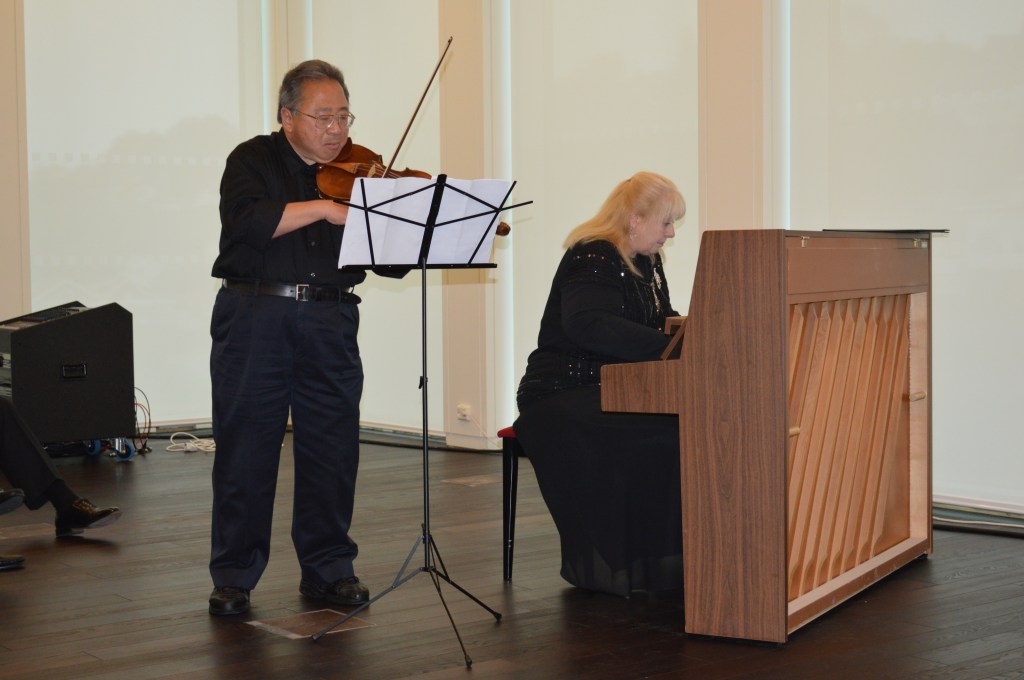
(above) Adiran and Bonnie performing at the KUBEN Museum in Arendal.
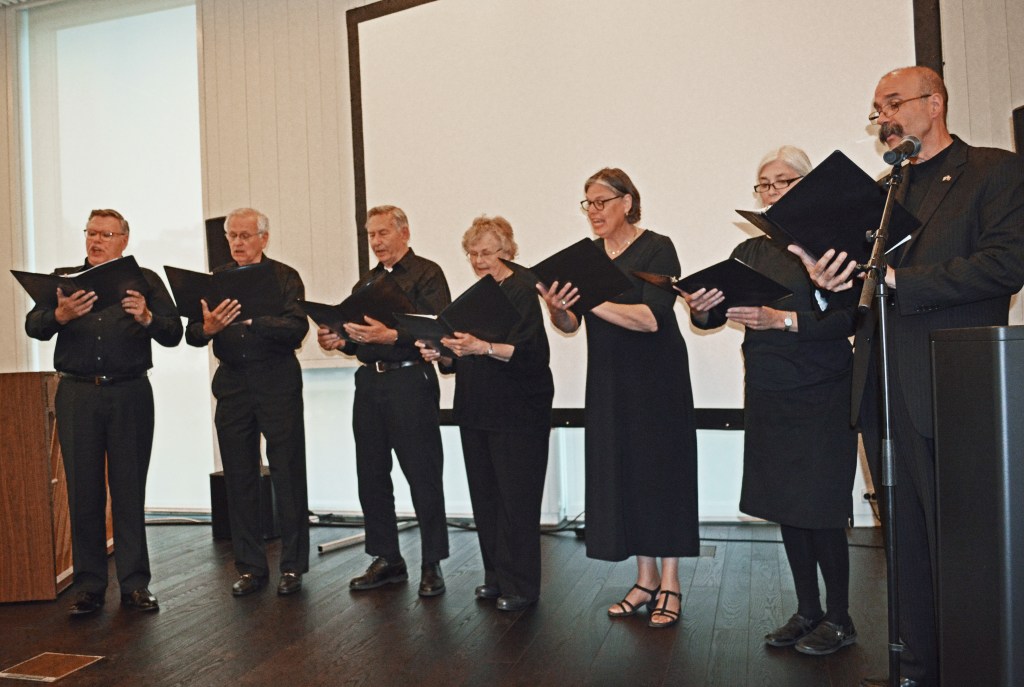
(above) The group singing at the KUBEN Museum: John, Joel, Roger, Barb, Katha, Martha, and Michael.
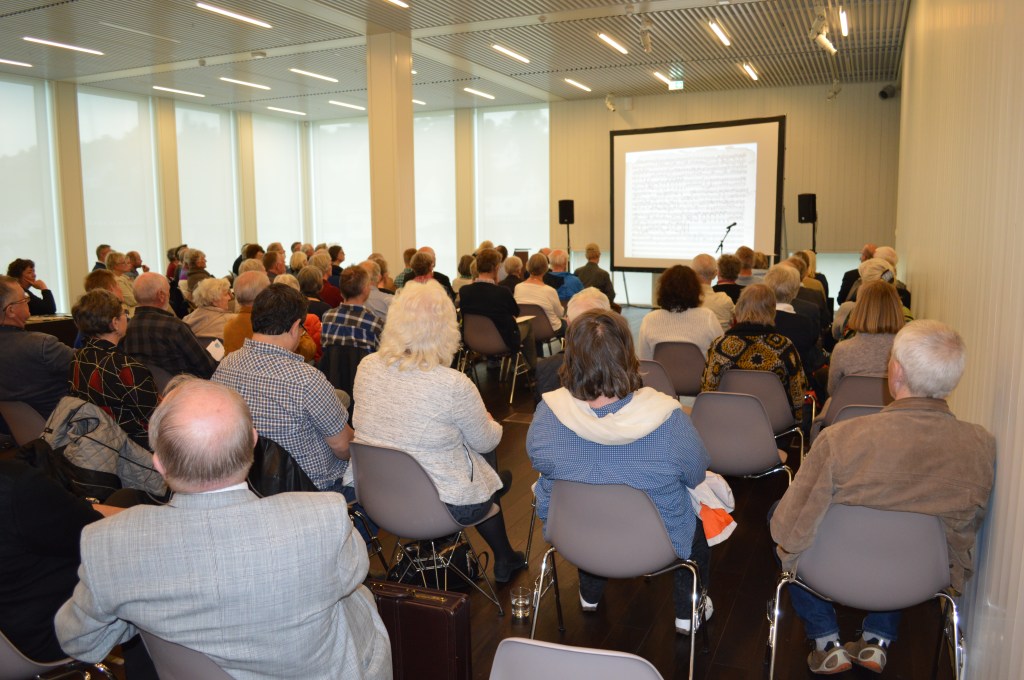
(above) The audience in Arendal.
The final concert, however, was the most moving! We were driven in cars an hour north of Bergen to the tiny hamlet of Sletta where a Norwegian-American immigrant museum has been placed. The buildings on the site were all from America. In fact, they were from Minnesota and North Dakota! We were all astounded! We sang in the sweet little church from North Dakota and were well-received by the audience. The other buildings included a schoolhouse, a jail, a doctor’s office, and a home all built in the 1880’s by immigrants to the Midwest from Norway. They were brought by ship to Norway as a gift from the Norwegian-Americans proud of their family’s roots in Norway and eager to share some of their immigrant family history with their cousins at home in Norway.
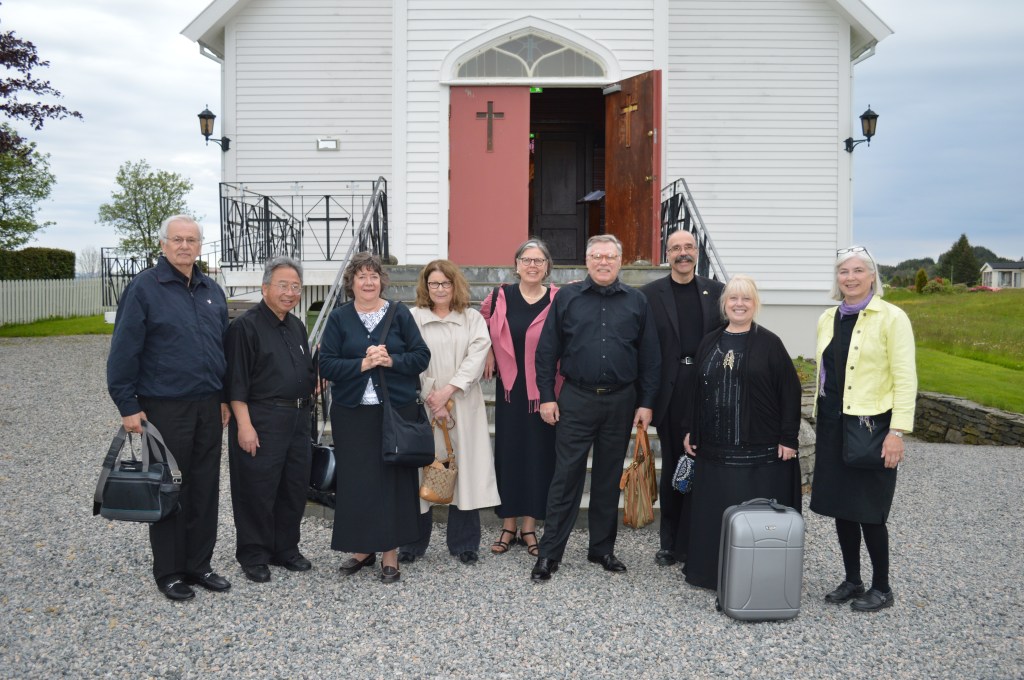
(above) The group posed in front of the North Dakota church at the Vest Norsk Utvandering Museet in Sletta. The suitcase in front of Bonnie carries her ipad (with all the music she plays) as well as scores and CDs to sell.
Each concert we gave came with its own history and its own wonderful serendipitous events making the music we shared even more special for us, the performers, as well as the audiences who applauded us. I am forever indebted to the vision of the Jorgensens and the hard work they have expended the past four years to make Theodora Cormontan come alive again for her country of origin and her country of adoption. I thank God for her witness through music to succeeding generations. As she wrote using original German text from F.W. Krummacher, 1796-1868, and translated by Michael: ‘ High from the Heavens above us, seeing our sorrow and sin, God, knowing all, knows and loves us. Heart, let the love dwell within…Love will not leave us forsaken; Heart, let the love dwell within.’”
The following article (electronically translated) appeared in the May 29, 2015 edition of the Norwegian newspaper Agderposten:
(Front page):
“Arendal’s forgotten composer
She wrote 140 compositions, established a music publishing business, a music store, and a music rental library”
(Pages 18-19):
“Theodora Cormontan, Arendal’s forgotten composer
Theodora Cormontan was a known and beloved figure in Arendal in her time, but today there are probably many who have not heard of her. This Sunday Michael and Bonnie Jorgensen from the USA will visit KUBEN. They will present a musical lecture about Theodora Cormontan’s life and music.
Theodora Cormontan was both a performer and composer. She was born in 1840 in Beitstad in Nord Trøndelag. Her father was the pastor Even Meldal Schjelderup Cormontan (1798- 1893).
In 1847 he was named as the pastor [of the Trinity Church] in Arendal and the family moved there.
Like most women from the upper class, Theodora received private lessons in singing and piano. She also received organ lessons at the Trinity Church from [the town musician] Friederich Wilhelm Thoschlag.
Later she traveled to study music in Copenhagen.
She must have been a very gifted musician, for not many women went abroad to study in music conservatories during this period.
Did she learn how to compose at this time? It was not uncommon for educated women to compose in addition to singing and playing the piano, but these compositions were usually only performed for family members.
Theodora, however, released her compositions through her own music publishing company that she established in the 1870s. In the period ca. 1870 – 1910 she composed around 140 compositions. She also ran a music store and owned an extensive music rental library in Arendal.
Theodora must have been well-liked and very popular among the citizens of Arendal, since at one point they presented her with a gift of 280 kroner, a huge sum at the time.
Crash in Arendal in 1886. However, the economic crash in Arendal in 1886 led to difficult times for the Cormontan family.
In 1887 Theodora, her sister Eivinda, and their father immigrated to America. Theodora’s two brothers and a sister already lived there.
Their difficult economic situation is reflected in a letter from a lawyer named Dedekam to the piano manufacturers Brødrene Hals in Oslo.
Dedekam had been assigned the task of collecting money from the Cormontan sisters for a piano they had rented from Brødrene Hals.
It was obviously an unpleasant job, for he writes:
‘After much work and in truth many annoyances that were made worse since both women were preparing to emigrate, I have personally paid the rest of the piano rental fee of Kr. 370.00, the fee Miss Theodora, a few hours before she boarded the steamer, gave written documentation that she owed you in the amount of kr 256, 50 kr, …’
Theodora had received money from the city of Arendal to pay the piano rental bill, but this money was lost when the Arendal Savings Bank went bankrupt after the crash.
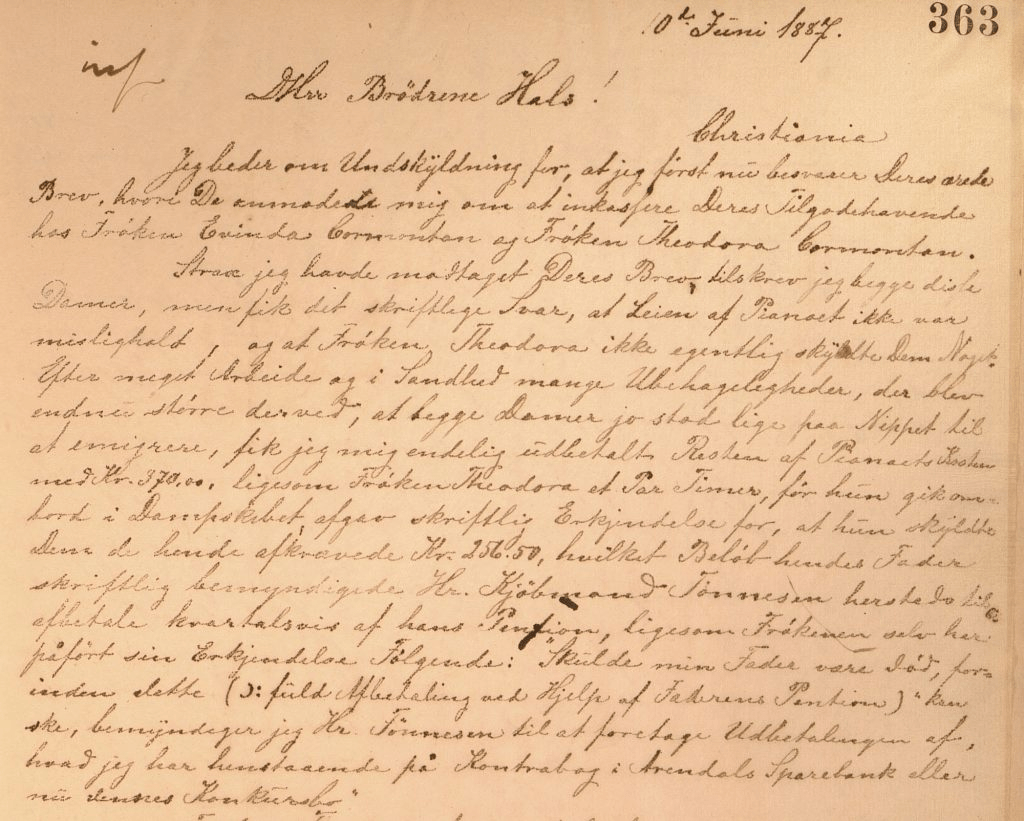
(above) The letter Michael Dedekam sent to Brødrene Hals. The document is archived at the KUBEN museum in Arendal.
Years in America. Theodora, her sister Eivinda, and their father came to the United States to stay with the sisters’ brother Christian in Minnesota. Their younger sister Maria [Marie] also lived there.
According to local newspapers Theodora gave concerts with Maria and her daughter, Louisa. She was also a professional organist, choral conductor, and a voice and piano teacher, all while she continued to compose diligently.
Later the two sisters lived at the Aase Haugen Home in Decorah, Iowa. Theodora died on October 26, 1922, and is buried in the Aase Haugen Cemetery.
Rediscovered compositions. In 2011 over 100 of Theodora’s handwritten compositions for piano and voice/piano were rediscovered in a box that had been stored in an attic in St. Peter, Minnesota. Most of the works had never been published.
A couple named Barb and Roger Nelson found the compositions. They contacted a professor of music at Gustavus Adolphus College in Minnesota, Michael Jorgensen, and his wife, pianist Bonnie Jorgensen.
The Jorgensens were so impressed with Theodora’s music that they decided to find out more about the composer’s life.
This has resulted in a performance that addresses Theodora’s life and music. Michael and Bonnie have traveled around the Midwest with this performance.”
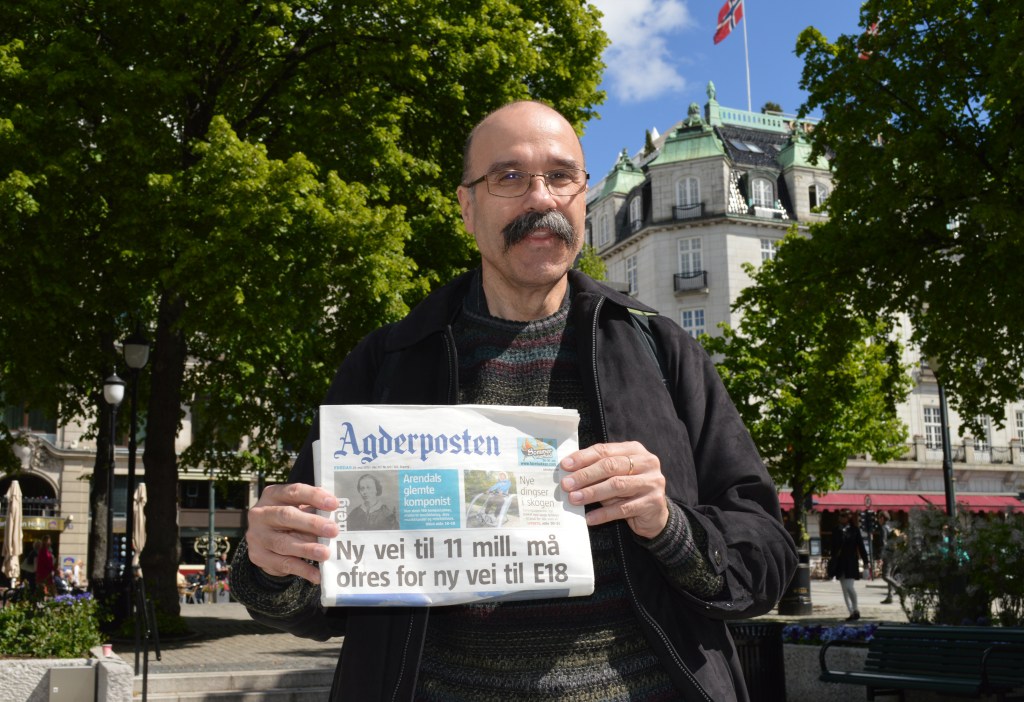
(above) While in Oslo, we find that Theodora Cormontan’s story is noted on the front page of the Agderposten, a newspaper published in Arendal. The Grand Hotel is in the background.
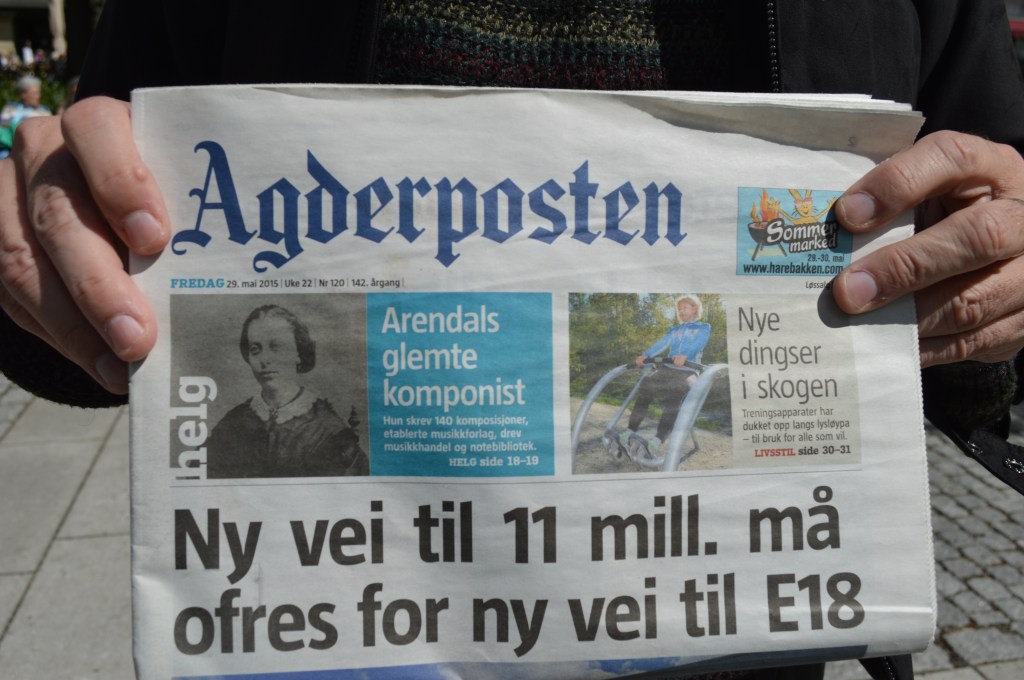
(above) A close-up of the front page of the May 29, 2015 edition of the Agderposten.
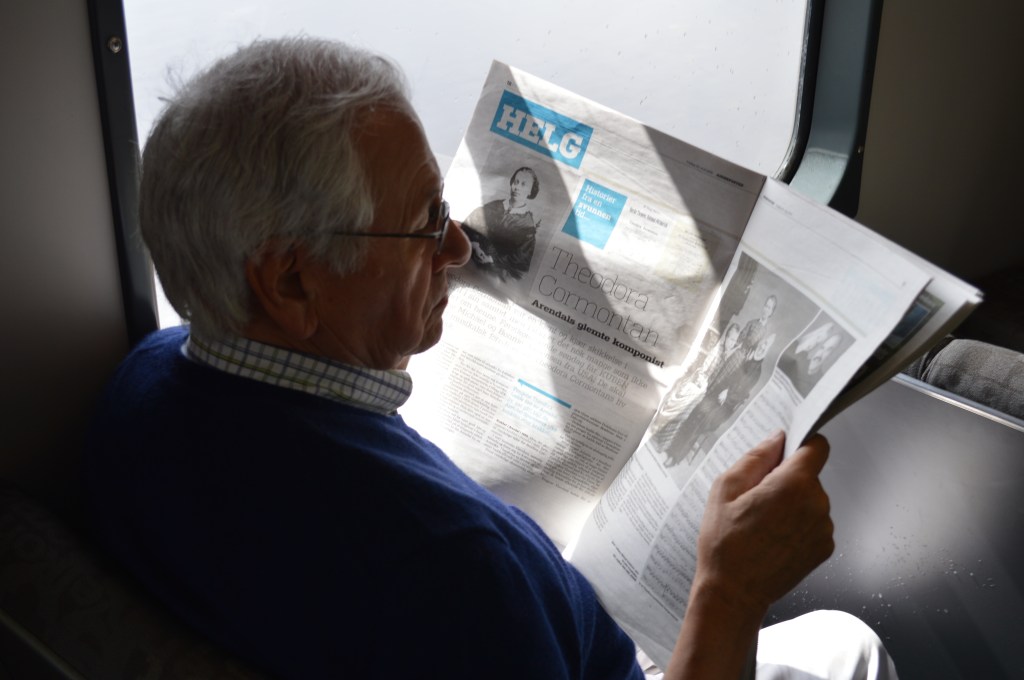
(above) Joel reading the Cormontan article while we ride on the train from Oslo to Arendal.
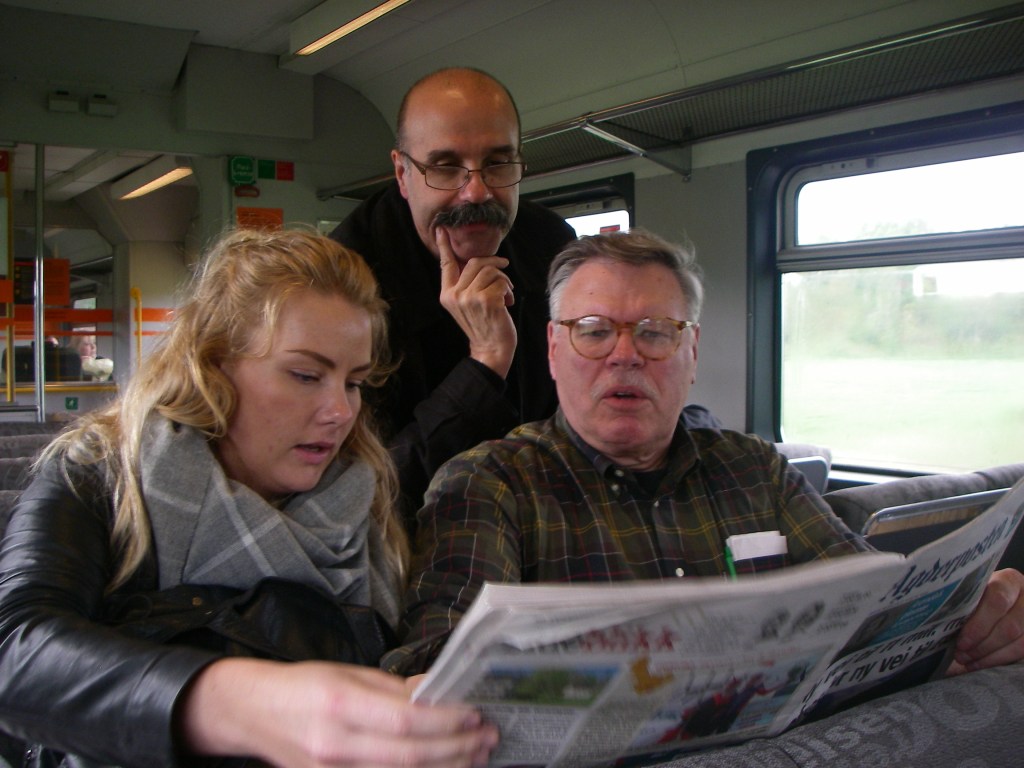
(above) John sharing the newspaper article with an unknown train passenger on the way to Arendal. Michael is looking over John’s shoulder.
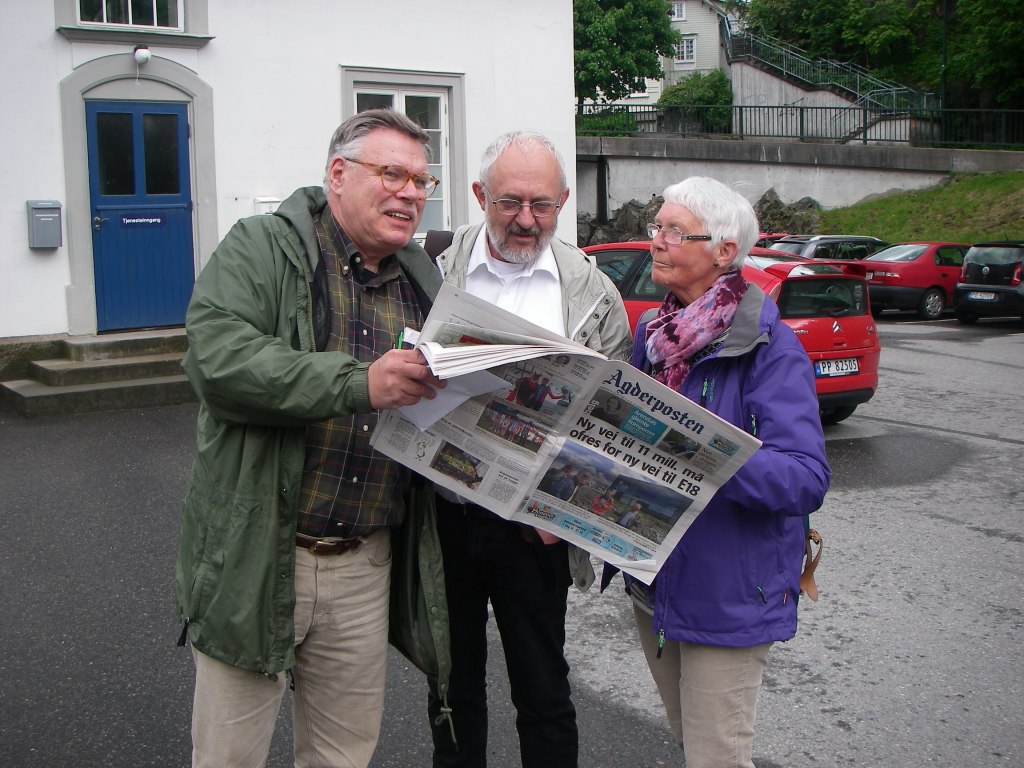
(above) John sharing the newspaper article shortly after arriving in Arendal.
The following article (electronically translated) is from the September 1, 2015 edition of the Fosna-Folket Norwegian newspaper:
“From the old days
Old tone poem brought to light
The other day, a concert was held at the National Library [of Norway], where, among other things, a tone poem by a star was performed. [Article by Terje Dybvik .]
The starting point for this concert was that, four years ago, a large stack of very special compositions appeared.
The Forgotten Composer
The approximately 150 handwritten compositions were composed by Theodora Cormontan and were found in a storefront in Minnesota [actually found in an attic in a home]. Until then, several [virtually all] of these were completely unknown. Cormontan, who was born in 1840 in Beistad in Nord-Trøndelag, immigrated to the USA in 1887.
Pioneer
She was one of the country’s first women to have her classical compositions published, and among the first women to start a music publishing house in Norway. Cormontan, who in recent times has been described as “the forgotten composer,” became known as a pianist, organist, publisher and composer.
O, Had I a Bird’s Wings
Of texts that Theodora Nicoline Meldal Cormontan set to music, one was Johan Selnes’s poem ‘O, havde jeg Fuglen sin Vinge.’ In Michael Jorgensen’s translation, this is called ‘Oh, Had I the Wings of a Sparrow.’ Johan A.N. Selnes (1882-1949) from Refsneshagen, worked for a number of years for Dagsposten as a correspondent in the then Stjorna municipality, as well as a journalist, photographer, and contributor of poems. Some of his pictures have also been in print in the ‘From the old days’ column [of this newspaper].
The Son Specially Invited
At the age of 24, Selnes immigrated to the United States. He was hired by a Norwegian-American magazine in Portland. After 14 years he returned to his old country. The hidden compositions by Theodora Cormontan were handed over to the National Library the other day [Thursday, May 28, 2015]. In that venue a concert was held, where “O, havde jeg Fuglen sin Vinge” was performed. Bjarne A.N. Selnes was with family who were especially invited to this concert.”
The following article is taken from:
STJØRNA
HEIMBYGDA VÅR
Stjørna heimbygdslag Årshefte nr. 11 – 2015
This electronically translated article was written by Bjarne J.M. Selnes, the son of Johan A.N. Selnes. Theodora Cormontan set one of Johan’s poems to music.
Concert at the National Library in Oslo
“In April [2015] I received a telephone call from the music division of the National Library in Oslo. The person who called told me that a box of old music manuscripts had been found in America, written by a Norwegian-American composer. One of the compositions was the setting of a poem written by my father, Johan Selnes. The caller added that a concert including the piece would be held at the National Library and that I would be sent a written invitation, which I subsequently received.
The invitation announced that the concert would take place on Thursday, May 28th, [2015 at 4:00 p.m.] in the large auditorium at the National Library and feature music by the composer and music publisher Theodora Cormontan (1840-1922). Cormontan immigrated to the United States in 1887, where she made her living as an organist and music teacher. The invitation letter noted that, in 2011, about 150 handwritten compositions by Theodora Cormontan were found in a box in the attic of a grocery store in St. Peter, Minnesota [the music was actually preserved in the attic of Barb and Roger Nelson and they offered to give it to Bonnie Jorgensen when they met her in the local grocery store]. Michael Jorgensen, a Professor of Music at Gustavus Adolphus College [in St. Peter], was contacted and [Bonnie and he] received the material [from the Nelsons]. The letter continued to describe that the music was being donated to the National Library and that Professor Jorgensen and a group of musicians were presenting a concert of the rediscovered music there. The concert would include Theodora Cormontan’s setting of Johan Selnes’ poem ‘O, havde jeg Fuglen sin Vinge.’
I was present at the performance, where the audience heard selections from the 150 rediscovered compositions. This included ‘O, havde jeg Fuglen sin Vinge,’ sung by baritone Michael Jorgensen, (who had translated the text to English: ‘Oh, Had I the Wings of a Sparrow’), with piano accompaniment by his wife Bonnie. This was quite an experience. A CD recorded in the U.S. and featuring 24 pieces composed by Cormontan, including ‘O, havde jeg Fuglen sin Vinge’ was sold at the concert. (One of the compositions on the CD can be found in the Norwegian hymn book). Printed scores of some of the pieces that were performed were also available. I got both the CD and the sheet music for the song from Michael and Bonnie. My dad wrote this poem just before he left America in the spring of 1906, and put it into the ‘Norwegian Ungdomsblad’ of March 17, 1906. In America, the poem first appeared in a magazine called ‘Ungdommens Ven,’ which was published in Minneapolis on August 15, 1909. He also included the poem in his book ‘Lyng,’ published in Christiania [now Oslo] in 1912 and also sold in America. Cormontan probably read the poem in ‘Ungdommens Ven’ or in the book ‘Lyng,’ and it must have inspired her, since she set it to music.
Besides the original Cormontan manuscripts that were donated to the National Library, there are digital copies of the compositions at the Aust Agder museum and archive in Arendal [also known as the KUBEN museum]. Theodora Nicoline Meldal [Cormontan] was born in Beitstad (Solberg), Nord-Trøndelag on June 9, 1840. Her parents were the parish priest Even Meldal Schelderup Cormontan and his wife Louisa Augusta, nee Hirsch. The [Norwegian] census of 1885 noted that [Theodora Cormontan] was a music dealer in Arendal. She immigrated to America in 1887 and died February 10th [October 22], 1922 in Decorah, Iowa, where she is buried.”
Taken from an email dating October 7, 2015 that I wrote to an emeritus colleague:
The older I get, the more I do not know. Odd, isn’t it? . . . I find myself wondering about Theodora Cormontan–I think about her a lot. How did she feel in 1920 at the Aase Haugen Nursing Home when she considered the stack of music she had composed over decades that would never be published? She met with gender discrimination, a bad accident that messed up her spine and her mobility, artistic isolation on the prairie where many people could not only not read music, but could not read, and after 1900 grinding poverty. Yet she kept on composing, at least until 1913. Surely she knew that her vision of being a recognized composer would be unrealized. Why did she keep on composing? And what did she think when she gave her music to Molly Helgerson Schmidt, probably the only musician she knew at the end of her life? If I were her, I would have thought that Molly would probably play a few pieces from time to time, but eventually the music would be thrown away and forgotten. Someone would put it in a box and someone would throw it out. Could she have guessed that Mollie’s daughter Carola would look inside the box in 1933 (after her mother died), see the music, and not throw it out? That Barb Schmidt Nelson would look inside the box in 1975 (after Carola died), see the music, and not throw it out? That Bonnie and I would look inside the box in 2011, see the music, and not throw it out? And now in 2015 it is going to be archived at the National Library of Norway. What does any of this mean? I do not know. But I believe there is a Higher Power that knows what Theodora has gone through, what you have gone through, and what I have gone through.
In closing, the following is taken from an email I sent to an emeritus colleague on November 18, 2016:
Theodora Cormontan has taught me a few things. One lesson is that she kept composing through it all. A bank embezzlement robbed her family of all its wealth in Arendal, Norway so she came to America. Six months after arriving, the negligence of a railroad company caused her permanent injury. Gender and immigrant discrimination limited her at every turn. But she kept on writing. Year after year. Trying to get her music published and consistently failing. Declining into poverty. At the end, she handed her stack of manuscripts to her one musician friend and she died, probably wondering what it was all about, but with her faith intact and still a musician until the end. Then her music sat in a couple of attics for 90 years. Now, it has life again. And I don’t know what will become of this renaissance. But if nothing else happens, it has changed my life. Theodora Cormontan’s music changed my life. So, we never know what will become of what we do.
Cormontan After 2019
The following translated news article came from Nettavisen, a Norwegian online newspaper launched in 1996 as the first online-only newspaper in Norway. It appears to currently be one of Norway’s most popular news websites.
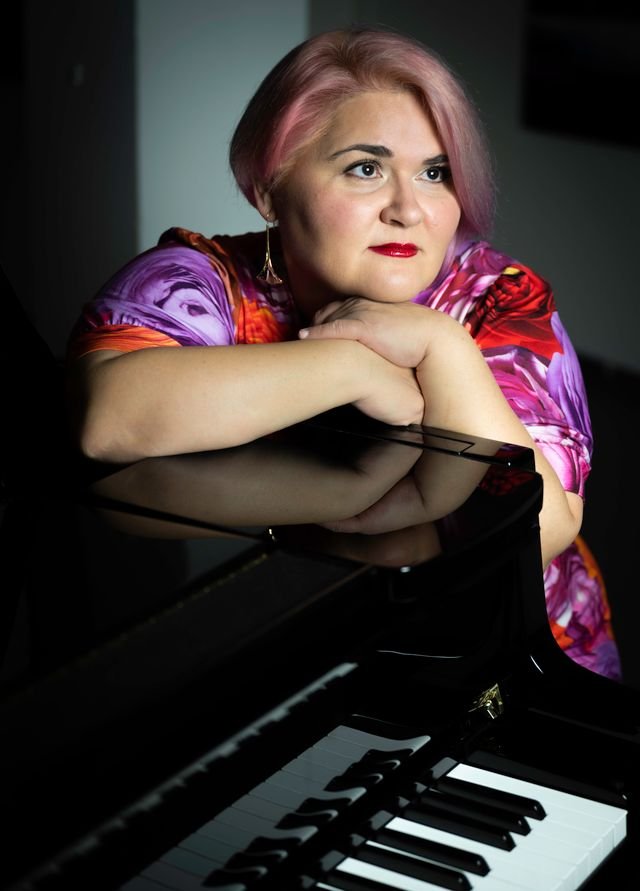
Monica Tomescu-Rohed does a great and important job.
“The Norwegian-Romanian pianist Monica Tomescu-Rohde comes up with something I’ve never heard before. It excites me and my curiosity even more.
By Tor Hammerø
Published: December 28, 2025
The postman’s ways are also inscrutable. For me, it means, for example, that music appears in the mailbox from most corners of the world and with all kinds of expressions. The pianist Monica Tomescu-Rohde with an address in Drammen belongs in that category.
The first business card arrived at home over a year ago, but is among the many that have been left to marinate. When the sequel, with the subtitle “My Home”, arrived with the Christmas mail, it was a great opportunity to bring out last year’s as well.
Women’s Focus
Tomescu-Rohde has had and has a unique project with these releases. She wants to highlight female composers. This means that in addition to meeting a completely unknown instrumentalist for me, I also get to say hello to a completely new composer, namely the Norwegian-American Theodora Cormontan. Haven’t heard of her either? Then I can promise that there are more than just us.
Theodora Nicoline Meldal Cormontan was born in Beitstad in Nord-Trøndelag in 1840 and emigrated to the USA in 1887 where she passed away in 1922. She was a pianist, composer and music publisher. The notes for the music we hear were found in a box in an attic in Minnesota not too long ago and some of it was recorded for the very first time on last year’s album.
Now there are even more first recordings of Cormontan’s music and Tomescu-Rohde shows us with her clear, distinct and sonorous piano playing romantic compositions that create intimate and seductive landscapes.
This has led to very pleasant meetings with both Monica Tomescu-Rohde and Theodora Cormontan.”
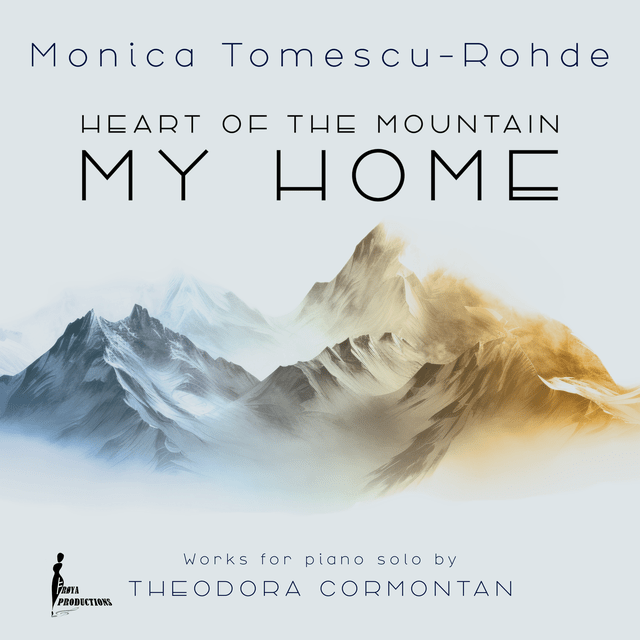
In late October, 2025, Monica Tomescu-Rohde wrote on her Facebook page “What is ‘home, when you weren’t born there? I came to Norway with my language. Theodora Cormontan left Norway with her music. This November, I’m releasing music written in exile: Heart of the Mountain 2: My home. Frist single: November 18. Album release: December 6.” [The Album release happened on December 12, 2025.]
The Fall, 2025 edition of Currents, the newsletter of the Norwegian American Historical Association, includes an article entitled “A Century of Collecting: 10 Objects from the NAHA arhcives tell their stories.” The article states “To celebrate 100 years of collecting and safeguarding these stories, we’ve chosen 10 objects from our collection to highlight.” One of the 10 objects is sheet music by Theodora Cormontan. Bonnie and I donated materials to NAHA, including a few scores that were either incomplete or essentially duplicates of scores we donated to the National Library of Norway.
In June of 2025 Kiddle encyclopedia, a “virtual search engine for kids,” added “Theodora Cormontan facts for kids” to its website.
On May 30, 2025 Monica Tomescu-Rohde wrote on Facebook that WKAF was playing her recording of Cormontan’s “Dream of Life” right at that moment. WKAF is a public classical music station in central Michigan.
The following is a Facebook entry from May, 2025. NTNU stands for Norwegian University of Science and Technology. Olavshallen is a cultural center in central Trondheim that includes two concert halls.
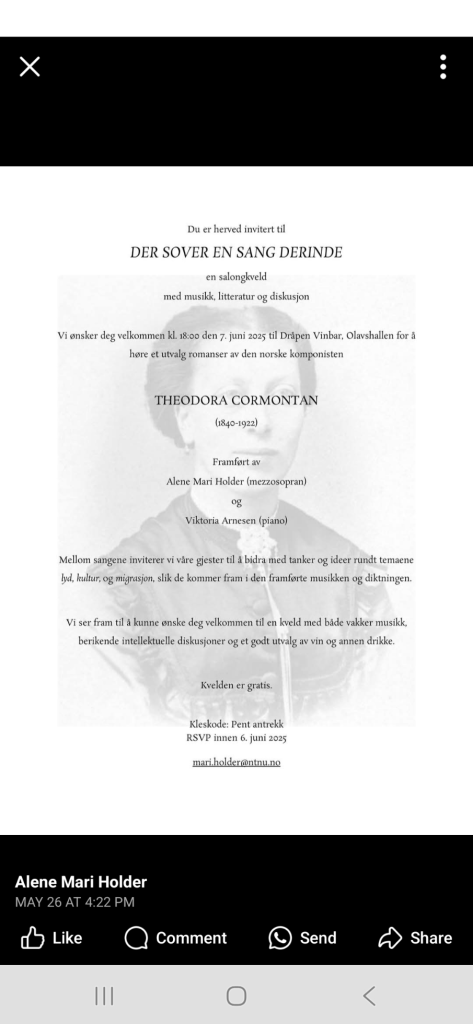
(Translation of above)

You are hereby invited to
A SONG SLEEPS THERE
a lounge evening
with music, literature and discussion.

We welcome you at 6:00 PM on June 7, 2025 to Dråpen Vinbar, Olavshallen to hear a selection of romances by the Norwegian composer
THEODORA CORMONTAN
(1840-1922)
performed by
Alene Mari Holder (mezzo-soprano)
and
Viktoria Arnesen (piano).

Between the songs, we invite our guests to contribute thoughts and ideas around the themes of sound, culture, and migration, as they emerge in the performed music and poetry.

We look forward to welcoming you to an evening of beautiful music, enriching intellectual discussions and a good selection of wine and other drinks.
Free entrance.

Dress code: Smart attire
RSVP by June 6, 2025
mari.holder@ntnu.no
On March 4, 2025, the Austrian radio station Ö1 featured information about Theodora Cormontan and played Monica Tomescu-Rohde’s recording of Cormontan’s “Fantasy Impromptu.” Ö1 (Österreich 1) is one of the four national radio channels operated by Austria’s public broadcaster ORF.
The Norwegian website Bydrammen.no published an article titled “Promoting female composers” on February 28, 2025. After discussing the historic imbalance of male/female composers of classical music, the article continues “Frøya Productions wants to do something about this imbalance, and since its inception in 2023, they have released several albums with music by female composers from different eras. On Friday, March 7, the company will release the album ‘Frøya’s Songs vol. 3,’ which contains songs by Nordic female composers.
The music on the album Frøya’s Songs is from Norway, Sweden and Iceland, from far back in time to the present day. The songs are performed by performers from the respective countries, and the collaboration is marked with launch concerts in connection with International Women’s day on March 8. The album is a collection of melodious, beautiful songs for voice and piano. The song ‘Dulgt Kjærlighet,’ which was released as a single in February, is a previously unknown version of Bjørnson’s famous poem, beautifully set to music by a woman whom few people have heard of.” The woman is Theodora Cormontan.
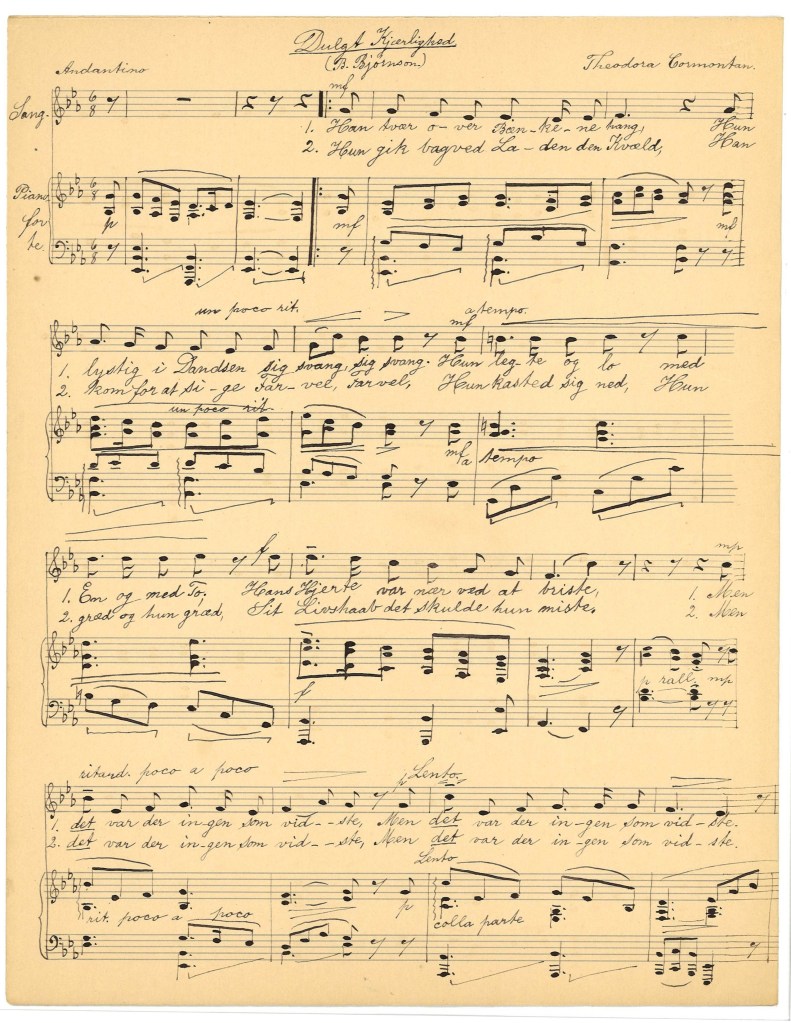
(above) The first page of the manuscript copy of Theodora Cormontan’s “Dulgt Kjærlighet”
The singer and pianist who will perform music by Norwegian composers are Merit Sehl and Monica Tomescu-Rohde. They are also the founders of Frøya Productions. The launch concerts dates and locations are: March 7, Drammen, Norway; March 8, Mariestad, Sweden; and March 9, Reykjavik, Iceland. In addition to Cormontan’s “Dulgt Kjærlighet,” the album also features her song “Bølgen (The Wave).” This song was found in the stack of Cormontan manuscripts we received in 2011. The manuscript noted that it was composed on February 3, 1876. The text is by Vilhelm Bergsøe. Bonnie and I never performed this work, so this is its premiere!
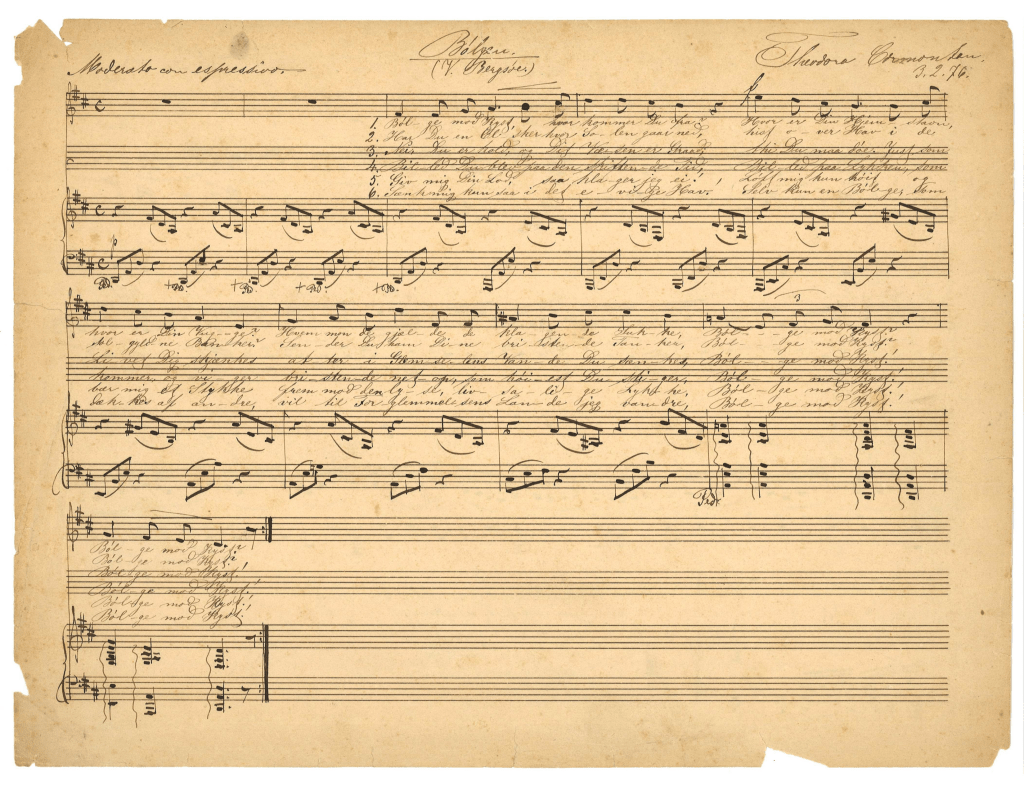
(above) The manuscript copy of Theodora Cormontan’s “Bølgen”
The 2025 bestselling historical novel “Krakk” explores the Arendal, Norway Depression and the fraudulent banker Alex Herlofson. Norwegian author Guri Idsø Viken wove Theodora Cormontan into this novel, describing her as a “strong character” from Arendal.
In 2025: To mark the 200th anniversary of Norwegian immigration to the United States, pianist/composer/researcher Steven Luksan and soprano/Nordic art song expert Laura Loge are presentng concerts, lecture-recitals, and workshops throughout the United States and Norway featuring music by Norwegian immigrant composers. Among the featured immigrant composers in this series (called “Musical Migration”) is Theodora Cormontan. To quote the artists, they are highlighting “The pioneering composer and musician Theodora Cormontan, whose music speaks to her deep faith and perserverance in life. Cormontan lived a life full of tragedy and eventually settled in the Midwest of the US. Her story and her music are featured on our Musical Migration Programs.”
Their series of 2025 performances includes: April–Nordic Chamber Music: Norway in Seattle; June–NORTANA & NAHA Crossings and Connections Conference at St. Olaf College, Northfield, MN; August–Kirsten Flagstad Museum/Utvandrer Museum, Hamar, Norway; September–Concerts and Workshops, Norskedalen, Valley, WI; Concert and Student Workshop, Vesterheim Museum/Luther College, Decorah, IA; Edvard Grieg Society of Minnesota, Mindekirken, Minneapolis, MN; November–International Edvard Grieg Society Convention and Workshop with students at the Grieg Academy, both in Bergen, Norway.
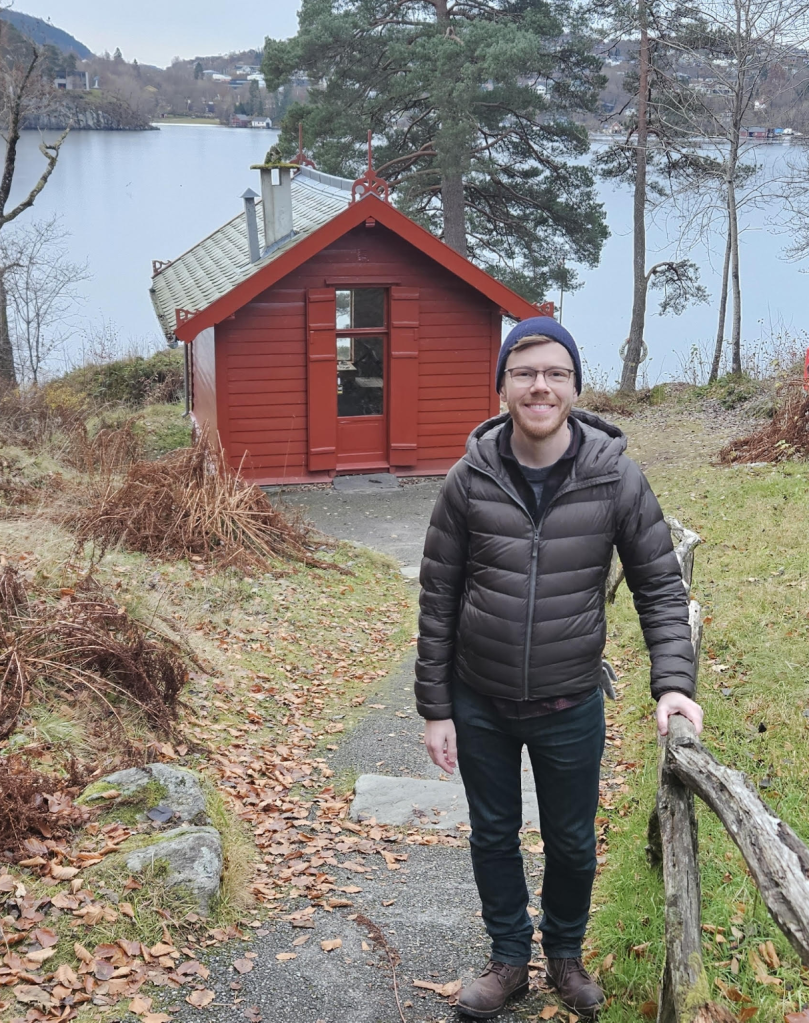
(above) Steven Luksan
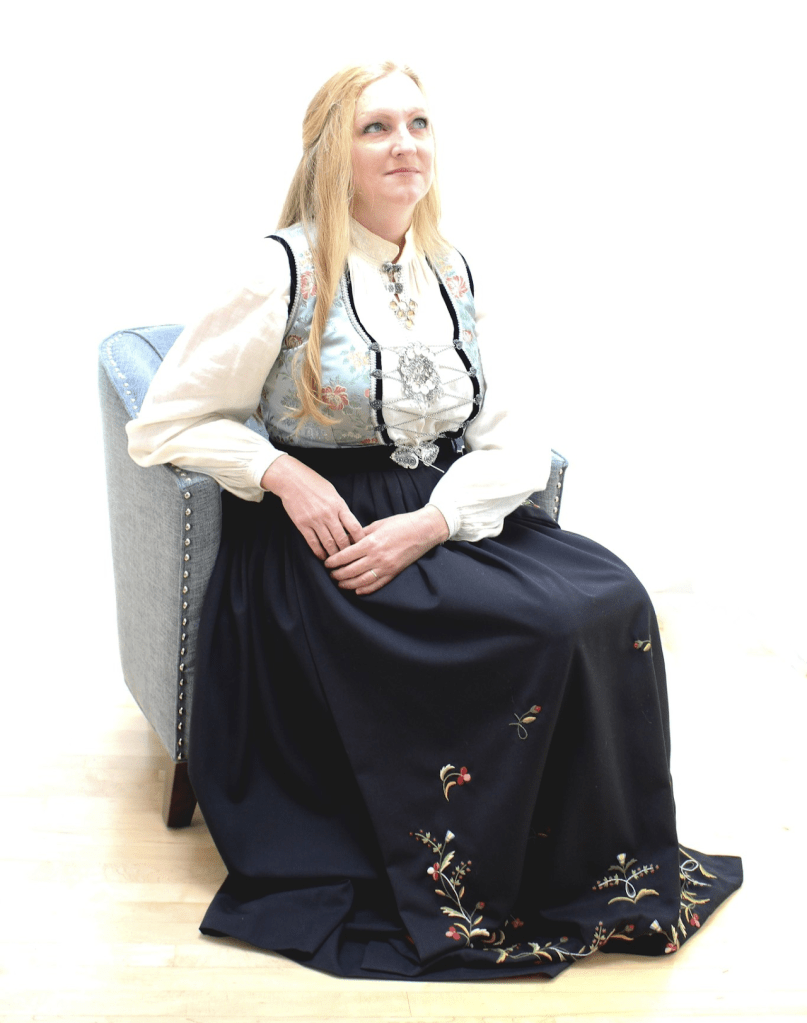
(above) Laura Loge
In mid-December of 2024 the Vesterheim Norwegian-American Museum in Decorah, Iowa published an online version of an article I wrote about Theodora Cormontan. The article first appeared in the Vesterheim Magazine in their Vol. 12, No. 1, 2014 edition. The focus of this issue was weddings, prompting the inclusion of a page about a composition Theodora wrote for a wedding and dedicated to the young bride, who almost certainly was a former student.
The Norwegian radio network NRK2 played Cormontan’s “Fantasia Impromptu” as recorded by Monica Tomescu-Rohde. It looks like this happened in early December, 2024 during their “Best of the Week” program.
The “Heart of the Mountain” recording was reviewed by Olga de Kort in the Dutch music magazine Luister, probably in their December, 2024 issue. The review (translated) includes the following: “The fact that her [Cormontan’s] own piano music has remained as good as unknown is not due to the quality of the compositions, as can be seen by Monica Tomescu-Rohde’s CD Heart of the Mountain. This beautiful and representative selection of Cormontan’s distinctive romantic music is the first recording of the piano works that were first discovered in the United States in 2011. With her clear, elegant and beautifully phrased and intoned playing, the pianist knows how to emphasize the lyrical beauty of the refined and melodic melodies of Cormontan’s atmospheric and colorful character pieces. With this CD, Monica Tomescu-Rohde pays tribute to a strong woman who, despite many obstacles, continued to compose and follow her musical path. [Tomescu-Rohde’s] interpretations radiate the love the pianist has for Theodora Cormontan’s music. Thanks to her inspired performance, the forgotten composer regains the name recognition and artistic significance she deserves.”
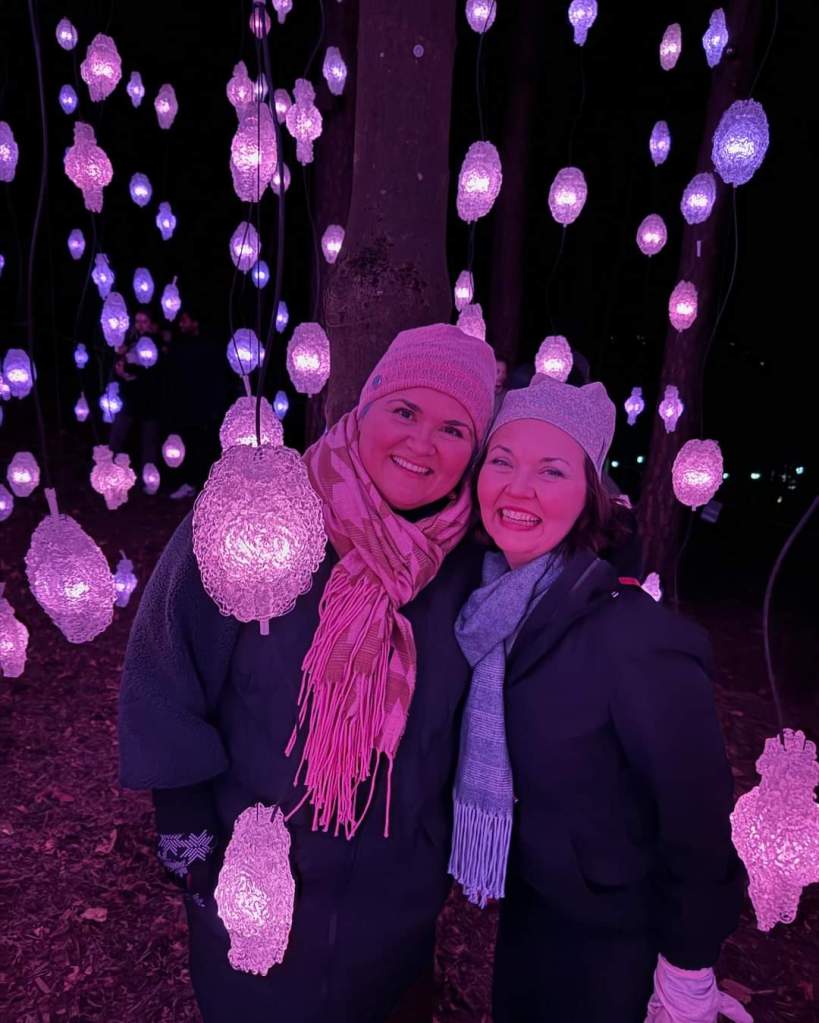
(above) Monica Tomescu-Rohde (left) and Shannon Wettstein Sadler at Ekebergparken in Oslo on November 2, 2024
Klassekampen Music Magazine, page 39, Friday, October 4, 2024. “Forward from Oblivion” by Martin Bjørnersen. An interview with Monica Tomescu-Rohde during her “Norwegian USA” tour regarding Theodora Cormontan.
Ballade.no published an article about Tomescu-Rodhe’s recording of piano music by Theodora Cormontan. Since 2000, Ballade.no has been an editorially independent online publication for and about Norwegian music life. The following is an electronic translation:

-Now they are alive again, says concert pianist Monica Tomescu-Rohde. (Photo: MSG Ous)
“Music by Norwegian composer rescued from attic after over a hundred years
The record label Frøya Productions was founded with one goal in mind: to promote female composers. Last Friday, they released the album Heart of the Mountain – the first recording of the music of Norwegian-American composer and music publisher Theodora Cormontan.
-Ed. [Guro Kleveland]
Published:
September 25, 2024
At 4:04 PM
Throughout history, it has mainly been male composers who have been given the spotlight. Frøya Productions wanted to do something about this imbalance, and since its inception in 2022, they have released two albums of music by female composers.
On Friday, September 20, they released the album Heart of the Mountain, with music for solo piano, signed by pianist Monica Tomescu-Rohde, and preceded it by the single “Fantasia Impromptu” in August.
In recent years, Tomescu-Rohde has focused on disseminating and promoting music written by female composers.
The music on the album Heart of the Mountain was written by Norwegian-American Theodora Cormontan. She was one of the first female owners of a music publishing house – specifically in Arendal – and is an important pioneer among female composers.
What is now being released is a collection of romantic, soothing and at times brilliant piano pieces that create an intimate atmosphere for the listener.
– When I realized that this beautiful music had been lying in a box in an attic for all these years, my fingers itched to let it ring again, explains pianist Monica Tomescu-Rohde
The handwritten sheet music had been lying in a box in an attic in Minnesota since the composer’s death, until a musician couple discovered it, and in 2015 donated all the sheet music to the National Library in Oslo.
In 2022, Monica selected some of the over 140 piano pieces and played them at concerts in connection with the 100th anniversary of Cormontan’s death in 1922.
Some of these pieces have now been recorded for the first time, in digital and physical format, and can be streamed on all platforms.
Tomescu-Rohde is very much looking forward to presenting Heart of the Mountain at concerts in the future, especially since the music until a few years ago only existed as written text on paper.
– Now they are alive again, concludes an enthusiastic and smiling Monica.
According to Frøya Productions, there is a lot of beautiful music in drawers and cabinets that shines when it is taken out. Their goal is to find and put skilled, talented female composers on the agenda.
Until now, the record label has concentrated on Norwegian composers, but next year Frøya Productions will expand the concept to include other Nordic countries, as their fourth album will feature music by Icelandic, Swedish and Norwegian female composers – recorded by musicians from their respective countries.”
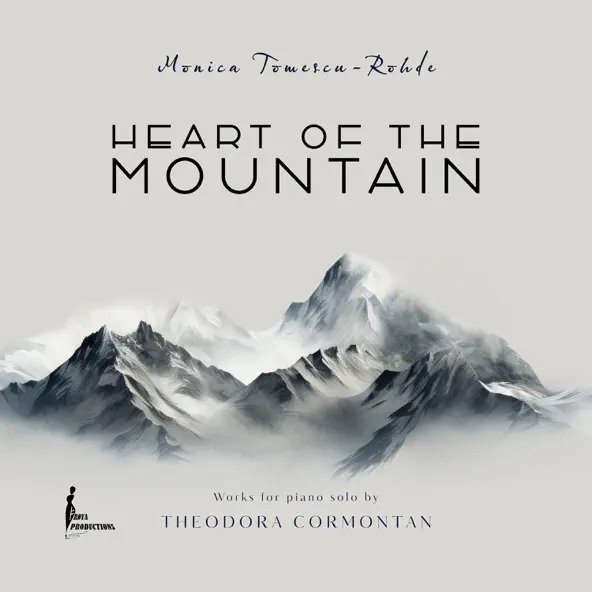
On September 23, 2024, Monica Tomescu-Rohde wrote the following on Facebook: “The biggest THANK YOU in accomplishing Heart of the Mountain goes to these two wonderful people: Bonnie Smith Jorgensen and Michael Jorgensen. Without their research, commitment, passion and generosity Theodora’s music would have remained hidden in an almost 100 years old cardboard box. Michael generously shared with me all his research and the music scores that Bonnie transcribed them in Finale, next to many manuscripts. As a token of gratitude and appreciation for all their work, I’ve dedicated Heart of the Mountain to them. Thank you!” I replied on Facebook: “We are so pleased that you have released a recording of beautifully played piano music by Theodora Cormontan! We appreciate that you are sharing your talent and this music with so many people and for the lovely dedication.”
On September 3, 2024 Norwegian pianist Monica Tomescu-Rohde sent me emails that included the information below. In her emails she is referencing a tour where she would perform piano music by Theodora Cormontan and introduce her recording of Cormontan piano works entitled “Heart of the Mountain,” (a translation into English of Cormontan’s last name):
“My tour is in collaboration with Shannon Wettstein Sadler, a wonderful pianist whom I got to know well under our trips to several EPTA (European Piano Teachers Association) conferences. Our tour is called “Connecting traditions” and includes my introduction to Theodora, with a lot of help from your research (you are always credited! You’ve done an AMAZING job in gathering so much information about her!).
Theodoras presentation is about half of the program, the rest consists in works for 4 hands by Grieg, Amy Beach and Florence B. Price. 🙂
[Here are the concerts] in Norway where I’m going to perform works by Theodora:
12th of September, under a concert named “She plays like a girl” at the Galleri Athene in Drammen
20th is the [“Heart of the Mountain” recording] release with a concert at Operalaaven in Hallingdal
21st in Drammen at a lunch concert in Haandverkeren
25th of October under “Connecting traditions” tour at Harmonien in Drammen
2nd of November at the Norwegian EPTA [European Piano Teachers Association] conference, Oslo.
The concerts in the States are following:
Sunday, September 29 3:00 PM performance at Farmington Lutheran Church in Farmington, MN
Tuesday, October 1, evening performance University of Wisconsin-Eau Claire
Wednesday, October 2 performance at Augsburg University, Minneapolis
Friday, October 4, noon performance at St. Cloud State University
Saturday, October 5 10 AM to noon Masterclass at Schmitt Music and 2 PM performance
Sunday, October 6 2 PM performance at University of Minnesota-Morris”
March 17, 2024: Soprano Laura Loge and pianist Angela Draghicescu performed songs from their newest collaboration – an album of previously-unrecorded songs by Norwegian women entitled A Bird Cried Out (Der skreg en fugl). The duo preformed previously unrecorded songs by Agathe Backer-Grøndahl, Anne Marie Ørbeck, Mon Schjelderup, Pauline Hall, Theodora Cormontan, Anna Lindeman, Hanna Marie Hansen, Magde Bugge, Inger Bang Lund, Hilda Neupert, and Inga Lærum Liebich. The event was part of the Nordic Chamber Music concert series and took place at St. Stephen’s Episcopal Church in Seattle, Washington. On April 19 Laura Loge, President of the Northwest Edvard Grieg Society, wrote an article about the featured composers for the Norwegian American.
February 25, 2024: Bonnie and Michael Jorgensen led the Sunday morning nondenomiational worship service at Lake Region Village in Haines City, Florida. The couple presented “Theodora Cormontan: the Life of a Christian Musician.”
June 23, 2023: Soprano Ingrid Vetlesen and pianist Bendik Båstrand performed songs by three female composers (Caroline Schytte-Jensen, Theodora Cormontan and Agathe Backer Grøndahl) at the opening of the summer exhibition at the Lillesand History Museum. Gina Lund, the administrator of Agder county, gave the opening address to around 100 visitors.
As part of the 300 year celebration of the founding of the city of Arendal, the theatre company Arendal Scene presented a historical retrospective at the Arendal Kulturhus on May 11-13, 2023. The May 13, 2023 issue of the Agderposten reported that this included how the women Sophie Dedekam, Theodora Cormontan and Elevine Heede “left at lasting mark on the history of music.” Pianist Rasmus Solem played music by Cormontan as part of the evening’s presentation.
Spring, 2023: Solveig Mebust wrote a dissertation for her PhD at the University of Minnesota titled “The Craft of Music: Women’s Music-Making in Nineteenth Century Norway.” The fourth chapter of the dissertation focuses on Theodora Cormontan.
11/27/2022: Trio Arcorno performed a concert with music by Theodora Cormontan, Ethel Smyth, and Fanny Mendelsohn. Players: Hilde Chapman (violin), Monica Tomescu-Rohde (piano), and Marianne Finseth (horn). Performed at the Holmsbu Church in Holmsbu, Norway.
Michael and Bonnie performed “Høgt frå den himmelske klåre” (“Heart, Let the Love Dwell Within”) at a Sunday service at Lake Region Village in Haines City, FL on October 16, 2022. Richard Horner led the service. The piece was performed 10 days before the 100th anniversary of Theodora’s passing.
The October 6, 2022 edition of the Agderposten, published in Arendal, Norway, carried an article about the Bygelaget Agderlag in the United States. It referenced information from the Agderlag newsletter article written by Sandra Bestland about Theodora Cormontan.
Monica Tomescu-Rohde reported in a September 30, 2022 email that she had received funding from the Norwegian Art Council to record Theodora Cormontan’s piano manuscripts.
Kvinnelige spor I musikkhistorien (Women’s traces in music history) concert series. Concert featuring the music of Theodora Cormontan. Gro Bente Kjellevod, voice, and Monica Tomescu-Rohde, piano. September 17, 2022 at 2 pm at the Galleri Athene in Drammen, Norway.
Monica Tomescu-Rohde, piano, Lecture-recital entitled “Theodora Cormontan-100 years of silence” in Portugal on September 3, 2022 as part of the European Piano Teachers Association conference. In an email after the performance Tomescu-Rohde wrote “I just wanted you to know that the presentation was a success! Some of the people in the audience were brought to tears by her story and her music!”
Ariel Wilberg sang “O, havde jeg Fuglen sin Vinge” (in Norwegian and English) at the 7/17/2022 Minneapolis Mindekirken bilingual Worship Service. https://www.youtube.com/watch?v=SPizoj9vttc&t=186s&ab_channel=Mindekirken-MinneapolisMN
July, 2022: Southbank Centre, the largest arts center in the UK, developed a playlist for the Women’s Euro 2022 football/soccer tournament, with one classical composition representing each of the 16 competing nations. For Norway, the representative piece was Cormontan’s “Aftendæmring,” recorded by Christian Steffensen.
Seattle Nordic Museum. Sunday, May 22, 2022. Duo recital with violinist Espen Lilleslåtten and violist Elias Goldstein. Works by Grieg, Cormontan, Sinding, and the world premiere of Norwegian Rhapsody by Steven Luksan.
March, 2022: Sarah Waters, a professor at Belhaven University in Jackson, MS, submitted a paper for a DMA program at New Orleans Baptist Theological Seminary entitled “Navigating a Controversial Modern Songbook: Theodora Cormontan’s Contributions to Frydetoner.”
January, 2022: The Winter, 2022 edition of the Agderlag newsletter contains a wonderful article by Sandra Bestland on Theodora Cormontan.
October 22-23, 2021. The Edvard Grieg Society of Minnesota and the Norway House in Minneapolis streamed two days of their second annual Song Festival featuring women composers of Nordic countries. The concerts featured compositions by Sofie Dedekam, Erika Bodom, Emma Dahl, Signe Lund, Theodora Cormontan, Anna Lindeman, Anne-Marie Ørbeck, Agathe Backer-Grøndahl, Jórunn Viðar, Mist Þorkelsdóttir, and Anniken Paulsen. The recitals were uploaded onto YouTube.
May 9, 2021. Theodora Cormontan’s “Allegro in G minor” and “Valse Brillante” were performed at Advent Lutheran Church in Madison, Wisconsin
https://www.youtube.com/watch?v=1yokh3CwJEc
May 2, 2021. Mindekirken (The Norwegian Lutheran Memorial Church) in Minneapolis. Prelude: “One Day in the Spring;” special music: “Ungbirken” (two verses of Norwegian and two in English!)
https://www.mindekirken.org/index.php/worship/services/78-mindekirken-service-may-2-2021
“Valse a l’etude” appears to have been played as a postlude at Mindekirken on Sept. 19, 2020.
(Below): Electronic translation of a portion of page 15 of the March 8, 2021 edition of the Agderposten
“But did the roads get named after them?
March 8 may be a good day to correct some of the history books. The women’s efforts are devoted little space. This is a small contribution to show how unfair it is.
[Brief biographies of eleven women from Arendal are shared in an effort to advocate for more attention to these significant historical figures. The article starts with Theodora Cormontan.]
Theodora Cormontan from Arendal was the first Norwegian woman to have her music published by a [Norwegian?] publishing house. Ellen Jacobsdatter Hafsøen from Arendal was the most powerful ship owner of the time. At the end of the 18th century, seven of the twelve largest trading houses in Arendal were run by women. Theodora Nicoline Meldal Cormontan (1840-1922) was a Norwegian-American pianist, music publisher and composer. Cormontan studied music in Copenhagen and during her studies she set several of H.C. Andersen’s poems.
When her mother died in 1865, she moved from Denmark back to Arendal to take care of the family. However, she did not give up her music career and traveled around the country playing concerts.
In 1879, Theodora Cormontan started her own music publishing house in Arendal. Her publishing house had branches in several Norwegian cities and in Copenhagen. Over the next seven years, she published 18 compositions from Norwegian and international composers, all women.
The Arendal crash in the late 1880s became the nail in the coffin for Theodora Cormontan’s music publishing, and when the family’s home burned down, she immigrated with her father and sister to Minnesota. Here she continued her music career for a few years, but a train accident, which made her partially paralyzed, made it impossible for her to hold concerts.
She still continued to compose until she died, aged 82. Although Theodora Cormontan was quite well known in Norway, she never gained a foothold in the same way as several of her contemporary male colleagues such as Ole Bull, Rikard Nordraak and Edvard Grieg.
In 2011, ninety years after Cormontan’s death, the American couple Bonnie and Michael Jorgensen found a box of 150 handwritten compositions. Cormontan’s latest work had come to fruition. The couple understood what a gift they had received, and have since 2011 worked to manage the inheritance. They tour the world with her music and make sure to keep her legacy alive.
Theodora Cormontan never married. It may, of course, be a coincidence, yet it is more plausible to believe that marriage and self-realization were an impossible combination of her time.”
December 13, 2020. A winter concert sponsored by the Northwest Edvard Grieg Society. At about 36’ on the YouTube recording you can hear a performance of “Dyb Sne” with soprano, viola, and piano. They perform Cormontan’s original version, using a viola instead of an alto singer.
http://nwegriegsociety.org/jul/
December, 2020. An 8×10 foot “feminist Christmas calendar” (or Advent calendar) was built in the Kristiansand, Norway Town Hall. The calendar fearutred the portraits and information of 24 “remarkable” Norwegian women. Theodora Cormontan was day 20. As the website blogg.no explained (translated): “In the days leading up to Christmas, the feminist Christmas calendar will ensure that these pioneers are not forgotten. Behind every slot (door) hides a woman who has left a clear and important mark on Norwegian history, but who is still in danger of being forgotten.” Caroline Mathilde Schytte Jensen and Kirsten Flagstad were also featured on the calendar.
April 24, 2020. The Daffodil Perspective, championing women, featured several Cormontan pieces as well as biographical information. Alas, you have to subscribe to hear it.
https://www.mixcloud.com/TheDaffodilPerspective/the-daffodil-perspective-24th-april-2020/
March 5, 2020. Classics a Day featured Bonnie’s recording of “Allegro in G minor.”
http://the-unmutual.blogspot.com/2020/03/
Theodora Cormontan – A Retrospective
Young women could not attend high school in Norway until the 1880’s, and Norwegian public colleges were not open to them until 1890. Theodora Cormontan was born in 1840. Only women of the cultured upper classes (the “people of condition”—de kondisjonerte) could continue their education by studying abroad. With the support of her parents, Theodora studied music in Paris, France; Germany; and Copenhagen, Denmark.
It is my theory that she studied in Paris in the late 1850’s with the famous Norwegian pianist Thomas Tellefsen. I also believe she studied voice with Severine Bye, whom Tellefsen married in 1857.
Additionally, it is my theory that she studied music in Berlin before 1863, perhaps in the school run by Theodor Kullak. Both Erika Røring Møinichen Lie Nissen (a Norwegian pianist with whom Cormontan performed) and Agatha Backer Grøndahl ( I think Theodora knew her) studied with Kullak in Berlin. Additionally, Theodora’s friend Felicita Thoschlag (with whom I believe Theodora studied in Paris) aslo studied in Berlin. Cormontan may have accompanied Felicita there as well.
It is documented that Cormontan studied in Copenhagen from 1863-1865, likely with Dr. Carl Helsted.
The Drammen Blad newspaper reported in November of 1866 that Cormontan, described as “a very advanced singer, endowed with a beautiful and sonorous voice,” had been engaged by the opera company at the Christiania Theater. No record has been found indicating she performed with the company.
Cormontan returned to Copenhagen in 1867-1868 to perform and teach singing, as well as to study voice with renowned Danish voice teacher Dr. Carl Helsted, with whom Edvard Grieg’s future wife Nina Hagerup also studied.
With her father’s abiding support, Theodora concertized throughout Norway as a soprano in 1869. The cities where she performed include Arendal, Grimstad, Kristiansand, Stavanger, Bergen, Trondheim, and Larvik.
Cormontan suffered from a serious illness that apparently extended from 1870 to the latter part of 1871. There is no record of her performing any of her compositions in public until August of 1872. There is also no record that she taught music theory before 1872. I believe that she studied music theory and music composition while she recovered in Arendal. I think her childhood music teacher/town musician Friedrich Thoschlag may well have devoted time to tutoring her in these areas, helping her to become a professional composer.
From 1872-1887 Theodora made her presence felt in Arendal’s music scene. She held regular concerts, often with the assistance of the city choir or the Arendal Hornmusikk Association. She was teaching music lessons at least by 1871. She owned and ran a music rental library that held 8000-9000 works by 1877, and she also owned and operated a music store where she sold music, pianos, and other musical instruments and materials.
Theodora became one of the first women in Norway to have her music published when Warmuth (the largest music publisher in Scandinavia at that time) published her 4 Sange op. 2 and her piano piece Blandt Fjeldene, op. 3, in 1875.
In 1879 Theodora became one of the very first women in Norway to own and run a music publishing company. She published 18 works by three women composers: Sophie Dedakem, Caroline Schytte Jensen, and Theodora herself. Cormontan’s sheet music publications were distributed throughout Norway, Sweden, Denmark, Germany, and Russia. I believe one of the primary reasons she opened her own music publishing company was her desire to write in larger forms so that her work would be considered alongside men composers of her era. Warmuth published 18 of her songs but only one of her piano compositions, Blandt Fjeldene. In 1885 alone she published six of her own piano works.
In February of 1886 a concert was given in Arendal that featured Theodora Cormontan’s “Honnør-Marsch” as well as works by Mendelssohn, Mozart, and other noted composers. This programming reflects a high degree of respect and support for Theodora as a composer, at least in her hometown of Arendal.
In March of 1886 a concert in Arendal featured a one-act Singspiel composed by Theodora Cormontan, a larger form than any of the scores we were given in St. Peter, Minnesota. Here we find that she composed the music to what is essentially a one-act opera. Although the article quoted below doesn’t say, we can assume that the work was accompanied by the orchestra that also performed on the program. Knowing about this composition adds credence to the theory that Cormontan desired to compose in larger forms; to compete and be considered with the same respect as men composers.
The following is from the 3/17/1886 edition of the Arendal Agderposten: “Lark.” Singspiel in 1 act by M. V. Brun [Brun wrote the play in 1868]. The music is composed by Theodora Cormontan. The characters include: Maria, a florist; her brother Andreas, a gardener; Lord Olboy, Box, [and other characters]. The action takes place in Maria’s Flower Shop. The Turner Music Association, assisted by the Dilettant Association, present an Evening Entertainment at 8 p.m. on Friday, March 19, 1886 in the Theater.” [The program included music performed by the Turners band and orchestra. “Lark” was the featured work of the evening.]
The Arendal economic crash of October, 1886 (Arendalskrakket) was triggered by bank manager and ship owner Axel Nicolai Herlofson, owner of Arendal Privatbank. He embezzled money belonging to the bank’s customers to cover deficits in his own business. For many years he perpetrated a fraud similar to a Ponzi scheme. Both the bank where Reverend Cormontan kept his money and the bank where Theodora kept her money went bankrupt. The Cormontan residence also burned down in February of that year. As a result of these disasters, Rev. Cormontan (age 89) and his daughters Eivinda (age 48) and Theodora (age 46) boarded the steamship Hekla at Kristiansand in May of 1887 and sailed for the United States of America. There they joined other members of the family who had already immigrated to Minnesota.
In her first few months living in Sacred Heart, Minnesota (with her younger sister Marie, Marie’s husband Edward, and their six children) Theodora was singing and playing the piano in concerts as well as offering music lessons to many students. On December 3, 1887, she traveled by train to nearby Granite Falls, MN to teach for the first time in that town. After a day of work she was scheduled to take the train home. Since it was likely her first time taking this train, Theodora accidentally began boarding the “Smoker,” the car for men. The brakeman notified her that she was getting on the wrong car and beckoned for her to board the next car, sometimes called the first-class car but usually referred to in the court documents as the “ladies car.” The baggage man and the express man probably saw her trying to board the first time and failed to see her being told to enter a different car, since the conductor testified in a deposition that they told him it was all clear to proceed. As Theodora got on the steps, with the brakeman at the top of the steps into the car, the train began to move. Theodora lost her balance. The brakeman, probably in an effort to make sure she did not fall under the wheels of the train, but unable to fight gravity and pull her toward him, grabbed her by the arm and waist and tossed her away from the train back on the depot. Thrown in such a manner, and wearing an ankle-length skirt, it is virtually certain that she ended up falling awkwardly on her back as the train continued down the tracks.
Theodora Cormontan subsequently sued the railroad for her injuries. The Complaint filed by the plaintiff for her October, 1889 civil trial testified that Theodora had suffered injuries to her spine, her spinal cord, and to nerves emanating from the spinal cord. After a jury of 12 men was selected, an interpreter for Theodora was sworn in. Theodora was likely somewhat fluent in English, but probably needed help to understand completely what was happening. Theodora was the only witness that first day, and her sister Eivinda (also with the aid of an interpreter) was the only witness the second day. C.G.V. Cormontan (her brother) also testified for the plaintiff, as did Louisa Lyders (Marie’s daughter), Dr. Jones (the specialist from Minneapolis who examined Theodora in February, 1888), and Edward and Marie Lyders (via deposition, since Sacred Heart is over 100 miles from St. Paul). The defense took less than a day to present its case. On Saturday, October 5, Eivinda was recalled to the stand for the plaintiff, as was Theodora on her own behalf. The attorneys summed up the case for their respective clients, and the jury was charged with determining a verdict. It apparently did not take the jury long to deliberate, since they reached a decision that same day. Since the next day was a Sunday, Theodora had to wait until Monday morning, October 7, 1889 to learn that the jury found in her favor and awarded her $5000 in damages. It appears that for the rest of her life Theodora Cormontan endured some level of chronic pain and experienced significant mobility issues (at best, walking unaided with difficulty), and that with advancing age her condition deteriorated so that by the end of her life she was confined to a wheelchair.
In early 1891 Theodora and her family hosted a women’s association/Ladies Aid meeting (Kvindeforeningen). By 1892 she was playing a reed pump organ in church services, directing choirs, and teaching music lessons. It appears she did not sing in public after her accident.
Ungdommens Ven (The Youth’s Friend) is a religious magazine for young people published from 1890-1916 by the K.C. Holter Publishing Company, Bernt B. Haugan and Nils Nielsen Rønning, editors. Frydetoner (Joyful Songs) is a collection of choral music that first appeared in Ungdommens Ven in the early 1890’s. Six compositions by Theodora Cormontan appeared in Ungdommens Ven between 1891-1894 and are included in the first two books (published in one volume) of the Frydetoner, first published in the mid-1890’s.
The following piano pieces by Theodora Cormontan were published in the United States:
Waltz Gracious, Op 53, Johnson and Lundquist, Minneapolis, (n.d.);
Polka Fantasia over Swedish Song, Op 54, Thompson Music Co. Chicago, 1895;
L’Elegance [also published in Norway in 1885 as La Eleganza, Menuet] Op 10, Hatch Music Co., Philadelphia, 1900;
A Jubilee Rhineländer, Op 58, Pioneer Publishing Co., Chicago, 1905; and
Danse de la Duchesse, Op 59, publisher unknown, 1906 .
Theodora Cormontan saw eighteen songs, two hymns, and eight piano pieces that she composed published in Norway between 1875-1885. The hymns and two of the piano pieces were also published in the United States, along with several other hymns and piano works. When added to the approximately 125 unpublished manuscripts found in St. Peter, Minnesota in 2011 and an unknown number of lost works, a picture emerges of an industrious artist whose productive period spans from about 1870 to 1915.
Cormontan’s sophisticated writing reflects a thorough knowledge of the works of other composers. Her music rental library provided easy access to the great music of past masters, including the complete works of Mozart and Beethoven. She was also clearly influenced by contemporary Norwegian composers: several of Edvard Grieg’s works may be found in her personal library; she wrote a piano piece based on a composition by Norwegian composer Halfdan Kjerulf; she dedicated one of her works to Norway’s most renowned woman composer, Agathe Backer-Grøndahl; and the only piece not written by Cormontan found in her collection of manuscripts was Huldredansen by the Norwegian pianist and composer Thomas Dyke Acland Tellefsen.
Cormontan wrote in the smaller forms for piano and voice; the only forms (essentially) in which society allowed women to compose at that time. She penned mostly salon music, domestic music that Camilla Cai (Professor Emerita of Music, Kenyon College) describes as “. . . for the entertainment of amateurs, students and the people of small towns, to be performed in housed concerts or small halls, rather than on the great public stage in competition with Beethoven.” There is evidence that Cormontan possessed the ability and the aspiration to compose in larger forms when society was ready. One of her compositions published in 1885, Honnør-Marsch for Norske Tunere, op. 42, was released in several different instrumental arrangements, including piano for two and four hands, piano and flute, piano and violin, piano and cornet, brass sextet and large orchestra, and military band. In 1886 she composed a one-act singspiel.
Cormontan frequently wrote in dance forms, including the polka, the gallop (similar to the polka but faster), the mazurka (the Polish national dance), and the dance-related march. She particularly favored the waltz, the most popular 19th century dance. Influenced by her beloved Norway’s struggle for independence and its own national identity, she joined other artists of her time in creating works that celebrated the folk songs and dances of Norway, with approximately 10% of her unpublished compositions conveying a strong nationalistic character.
Theodora displays a pronounced gift for melody in her writing. She makes informed rhythmic and harmonic choices that are probably as adventurous as she dared to be and retain any hope of being published. She is typically less successful in developing themes and transitioning from one theme to the next in her music. This may reflect the apparently abrupt ending of her training in 1865 to return to Norway after the death of her mother. More likely, it is a product of the bias Cormontan experienced in her European education, where the great music conservatories typically excluded women from classes in advanced theory and composition until the beginning of the 20th century. Still, when one considers the many challenges she faced related to gender bias, physical pain and mobility issues associated with her injury, her immigrant status in the United States, and her artistic isolation on the Minnesota prairie, Theodora Cormontan must be considered a remarkable composer worthy of being heard and remembered.
 Theodora Cormontan